
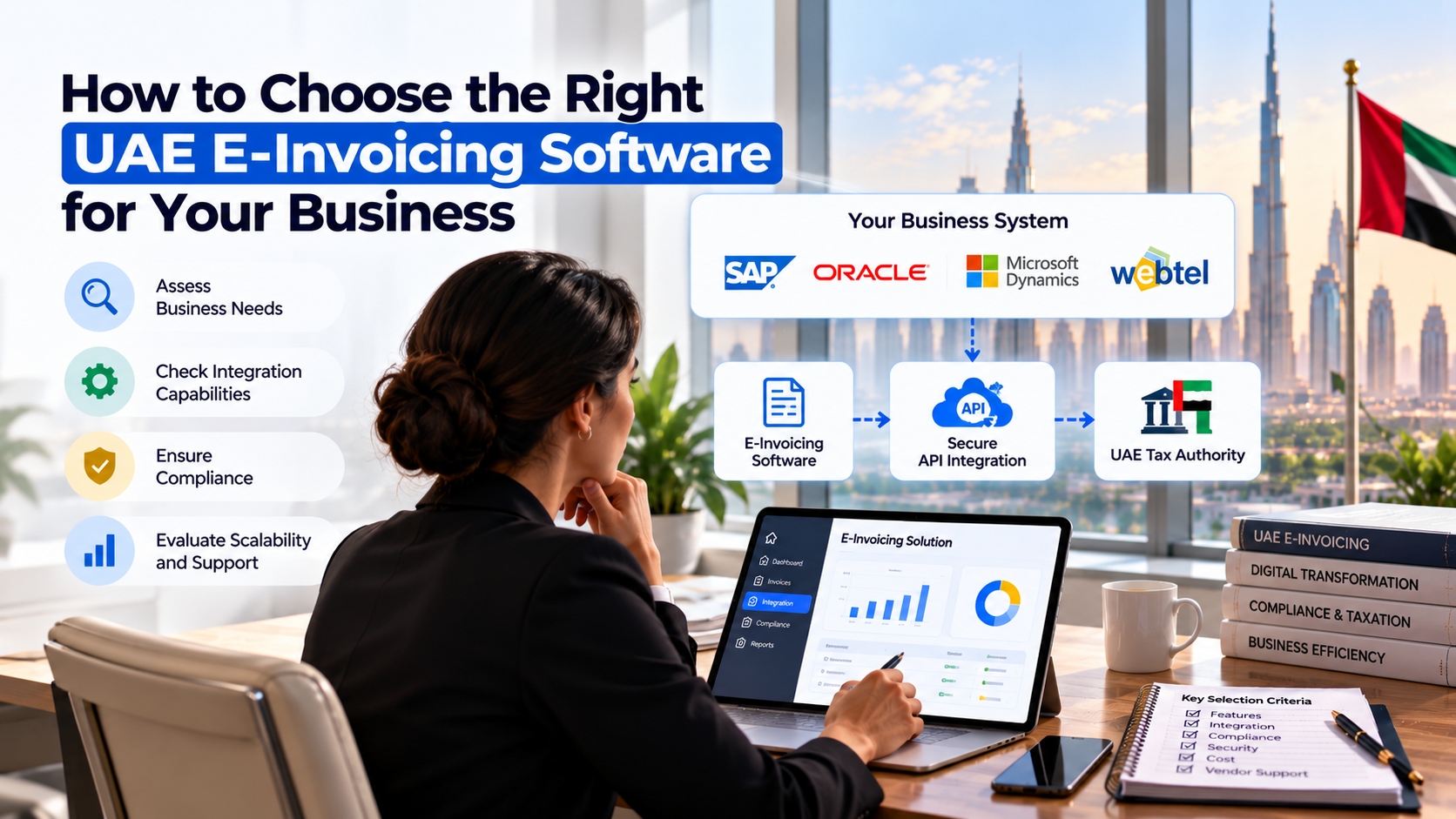
Managing invoices becomes more complicated as a business grows. Finance teams may need to handle customer billing, supplier invoices, payment records and tax documentation across different applications. In the UAE, businesses must also prepare for structured electronic invoicing requirements, making software selection an important part of their financial planning. Choosing the right UAE e-invoicing software means finding a solution that fits existing systems, supports accurate invoice processing and helps the business prepare for applicable compliance requirements.
The best software is not necessarily the one with the longest feature list. Businesses should evaluate compliance readiness, accounting integration, invoice tracking, implementation costs and ongoing support before making a decision. Understanding these requirements first makes it easier to compare providers and avoid unnecessary changes to established workflows.
What Should UAE E-Invoicing Software Help Your Business Do?
Electronic invoicing is more than creating a digital document or emailing a PDF. Under the UAE framework, an e-invoice involves structured invoice data exchanged electronically through the applicable system.
Businesses should therefore assess whether their software can support the complete invoicing workflow, from preparing accurate information to tracking processing results and maintaining consistent records.
A suitable solution should help with the following activities:
Invoice data preparation: Collecting the required customer, supplier and transaction details.
Validation: Identifying missing or incorrect information before it causes processing problems.
Electronic exchange: Transferring invoice data through the supported invoicing process.
Status tracking: Making it easier to identify invoices that need attention.
Record reconciliation: Comparing invoice information with accounting entries and related transactions.
The exact capabilities required will depend on the business's systems, transaction types and applicable obligations. Defining these needs before evaluating providers helps prevent a mismatch between the software and the company's actual workflow.
Five Factors to Consider When Choosing UAE E-Invoicing Software
Different businesses have different requirements. A small consultancy may need straightforward invoice handling, while a distributor using an ERP may require automated data exchange and more detailed transaction monitoring.
1. Compliance Readiness
Start by checking whether the provider has the required accreditation under the UAE e-invoicing framework. Verify its current status through official Ministry of Finance resources rather than relying solely on marketing claims.
Also ask how the solution handles invoice validation, rejected submissions, corrections and credit notes. These details help you understand whether the proposed system supports the transactions your business processes.
2. Compatibility with Existing Accounting Software
Replacing an established accounting system can be costly and disruptive. Before choosing a new platform, determine how it will work with the applications your business already uses.
Ask providers:
Which accounting and ERP systems can be connected?
Does the integration require custom development?
How will customer and supplier data be mapped?
What happens when information fails to transfer correctly?
A clear explanation of these points helps you estimate implementation effort and identify any manual work that may remain.
3. Invoice Tracking and Error Handling
Finance teams need to know what happens after an invoice enters the processing workflow. If an invoice is rejected or contains incorrect information, employees should be able to identify the issue and understand what needs to happen next.
During a product demonstration, ask the provider to show how invoice statuses are displayed, how errors are reported and how corrected records are handled. Testing these scenarios provides a more realistic picture than seeing only successful transactions.
4. Pricing and Ongoing Costs
The subscription fee does not always represent the total cost of using a solution. Businesses should also consider setup, integration, employee training and ongoing support.
Before signing an agreement, clarify:
What is included in the initial implementation?
Are there transaction-volume or user limits?
Do integrations or additional configurations cost extra?
What support is available after deployment?
How could costs change as the business grows?
Comparing the complete cost helps businesses avoid selecting an apparently cheaper option that creates additional work or unexpected expenses.
5. Security and Support
Invoice records contain commercially sensitive information. Review how the provider manages user access, protects information and maintains records needed for reconciliation or audit purposes.
Support is equally important. Ask who handles technical issues, how problems are escalated and what assistance is available during onboarding. Clear responsibilities can make it easier to resolve problems without interrupting routine finance operations.
How to Compare Different Providers
Rather than relying on product demonstrations alone, evaluate each provider against the same set of requirements.
Evaluation area | What to verify |
|---|---|
Compliance | Required accreditation and support for applicable requirements |
Integration | Compatibility with existing accounting or ERP systems |
Data quality | Identification of missing or inconsistent information |
Error handling | Clear rejection messages and correction workflows |
Security | Access controls and record-management practices |
Implementation | Setup, testing and employee training |
Total cost | Subscription, integration and ongoing support charges |
Once the options have been reviewed, divide the requirements into three categories:
Essential: Compliance requirements, critical integrations and reliable invoice processing.
Important: Clear status tracking, useful support and straightforward reconciliation.
Optional: Additional capabilities that may become useful as the business expands.
This makes the decision more practical. It also helps prevent businesses from paying for features they do not need while overlooking essential requirements.
Preparing Your Business Before Implementation
Choosing suitable software is only part of the process. Businesses should also prepare their data and internal workflows before implementation begins.
Review Existing Records
Identify where customer details, supplier information and invoice records are stored. Look for incomplete fields, duplicate entries and inconsistencies between systems.
For example, the same customer may appear under slightly different names in a sales database and accounting application. If these differences are not addressed before integration, employees may have to correct the same information repeatedly.
Cleaning the relevant records gives the implementation team a more reliable starting point.
Map the Current Workflow
Document how invoices are created, received, checked and recorded. Include less frequent situations, such as credit notes, corrections and rejected submissions.
Businesses exploring e-invoicing solutions for UAE businesses can use the available solution information as a starting point when assessing their software, integration and implementation requirements.
Before going live, test representative transactions. Include a routine invoice, a credit note and an example containing incorrect information. Confirm that the system identifies the problem and that employees understand how to resolve it.
Assign Clear Responsibilities
Decide who will manage invoice data, coordinate with the provider and investigate processing issues. In smaller businesses, one person may handle several tasks, but ownership should remain clear.
Finance teams should understand the invoice workflow, while IT staff or external technical teams should know how to investigate integration problems. Clear responsibilities help prevent unresolved issues from being passed between departments.
A Practical Example: Choosing Software for a Growing Business
Consider a UAE trading company that creates sales invoices through accounting software but receives supplier invoices by email. Employees enter information manually and use a spreadsheet to track outstanding records.
As the company grows, the finance team spends more time checking information and reconciling invoices. The business begins comparing two software options.
Option A: Basic invoice processing
Lower initial cost.
Requires some manual data entry.
May suit a business with straightforward invoicing needs.
Option B: Integrated invoice processing
Connects with the existing accounting system, subject to integration validation.
Provides clearer processing statuses.
May reduce repetitive work but involve higher implementation costs.
The better choice depends on the company's actual workload. Before deciding, the business should estimate how much time employees spend entering data, correcting errors and reconciling records.
It should then compare these costs with each provider's fees and test typical transactions. If the company processes relatively few invoices, the simpler option may be sufficient. If manual work is a growing problem, an integrated solution may offer better long-term value.
The key is to evaluate the complete workflow rather than choosing software based on price or features alone.
Common Mistakes to Avoid
A few avoidable mistakes can make software selection and implementation more difficult.
Choosing on price alone: Consider integration costs, employee time and ongoing support.
Ignoring data quality: Incomplete records can lead to avoidable validation problems.
Testing only routine invoices: Credit notes, corrections and rejected submissions also need attention.
Overlooking integration requirements: Confirm what can connect and whether additional development is necessary.
Leaving responsibilities unclear: Decide who handles errors, technical issues and reconciliation before implementation.
Addressing these issues early can help businesses avoid unnecessary rework and prepare for a smoother transition.
Conclusion
Choosing UAE e-invoicing software requires more than comparing prices and feature lists. Businesses should assess compliance readiness, accounting integration, invoice tracking, security and the total cost of implementation.
Start by reviewing your current workflow, identifying essential requirements and comparing providers against consistent criteria. Test realistic transactions and clarify implementation responsibilities before committing.
A solution that fits your business's actual needs can help organise invoice processing, reduce avoidable manual work and prepare your finance operations for structured electronic invoicing.