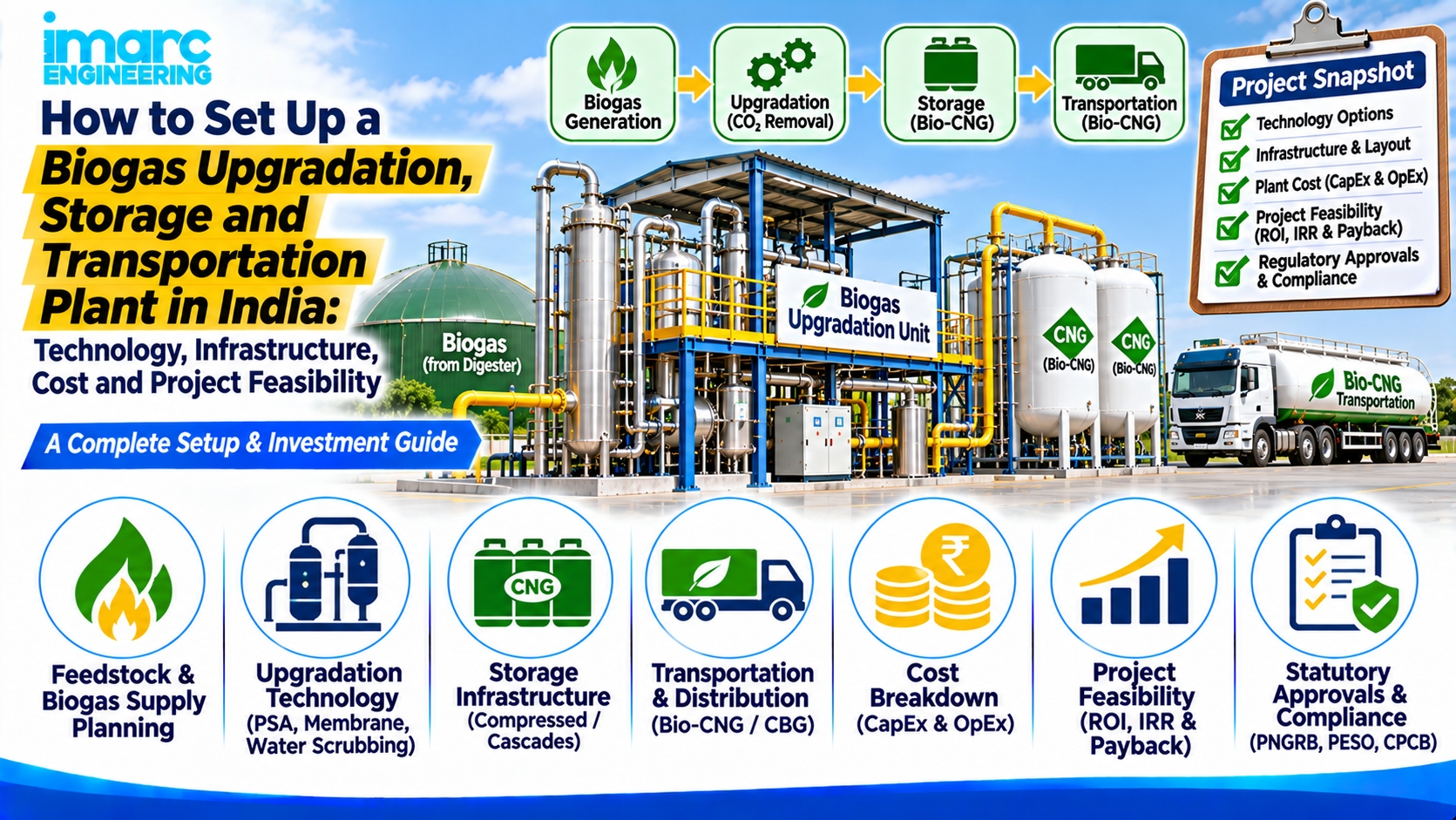
Many project developers treat biogas upgradation, storage and transportation as a straightforward add-on once a digester is running. In practice, raw biogas quality varies, the chosen upgradation technology under-performs against actual gas composition, storage and cascade systems prove larger or more complex than budgeted, and transportation logistics constrain offtake. The project that looked viable on a simple methane-recovery calculation becomes difficult to commission and operate at the planned utilisation. The difficulty is not the absence of technology. It is the incomplete assessment of gas quality, process suitability, full infrastructure scope, cost and commercial feasibility before investment.
A biogas upgradation, storage and transportation facility in India requires integrated planning of gas purification technology, compression systems, storage infrastructure, transportation logistics and project costs. A structured biogas upgradation project feasibility assessment can help promoters evaluate these requirements, identify technical and financial risks, and develop a realistic investment plan before committing major capital.
What Setting Up the Plant Actually Requires
An upgradation, storage and transportation facility involves several interdependent elements:
Reliable supply of raw biogas at known composition, moisture and impurity levels
Upgradation technology matched to gas quality and target product specification (typically high-methane Bio-CNG or pipeline-quality gas)
Compression, storage, cascade filling or dispensing systems sized for realistic throughput
Transportation mode (cascades, cylinders or pipeline interconnection) aligned with offtake points
Safety, PESO and environmental compliance infrastructure
Realistic capital and operating cost assumptions that reflect early utilisation and recovery efficiency
Projects that treat these elements as sequential afterthoughts frequently face delayed commissioning, lower methane recovery or weaker returns than projected.
Why These Projects Encounter Planning Gaps
Raw biogas quality is assumed rather than characterised
Digester output varies with feedstock, temperature and operating discipline. Higher H₂S, moisture or CO₂ than expected reduces upgradation efficiency and increases operating cost and maintenance.
Technology is selected before gas characterisation
Different upgradation routes (pressure swing adsorption, membrane, water scrubbing and others) respond differently to impurity profiles and desired purity. Choosing a unit without matching it to actual gas and product goals leads to lower recovery or unstable operation.
Storage and filling infrastructure are under-scoped
Buffer storage, cascade filling, cylinder handling and associated safety systems are often treated as minor packages. In practice they form a material part of both CapEx and daily operating effort.
Transportation and offtake logistics are left open
Whether gas moves by cascade, cylinder or pipeline determines storage philosophy, filling capacity and working capital. Without clarity on offtake points and volumes, infrastructure is either oversized or insufficient.
Full project cost is incomplete
Estimates frequently focus on the upgradation skid. Compression, storage, civil works, electrical systems, safety systems, PESO-related requirements, first-fill and commissioning support expand the investment once detailed.
Utilisation and recovery assumptions are optimistic
Early operating periods rarely match design recovery rates or continuous throughput. Downtime, gas quality variation and lower offtake reduce effective utilisation and raise unit costs.
Regulatory and safety scope is under-estimated
Compressed gas handling brings specific design, layout, inspection and licensing requirements. These are sometimes addressed late and create both cost and schedule impact.
How to Plan the Facility Properly
A practical planning sequence includes:
Characterise raw biogas — typical and range values for methane, CO₂, H₂S, moisture and other impurities under realistic digester operating conditions.
Define target product specification — purity, pressure and intended use (vehicle fuel, industrial, pipeline injection).
Match upgradation technology to gas composition, recovery targets and operating philosophy.
Define compression, storage and filling requirements based on throughput, offtake pattern and transportation mode.
Engineer the complete infrastructure scope — process units, utilities, safety systems, civil, electrical and material handling.
Estimate CapEx on a fully installed basis — equipment, installation, storage, civil works, soft costs and contingency linked to identified risks.
Model OpEx with realistic utilisation — energy, consumables, maintenance, labour and lower early-year recovery or throughput.
Clarify offtake and logistics — volumes, delivery mode, distance and commercial terms.
Assess site, safety and regulatory requirements — layout constraints, PESO-related design inputs, environmental consents and local compliance conditions.
Stress-test the business case — sensitivity to gas quality, recovery efficiency, utilisation and offtake volume before final investment decision.
When gas quality or offtake arrangements remain uncertain, a structured feasibility assessment is justified before equipment commitment.
Practical Scenarios
Scenario A: Uncharacterised gas
The upgradation unit was selected on assumed digester output. Higher H₂S and moisture reduced recovery and increased maintenance, lowering effective plant utilisation.
Scenario B: Under-scoped storage and filling
The process skid was budgeted carefully. Cascade storage, filling infrastructure and safety systems were under-estimated. Final CapEx and layout complexity exceeded the original plan.
Scenario C: Logistics mismatch
The plant was designed for continuous offtake. Actual demand was intermittent and distance-dependent. Storage capacity proved insufficient and working capital rose.
Scenario D: Integrated planning
Gas was characterised, technology was matched after evaluation, full infrastructure scope was costed, and offtake mode was defined early. The project proceeded with clearer visibility of cost and operating risk.
Decision Point: Concept Viability or Investment-Ready Plan?
Ask:
Is raw biogas quality known across realistic operating conditions?
Has the upgradation technology been matched to actual gas composition and target purity?
Does the cost estimate include compression, storage, filling, safety systems, civil works and realistic contingency?
Are operating cost and utilisation assumptions grounded in expected early performance rather than ideal recovery figures?
Is the transportation and offtake model defined and reflected in storage design?
If the answers rely mainly on generic recovery claims and skid quotes, the project is not yet decision-ready.
Biogas Upgradation, Storage and Transportation Planning Checklist
Raw biogas composition and variability characterised
Target product specification and offtake mode defined
Upgradation technology matched to gas quality and recovery goals
Compression, storage and filling systems sized for realistic throughput
Complete infrastructure scope engineered (process, utilities, safety, civil, electrical)
CapEx estimated on fully installed basis with risk-linked contingency
OpEx modelled with realistic utilisation and recovery efficiency
Offtake volumes, logistics and commercial terms clarified
Site layout, PESO-related and environmental requirements reviewed
Business case stress-tested for gas quality, recovery and volume sensitivities
When to Complete These Assessments
Before selecting or ordering upgradation and compression equipment
Before finalising storage and cascade design
Before approaching lenders or investors with a firm investment figure
When upstream digester performance is still stabilising
Prior to detailed engineering and major procurement
When earlier concept estimates appear too low relative to complete scope
The costliest time to discover gas quality or infrastructure gaps is after the main process equipment has been ordered and civil work has started.
How IMARC Engineering Can Help
IMARC Engineering supports promoters planning biogas upgradation, Bio-CNG and related facilities who need gas characterisation support, technology fit evaluation, complete infrastructure and CapEx–OpEx planning, and overall project feasibility grounded in practical operating conditions.
Relevant support is available through CBG and biogas project planning support for teams preparing an upgradation, storage and transportation facility before major capital commitment.
Talk to IMARC Engineering if you are evaluating a biogas upgradation and storage project and need a clear view of technology suitability, infrastructure scope and full project cost before investing: https://www.imarcengineering.com/contact-us
Conclusion
Setting up a biogas upgradation, storage and transportation plant in India requires more than selecting an upgradation skid and assuming digester gas will be consistent. Gas quality and variability, technology match, complete compression and storage infrastructure, realistic cost coverage and defined offtake logistics determine whether the facility can run at planned utilisation and remain viable.
Projects that address these elements early reduce the risk of delayed commissioning and under-performance. The practical takeaway is clear: treat gas characterisation and full-scope infrastructure cost as core design inputs, not secondary details. Only an integrated assessment of technology, infrastructure, cost and feasibility supports a sound investment decision.
Contact Us:
IMARC Engineering
Phone +91-120-433-0800
Email: sales@imarcengineering.com
India: C-130, Sector 2, Noida, Uttar Pradesh 201301
LinkedIn: https://www.linkedin.com/showcase/imarc-engineering/