
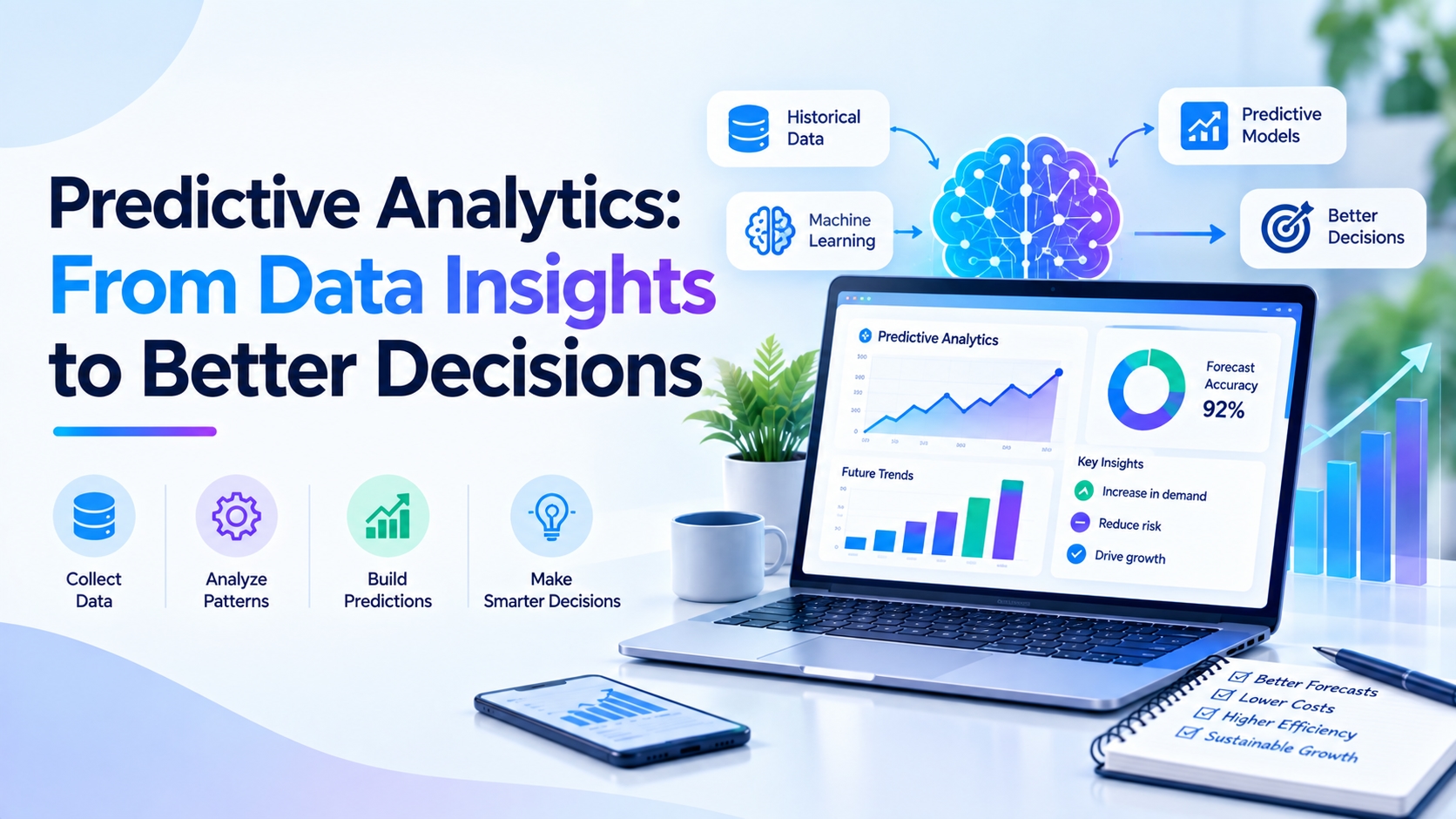
Every business creates a tremendous volume of data daily, but gathering information is just the first step. The true power is in knowing what that information can tell about future results. Predictive analytics can be used to analyse past and current data, predict future events, and support better decisions across every level of an organization.
From predicting customer behavior to forecasting demand and managing operational risks, predictive analytics is becoming an important part of modern business strategy. Rather than making assumptions or going by previous experience, organizations can rely on data-driven insights to anticipate what might occur in the future.
Predictive Analytics: What Is It?
Predictive analytics is an analytic technique that employs historical data, statistical techniques, machine learning, and predictive models for forecasting purposes. This involves analysis of the relationships in the data and making predictions.
For example, an e-commerce company can utilize historical transactions, browsing behaviors, and trends to predict the products that consumers will buy in the future. Similarly, a financial institution can analyze transactions to identify any possible fraud.
It does not involve predicting the future as an exact science. Instead, predictive analytics provides businesses with actionable insights that they can use in their planning processes.
Predictive Analytics: How It Works
Predictive analytics is usually a step-by-step process that converts raw data into actionable insights.
1. Collect Relevant Data
It starts with information collection from various sources, including customer interactions, sales records, websites, applications, sensors and business systems. Data quality is crucial because predictions rely on the accuracy of the data, and incomplete or inconsistent information can impact this.
2. Create and Interpret the Data
Data is gathered, processed, and analyzed to look for trends, relationships, and anomalies. Companies can merge multiple data sets to get a more comprehensive picture of the issue they're trying to solve.
3. Build Predictive Models
Statistical methods and machine learning algorithms are then used to develop models. Businesses can apply classification, regression, or time-series forecasting, depending on the goal. Firms working with professional AI development services gain access to the technical expertise needed to build and fine-tune these models effectively.
4. Make and Confirm Inferences
After being tested, a model's predictions can help support business processes. The models can be continually evaluated and revised as additional data is collected.
Why Predictive Analytics Matters for Businesses
Predictive analytics is not just about predictions. It can assist businesses to shift from being reactive to more proactive in their decision-making.
Predictive insights can help organisations to:
Predict when customers are about to leave.
Predict product demand and enhance stock forecasting.
Identify suspicious activity and risk.
Predict sales and revenue trends.
Enhance the management of resources and operations.
Identifying future possibilities sooner allows decision-makers to assess various scenarios and make more informed decisions. Businesses that invest in professional Predictive Analytics services gain the structure and expertise needed to translate raw data into clear strategic direction.
Predictive Analytics Use Cases
Predictive analytics can be used in a variety of industries because there is historical data in almost every organization that can be used to find patterns of interest.
Retail and eCommerce businesses can predict demand, provide custom recommendations, and determine when customers are likely to cease buying. These insights can help enhance marketing campaigns and inventory management.
Predictive models can be used in healthcare to identify risk factors, monitor patient progress, and aid in resource planning for healthcare organizations. Predictive analytics can help in fraud prevention, credit risk analysis, and financial forecasting within the finance industry.
Predictive models can help manufacturing companies to predict equipment failure and schedule maintenance before it happens. In the meantime, logistics firms can use previous delivery data, traffic patterns, and demand trends to enhance planning.
Delivering these capabilities across industries often requires robust artificial intelligence development services that combine domain expertise with advanced modelling to ensure predictions are both accurate and actionable.
Leverage Predictive Analytics and Better Decision-Making
The key benefit of predictive analytics is that it offers context to key decisions. A sales manager can not only rely on the past sales data. A predictive model can integrate past performance, market factors, and customer behaviour to forecast future demand.
This enables teams to ask more meaningful questions: What might occur next? Who will be the most receptive customers? Where is there room for growth in demand? What are the risks that need to be addressed?
Predictive insights can thus be used as a basis for strategic planning instead of a business report. Organizations that embed these capabilities through an AI development company can deliver prediction-driven features directly into the tools their teams use every day — from CRM platforms to operational dashboards.
Challenges to Consider
While predictive analytics can provide valuable insights, the key is not just choosing the right algorithm, but implementing it effectively. The accuracy of predictions can be diminished due to poor-quality data, small data sets, evolving customer behavior, and selecting the wrong model.
It is also important to track the models over time. The model that works well enough for now may not work as well if market conditions or user behavior change.
Responsible data use and data privacy go hand in hand. Businesses need to put in place suitable governance and control processes and manage sensitive information appropriately.
The Future of Predictive Analytics Is Here
Predictive analytics is becoming more accessible and impactful with the power of AI, machine learning, cloud computing, and real-time data. Modern systems can analyze more data and provide insights quickly compared to traditional analysis.
Predictive Analytics will become a constant part of business decision-making, as businesses continue to look for data-driven strategies. Its primary benefit is not to foretell all events accurately, but to assist organisations in understanding what may happen and being prepared.
Conclusion
Predictive analytics is about creating insights from old and new data to inform future decisions. It makes businesses future-oriented through its pattern recognition, predictions of probable events, and focus on risk identification.
Good data, models, monitoring systems, and governance are what predictive analytics needs to make complicated data into useful business intelligence. In this way, businesses will be able to plan ahead, respond faster, and take informed decisions, instead of decisions driven by speculation.




