
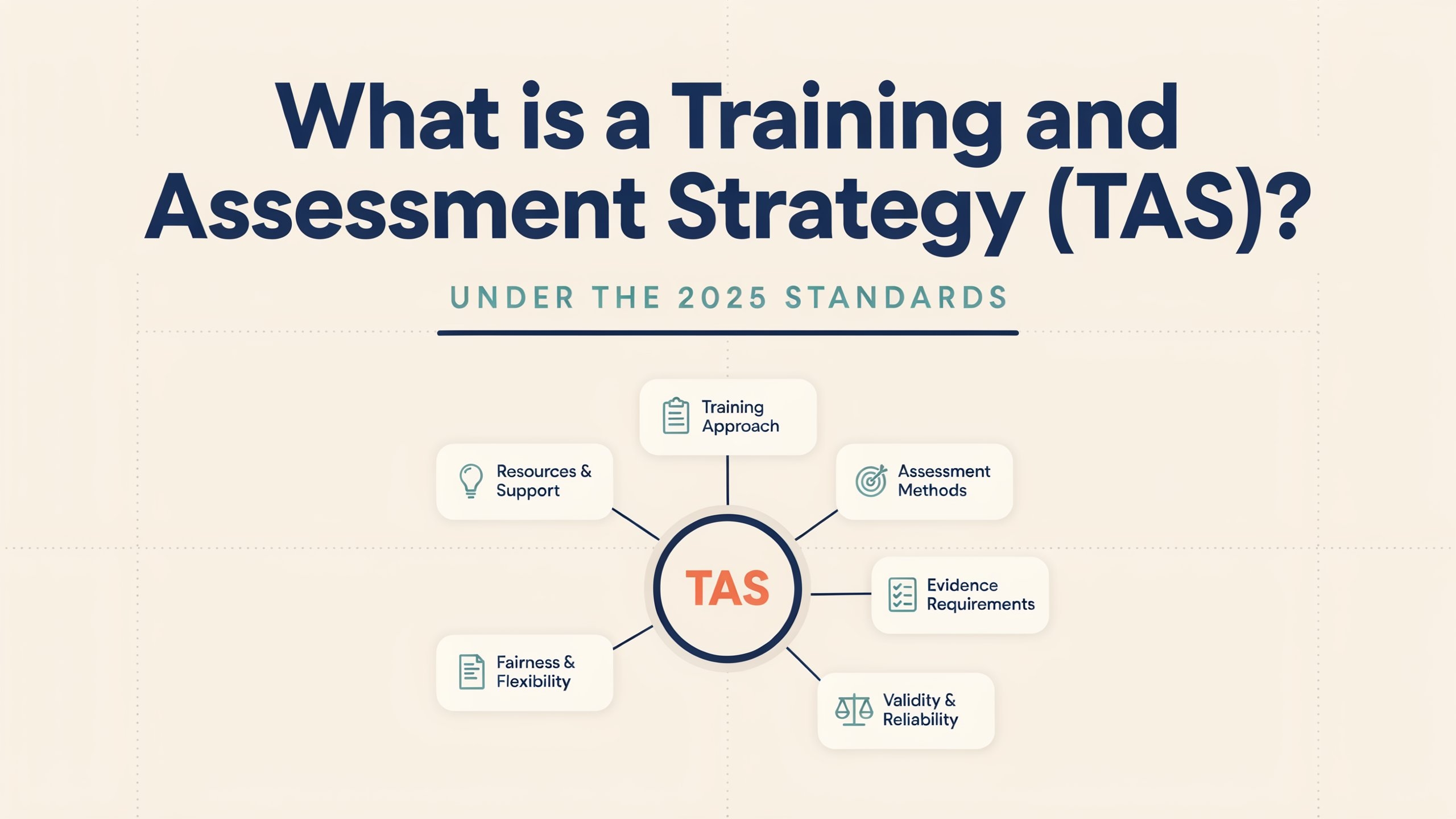
For years, the Training and Assessment Strategy, or TAS, was one of the first documents an auditor asked to see. It showed how a Registered Training Organisation (RTO) planned to deliver and assess a qualification, skill set, or unit of competency. When the 2025 Standards for RTOs came into effect on 1 July 2025, many providers asked whether the TAS still mattered. This article explains what a TAS is, whether it is still needed, and what it should contain to show compliance.
What Is a Training and Assessment Strategy?
A Training and Assessment Strategy is a structured plan for each training product on an RTO’s scope of registration. A training product can be an AQF qualification, a skill set, an accredited course, or a unit of competency. The TAS sets out who the RTO will train, what will be taught, how it will be delivered and assessed, what resources and supports are needed, and how the RTO will confirm that students reach the required standard.
A good TAS does three jobs:
It acts as a blueprint. Trainers, assessors, and administrative staff all work from the same plan.
It shows line of sight. It connects the Standards, the training product requirements on training.gov.au, the Principles of Assessment, the Rules of Evidence, and current industry expectations to what actually happens in the classroom, workplace, or online environment.
It provides evidence. During an audit or regulatory activity, it demonstrates that the RTO has planned its training and assessment deliberately and in consultation with industry.
Is a TAS Still Required Under the 2025 Standards?
The 2025 Standards came into effect on 1 July 2025 and replaced the Standards for RTOs 2015. They have three elements:
The Outcome Standards, organised into four Quality Areas: training and assessment, VET student support, the VET workforce, and governance.
The Compliance Requirements, which include the Fit and Proper Person Requirements and the Nationally Recognised Training Logo Conditions of Use.
The Credential Policy, which sets out the credentials needed by people who deliver training, assess students, and validate assessment.
All RTOs must comply with all three elements.
The 2015 Standards named the TAS directly and prescribed what it had to cover, including the well-known “amount of training” requirement. The 2025 Standards take an outcomes-focused approach and no longer name the TAS in the same way. This does not remove the need for one. The Standards still require RTOs to show that training is well structured, that assessment is valid and reliable, that industry has been consulted, and that students are properly supported. A documented strategy for each training product remains the clearest and most practical way to demonstrate all of this.
The regulator has also confirmed that it will not provide a TAS template. RTOs can decide how they compile and present their strategies for training and assessment, so long as the strategy shows how the outcomes in the Standards are achieved. That flexibility is useful, but it also means each RTO must make sure its document is complete, logical, and supported by evidence.
What a TAS Should Include Under the 2025 Standards
The Standards do not give a fixed checklist, so a TAS is best built around the requirements in the Outcome Standards, the Compliance Requirements, and the Credential Policy. The sections below describe what a strong TAS should contain.
1. Training Product Details and Scope
Begin with the basics:
The code, title, and release of the training product, matched to training.gov.au
Confirmation that the product, including any imported elective units, is on the RTO’s scope of registration
The packaging rules and the core and elective units chosen, with a reason for each elective
The AQF level and the intended vocational outcome
Elective choices should be relevant to the qualification, protect the integrity of the AQF alignment, and lead to a valid, industry-supported outcome. Any imported elective must be on the RTO’s scope.
2. Target Learner Cohort and Pre-Enrolment Review
The TAS should describe who the training is designed for. This includes typical learner characteristics, prior experience, employment status, location, and any known barriers to learning.
The 2025 Standards require RTOs to review each prospective student’s skills and competencies before enrolment. This includes language, literacy, and numeracy (LLN) proficiency and digital literacy. The review applies to every training product, including standalone units of competency such as first aid. The Standards do not prescribe a framework or tool. The RTO must analyse what level of LLN and digital literacy each training product demands and then choose a suitable method to check it, such as a purpose-built tool or other evidence that the student has the right level.
Your TAS should record:
The LLN and digital literacy demands of the training product
The method used to review prospective students
How the outcome of the review is used to advise students and plan support
3. Industry, Employer, and Community Engagement
Engagement is a central feature of the 2025 Standards. RTOs must show how they identify relevant industry, employer, and community representatives and how they seek meaningful advice and feedback from them. Community representatives are stakeholders who are not industry or employer representatives. They may include advocacy groups relevant to the student cohort and First Nations groups or representatives.
The Standards do not set a minimum number or frequency of engagements. RTOs decide this based on the training product and how quickly the relevant industry changes. Your TAS should include:
The industry, employer, and community stakeholders identified for the training product
The methods of engagement, such as advisory groups, meetings, surveys, workplace visits, or feedback from placement hosts
How the advice received has shaped delivery, resources, assessment, and the TAS itself
How engagement will continue over time
An industry association or enterprise RTO may include internal engagement, but this should not be the only form used.
4. Training Structure, Sequencing, and Pacing
Standard 1.1 requires training to be structured and paced so that students can progress, with enough time for instruction, practice, feedback, and assessment. Although “amount of training” is no longer a named requirement, RTOs must still be able to justify the duration they have chosen. The AQF Volume of Learning requirements also continue to apply.
The TAS should explain:
The total duration of the course and the weekly or term schedule
The sequence of units and the reasons for that order
How prerequisite units are handled. Delivery of a later unit can begin before a prerequisite is finished, but the student must be assessed as competent in the prerequisite before competency is determined in the later unit.
The balance of classroom, online, practical, simulated, and workplace learning
How the chosen duration provides enough time for instruction, practice, feedback, and assessment, taking into account the cohort, delivery mode, facilities, industry expectations, and the complexity of the skills involved
Attendance recording is not prescribed by the Standards. Providers who are CRICOS registered or who receive government funding may still have attendance monitoring obligations under other requirements.
5. Delivery Methods and Engaging Training
The Standards expect training to be engaging, well structured, and able to build the skills and knowledge required by the training product. Your TAS should describe the delivery modes (face to face, online, blended, workplace-based) and the range of techniques used. These might include demonstrations, group activities, case studies, practical workshops, simulations, and guest industry speakers.
Using a variety of techniques helps to cater for diverse learning needs and preferences. The TAS should also describe how learners progress through the course and how trainers give feedback along the way.
6. Resources, Facilities, and Equipment
List what is needed to deliver and assess each training product, including:
Learning materials and technology platforms
Equipment, tools, and software that reflect current industry practice
Simulated environments and their specifications, where the training product sets them out
Facilities for practical work
Any licensing or safety requirements attached to the training product
The TAS should confirm that the resources match the assessment conditions in the training product.
7. Work Placement and Workplace Arrangements
Where a training product involves work placement or workplace-based assessment, the TAS should set out:
The required hours or tasks
Host employer expectations and the process for selecting suitable hosts
Supervision arrangements and how evidence is captured
Work health and safety considerations
Student wellbeing during placement, including how the RTO coordinates with employer support systems, with the consent of the employer and student
If an employer or supervisor helps to collect evidence, for example where an assessor’s presence would compromise safety or privacy, the TAS should make clear that this person only collects evidence. The assessment judgement must always be made by a suitably qualified assessor who meets the Credential Policy.
8. Assessment Strategy and Assessment Tools
This is the heart of any TAS. The Standards require assessment to be consistent with the requirements of the training product and conducted in line with the Principles of Assessment (fairness, flexibility, validity, and reliability) and the Rules of Evidence (validity, sufficiency, authenticity, and currency).
The assessment section should describe:
The assessment methods for each unit, such as knowledge questions, projects, practical demonstrations, observations, case studies, and third-party reports
How the assessment requirements, performance evidence, and knowledge evidence in each unit are fully covered
Where direct observation by the assessor is required and how it will be achieved across face-to-face, online, rural, and remote settings, with attention to privacy rules and the National Principles for Child Safe Organisations where relevant
The assessment conditions and the resources assessors will use
How the RTO ensures evidence is the original and genuine work of the student. There is no acceptable level of plagiarism, and providers must have systems to confirm authenticity, whether through software or other means.
How assessment tools are contextualised for the cohort and the training environment. Generic, off-the-shelf materials that have not been tailored can pose a compliance risk, even if sold as pre-validated.
Standard 1.3 requires assessment tools to be reviewed before use. The Standards do not say who must carry out this review, and the reviewer does not need to hold specific credentials. The RTO can use industry experts, employers, other trainers with current industry knowledge, or a group with similar knowledge to the target students. Feedback should be built into revised tools, and the TAS should describe the process.
9. Recognition of Prior Learning and Credit Transfer
The Standards require that students are offered opportunities to seek recognition of prior learning. Your TAS should explain:
How students are informed about RPL before and during enrolment
The RPL process, which should be as rigorous as the assessment system and designed to confirm that the student has the skills, knowledge, and competencies in the training product
How evidence such as employer declarations is authenticated, since relying on a declaration alone is risky
How gap training and assessment are provided where needed
Recognition of Current Competency is no longer a separate term and is treated as part of RPL. If an RTO decides not to offer RPL for a particular short or low-cost course, it must be able to justify that decision and communicate it clearly to students before enrolment.
Credit transfer should also be covered. Where a student provides legitimate, authenticated AQF certification that meets the requirements, credit must be granted, with limited exceptions such as unverifiable evidence, licensing restrictions, or a request for an entire qualification by credit transfer alone. Authenticity can be checked through the student’s USI transcript or by contacting the issuing organisation.
10. Student Support, Inclusion, and Wellbeing
The second Quality Area focuses on VET student support, and the TAS should show how support is built into delivery. Include:
Information provided to students before and during enrolment
Training support services and learning support available
Reasonable adjustments for students with disability, made in line with the Disability Standards for Education 2005 and without compromising the integrity of the training product. Where a physical requirement cannot be adjusted, this should be communicated before enrolment along with alternative pathways.
How the training environment, materials, and assessment are accessible and inclusive for all students, including a culturally safe environment for First Nations people
How student wellbeing needs are identified and how students are advised of available services, including services relating to financial hardship
The extent of wellbeing support depends on the course, its duration, the cohort, and the size of the provider. RTOs are not required to deliver counselling directly, but they must guide students to appropriate supports.
11. Trainer and Assessor Requirements
The third Quality Area covers the VET workforce. The TAS should identify who will train and assess and how they meet the requirements. Under the Standards and the Credential Policy, each trainer and assessor must have:
A training and assessment credential listed in the Credential Policy
Industry competencies, skills, and knowledge relevant to, and at least to the level of, the training product being delivered or assessed
Current industry skills and knowledge, maintained through activities such as working or volunteering in industry, relevant professional development, industry association membership, and networking
Several points deserve attention when planning the workforce:
Co-assessment is not allowed. One person cannot hold the training credential while another holds only the industry skills. Each assessor needs both.
Industry experts may contribute to training and assessment, but only under the direction of a fully qualified trainer or assessor who also has current industry competence.
People working under direction, including those working towards a credential, may deliver training and help collect evidence, but cannot make assessment judgements unless they hold an assessment-only credential such as the Assessor Skill Set. A person actively working towards TAE40122 or TAE50122 has two years to complete it, and the RTO must be able to show how it determined an appropriate level of supervision for that person.
The 2025 Standards do not set a workforce to student ratio. RTOs must have enough suitably qualified staff to deliver the services and meet all obligations.
12. Third Party Arrangements
If any part of recruitment, training, assessment, or student support is delivered by a third party, the TAS should say so clearly. The Standards require RTOs to have a system for making sure third parties meet the Standards and understand their obligations. Third parties include organisations as well as individuals, such as education agents, brokers, and providers delivering VET in secondary schools. The TAS should explain who is responsible for what, how the arrangement is monitored, and how students are informed about the roles of the RTO and the third party. Third parties must not use the RTO’s branding in a way that conceals their involvement or misleads students.
13. Validation and Continuous Improvement
The Standards require validation of assessment practices and judgements at least once every five years for every training product on scope, and more often where the RTO becomes aware of risks to training outcomes, a change to the training product, or relevant feedback from students, trainers, assessors, or industry. The earlier requirement to validate 50 per cent of products within the first three years of the cycle has been removed.
Your TAS should include:
A validation schedule covering each training product
Who will validate. The validator or team should collectively have industry competencies, relevant knowledge of current industry practice, and one of the validation credentials listed in the Credential Policy. The outcome must not be determined solely by the person who designed or delivered the training and assessment.
Special rules for TAE products. At least one validator must hold an AQF qualification or skill set at least to the level being validated for qualifications and skill sets that enable assessment judgements. Standard 1.5 also requires validation by an independent person once the first cohort has completed.
How validation results, student feedback, complaints, industry input, and performance data are used to improve the TAS and assessment tools
14. Records and Certification
The TAS should reflect the RTO’s record-keeping and certification processes:
Assessment evidence must be kept for two years for students who complete a training product on or after 1 July 2025, unless a licensing body or funding contract requires longer. Digital copies are acceptable if they are of sufficient quality and stored securely.
AQF certification documentation must be issued within 30 calendar days of completing assessment, provided the student has completed or withdrawn from the training product.
Certification must only be issued to students who have been assessed as meeting the requirements of the training product.
Why Every RTO Still Needs a Strong TAS
The 2025 Standards give providers more freedom, but that freedom comes with responsibility. A well-built set of RTO Training & Assessment Strategies helps an organisation turn broad outcome statements into clear, repeatable practice, and it gives auditors a coherent picture of how quality is achieved. Without one, it becomes difficult to show that decisions about duration, delivery, resources, and assessment were made deliberately and with industry input.
Practical Tips for Building a Compliant TAS
Write one TAS per training product. Do not copy and paste between qualifications without adapting to the cohort and context.
Keep it a living document. Update it when the training package changes, when industry feedback arrives, or when validation identifies an issue.
Record your justification. Where the Standards do not prescribe a number or method, explain why your choice is appropriate for your students.
Link to evidence. Reference meeting records, validation reports, assessment mapping, trainer credential files, and student feedback.
Involve your trainers and assessors. The people delivering the course are best placed to spot unrealistic timeframes or resource gaps.
Review before each intake. Confirm that the training product is current on training.gov.au and that your delivery plan still fits the cohort.
Check for other obligations. Government funding contracts, licensing bodies, and CRICOS requirements may add to what the TAS must cover.