
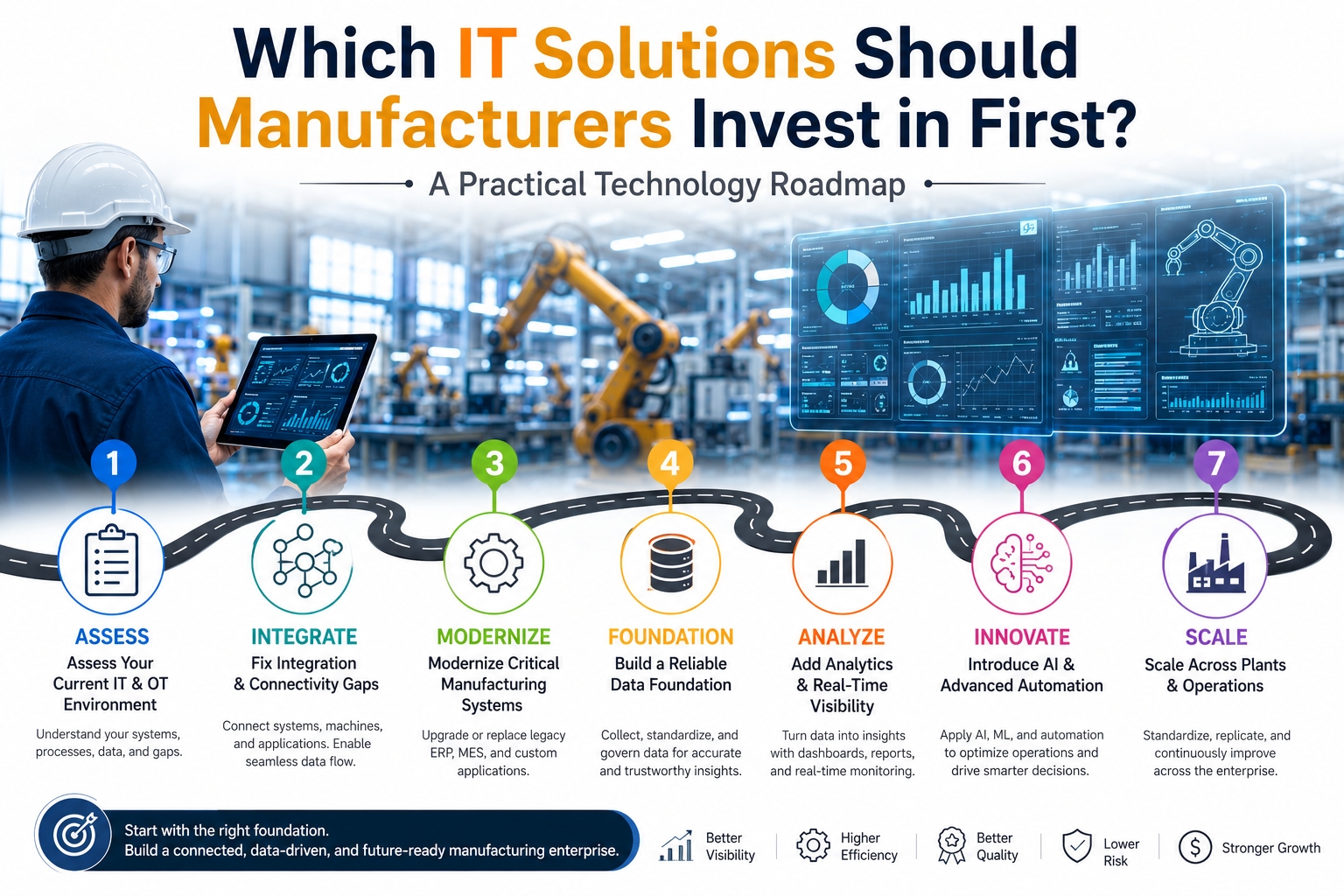
Manufacturers should prioritize foundational IT solutions before advanced technologies. A practical sequence is to assess existing IT and OT systems, fix integration gaps, modernize critical applications, establish reliable data, add analytics, introduce AI where justified, and then scale across plants. The exact priority depends on business goals, technology maturity, operational challenges, and existing infrastructure.
Why Technology Prioritization Matters in Manufacturing
Manufacturers rarely start with a clean technology environment. A typical factory might have an ERP system for business operations, MES for production, SCADA for supervision, PLCs controlling equipment, spreadsheets supporting manual processes, and custom applications built over many years.
The problem is often not the absence of technology. It is the lack of connection between systems.
Common challenges include:
Legacy applications
Disconnected machines
Data silos
Multiple software platforms
Manual processes
Limited production visibility
Integration gaps
Inconsistent data
Cybersecurity risks
Adding another technology without addressing these problems often increases complexity.
For example, deploying an AI application without reliable production data gives the organization another technology layer without solving the underlying data problem.
A manufacturing technology roadmap should therefore follow a logical dependency structure:
Assess → Integrate → Modernize → Connect Data → Analyze → Apply AI → Scale
Step 1: Assess Your Current Manufacturing IT Environment
Before investing in new IT solutions for manufacturing, create an inventory of your current technology environment.
Review:
ERP
MES
SCADA
PLC and machine connectivity
IIoT infrastructure
Databases
Cloud infrastructure
APIs and integrations
Cybersecurity controls
Reporting and analytics
Legacy applications
Custom software
Then map how information moves between systems.
For example, determine how a customer order reaches production planning, how production information reaches the ERP, and how quality information reaches management.
Your assessment should identify four categories:
Systems that work well and should remain.
Systems that need modernization.
Systems that require integration.
Systems that should eventually be retired.
This assessment prevents manufacturers from investing in technology without understanding existing dependencies.
Step 2: Fix Integration and Connectivity Gaps
Integration should often come before advanced technology.
A manufacturer might have excellent individual systems but still lack a reliable flow of information between them. Connecting ERP, MES, SCADA, machines, data platforms, and business applications creates a stronger foundation for modernization.
Key areas include:
IT/OT integration
APIs
Middleware
Machine connectivity
ERP-MES integration
Data exchange
Cloud-edge architecture
Centralized data access
ISA-95 provides a framework for understanding information exchange between enterprise and manufacturing control functions. Its current standards address models, terminology, activities, and information exchange across manufacturing and enterprise systems.
Consider a manufacturer where production status remains inside the MES while inventory information sits in the ERP. Employees might manually reconcile the two systems.
An integration layer can establish automated information exchange and reduce unnecessary manual work.
Integration also matters for future technologies. Analytics and AI require access to relevant, consistent data. Without integration, each new application risks creating another data silo.
Step 3: Modernize Critical Manufacturing Systems
Once connectivity gaps are understood, evaluate your core manufacturing applications.
Manufacturers often consider modernization for:
ERP systems
MES platforms
Custom manufacturing applications
Legacy applications
Production workflows
Quality systems
Inventory applications
Do not replace a system simply because it is old.
Instead, evaluate each application using four options:
Replace → Modernize → Integrate → Retire
Replace a system when its architecture, functionality, security, or support limitations create a significant business problem.
Modernize it when the underlying business capability remains useful but the technology needs improvement.
Integrate it when the application works well but operates in isolation.
Retire it when another system already provides the required capability.
This approach reduces unnecessary disruption and helps organizations direct investment toward high-impact areas.
Step 4: Build a Reliable Manufacturing Data Foundation
Reliable data should come before advanced AI.
Manufacturers generate data from machines, production systems, quality systems, inventory applications, supply chains, and business processes. The value of this data depends on its accuracy, consistency, accessibility, and context.
A manufacturing data foundation should address:
Data collection
Data standardization
Data storage
Data governance
Data quality
Real-time data
Historical production data
Data platforms
For example, two plants might record the same production metric using different names, units, or formats. Analytics built on this data will produce inconsistent results unless the underlying information is standardized.
A strong data foundation supports dashboards today and advanced analytics and AI later.
NIST's 2026 roadmap for AI and ML in smart manufacturing highlights industrial data complexity, data management, heterogeneous systems, and trustworthy operation as important challenges for industrial AI adoption.
Step 5: Add Analytics and Real-Time Visibility
After establishing reliable data, manufacturers can focus on analytics.
Analytics helps teams understand what is happening across production and business operations.
Useful applications include:
Production dashboards
Quality analytics
Inventory analytics
Production performance reporting
Supply chain visibility
Plant-level KPI tracking
Manufacturers should understand four common analytics levels:
Descriptive analytics answers, “What happened?”
Diagnostic analytics answers, “Why did it happen?”
Predictive analytics answers, “What is likely to happen?”
Prescriptive analytics answers, “What action should we take?”
Start with the questions that matter to the business.
A plant manager might need real-time production visibility. A supply chain leader might need inventory and order visibility. A quality team might need defect analysis.
The technology should follow the decision requirement.
Step 6: Introduce AI and Advanced Manufacturing Technologies
AI should enter the roadmap after the organization has a clear business case and sufficient data.
Potential applications include:
Machine learning
Predictive analytics
Computer vision
AI-assisted decision-making
Intelligent automation
Generative AI
AI agents
These technologies make more sense when the manufacturer has defined the problem, identified the required data, established integration, and determined how success will be measured.
For example, an AI model for production forecasting requires historical and operational data. An AI assistant for manufacturing workflows needs access to trusted information and appropriate system permissions.
NIST's 2026 smart manufacturing roadmap describes AI and ML applications across areas including industrial analytics, sensing, robotics, supply chain optimization, and sustainable manufacturing, while also highlighting integration, reliability, explainability, and data challenges.
The key question is not “Where can we use AI?”
Ask instead:
“What manufacturing problem will AI solve, and how will we measure the result?”
Step 7: Scale the Technology Across Plants
A successful pilot is not automatically a successful enterprise rollout.
Before expanding a solution, manufacturers should establish:
Pilot selection criteria
Proof-of-value requirements
Standard architecture
Security controls
Integration standards
Training
Change management
Governance
Multi-plant deployment processes
Choose a pilot where the business problem is clear, the data is available, and the expected outcome is measurable.
After proving value, standardize the architecture before deploying it across other facilities.
This prevents every plant from creating its own version of the same solution.
Manufacturing IT Investment Priority Matrix
The right priority varies by manufacturer. The following framework provides a starting point.
Technology | Best time to invest | Business problem solved | Priority |
|---|---|---|---|
ERP | When core business processes are fragmented | Finance, procurement, inventory, orders | High |
MES | When production visibility and execution are weak | Production tracking and execution | High |
IT/OT integration | When systems and machines operate in silos | Data and system connectivity | High |
IIoT | When machine data is difficult to access | Equipment and operational visibility | High or Conditional |
Data platform | When data is fragmented or inconsistent | Centralized and governed data | High |
Analytics | When reliable data is available | Reporting and decision-making | High |
Cloud | When infrastructure needs flexibility or scale | Infrastructure and application scalability | Medium or Conditional |
Cybersecurity | Throughout every modernization stage | Security and operational resilience | High |
AI | When data and business cases are ready | Prediction, optimization, decision support | Conditional |
Custom manufacturing software | When standard tools do not fit specific workflows | Specialized operational requirements | Conditional |
Cybersecurity should not wait until the end of the roadmap. Connecting IT and OT increases the need for appropriate security controls because industrial systems affect physical processes and production operations. NIST guidance emphasizes the distinct performance, reliability, and safety requirements of OT environments.
How to Measure ROI From Manufacturing IT Investments
Technology investments need measurable baselines.
Before implementation, document the current performance of the process being changed.
Useful KPIs include:
Downtime
Overall Equipment Effectiveness, or OEE
Production throughput
Defect rates
Inventory accuracy
Order cycle time
Manual processing time
Energy usage
Maintenance costs
IT operating costs
The right KPI depends on the project.
For example, an MES project might focus on production visibility, throughput, quality, and manual reporting. An integration project might focus on processing time, data accuracy, and manual reconciliation.
Do not measure ROI only through software usage. Measure whether the technology improves the business process it was designed to support.
How to Choose a Manufacturing IT Solutions Partner
The right technology partner should understand both manufacturing operations and enterprise technology.
Evaluate providers against these areas:
Manufacturing domain expertise
IT and OT understanding
ERP and MES integration
Legacy modernization
Cloud expertise
Data engineering
AI capabilities
Cybersecurity
Custom software development
Scalability
Support and maintenance
Implementation methodology
Business outcome measurement
Ask potential providers:
How will you integrate our existing systems?
How will you handle legacy applications?
How will you protect IT and OT environments?
What integration architecture do you recommend?
How will you validate a pilot?
Which KPIs should we measure?
How will the solution scale across plants?
What support will we receive after implementation?
A strong partner should explain the architecture, dependencies, risks, implementation stages, and measurement approach clearly.
How Azilen Supports Manufacturing IT Modernization
Manufacturers often need several capabilities to execute a technology roadmap. These can include custom manufacturing software, IT/OT integration, IIoT, AI and ML, data engineering, cloud solutions, legacy modernization, and enterprise system integration.
Azilen supports manufacturing organizations across these technology areas and provides a technology-focused approach to manufacturing modernization.
Manufacturers evaluating their next technology investment can review manufacturing technology solutions to understand the available capabilities and solution areas.
Conclusion: Build Your Manufacturing IT Roadmap in the Right Order
The best IT solutions for manufacturing are not necessarily the newest technologies. They are the technologies that solve the most important business and operational problems in the right sequence.
A practical roadmap is:
Assess → Integrate → Modernize → Connect Data → Analyze → Apply AI → Scale
Start by understanding your existing IT and OT environment. Fix integration gaps. Modernize critical systems. Establish reliable data. Add analytics and visibility. Then introduce AI and advanced technologies where the business case supports them.
Before making your next investment, evaluate your current technology stack, identify the largest operational gaps, and prioritize the initiatives with measurable business outcomes.
Frequently Asked Questions
What IT solutions does a manufacturing company need?
Most manufacturers need a combination of ERP, MES, IT/OT integration, machine connectivity, data platforms, analytics, cybersecurity, cloud infrastructure, and specialized software. The exact technology stack depends on the company's production model, existing systems, data maturity, operational challenges, and growth plans.
What should manufacturers implement first?
Manufacturers should usually start with an assessment of existing IT and OT systems. Next, address integration and connectivity gaps, then modernize critical applications and establish reliable data. Analytics and AI should follow when the required data and business cases are ready.
How do you create a manufacturing technology roadmap?
Start by documenting current systems, processes, data flows, integration points, and security risks. Identify business problems and rank them by impact and urgency. Map each problem to a technology initiative, define dependencies, establish KPIs, and create phased implementation stages from assessment through multi-plant scaling.
Should manufacturers upgrade ERP or MES first?
There is no universal answer. Upgrade the system creating the greater business or operational constraint. ERP should receive priority when enterprise processes are fragmented. MES should receive priority when production execution and visibility are the main problems. Integration between the two should also be considered before making either investment.
When should a manufacturer invest in AI?
A manufacturer should consider AI when it has a defined business problem, reliable data, suitable infrastructure, integration access, and measurable success criteria. AI should not be the first step when basic data quality, connectivity, cybersecurity, or core manufacturing systems remain unresolved.
How does IT/OT integration support manufacturing?
IT/OT integration connects enterprise applications with production systems and equipment. It allows relevant information to move between business and manufacturing environments while maintaining appropriate security and system boundaries. ISA-95 provides a structured reference for enterprise-control system integration and information exchange.
How do you calculate manufacturing IT ROI?
Establish a baseline before implementation, then measure changes against the selected business KPIs. Depending on the project, these might include downtime, OEE, throughput, defect rates, inventory accuracy, processing time, energy usage, maintenance costs, or IT operating costs. Compare the measurable business impact with implementation and ongoing operating costs.
How do you choose a manufacturing IT solutions provider?
Evaluate manufacturing expertise, IT/OT knowledge, integration experience, legacy modernization, cybersecurity, cloud, data, AI, custom software, scalability, and support. Ask providers to explain their architecture, implementation methodology, pilot strategy, security approach, and KPI measurement process before selecting a partner.