
The oil and gas industry has always relied on data. Geological surveys, seismic studies, drilling records, production measurements, equipment sensors, pipeline systems, and refinery controls generate enormous amounts of information every day.
The challenge is turning that information into better decisions quickly enough to affect operations.
Artificial intelligence is changing how companies approach that challenge. AI systems can identify patterns across large datasets, predict equipment problems, optimize operating conditions, support engineering decisions, and automate parts of complex workflows.
The shift is becoming more strategic. The International Energy Agency reports that oil and gas companies are among the earlier adopters of AI in the energy sector, with applications spanning exploration, production, maintenance, safety, leak detection, and methane reduction.
Deloitte's 2026 Oil and Gas Industry Outlook points to generative AI, agentic AI, and real-time analytics moving from pilots toward broader operational deployment. Deloitte also reports that AI and generative AI accounted for less than 20% of total IT spending among U.S. oil and gas companies at the time of its analysis, with spending projected to exceed 50% by 2029.
For executives, the important issue is not whether AI sounds promising. It is where artificial intelligence in oil and gas creates measurable operational value and how companies should deploy it responsibly.
How AI Is Reshaping the Oil and Gas Industry
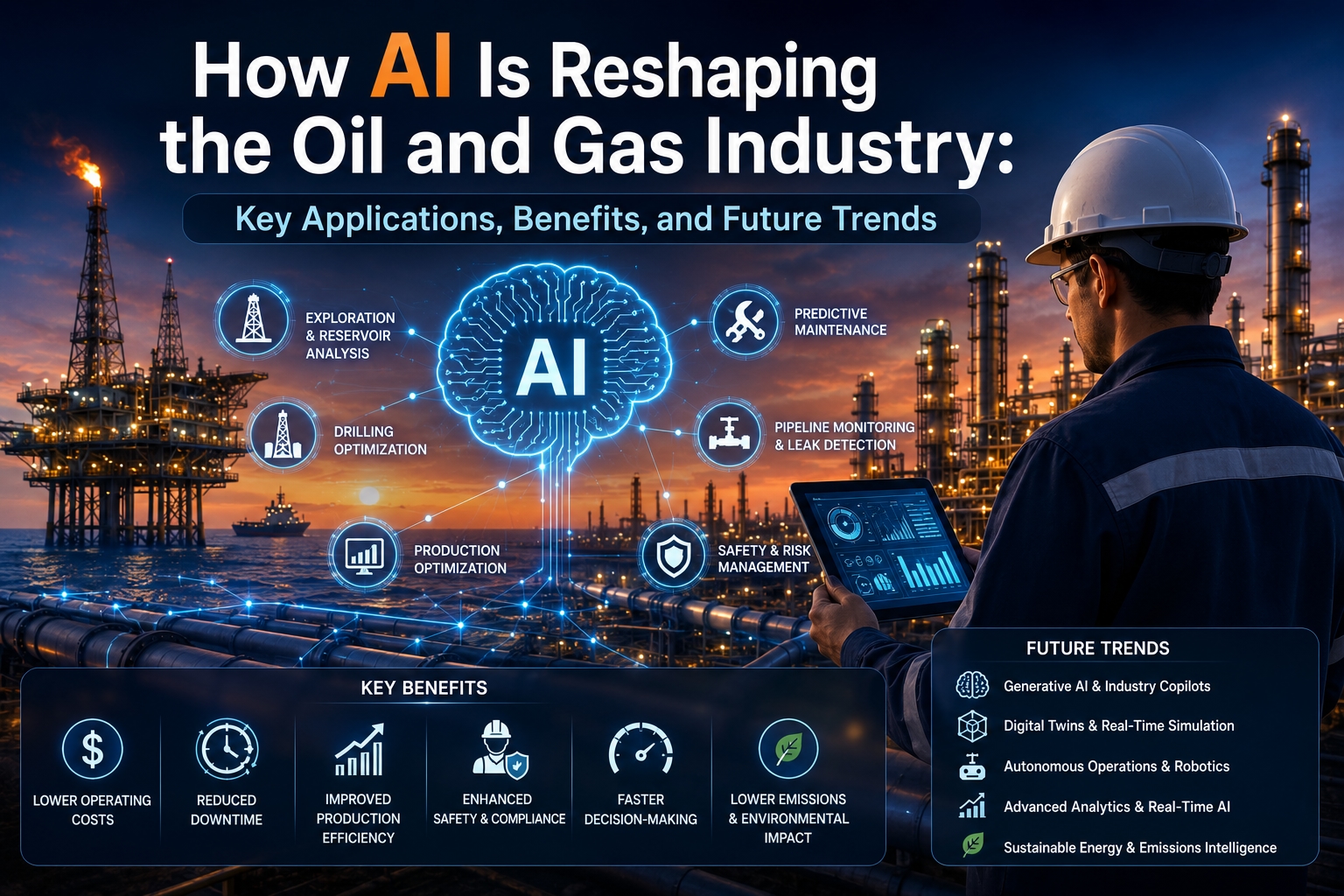
AI is affecting nearly every stage of the oil and gas value chain.
In upstream operations, machine learning helps analyze geological and seismic information, forecast production, optimize drilling, and evaluate well performance.
In midstream operations, AI supports pipeline monitoring, predictive maintenance, anomaly detection, asset inspection, and logistics.
In downstream operations, AI is being applied to refinery process optimization, energy management, equipment reliability, production scheduling, quality control, and demand forecasting.
The common thread is better use of operational data.
Traditional analytics often depend on predefined rules and manual analysis. Machine learning models can identify relationships across thousands of variables and continuously evaluate new data. Generative AI adds another layer by making technical information easier for employees to search, summarize, and use.
The result is a move from data collection toward data-driven operations.
Key AI Applications in Oil and Gas
1. Predictive Maintenance
Equipment failure is expensive in oil and gas. A failed compressor, pump, turbine, drilling component, or processing unit can create downtime, maintenance costs, production losses, and safety concerns.
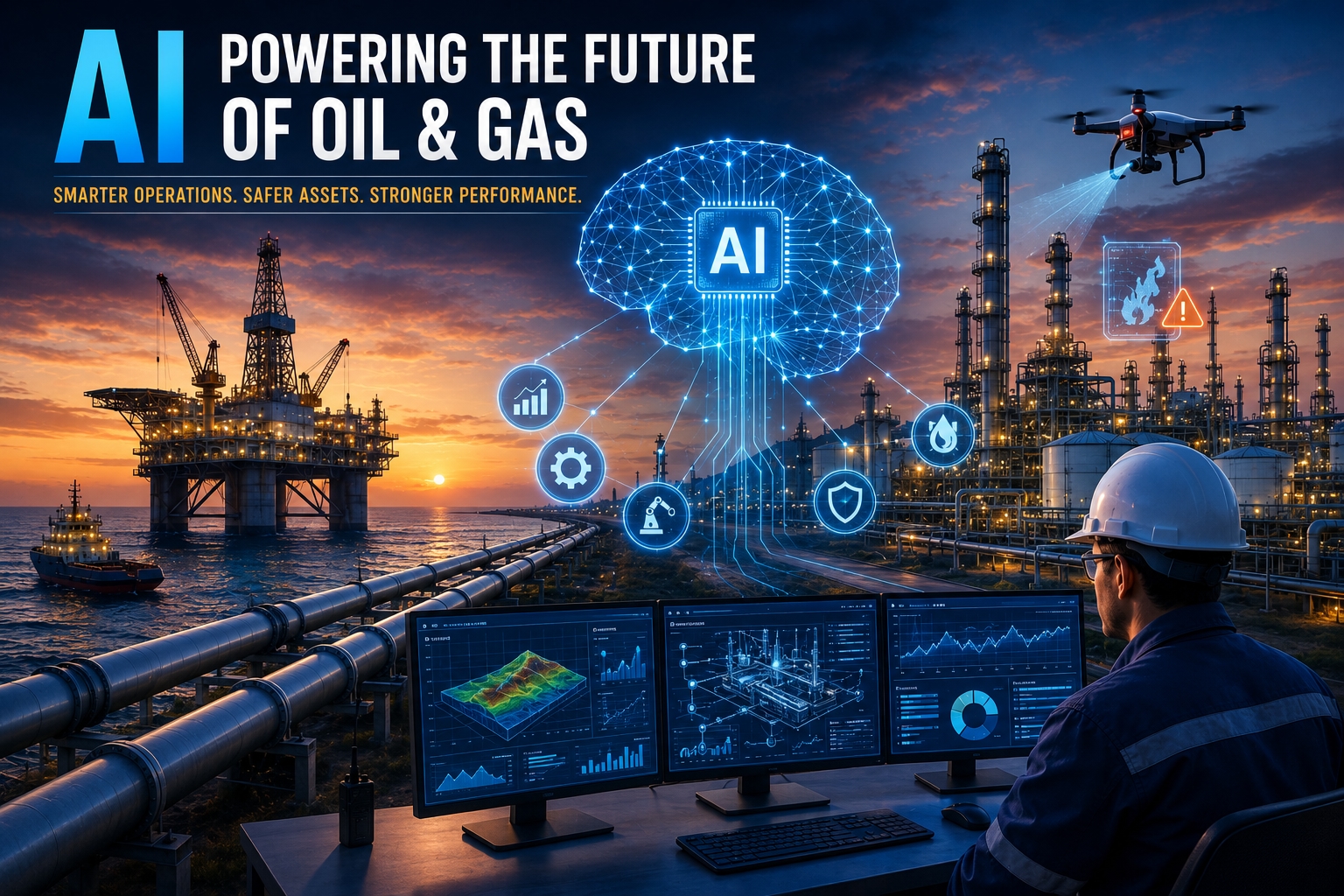
Predictive maintenance uses historical and real-time equipment data to identify conditions associated with potential failures.
Models can analyze variables such as:
Vibration
Temperature
Pressure
Equipment cycles
Operating history
Maintenance records
Sensor anomalies
Instead of waiting for equipment to fail or servicing every asset according to a fixed schedule, maintenance teams receive data-driven signals about which assets require attention.
Deloitte identifies event-based predictive maintenance as an important application of AI and digital technologies across energy infrastructure.
The business value comes from reducing unexpected downtime, improving maintenance planning, and allocating technicians and spare parts more efficiently.
2. Drilling Optimization
Drilling operations generate large amounts of real-time data. AI can analyze drilling parameters, geological information, equipment conditions, and historical well performance to identify patterns and support operational decisions.
AI applications in drilling include:
Drilling parameter optimization
Detection of abnormal drilling conditions
Equipment performance monitoring
Nonproductive time reduction
Well performance prediction
Automated analysis of drilling data
AI does not replace drilling engineers. Instead, it gives them a way to process more information and identify patterns faster.
For operators managing large portfolios of wells, this analytical advantage becomes more valuable as historical datasets grow.
3. Production Optimization
Production optimization is one of the most commercially important AI use cases in oil and gas.
Machine learning models can evaluate production history, reservoir characteristics, well conditions, operating parameters, and sensor data to identify relationships affecting output.
For example, a model might identify a combination of operating conditions associated with declining production or recommend where engineers should investigate an unusual change in well performance.
Deloitte reports that around half of AI and generative AI spending by U.S. oil and gas companies is currently directed toward process optimization. Its research also describes AI-driven analytics being used to adjust drilling parameters and production rates in real time.
This makes production optimization a key part of the broader digital transformation of oil and gas operations.
4. Reservoir and Seismic Analysis
Subsurface analysis is another area where AI has significant potential.
Geoscientists work with seismic surveys, well logs, geological models, reservoir simulations, and production data. AI can help classify geological features, identify patterns, accelerate interpretation, and support reservoir modeling.
The IEA identifies subsurface data processing and reservoir simulation among AI applications in the oil and gas sector.
The advantage is speed and scale. AI can process large datasets and surface relationships for experts to evaluate.
However, subsurface applications require careful validation. A prediction that looks statistically strong still needs to make geological and engineering sense before influencing major investment or drilling decisions.
5. Pipeline Monitoring and Leak Detection
Pipeline networks require continuous monitoring.
AI can analyze pressure, flow, temperature, vibration, inspection data, and other operational signals to identify unusual behavior.
Machine learning models can establish normal operating patterns and flag deviations for investigation.
AI also works alongside drones, satellite imagery, cameras, acoustic systems, and other inspection technologies.
Leak detection is particularly important because a faster response can reduce operational losses, environmental impact, and safety risks.
The IEA lists leak detection and methane emissions reduction among the established areas where AI is being applied in oil and gas operations.
6. Refinery and Process Optimization
Refineries operate with highly interconnected processes. Small changes in feedstock quality, temperature, pressure, equipment condition, or throughput can affect efficiency and product yield.
AI-based process optimization analyzes multiple variables simultaneously and identifies operating patterns associated with improved performance.
Potential applications include:
Energy consumption optimization
Throughput optimization
Product quality prediction
Yield optimization
Process anomaly detection
Production scheduling
Equipment monitoring
The objective is not to automate every decision. It is to provide operators and engineers with better information at the point where operational decisions are made.
7. Safety and Risk Management
Safety remains a critical application area for AI in the energy industry.
AI can analyze incident reports, inspection records, equipment conditions, work orders, and operational data to identify recurring risk patterns.
Computer vision can also support defined inspection tasks where cameras are already deployed.
Generative AI provides another potential use. Employees can use natural-language interfaces to retrieve information from approved technical documents, procedures, maintenance records, and safety materials.
The technology still requires boundaries. High-consequence decisions should retain appropriate human oversight, especially when AI outputs influence physical operations.
8. Methane and Emissions Monitoring
AI is increasingly relevant to emissions management.
Oil and gas companies collect emissions-related information from sensors, aerial inspections, satellites, drones, and operational systems. AI can help combine these datasets and identify potential sources requiring investigation.
The IEA specifically identifies methane emissions detection and reduction as an important area for AI adoption in the oil and gas sector.
This application has both environmental and operational relevance. A detected leak can represent an emissions concern as well as lost product and an indication of equipment or process problems.
9. Supply Chain and Demand Forecasting
Oil and gas supply chains operate across production, transportation, storage, procurement, inventory, and customer demand.
AI forecasting models can process historical demand, inventory levels, logistics data, weather information, market signals, and operational constraints.
Companies can use these models to improve:
Inventory planning
Spare-parts management
Procurement
Transportation scheduling
Production planning
Demand forecasting
Better forecasting does not eliminate market uncertainty. It gives decision-makers a stronger analytical foundation for managing it.
Business Benefits of AI Adoption
The business case for AI becomes stronger when technology is connected to measurable operating metrics.
Lower Operating Costs
AI can help reduce costs through predictive maintenance, energy optimization, improved logistics, and better resource allocation.
The financial impact varies by asset and application. Companies should calculate the opportunity using their own operating baseline rather than relying on generic industry ROI claims.
Reduced Downtime
Unplanned downtime can affect production, maintenance schedules, labor requirements, and customer commitments.
Predictive analytics gives maintenance teams earlier visibility into equipment conditions, allowing them to investigate potential issues before they become failures.
Deloitte cites an oil and gas example in which predictive algorithms prevented more than 140 hours of downtime and protected 1.6% uptime.
That example demonstrates why operational measurement matters. AI value is easier to defend when it is connected to a specific asset and measurable performance indicator.
Improved Production Efficiency
Production optimization systems can help operators identify inefficiencies across wells, facilities, and processing systems.
The benefit does not always come from producing more. It can also come from achieving the same output with fewer resources, less energy, or lower operational risk.
Better Asset Management
AI gives asset managers a way to prioritize attention across large equipment portfolios.
Instead of treating every asset equally, companies can use risk and condition information to determine where inspections, maintenance, or capital investment deserve priority.
Faster Decision-Making
AI can reduce the time required to collect and analyze information.
Generative AI can further improve access to internal knowledge by allowing employees to ask questions in natural language and retrieve information from approved company sources.
For large organizations, reducing information-search time across engineering, maintenance, operations, and corporate functions can become a meaningful productivity opportunity.
The Role of Generative AI and Agentic AI
The next stage of AI adoption extends beyond predictive models.
Generative AI can summarize technical documents, assist with engineering research, generate reports, search internal knowledge, and support employees with routine analytical tasks.
Agentic AI goes further by coordinating multiple steps within a defined workflow.
For example, an AI agent could identify an equipment anomaly, retrieve relevant maintenance history, compare the condition with established procedures, prepare an inspection recommendation, and route the issue to the appropriate team.
The important distinction is autonomy.
A generative AI assistant primarily helps a person create or retrieve information. An agentic system can perform a sequence of tasks within predefined permissions.
Deloitte's 2026 oil and gas research identifies agentic AI, generative AI, and real-time analytics as technologies moving toward broader operational use.
For oil and gas companies, adoption should remain controlled. Agentic systems operating near physical infrastructure require clear permissions, testing, monitoring, cybersecurity, and human escalation paths.
Challenges Holding Back AI Adoption
Data Quality
AI models depend on reliable data.
Oil and gas companies often have information distributed across historians, SCADA systems, enterprise applications, maintenance platforms, engineering databases, spreadsheets, and specialized operational technology.
Data integration and data quality work often determine whether an AI project succeeds.
Legacy Systems
Many facilities operate equipment and software that were installed long before modern AI platforms existed.
Replacing these systems is expensive and disruptive.
A practical AI strategy often focuses on integrating with existing infrastructure rather than rebuilding the entire technology environment.
Cybersecurity
AI creates new connections between data, applications, models, and operational systems.
The security architecture therefore needs to account for access controls, identity management, network segmentation, monitoring, secure APIs, model security, and operational technology protections.
The DOE describes AI as increasingly integral to how the U.S. energy sector plans, operates, monitors, and protects critical infrastructure, highlighting the growing connection between AI capability and energy security.
Workforce Adoption
An AI model has little business value if employees do not trust or use it.
Operators, engineers, maintenance teams, and business leaders should participate in testing and validation.
Training should cover both capabilities and limitations. Employees need to know when an AI recommendation is useful and when human review is required.
Governance
AI governance needs to define data ownership, model validation, access rights, monitoring, accountability, and acceptable use.
For operational applications, companies also need clear procedures for handling incorrect predictions, model failures, and unexpected system behavior.
Future Trends in AI for Oil and Gas
The future of AI in oil and gas is likely to focus less on isolated models and more on connected operational systems.
AI Moving From Pilots to Core Operations
Deloitte expects AI and generative AI to become a larger component of oil and gas technology spending over the next several years. Its 2026 outlook describes a shift toward enterprise-wide deployment and operations-focused capabilities.
This suggests that the next challenge is scaling proven applications rather than producing more demonstrations.
Real-Time AI
Real-time analytics will become increasingly important as companies connect more sensors, equipment, production systems, and control environments.
The value of AI increases when predictions arrive early enough to influence an operational decision.
Digital Twins and AI
Digital twins create virtual representations of physical assets or processes.
Combined with AI, they can support scenario analysis, asset performance monitoring, predictive maintenance, and operational optimization.
For example, operators can use historical and real-time data to evaluate how an asset might respond to changing operating conditions before making a physical adjustment.
AI-Powered Workforce Tools
As experienced workers retire and technical skills become harder to replace, AI-based knowledge systems will become more relevant.
A technician should be able to retrieve approved procedures, equipment history, inspection information, and troubleshooting guidance without searching through disconnected systems.
This makes AI a potential knowledge-management tool as well as an operational technology.
Physical AI and Robotics
AI-enabled robots, drones, inspection systems, and autonomous equipment are another emerging area.
These technologies could perform inspection or monitoring tasks in environments where sending people is costly or hazardous.
The technology remains more emerging than predictive maintenance or analytics, so companies should evaluate each application based on reliability, safety, operating conditions, and economic value.
How Oil and Gas Companies Should Approach AI Implementation
Successful AI adoption should begin with a business problem.
A practical framework is:
Identify a measurable operational problem.
Establish the current performance baseline.
Determine whether sufficient data exists.
Evaluate technical and cybersecurity requirements.
Select a focused pilot.
Define success metrics before deployment.
Integrate the solution into existing workflows.
Measure the financial and operational impact.
Improve the model based on real operating conditions.
Scale only after the business case is demonstrated.
For example, instead of launching a broad "AI transformation" program, an operator might begin with predictive maintenance for a specific compressor fleet.
The company can measure failure frequency, maintenance costs, downtime, model accuracy, response time, and production impact.
If the pilot produces measurable value, the same framework can be evaluated for other asset classes.
This approach reduces technology risk and gives executives a defensible basis for further investment.
What the Future Means for Oil and Gas Leaders
AI is becoming part of the industry's broader digital transformation. The companies gaining the most value will not necessarily be those with the largest AI budgets.
They will be the companies that connect AI investment to important operational problems.
CEOs should focus on business value and capital discipline.
CTOs and CIOs should focus on architecture, integration, cybersecurity, and scalable data foundations.
COOs should focus on workflow integration and operational adoption.
Engineering and operations leaders should validate whether AI outputs make sense in real operating conditions.
The objective is shared: turn data into better decisions without introducing unacceptable operational or security risk.
Conclusion
AI is reshaping the oil and gas industry by changing how companies analyze data, maintain equipment, optimize production, monitor infrastructure, manage emissions, and support employees.
Predictive maintenance, drilling optimization, production analytics, reservoir analysis, pipeline monitoring, refinery optimization, and emissions detection are already practical application areas. Generative AI, agentic AI, digital twins, real-time analytics, and AI-enabled robotics represent the next wave of development.
The IEA confirms that AI is already being used across exploration, production, maintenance, safety, leak detection, and emissions management.
The most important shift is strategic. AI is moving from an experimental technology initiative toward an operational capability.
For oil and gas leaders, the right approach is disciplined. Start with a measurable problem. Build the data foundation. Involve domain experts. Establish governance and cybersecurity controls. Measure results against a baseline. Then scale the applications that demonstrate real value.
That is how AI becomes part of a sustainable digital transformation strategy, improving operational efficiency while giving decision-makers better information at the moment it matters.