
Generative AI in FinTech is moving into a more practical phase. Financial institutions and FinTech companies are shifting attention from AI demonstrations and isolated pilots toward applications that improve productivity, customer experience, risk management, compliance, and product development.
The change is visible across the financial sector. Federal Reserve research published in April 2026 found that about 18% of firms had adopted AI by the end of 2025, while other surveys showed substantially higher adoption when measured at the workforce or firm-with-LLM level. The variation reflects different definitions of adoption, but the direction is clear: AI is becoming part of everyday business operations.
For financial executives, the central question has therefore changed. The challenge is no longer deciding whether to experiment with AI. It is determining where Generative AI creates measurable value while maintaining the security, reliability, privacy, and governance expected from financial services.
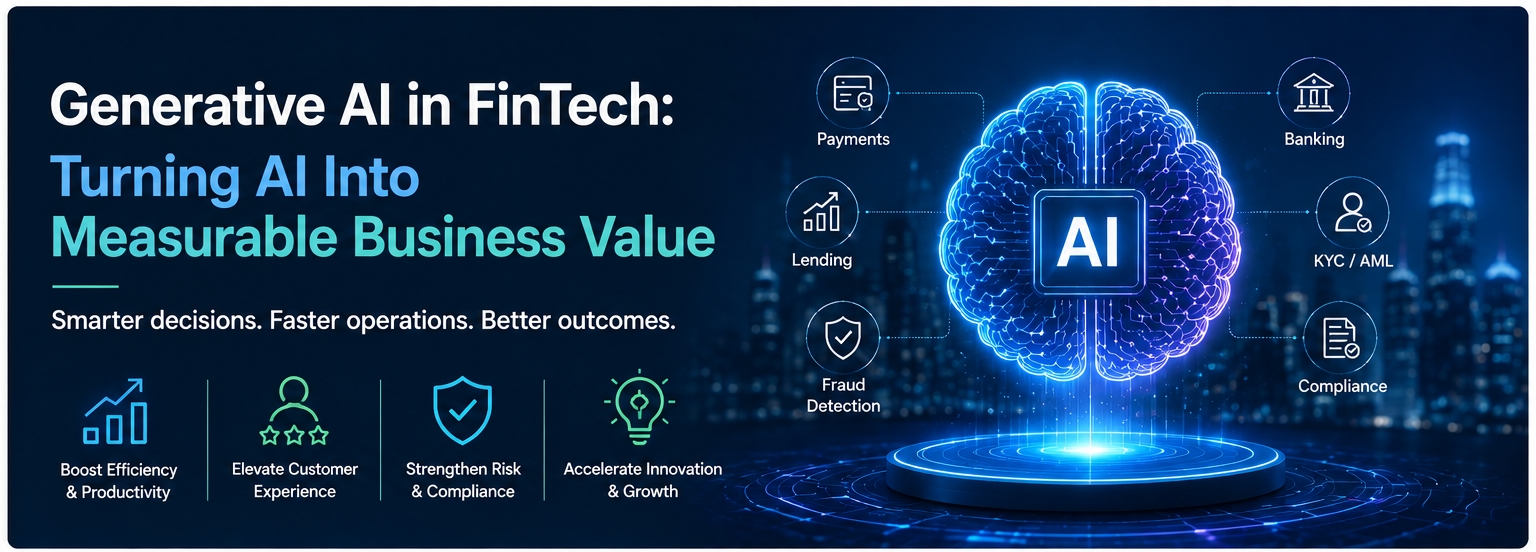
What Is Generative AI in FinTech?
Generative AI refers to AI systems that generate new content such as text, summaries, code, recommendations, and structured responses based on information provided to the model.
Traditional AI and machine learning are commonly used for prediction, classification, scoring, and anomaly detection. Generative AI adds the ability to interpret and produce information through natural language and other content formats.
The two approaches often work together.
For example, a fraud detection model might identify an unusual transaction pattern. A Generative AI system can then summarize the customer's activity, organize supporting information, and prepare an investigation report for an analyst.
This combination makes Generative AI for FinTech particularly useful for information-heavy workflows where employees spend significant time searching, reviewing, summarizing, and documenting information.
Why Financial Services Companies Are Investing in Generative AI
Financial organizations operate on large volumes of structured and unstructured data. Customer records, transaction histories, loan applications, contracts, financial statements, policies, regulatory documents, and service conversations all require processing.
Generative AI provides a new interface for working with this information.
Several business pressures are driving adoption:
Customers expect faster digital experiences.
Employees need better access to institutional knowledge.
Financial institutions face pressure to improve operating efficiency.
Compliance teams manage large volumes of regulatory information.
FinTech companies compete on product speed and personalization.
Engineering teams are adopting AI-assisted development tools.
Deloitte's 2025 research, based on about 540 financial services respondents, found that 46% fit its definition of Generative AI “pioneers,” meaning organizations with high or very high self-assessed GenAI expertise. The research also found differences in how effectively organizations were progressing from experimentation toward implementation.
The implication is important. Access to an AI model is not the same as organizational readiness. Business processes, data, governance, technical architecture, and employee capabilities determine whether an AI investment produces value.
Generative AI Use Cases in FinTech
AI-Powered Customer Service
Financial institutions are using AI assistants to answer routine questions, summarize conversations, retrieve information, and guide customers through self-service processes.
The value comes from reducing repetitive work and improving response times.
The technology should still include clear escalation paths. Account disputes, sensitive complaints, complex financial questions, and other high-impact situations require appropriate human involvement.
Financial Document Intelligence
Document processing remains a major source of manual work.
Generative AI can help extract information from financial documents, summarize reports, compare documents, identify missing information, and prepare structured outputs.
A lender, for example, might use AI to organize information from several application documents before an employee reviews the case.
The objective is not to remove human review. It is to reduce the amount of time employees spend preparing information for review.
Fraud Detection and Investigation
AI in FinTech already plays an important role in transaction monitoring and anomaly detection. Generative AI extends these capabilities by helping investigators interpret large amounts of information.
An AI system can summarize suspicious activity, organize transaction histories, identify relevant evidence, and prepare case notes.
This is particularly useful for investigation teams dealing with large case volumes.
The threat environment is also changing. FINRA reported in January 2025 that criminals were using GenAI to facilitate new-account fraud and account takeovers, including techniques designed to exploit identity verification processes.
This creates a two-sided AI challenge. Financial organizations need AI to improve fraud defenses while also preparing for more sophisticated AI-assisted attacks.
KYC and AML Workflow Automation
Know Your Customer and Anti-Money Laundering processes involve extensive document review, customer research, transaction analysis, and case documentation.
Generative AI can assist with:
Customer profile summaries
Due diligence documentation
Policy searches
Case preparation
Transaction explanations
Investigation notes
The technology is best positioned as an analyst assistant rather than an autonomous compliance authority.
AI Credit Underwriting
AI credit underwriting can help lenders process applications, analyze information, identify relevant patterns, and support credit teams.
However, lending decisions require a higher level of scrutiny.
Credit models need appropriate controls around fairness, explainability, data quality, and adverse-action reasoning. The Consumer Financial Protection Bureau has stated that lenders using complex algorithms still need to provide accurate and specific reasons when applicants are denied credit.
Generative AI therefore needs careful positioning in lending workflows. It might summarize application information or support an analyst, while a validated decisioning system handles the underlying credit assessment.
AI-Powered Compliance
Compliance teams continuously work with policies, regulatory material, internal controls, and evidence.
Generative AI can help employees search large knowledge bases, summarize requirements, compare policies, and prepare compliance documentation.
Retrieval-augmented generation, commonly called RAG, is particularly useful for these applications. Instead of relying entirely on a model's general knowledge, the system retrieves relevant information from approved internal sources before generating an answer.
This approach improves traceability and reduces the risk of unsupported responses.
Internal Knowledge Assistants
Employees often spend considerable time searching across policy repositories, technical documentation, product information, and internal procedures.
A secure internal AI assistant can provide a conversational interface to this information.
For large financial organizations, the benefit extends beyond productivity. It can also improve consistency by helping employees access the same approved source material.
Financial Intelligence and Forecasting
Generative AI is also changing how business users interact with financial data.
Instead of requiring every executive to work through dashboards, users can ask natural-language questions about revenue, customer segments, transaction volumes, operational performance, or cost trends.
The underlying calculations still need to come from governed data systems. Generative AI should explain and interact with trusted analytics rather than inventing financial results.
AI-Assisted Software Development
Engineering teams are using AI for code generation, documentation, testing, debugging, and code review.
For FinTech companies, faster development can support shorter product cycles.
Financial software still requires rigorous testing, security review, dependency management, and human code review. AI-generated code should enter established engineering controls rather than bypass them.
How Generative AI Improves Financial Operations
The strongest AI business cases often improve existing workflows rather than introduce entirely new products.
Consider a compliance analyst who spends significant time reviewing documents and preparing case summaries. An AI-assisted workflow can organize the information first, allowing the analyst to focus on verification and judgment.
At scale, these time savings become operational improvements.
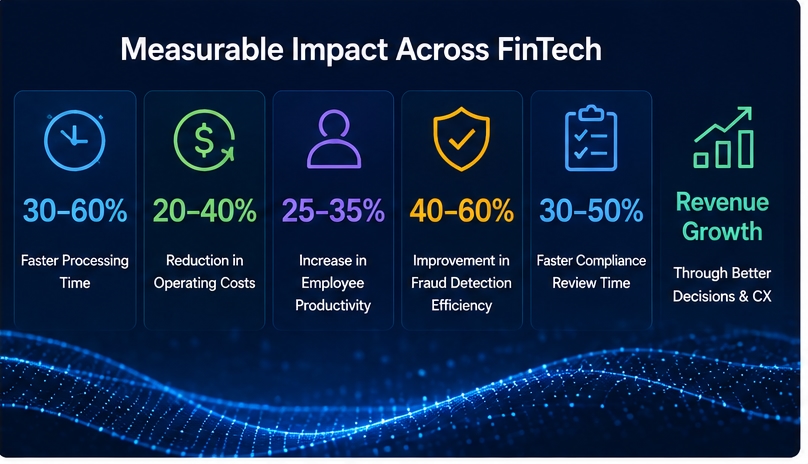
Executives should measure:
Processing time
Cost per workflow
Employee throughput
Error and rework rates
Customer response time
Compliance review time
AI infrastructure costs
Deloitte's 2025 research also found strong expectations around productivity. In a separate finance and accounting survey, 42.7% of respondents identified increased efficiency and productivity as the greatest benefit of AI agents.
Generative AI and Customer Experience
Customer expectations are influencing how financial products are designed.
AI assistants can provide conversational support, explain financial products, personalize educational content, and help customers navigate digital services.
The challenge is maintaining trust.
A financial AI assistant that gives an incorrect answer with high confidence creates more risk than a conventional search interface that simply fails to find information.
Organizations therefore need controlled knowledge sources, response validation, escalation mechanisms, and monitoring.
High-impact decisions should retain appropriate human oversight.
Managing the Risks of Generative AI
Financial organizations face several categories of AI risk.
Data privacy is a primary concern. Financial systems contain sensitive personal and transactional information, so organizations need clear rules for data access, retention, processing, and model usage.
Accuracy is another challenge. Generative models can produce convincing but incorrect information. RAG, validation rules, testing, and human review help reduce this risk.
Cybersecurity also deserves specific attention. Prompt injection, data leakage, unauthorized access, insecure integrations, and manipulation of AI workflows create new attack surfaces.
Third-party dependency is another consideration. Financial organizations need visibility into how external AI vendors handle data, security, availability, model changes, and incident response.
Governance must cover the entire AI lifecycle.
NIST's AI Risk Management Framework provides a voluntary structure built around four functions: Govern, Map, Measure, and Manage. Its Generative AI Profile identifies risks and suggested actions specific to generative systems.
Regulatory expectations also continue to develop. In April 2026, the OCC, Federal Reserve, and FDIC issued revised model risk management guidance. The agencies noted that Generative AI and agentic AI models are novel and rapidly evolving and therefore outside the scope of that specific guidance. They also announced plans for further consideration of AI and model risk management.
This reinforces the need for organizations to avoid treating a single framework as a substitute for risk assessment.
A Practical Approach to Generative AI Adoption
A successful implementation starts with the business problem.
First, identify workflows where AI has a measurable advantage. High-volume, repetitive, information-heavy processes are often strong candidates.
Second, evaluate data readiness. Fragmented, outdated, or poorly governed data will limit AI performance.
Third, select the appropriate architecture. RAG works well when responses need to reference controlled organizational knowledge. Traditional machine learning might remain better suited to certain prediction and scoring tasks.
Fourth, establish security controls around data, identities, permissions, APIs, prompts, outputs, and logging.
Fifth, define human oversight based on risk. Low-risk productivity tasks require different controls from credit, fraud, compliance, or customer-impacting decisions.
Sixth, test before production. Evaluation should cover accuracy, security, bias, latency, cost, failure scenarios, and operational performance.
Finally, scale based on evidence.
A small production deployment with measurable results is more valuable than dozens of disconnected AI experiments.
Measuring Business Value
AI initiatives need business metrics from the beginning.
Useful KPIs include:
Processing time reduction
Cost per transaction
Employee productivity
Customer response time
Customer satisfaction
Fraud investigation efficiency
Compliance processing time
Error rates
Revenue contribution
AI operating cost
Return on investment
Executives should establish a baseline before implementation. Without a baseline, it becomes difficult to determine whether an AI system is delivering meaningful improvement.
The goal is not maximum AI usage. The goal is better business performance.
Where Generative AI in FinTech Is Heading
The next stage of AI adoption will involve deeper integration with financial workflows.
AI agents are moving toward multi-step task execution. RAG will remain important for connecting models with trusted organizational knowledge. Multimodal AI will expand the ability to process documents, images, forms, and other information formats.
Financial organizations are also likely to place greater emphasis on AI evaluation, observability, security, and governance as deployments become more operationally important.
For companies evaluating implementation approaches, Generative AI in FinTech provides additional context on applying generative technologies to financial technology use cases.
The broader direction is clear. AI is becoming part of how financial products are built, delivered, supported, and managed.
Conclusion
Generative AI in FinTech is moving beyond experimentation toward practical applications across operations, customer service, compliance, fraud investigation, lending support, analytics, and software development.
The organizations gaining value will not be those deploying the largest number of AI tools. They will be the ones connecting AI to specific business problems and measuring the results.
Strong data, secure architecture, reliable knowledge sources, human oversight, continuous testing, and effective governance are essential.
For financial leaders, the opportunity is to treat Generative AI as an operating capability with measurable outcomes. When technology decisions are tied to productivity, customer experience, risk management, and financial performance, AI becomes easier to evaluate, govern, and scale.