
Physical AI is moving manufacturing automation beyond fixed rules and predefined workflows. AI-enabled robots, computer vision systems, autonomous mobile robots, intelligent inspection, and adaptive production systems are increasingly connecting perception, decision-making, and physical action.
The investment case, however, requires more than proving that an AI model works.
Manufacturers need to know whether a Physical AI deployment improves throughput, reduces downtime, lowers scrap, improves quality, or creates measurable capacity. This makes physical AI ROI a critical part of every manufacturing automation strategy.
The global robotics market shows why this question matters. The International Federation of Robotics reported 542,000 industrial robots installed worldwide in 2024, while the global operational stock reached 4.66 million units.
As adoption grows, manufacturers need a disciplined method for separating technical performance from actual business value.
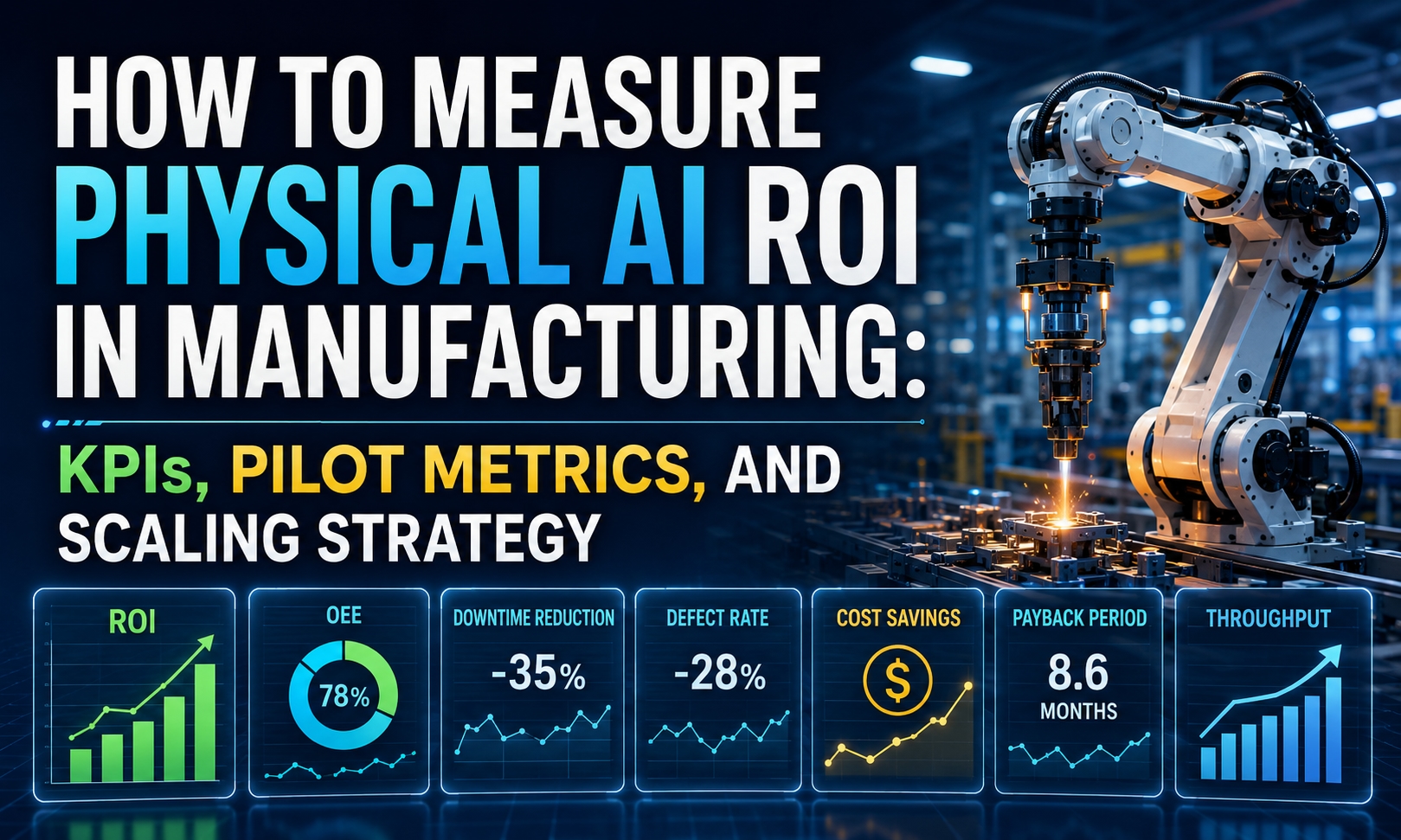
What Is Physical AI ROI?
Physical AI ROI measures the financial and operational value generated by AI-enabled physical systems compared with the total cost of implementing and operating them.
Unlike conventional software AI, Physical AI interacts with physical environments. It might control a robot, identify defects through cameras, predict equipment failures, optimize production movements, or respond to changing factory conditions.
A basic ROI calculation is:
ROI = (Net Benefits − Total Investment) ÷ Total Investment × 100
The investment calculation should include more than the price of the robot or AI software.
Consider:
Robotics and automation hardware
Sensors and cameras
Edge computing infrastructure
AI software and models
System integration
Data infrastructure
Factory-floor modifications
Employee training
Cybersecurity
Maintenance
Model monitoring and updates
Ongoing operating costs
PwC notes that Physical AI combines hardware economics with software and data economics, making deployment, reliability, integration, and scalability important parts of the value equation.
Start With a Baseline Before the Physical AI Pilot
You need a reliable baseline before measuring improvement.
Suppose a factory introduces AI-powered visual inspection. Measuring defect detection after deployment tells you how the system performs technically. It does not tell you whether the factory reduced scrap, rework, warranty claims, or inspection costs.
Record the current state first.
Useful baseline metrics include:
Overall equipment effectiveness, or OEE
Production throughput
Cycle time
Unplanned downtime
Mean time between failures
Mean time to repair
Defect rate
Scrap rate
Rework rate
Labor hours
Energy consumption
Maintenance costs
Your baseline should cover enough production cycles to account for normal variation.
This creates a defensible comparison between pre-deployment and post-deployment performance.
The Most Important AI Manufacturing KPIs
A strong Physical AI measurement framework combines technical, operational, financial, and strategic KPIs.
Technical KPIs
Technical metrics help determine whether the system works as designed.
Track:
Model accuracy
Precision and recall
False-positive rate
False-negative rate
Inference latency
System availability
Data quality
Model drift
These metrics matter, but they should not become the final definition of success.
A computer vision model with 98% detection accuracy still produces limited business value if it slows production or generates excessive false alarms.
Operational KPIs
Operational metrics connect AI performance to factory performance.
Track:
OEE
Throughput
Cycle time
Downtime
MTBF
MTTR
First-pass yield
Defect rate
Scrap
Rework
Asset utilization
McKinsey's research on manufacturing AI highlights production capacity, labor productivity, quality, and end-to-end visibility as major areas where manufacturers expect digital and AI investments to create value.
Financial KPIs
Financial metrics determine whether the technology creates an attractive business case.
Track:
Direct cost savings
Downtime-related savings
Maintenance savings
Scrap reduction
Labor efficiency
Additional production capacity
Energy savings
Total cost of ownership
Payback period
ROI
Strategic KPIs
Some Physical AI benefits are harder to capture through immediate cost savings.
Strategic metrics include:
Production flexibility
Workforce productivity
Factory resilience
Ability to scale automation
New product introduction speed
Deployment time across facilities
AI readiness
How to Measure Physical AI ROI by Use Case
The right KPIs depend on what you are automating.
Predictive Maintenance
For AI-driven maintenance, measure:
Unplanned downtime
MTBF
MTTR
Emergency maintenance
Maintenance labor
Spare-parts costs
Equipment availability
The financial benefit comes from reducing failures, maintenance disruption, and production losses.
Computer Vision and Quality Inspection
For AI-powered inspection, measure:
Defect detection
Defect escape rate
First-pass yield
Scrap
Rework
Inspection time
Warranty-related issues
The goal is not simply better image classification. The goal is better production quality with measurable operational value.
Robotics and Intelligent Automation
For robotic automation, measure:
Cycle time
Throughput
Labor hours
Robot utilization
Production capacity
Downtime
Safety-related indicators
The business case should account for both the productivity created and the complete cost of deployment.
Production Optimization
Measure:
OEE
Throughput
Changeover time
Schedule adherence
Capacity utilization
Production losses
Physical AI becomes more valuable when systems adapt to changing production conditions rather than following static rules.
How to Calculate Manufacturing Automation ROI
Start by calculating total investment.
Total investment = Hardware + Software + Integration + Infrastructure + Implementation + Training + Operating Costs
Then calculate measurable financial benefits.
Financial benefits = Downtime savings + Scrap reduction + Rework reduction + Maintenance savings + Labor efficiency + Additional capacity + Energy savings
Net benefit is:
Net benefit = Financial benefits − Total investment
Then:
ROI = Net benefit ÷ Total investment × 100
Illustrative example
Assume a manufacturer invests $500,000 in an AI-enabled robotic inspection system.
During the first year, the system produces:
$180,000 in scrap reduction
$120,000 in rework savings
$100,000 in labor efficiency
$80,000 in additional production value
Total measurable benefit = $480,000.
If annual operating costs are $80,000, the net benefit is $400,000.
ROI:
($400,000 − $500,000) ÷ $500,000 × 100 = -20%
This hypothetical example shows why manufacturers need to include the complete cost structure. A technically successful system might still fail the financial test during its first year.
The calculation also helps identify what needs to change before scaling.
Measuring the ROI of a Physical AI Pilot
A pilot should prove both technical feasibility and economic value.
Follow a structured process:
Select one high-value manufacturing problem.
Document the current baseline.
Define success criteria.
Establish a measurement period.
Track technical and operational KPIs.
Record all implementation costs.
Measure financial benefits.
Calculate payback and ROI.
Review the results with operations and finance teams.
Decide whether to scale, modify, or stop.
Digital twins and simulation also provide an opportunity to test production scenarios before committing to physical deployment. McKinsey has reported cases where manufacturers used digital twins and Industry 4.0 approaches to improve throughput, reduce unit costs, and evaluate investments before implementation.
Common Mistakes When Measuring Physical AI ROI
Manufacturers often make several mistakes when evaluating AI automation.
Measuring model accuracy instead of business results
Accuracy is a technical metric. It does not automatically translate into savings.
Starting without a baseline
Without pre-deployment measurements, you cannot confidently attribute improvements to the new system.
Ignoring integration costs
Connecting AI with MES, ERP, SCADA, PLCs, robotics, and existing factory systems often requires substantial engineering effort.
Counting theoretical capacity as savings
A factory producing more units only creates financial value when the additional capacity is used and generates revenue or avoids another cost.
Ignoring ongoing costs
Hardware maintenance, cloud services, edge infrastructure, monitoring, retraining, and software updates affect long-term ROI.
Scaling before proving the pilot
A successful demonstration does not prove that the system will perform consistently across different factories, products, shifts, or operating conditions.
When Should Manufacturers Scale Physical AI?
Scale when the evidence supports the business case.
Look for:
Stable technical performance
Consistent operational improvements
Positive financial results
Reliable data
Workforce acceptance
Validated safety performance
Integration readiness
Repeatable deployment processes
Sustainable operating costs
BCG's 2026 research emphasizes the need to distinguish proven robotics capabilities from emerging technologies. Its framework recommends sequencing investments based on what is technically deployable and where value is already demonstrable.
This is particularly important for emerging Physical AI applications. Manufacturers should not evaluate every robotic or AI capability as if it has the same maturity.
How Physical AI ROI Changes at Scale
A pilot might involve one production cell. A scaled program could involve multiple facilities, thousands of sensors, centralized monitoring, and different production environments.
New considerations appear at scale:
Multi-site deployment
Standardized architecture
Centralized governance
Edge computing
Cybersecurity
Hardware maintenance
Model monitoring
Workforce training
MES and ERP integration
AI lifecycle management
Measure both site-level ROI and portfolio-level ROI.
A solution that delivers strong results in one facility might require additional engineering before it becomes economically attractive across ten facilities.
Physical AI ROI: Build or Partner?
Internal manufacturing and engineering teams understand production processes, equipment, workforce requirements, and operational constraints.
Specialist expertise becomes valuable when projects combine AI, robotics, computer vision, edge computing, industrial data, OT systems, cloud platforms, and complex integrations.
The right partner should help connect technical deployment with measurable operational outcomes.
For organizations evaluating Physical AI applications, Physical AI in manufacturing automation provides additional context on use cases, implementation considerations, and manufacturing automation strategies.
Conclusion: Build the ROI Case Before You Scale
Physical AI ROI should connect technical performance with measurable manufacturing outcomes.
Start with a specific operational problem. Establish a baseline. Define the KPIs before deployment. Measure technical performance, operational improvement, and financial impact together.
The global industrial robotics market shows continued investment in physical automation. IFR recorded 542,000 industrial robot installations in 2024, while Stanford's 2026 AI Index reported 4.66 million industrial robots operating globally at the end of 2024.
The manufacturers that gain lasting value will not be the ones that deploy the most AI systems. They will be the ones that understand where Physical AI creates measurable value, prove it through disciplined pilots, and scale solutions with reliable economics.