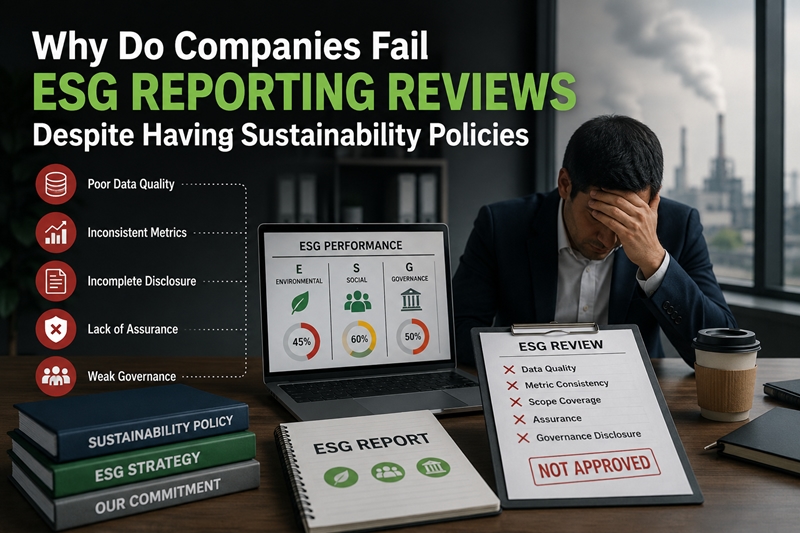
A manufacturing company may have a board-approved sustainability policy, environmental protection commitments, employee welfare guidelines, and a supplier code of conduct. Yet, when its ESG report undergoes a detailed review, the company may be unable to justify its reported emissions, demonstrate progress against sustainability targets, or provide supporting records for its claims.
This situation exposes a common weakness in corporate sustainability management.
Companies often develop sustainability policies to establish organizational commitments. However, ESG reporting compliance requires something more: measurable performance, consistent data collection, documented controls, clear accountability, and verifiable evidence.
For manufacturing companies, the challenge is particularly significant because environmental, social, and governance information originates from different facilities, departments, contractors, and suppliers.
Understanding why these gaps occur can help organizations identify weaknesses before they become reporting findings, investor concerns, or customer compliance issues.
Why Sustainability Policies Alone Cannot Ensure ESG Reporting Compliance
A sustainability policy communicates what an organization intends to achieve. An ESG reporting review examines whether its disclosures are accurate, complete, consistent, and supported by appropriate evidence.
Consider a company whose environmental policy commits to reducing greenhouse gas emissions. During a reporting review, the company may be asked to demonstrate:
Which manufacturing facilities were included in emissions calculations?
What electricity and fuel consumption records support the figures?
Which emissions factors and calculation methodologies were applied?
How was the reported reduction measured against the baseline?
Who reviewed and approved the final emissions data?
If the company cannot answer these questions, its sustainability commitment may be genuine, but its reported performance remains difficult to verify.
This distinction is reflected in the Global Reporting Initiative's reporting principles, which emphasize accuracy, completeness, balance, and verifiability.
The central problem is not always a missing policy. It is the absence of an effective system connecting policy commitments with operational performance and reliable disclosures.
What Are the Most Common Reasons Companies Fail ESG Reporting Reviews?
Companies can receive significant review findings for several interconnected reasons. These problems frequently develop during routine operations and become visible only when reporting information is examined.
1. Sustainability Policies Are Not Implemented Consistently
A company may establish a waste reduction policy without introducing standardized waste measurement procedures across its manufacturing facilities.
One plant may maintain detailed waste disposal records, while another relies on monthly estimates. Both facilities technically operate under the same sustainability policy, but their reporting practices differ.
Reviewers may identify:
Missing implementation procedures.
Inconsistent monitoring between facilities.
Sustainability targets without measurable indicators.
Incomplete records of corrective actions.
Limited evidence of management oversight.
Practical solution: Translate each material sustainability commitment into defined responsibilities, measurable indicators, monitoring schedules, and documented controls.
2. ESG Data Is Incomplete or Inconsistent
Environmental and social information is often collected independently by production, human resources, procurement, finance, and EHS departments.
Without standardized reporting procedures, departments may use different measurement units, reporting periods, or definitions.
For example, an operations team may report electricity consumption using meter readings, while the finance department records electricity purchased through utility invoices.
These figures can differ because of billing periods, meter coverage, or adjustments.
Neither figure is necessarily incorrect, but unexplained differences create reporting uncertainty.
Companies should establish common KPI definitions, reconciliation procedures, and documented calculation methods before consolidating ESG data.
3. Reported Sustainability Claims Lack Supporting Evidence
An organization might report that employee safety training increased by 25% during the year.
However, the reviewer may discover that training attendance records are incomplete or that the reported figure includes employees attending multiple sessions without a clearly defined counting methodology.
Similarly, claims about waste recycling, renewable energy consumption, or supplier assessments require supporting documentation.
Typical evidence may include:
Electricity bills and fuel purchase records.
Waste disposal manifests and authorized vendor documentation.
Employee training registers.
Environmental monitoring reports.
Supplier assessment records.
Approved calculation worksheets.
A sustainability claim should be traceable from the published disclosure to its original evidence.
4. ESG Reporting Responsibilities Are Poorly Defined
Many organizations assign overall ESG reporting responsibility to a sustainability manager without establishing ownership of individual data points.
This creates uncertainty when information is incomplete or inconsistent.
For example, the EHS department may collect hazardous waste records, while procurement manages waste disposal contractors. If neither department is responsible for reconciling vendor certificates against internal records, discrepancies may remain unresolved.
A practical responsibility structure should identify the data owner, reviewer, approving authority, and escalation contact for each material disclosure.
5. Reporting Boundaries Are Incorrect
Reporting boundaries determine which entities, facilities, operations, workers, or activities are included in particular ESG disclosures.
Problems arise when companies apply these boundaries inconsistently.
A manufacturer may include electricity consumption from its primary factory while overlooking another facility that should fall within its reporting boundary.
Likewise, safety statistics may exclude contract workers even where the applicable disclosure requires their inclusion.
The appropriate boundary depends on the reporting framework and specific metric.
Companies should document these decisions and review them following acquisitions, expansions, outsourcing arrangements, or operational restructuring.
6. ESG Reports Present Achievements Without Adequate Context
Some sustainability reports emphasize improvements while giving insufficient attention to missed targets, adverse incidents, or deteriorating indicators.
For instance, a company may highlight reduced electricity consumption without explaining that production volumes also declined.
An absolute reduction in energy consumption does not automatically demonstrate improved energy efficiency.
A more meaningful assessment may compare both total energy consumption and energy intensity, using an appropriate production denominator.
Balanced reporting helps readers distinguish genuine operational improvements from changes caused by production levels or business conditions.
How Do ESG Reporting Gaps Appear in Manufacturing Operations?
Manufacturing companies face distinctive reporting challenges because their ESG information depends heavily on physical operations.
Consider the following illustrative scenario.
A manufacturing company operates three facilities and reports a 12% reduction in annual electricity consumption. Its sustainability policy emphasizes energy efficiency, and management believes the reduction demonstrates successful implementation.
During an ESG reporting review, several discrepancies emerge.
Reported information | Review finding |
|---|---|
Electricity consumption decreased by 12% | One facility's data was excluded |
Energy efficiency improved | Production-volume changes were not evaluated |
Emissions decreased | Emissions calculations used inconsistent factors |
Sustainability targets were achieved | Baseline calculations were not documented |
ESG data was internally reviewed | No evidence of formal approval was retained |
This is an illustrative example, not a documented audit finding.
The review does not necessarily establish that the company failed to reduce energy consumption. Instead, it shows that the reported reduction cannot be accepted without further reconciliation.
The company must reconstruct its data, confirm reporting boundaries, validate calculations, and determine whether the original disclosure requires correction.
The important lesson is that sustainability performance and reporting reliability are related but separate responsibilities.
A company may achieve operational improvements while still producing disclosures that are insufficiently supported.
Speak with an expert: https://www.imarcengineering.com/contact?service=esg-compliance
What Do ESG Reporting Reviewers Actually Examine?
The scope of a review depends on whether it is an internal assessment, customer ESG evaluation, regulatory examination, third-party assessment, or independent assurance engagement.
Nevertheless, several areas commonly require attention.
Review area | Key question | Typical evidence |
|---|---|---|
Governance | Who oversees ESG reporting? | Committee records, responsibility matrix |
Environmental data | Are reported figures accurate? | Meter readings, invoices, calculation sheets |
Workforce practices | Are employee-related claims supported? | HR records, training registers |
Supplier management | Are material supplier risks assessed? | Supplier questionnaires, assessment records |
Reporting boundaries | Are relevant operations included? | Facility lists, consolidation methodology |
Corrective actions | Have identified weaknesses been addressed? | Action registers, closure evidence |
Reviewers may also examine whether reported information is consistent with previous reporting periods and whether material changes in calculation methods are explained.
For companies applying IFRS S1, sustainability-related financial disclosures address governance, strategy, risk management, and metrics and targets. These requirements should not be confused with those of other frameworks.
The objective is to establish whether disclosures fairly represent the organization's performance under the applicable criteria.
How Do BRSR Requirements Affect Indian Companies?
India's Business Responsibility and Sustainability Report (BRSR) framework provides a structured approach to sustainability disclosures for specified listed entities.
The requirements do not automatically apply to every Indian manufacturing company.
SEBI's March 28, 2025 circular introduced changes concerning BRSR Core assessment or assurance and value-chain ESG disclosures.
These developments reinforce the importance of maintaining dependable sustainability data and supporting documentation.
Manufacturing companies should distinguish between three situations:
Mandatory reporting: Applicable regulatory disclosures based on listing status and relevant requirements.
Voluntary reporting: Sustainability disclosures prepared using selected frameworks or organizational commitments.
Contractual assessments: ESG information requested by customers, lenders, investors, or business partners.
An unlisted manufacturer may not have the same BRSR obligations as a covered listed entity but may still need reliable ESG information to satisfy customer or financing requirements.
Companies should verify the current applicability of relevant requirements rather than assuming that every ESG framework is mandatory.
How Can Companies Prepare for an ESG Reporting Review?
Preparation should begin well before the reporting deadline.
Step 1: Identify Applicable Reporting Requirements
Determine which disclosures are mandatory, voluntary, or contractually required.
Create a reporting register specifying the applicable framework, metric, reporting boundary, responsible department, and evidence requirements.
Step 2: Conduct an ESG Reporting Gap Assessment
Compare existing reporting practices against applicable requirements.
Evaluate whether each material disclosure has an established methodology, reliable data source, responsible owner, and documented review process.
Prioritize gaps that could materially affect reporting accuracy or completeness.
Step 3: Standardize Data Collection
Introduce consistent templates and calculation procedures across departments and facilities.
Define measurement units, reporting periods, data sources, and methods for handling estimates.
Ensure that changes in methodology are documented.
Step 4: Establish an Evidence Register
Maintain an organized record linking each material ESG disclosure to its supporting documents.
A useful evidence register identifies:
The disclosure or KPI.
Original data source.
Responsible department.
Reporting period.
Calculation methodology.
Reviewer and approval status.
Outstanding exceptions.
This reduces dependence on informal email exchanges and individual employees' knowledge.
Step 5: Test Controls Before Publication
Internal reviewers should examine selected disclosures and reproduce important calculations.
For example, reported electricity consumption can be reconciled against meter records and utility invoices, with differences investigated and documented.
Unresolved material discrepancies should be escalated before report approval.
Step 6: Track Corrective Actions
Every significant finding should have an assigned owner, completion deadline, corrective action, and supporting closure evidence.
Closing a finding should involve more than updating a spreadsheet. The company should establish whether the underlying reporting weakness has actually been corrected.
How Can Companies Prevent the Same ESG Reporting Findings Every Year?
Repeated findings often indicate that companies are correcting individual reporting figures without addressing the processes responsible for generating them.
For example, correcting an emissions calculation may resolve the immediate disclosure issue. However, if facilities continue using inconsistent fuel conversion factors, the same problem may return.
Companies should therefore distinguish between:
Immediate correction: Fixing the inaccurate or incomplete reported information.
Root-cause corrective action: Changing the process, responsibility, methodology, or control that allowed the problem to occur.
Periodic management reviews, employee training, internal control testing, and documented follow-up can help prevent recurrence.
The objective should be to make reliable ESG reporting part of routine business operations rather than an annual documentation exercise.
How IMARC Engineering Can Help
IMARC Engineering supports manufacturing businesses in identifying ESG compliance gaps and improving reporting readiness. Its ESG compliance consulting services can help organizations evaluate existing policies, review operational sustainability practices, assess data collection processes, and identify weaknesses in supporting documentation. Through structured gap assessments and practical improvement recommendations, businesses can establish clearer reporting responsibilities and stronger evidence management processes. This helps companies prepare more reliable sustainability disclosures, address recurring review findings, and align ESG reporting practices with applicable frameworks and business requirements.
Conclusion
Sustainability policies establish corporate commitments, but reliable ESG reporting depends on measurable implementation, accurate information, and verifiable evidence. Companies often encounter reporting review findings because responsibilities are unclear, operational records are incomplete, or sustainability claims cannot be traced to supporting documentation. Addressing these weaknesses requires consistent data collection, effective internal controls, and regular compliance assessments. By treating ESG reporting as an ongoing management responsibility rather than an annual exercise, manufacturing companies can improve disclosure credibility, strengthen accountability, and reduce recurring reporting problems.
Contact Us:
IMARC Engineering
Phone: +91-120-433-0800
Email: sales@imarcengineering.com
India: C-130, Sector 2, Noida, Uttar Pradesh 201301
LinkedIn: https://www.linkedin.com/showcase/imarc-engineering/