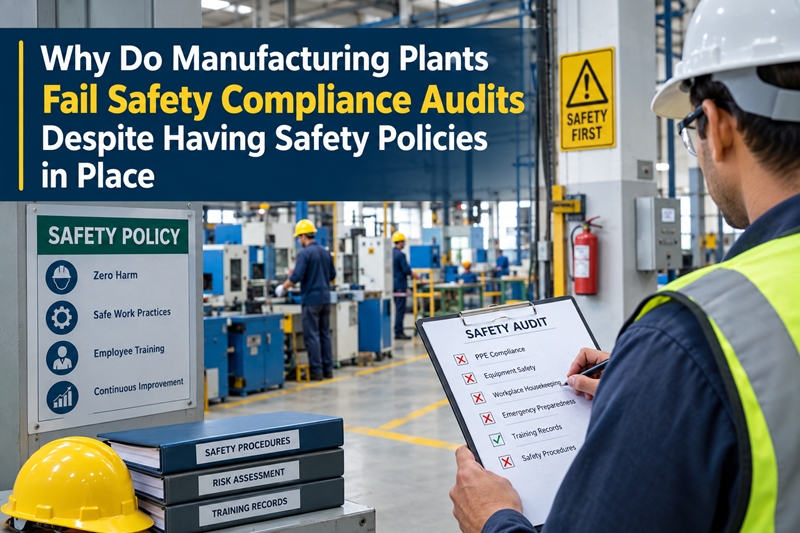
A manufacturing plant may have an approved safety policy, trained employees, documented standard operating procedures (SOPs), and regular workplace inspections. Yet, during a safety compliance audit, the facility may still receive major non-conformities related to machinery safety, employee practices, risk assessments, or regulatory requirements.
Why does this happen when the company already has a formal safety management system?
The problem often lies in the gap between documented safety requirements and actual shop-floor implementation. A policy may require equipment isolation before maintenance, but technicians may bypass the procedure during urgent breakdowns.
Health and Safety Compliance Audits help manufacturers identify these differences by examining workplace conditions, employee practices, documentation, and the effectiveness of existing controls.
Understanding these failures allows factory owners, plant heads, and EHS managers to address underlying weaknesses rather than repeatedly correcting the same audit findings.
What Do Safety Compliance Auditors Actually Examine?
A safety compliance audit is not simply a review of safety policies or inspection registers. It evaluates whether a manufacturing facility meets defined safety requirements and whether the implemented controls adequately address workplace risks.
Auditors generally examine three types of evidence:
Documentary evidence: Safety policies, hazard identification and risk assessments (HIRA), training records, statutory documents, inspection reports, and corrective-action registers.
Physical evidence: Machine guarding, electrical installations, emergency exits, ventilation systems, chemical storage, and protective equipment.
Operational evidence: Employee behaviour, maintenance practices, contractor activities, supervisory controls, and emergency response readiness.
Example: A manufacturing plant maintains approved machine operating procedures, but operators routinely remove safety guards to clear material jams.
Although the required documentation exists, the machinery remains exposed to unsafe operating practices.
The audit finding is therefore related to ineffective implementation rather than missing paperwork.
This distinction is essential: having a safety procedure does not automatically demonstrate that the associated risk is adequately controlled.
Why Do Manufacturing Plants Fail Safety Audits Despite Having Safety Policies?
Several operational and management weaknesses can cause a manufacturing facility to fail an audit even when its safety documentation appears complete.
1. Safety Policies Are Not Converted Into Practical Shop-Floor Controls
Many manufacturing companies establish broad commitments to workplace safety without defining how those commitments should be implemented.
For example, a policy may require safe machine operation but fail to establish specific requirements for guarding, equipment isolation, or maintenance access.
Common implementation gaps include:
Safety responsibilities are not clearly assigned to supervisors.
Standard operating procedures do not address actual working conditions.
Engineering controls are inadequate or poorly maintained.
Employees follow informal practices rather than approved procedures.
Safety performance is not regularly verified.
What manufacturers should do: Connect every critical safety requirement to a practical procedure, accountable employee, appropriate risk control, and verification method.
The objective is to ensure that safety policies influence daily operational decisions rather than remaining administrative documents.
2. Risk Assessments Are Not Updated After Operational Changes
Manufacturing operations frequently change due to production expansion, equipment relocation, automation, or process modifications.
However, the original HIRA documents may remain unchanged.
Consider a packaging facility that increases conveyor speed and modifies operator access points. If the existing assessment is not updated, newly introduced entanglement or maintenance hazards may remain unidentified.
Risk assessments should be reviewed whenever significant changes occur, including:
Installation or relocation of machinery
Changes in manufacturing processes or production capacity
Introduction of hazardous chemicals
Modifications to factory layout or material movement
Changes in maintenance methods or contractor activities
What manufacturers should do: Establish a management-of-change process that requires relevant safety risks to be reassessed before modified operations begin.
3. Training Records Do Not Demonstrate Employee Competence
A completed training register confirms that employees attended a programme. It does not necessarily establish that they can perform their tasks safely.
For instance, a maintenance technician may attend lockout/tagout training but remain unable to demonstrate correct equipment isolation.
Auditors may identify such gaps through:
Employee interviews
Practical demonstrations
Observation of actual work activities
Verification of task-specific competence
Review of refresher training requirements
What manufacturers should do: Evaluate whether workers can correctly apply safety procedures, particularly for high-risk activities.
Competence verification should focus on practical performance rather than training attendance alone.
4. Production Pressures Encourage Unsafe Shortcuts
Manufacturing plants operate under production schedules, delivery commitments, and downtime constraints.
When safety procedures are perceived as slowing production, employees may develop shortcuts that become accepted workplace practices.
Examples include:
Bypassing machine interlocks to reduce stoppages
Performing maintenance without complete isolation
Entering restricted areas during equipment operation
Using unsuitable access arrangements for urgent repairs
Skipping required pre-operation safety checks
These practices may remain unnoticed during routine inspections.
What manufacturers should do: Examine whether production targets, staffing arrangements, and maintenance schedules provide sufficient time and resources for safe work.
Plant managers should ensure that supervisors are accountable for safety performance alongside operational output.
5. Corrective Actions Address Symptoms Instead of Root Causes
Repeated safety non-conformities often indicate weaknesses in corrective-action management.
Consider the following situation:
Audit finding: Workers can access hazardous moving machinery components.
Weak corrective action: Conduct another safety awareness session and install warning signs.
More effective corrective approach:
Investigate why hazardous access is possible.
Assess suitable engineering safeguards.
Implement the necessary protective measures.
Verify that the safeguards function correctly.
Monitor whether the original exposure has been adequately controlled.
Training may support corrective action, but it cannot substitute for necessary engineering controls.
What manufacturers should do: Close findings only after verifying that the implemented measures effectively address the identified risk.
Where Do Safety Documents and Actual Factory Conditions Commonly Differ?
One of the most useful ways to identify compliance weaknesses is to compare documented requirements with actual operating conditions.
Safety area | What records may indicate | What auditors may discover |
|---|---|---|
Machine safety | Approved operating procedures | Missing or bypassed machine guards |
Employee training | Completed training registers | Workers unable to demonstrate safe practices |
Risk assessment | Approved HIRA documentation | New hazards not evaluated |
Maintenance safety | Permit-to-work records | Inadequate equipment isolation |
Emergency preparedness | Documented emergency plan | Blocked exits or inadequate worker awareness |
Chemical handling | Safety data sheets available | Improper storage or insufficient exposure controls |
Corrective actions | Findings marked closed | Previously identified hazards remain |
These examples demonstrate why documentation should be supported by physical verification, worker interviews, and operational observations.
A reliable safety management system must produce consistent results under actual working conditions.
Why Do Internal Safety Inspections Miss Problems Identified During External Audits?
Internal inspections and independent compliance audits may evaluate different aspects of workplace safety.
Routine inspections often concentrate on visible hazards, housekeeping, PPE compliance, and equipment condition.
A broader audit may additionally examine:
Applicability of statutory safety requirements
Effectiveness of risk assessments and engineering controls
Management accountability and supervision
Contractor safety management
Corrective-action effectiveness
Alignment between written procedures and actual work practices
Another challenge is familiarity.
Internal teams may become accustomed to longstanding unsafe practices and gradually treat them as normal operating conditions.
For example, a temporary electrical installation may remain in use for months because employees no longer consider it unusual.
An independent audit can help challenge such assumptions.
However, the effectiveness of any audit depends on auditor competence, appropriate scope, sufficient evidence, and the ability to evaluate critical workplace hazards.
How Do Contractor Activities Create Hidden Safety Compliance Gaps?
Contractors frequently perform high-risk activities during maintenance shutdowns, equipment installation, construction, and facility expansion.
Although permanent employees may follow established procedures, contractor activities can introduce additional risks.
Common contractor safety gaps include:
Inadequate safety induction before work begins
Unclear responsibilities between contractors and plant personnel
Insufficient verification of technical competence
Poor implementation of permit-to-work procedures
Inadequate supervision of hazardous activities
Limited coordination between contractors working simultaneously
Example: One contractor begins electrical maintenance while another team remains unaware that the equipment is under isolation.
Such situations can create serious risks even when both contractors have submitted the required documentation.
What manufacturers should do: Verify contractor competence, establish clear responsibilities, coordinate simultaneous operations, and monitor safety controls throughout the work.
Contractor compliance should be evaluated at the worksite, not only during vendor onboarding.
What Are the Regulatory Implications for Indian Manufacturing Plants in 2026?
India's occupational safety regulatory framework has undergone significant changes.
The Government of India brought the four labour codes, including the Occupational Safety, Health and Working Conditions Code, 2020, into effect on 21 November 2025. The Occupational Safety, Health and Working Conditions (Central) Rules, 2026 were subsequently notified in May 2026.
Manufacturing businesses should review whether their existing compliance systems reflect applicable requirements.
Important review areas may include:
Workplace health and safety obligations
Applicable establishment registration and statutory documentation
Machinery and hazardous-process safety requirements
Employee training and occupational health arrangements
Accident reporting and record maintenance
Applicable inspection and compliance obligations
Specific requirements depend on the establishment, manufacturing activities, workforce characteristics, jurisdiction, and relevant central or state rules.
A critical compliance mistake is assuming that historical approvals, existing safety policies, or previous audit results automatically establish compliance with current requirements.
Manufacturers should maintain an updated legal compliance register and periodically verify the applicability of regulatory obligations.
Speak with an expert: https://www.imarcengineering.com/contact?service=health-safety-compliance-audit
How Can Manufacturers Identify and Close Safety Compliance Gaps Before an Audit?
Preparing for a safety audit should involve more than collecting documents shortly before the inspection.
A structured approach can help identify deficiencies before they become recurring non-conformities.
Step 1: Review Applicable Compliance Requirements
Identify relevant statutory obligations, internal procedures, customer requirements, and previous audit commitments.
Verify that the compliance register reflects current operations and applicable requirements.
Step 2: Inspect High-Risk Manufacturing Activities
Prioritise operations according to their actual hazards.
Depending on the facility, these may include:
Machinery operation and maintenance
Electrical installations
Material handling and lifting operations
Chemical storage and handling
Confined-space activities
Work at height
Emergency response arrangements
Step 3: Compare Procedures With Actual Working Practices
Observe employees performing routine and non-routine activities.
Interview operators, maintenance technicians, supervisors, and contractors to determine whether documented controls are understood and followed.
Step 4: Investigate Previous Audit Findings
Review earlier non-conformities, near-miss investigations, and corrective-action reports.
Identify findings that recur or remain unresolved.
Step 5: Prioritise Corrective Actions According to Risk
Address imminent dangers immediately.
For other deficiencies, consider potential severity, exposure, likelihood, legal requirements, and the effectiveness of existing controls.
Assign accountable owners and realistic completion deadlines.
Step 6: Verify Corrective-Action Effectiveness
Reinspect affected areas and confirm that implemented measures address the original hazards.
Where necessary, update procedures, risk assessments, training requirements, and maintenance arrangements.
The objective is not simply to close audit observations but to prevent the same unsafe conditions from recurring.
How Can Plant Managers Measure Whether Safety Improvements Are Working?
Manufacturers often measure safety performance through completed inspections, training sessions, or the number of reported accidents.
Although these indicators provide useful information, they do not independently demonstrate that workplace risks are controlled.
Plant managers should also evaluate the effectiveness of preventive measures.
Useful indicators include:
Performance indicator | What it helps assess |
|---|---|
Repeat audit findings | Whether corrective actions prevent recurrence |
Overdue high-risk actions | Whether critical deficiencies receive timely attention |
Machine safeguard verification | Whether protective systems remain functional |
Permit-to-work compliance | Whether hazardous activities follow required controls |
Worker competence assessments | Whether employees can perform tasks safely |
Emergency drill observations | Whether emergency arrangements work in practice |
A low reported accident rate should not be interpreted as proof of effective safety management.
A facility may operate without a reported injury while workers remain exposed to serious hazards.
Management reviews should therefore consider both incident outcomes and proactive evidence of risk-control effectiveness.
How IMARC Engineering Can Help
IMARC Engineering helps manufacturing businesses identify gaps between documented safety requirements and actual workplace conditions. the company supports the evaluation of regulatory obligations, operational hazards, safety procedures, and existing control measures. Its assessments help manufacturers identify non-conformities, prioritise corrective actions, and improve audit readiness. By examining documentation alongside shop-floor implementation, IMARC Engineering enables factory owners, plant managers, and EHS teams to make informed decisions about workplace safety improvements and compliance requirements.
Conclusion
Manufacturing plants often fail safety compliance audits because documented policies do not consistently translate into effective workplace controls. Outdated risk assessments, inadequate competence verification, production pressures, weak contractor oversight, and ineffective corrective actions can create serious gaps between expectations and actual practices. Preventing repeated findings requires manufacturers to examine how safety systems function during everyday operations, not merely whether procedures exist. Regular verification, accountable management, and risk-based improvements can strengthen compliance while providing more reliable protection for workers and manufacturing operations.
Contact Us:
IMARC Engineering
Phone: +91-120-433-0800
Email: sales@imarcengineering.com
India: C-130, Sector 2, Noida, Uttar Pradesh 201301
LinkedIn: https://www.linkedin.com/showcase/imarc-engineering/