
Modern supply chains face constant disruption. Demand changes overnight. Suppliers experience delays. Transportation costs fluctuate. Geopolitical events, labour shortages, and changing customer expectations add more complexity than ever before.
Traditional supply chain software provides visibility into these challenges, but it still depends on people to analyse information and make decisions. This delay often leads to stock shortages, excess inventory, missed delivery deadlines, and higher operating costs.
Agentic AI in supply chain management changes this model. Instead of simply providing recommendations, intelligent AI agents analyse real-time data, make decisions within defined business rules, and execute actions across connected enterprise systems. The result is a more agile, efficient, and resilient supply chain. Industry analysts also expect rapid growth in enterprise adoption of agentic AI for supply chain operations over the coming years.
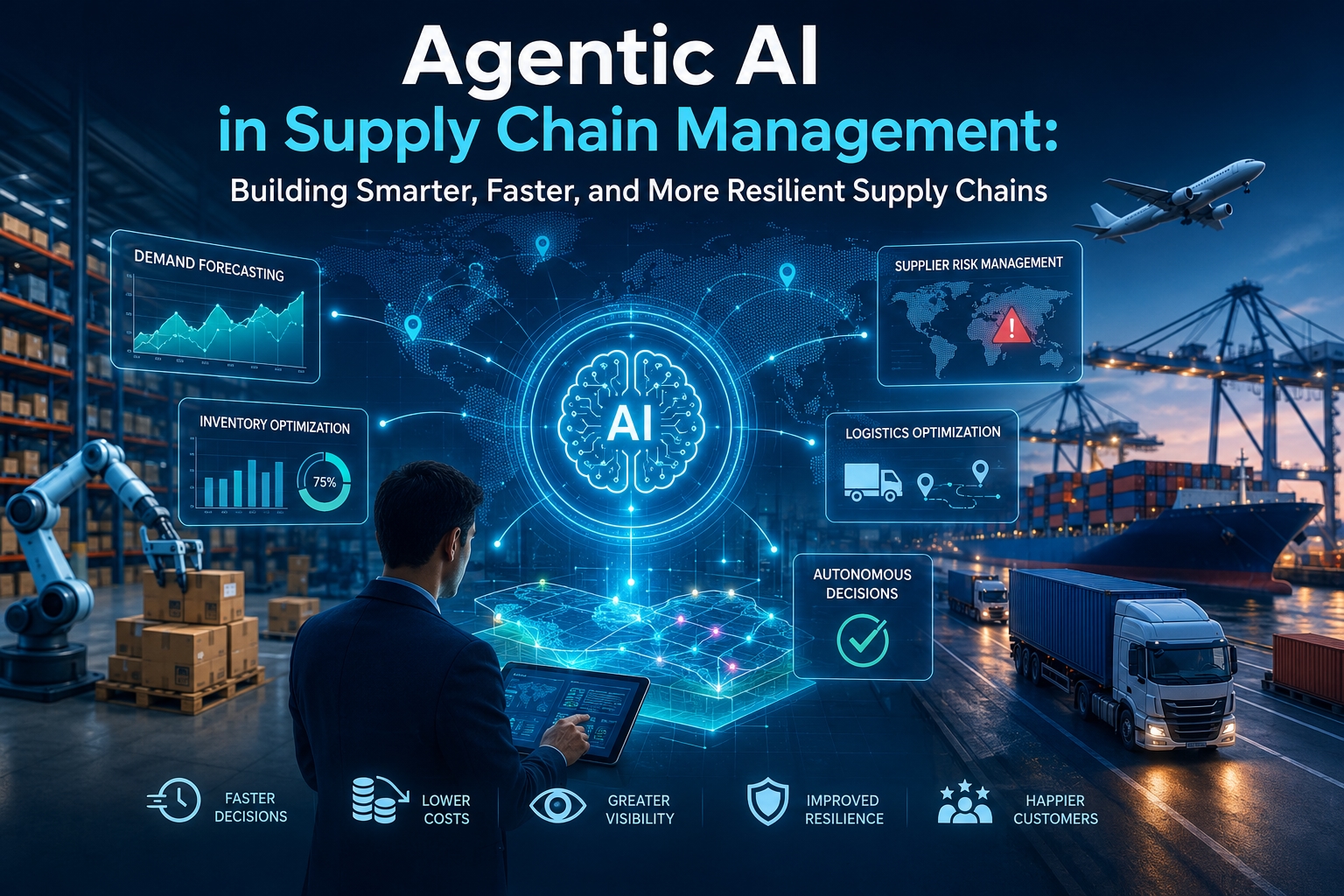
What Is Agentic AI in Supply Chain Management?
Agentic AI refers to autonomous AI systems that can understand business goals, evaluate changing conditions, plan actions, and complete tasks with minimal human intervention.
In supply chain management, AI agents work across systems such as ERP, Warehouse Management Systems (WMS), Transportation Management Systems (TMS), CRM platforms, and procurement applications.
Unlike traditional AI, which predicts outcomes or generates reports, agentic AI takes action. For example, if a supplier shipment is delayed, an AI agent can:
Identify the disruption
Assess inventory levels
Find alternative suppliers
Update production schedules
Optimise transportation routes
Notify internal teams and customers
This ability to reason and execute makes agentic AI a significant advancement over conventional automation.
Why Traditional Supply Chains Need Agentic AI
Many organisations still rely on disconnected systems and manual workflows.
Typical challenges include:
Inaccurate demand forecasting
Inventory shortages
Excess stock
Supplier delays
Rising logistics costs
Limited visibility
Slow decision-making
Human teams often spend hours reviewing reports before taking action. By the time decisions are made, conditions have already changed.
Agentic AI continuously monitors operational data and responds in real time, reducing delays and improving business agility.
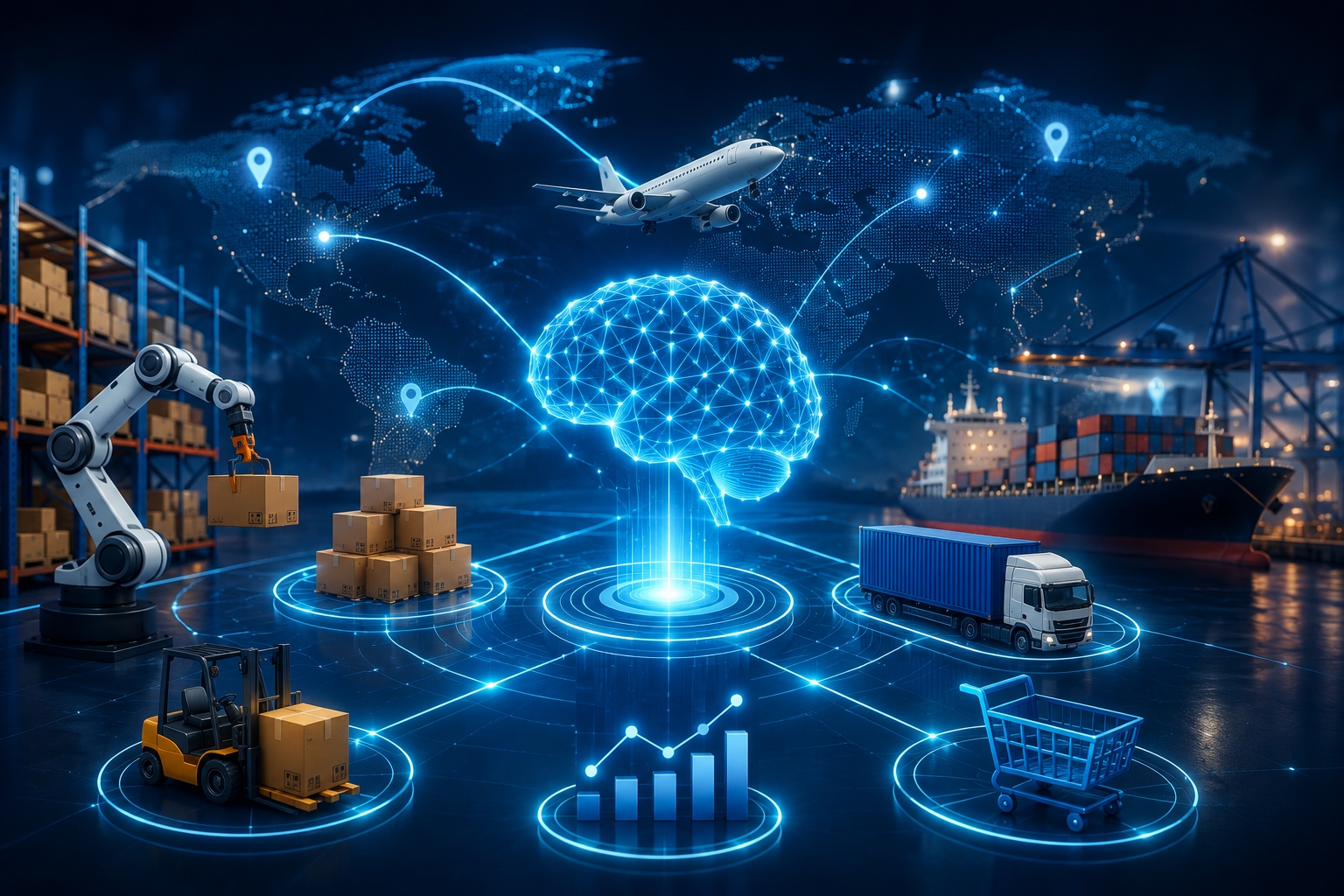
Key Applications of Agentic AI in Supply Chain Management
1. Intelligent Demand Forecasting
AI agents analyse historical sales, seasonal trends, weather conditions, promotions, market signals, and customer behaviour.
Instead of generating static forecasts, they continuously refine predictions and recommend inventory adjustments.
Benefits include:
Better forecast accuracy
Lower inventory costs
Reduced stockouts
Improved customer satisfaction
2. Inventory Optimisation
Maintaining the right inventory balance remains one of the biggest supply chain challenges.
Agentic AI continuously evaluates inventory across warehouses and distribution centres.
When demand changes unexpectedly, AI agents automatically recommend or execute replenishment decisions while preventing excess inventory.
3. Procurement Automation
Procurement teams manage thousands of purchase orders, supplier contracts, and pricing negotiations.
AI agents automate routine procurement activities by:
Comparing supplier performance
Evaluating pricing
Monitoring contract compliance
Generating purchase orders
Identifying alternative suppliers during disruptions
This reduces manual work and improves procurement efficiency.
4. Logistics and Route Optimisation
Transportation delays directly affect customer experience.
Agentic AI analyses traffic, weather, fuel costs, warehouse capacity, and carrier availability.
It dynamically adjusts delivery routes while minimising transportation costs.
5. Supplier Risk Management
Supplier disruptions create expensive production delays.
AI agents monitor supplier performance using operational data, delivery history, financial signals, and external events.
When risks appear, they recommend alternative suppliers before disruptions affect production.
6. Warehouse Automation
Warehouse operations involve receiving, picking, packing, inventory tracking, and shipping.
Agentic AI coordinates these activities by assigning tasks, balancing workloads, predicting bottlenecks, and improving warehouse efficiency.
Business Benefits of Agentic AI
Organisations adopting agentic AI achieve measurable operational improvements.
Faster Decision-Making
Instead of waiting for manual approval on routine activities, AI agents make decisions within predefined governance policies.
Lower Operational Costs
Automation reduces repetitive manual work, improves resource allocation, and eliminates unnecessary operational expenses.
Improved Supply Chain Visibility
AI agents monitor multiple enterprise systems simultaneously, providing a unified operational view.
Better Customer Experience
Accurate inventory planning and faster logistics improve on-time delivery performance.
Increased Supply Chain Resilience
Agentic AI responds immediately to disruptions instead of waiting for manual intervention.
Continuous Learning
Unlike traditional automation, AI agents improve through operational feedback, making future decisions more accurate.
Industry Use Cases
Manufacturing
Manufacturers use agentic AI to optimise production planning, inventory replenishment, maintenance scheduling, and supplier coordination.
Retail
Retailers improve inventory availability, demand forecasting, pricing strategies, and omnichannel fulfilment.
Healthcare
Healthcare organisations automate medical inventory management, pharmaceutical logistics, and supplier monitoring.
Automotive
Automotive companies coordinate thousands of suppliers while reducing production delays.
Logistics
Logistics providers optimise fleet management, route planning, shipment tracking, and warehouse operations.
E-commerce
Online retailers use AI agents to improve order fulfilment, customer communication, and delivery performance.
Challenges to Consider
Although agentic AI delivers significant value, successful implementation requires careful planning.
Common challenges include:
Poor data quality
Legacy enterprise systems
Security and compliance requirements
Change management
Governance policies
Human oversight
Most successful organisations adopt a human-in-the-loop approach, allowing AI agents to automate routine decisions while escalating high-impact decisions to supply chain professionals.
Best Practices for Successful Implementation
Enterprises should follow a structured adoption strategy.
Start with one high-value business process, such as inventory optimisation or logistics planning.
Establish clear governance policies defining which decisions AI agents can make autonomously.
Integrate AI agents with ERP, CRM, WMS, TMS, and procurement platforms.
Monitor AI performance using business KPIs such as inventory turnover, fulfilment accuracy, transportation costs, and customer satisfaction.
Expand deployment gradually across additional supply chain functions after demonstrating measurable business value.
The Future of Agentic AI in Supply Chain Management
Supply chains are becoming increasingly digital, connected, and autonomous.
Future AI agents will coordinate multiple business functions simultaneously, including procurement, manufacturing, logistics, customer service, finance, and sustainability reporting.
Rather than replacing supply chain professionals, these intelligent systems will augment human expertise by handling repetitive operational decisions while people focus on strategic planning and innovation.
Industry forecasts indicate that intelligent AI agents will become a standard capability across enterprise supply chain software over the next several years.
Why Enterprises Need Agentic AI Development Services
Every organisation has unique supply chain workflows, business rules, and technology ecosystems.
Off-the-shelf AI solutions rarely meet complex enterprise requirements.
Custom Agentic AI development services help organisations:
Build autonomous AI agents tailored to business goals
Integrate AI with ERP, CRM, WMS, and TMS platforms
Develop secure and scalable enterprise AI architectures
Improve operational efficiency
Reduce supply chain risks
Deliver measurable return on investment
Working with an experienced AI development partner ensures that agentic AI aligns with business objectives while maintaining security, compliance, and governance.
Conclusion
Agentic AI is transforming supply chain management from reactive decision-making to intelligent autonomous operations.
By combining real-time data, advanced reasoning, and workflow automation, AI agents help enterprises optimise inventory, improve logistics, reduce costs, strengthen supplier relationships, and respond rapidly to disruptions.
As global supply chains continue to grow in complexity, organisations investing in agentic AI today will be better positioned to build resilient, scalable, and future-ready operations.
For a deeper technical understanding of enterprise implementation strategies, explore Azilen's guide on Agentic AI in Supply Chain Management.