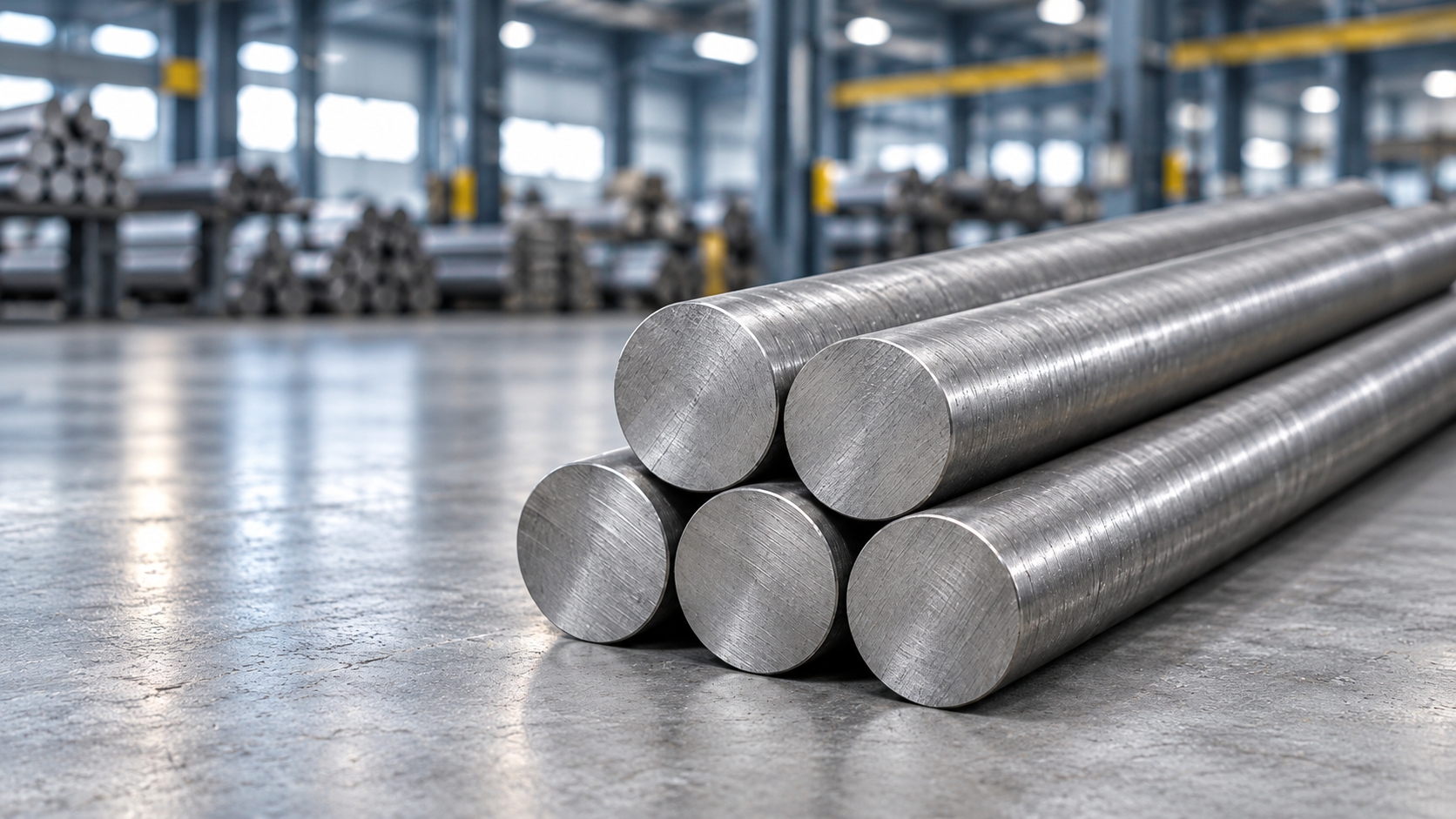
A 90 mm bar goes onto the lathe, and three passes in the insert chatters on a hard spot. Or the finished shaft measures oval by half a millimetre and nobody can say why. Here's the usual cause: the order said grade and diameter, and nothing else.
That's how most buyers purchase alloy steel round bars. Grade, diameter, length, price. Which means the delivery condition, the tolerance class and the surface finish are left to whatever the supplier had on the floor.
That gap is where your rework budget disappears.
Alloy Steel Round Bars: Grades, Finishes and the Tolerance Trap
Alloy steel round bars are carbon steel with added chromium, nickel, molybdenum or manganese, rolled or drawn to a round section for shafts, gears, spindles, fasteners and tooling. Three grades account for most of the enquiries we handle.
EN19 (AISI 4140)
Around 0.38–0.43% carbon, 0.80–1.10% chromium and 0.15–0.25% molybdenum. General-purpose shafts, studs and hydraulic parts. Often called equivalent to 4140; treat that as close, not identical.
EN24 (AISI 4340)
Nickel at 1.65–2.00% gives deep hardening and toughness in large diameters. Think heavy shafts and high-stress gear blanks. Costs more, and that price gap is why substitution happens.
20MnCr5
A case-hardening grade with about 0.17–0.22% carbon, 1.10–1.40% manganese and 1.00–1.30% chromium under EN 10084. The surface goes hard after carburising while the core stays tough, so it suits gears and pinions.
The detail most buyers skip is the finish. Black (hot-rolled) bar, peeled or turned bar, and bright drawn or ground bar are three different products. Hot-rolled round bar dimensions and tolerances follow standards such as EN 10060, which allow a wider diameter spread and some ovality than most machinists assume. Peeled bar removes the decarburised skin. Bright bar arrives close to size but costs more per kilo. Pick by what your machining step needs, not by the cheapest row on the quote. And here's the harder part: no finish removes a hard spot or a segregated core, so internal soundness still needs a certificate and, for large diameters, an ultrasonic check.
Five Questions to Ask Before Placing an Order for Round Bars
Get every answer in writing.
Which standard governs diameter tolerance, ovality and straightness? A good answer: a named standard and a tolerance class you can check with a micrometer. A bad answer: "standard market tolerance." There is no such document.
What is the delivery condition, in writing? A good answer: annealed, normalised or quenched and tempered, with a hardness range. A bad answer: "ready to machine." Ready for which machine, at what hardness?
Is the heat number stamped or tagged on the bar ends and matched to the certificate? A good answer: yes, with an EN 10204 3.1 certificate, or a 3.2 when you want an independent inspector. A bad answer: a certificate that covers "the lot" with no bar-level marking.
What internal checks are available for larger sizes? A good answer: ultrasonic testing offered, cost and acceptance level stated. A bad answer: "our material has never failed." Everyone's material has never failed until it does.
What do you pack, document and cut, and to what tolerance? A good answer: packing method, cut-length tolerance with saw-kerf allowance, and export paperwork such as packing list and certificate of origin when needed. A bad answer: vague promises on cut length. Pieces that arrive 2 mm short can't be uncut.
Where the Right Round Bar Saves You Machining Time and Scrap
Matching the bar to the job protects margin in ways the quote never shows.
Less stock to machine away. Peeled or bright bars close to finished size cut turning passes, tool wear and chip weight you paid for by the kilo.
Fewer surprises mid-machining. Consistent chemistry and a stated hardness range mean your cutting parameters hold from one bar to the next.
Fewer rejected parts. Heat-traceable bars let you trace a failure to a cause, which settles disputes in days. Quenched-and-tempered 4140 can exceed 900 MPa tensile, but only if the bar really is 4140.
Less cash locked in inventory. Cut-to-length supply and flexible quantities mean you buy what the job needs, not a full bundle.
Fewer purchase orders. One partner across several grades cuts vendor follow-ups.
Delivery you can plan a shift around.
Alloy Steel Round Bars Supplier in India: Stockists, Mills and Exporters
India is the world's second-largest crude steel producer, according to worldsteel. Much of that capacity sits in Odisha, Jharkhand and Chhattisgarh, while demand clusters in Maharashtra, Tamil Nadu, Gujarat and Haryana, which means a bar can travel well over a thousand kilometres before it reaches your shop. That freight leg is why the choice of alloy steel round bars stockists in India matters: a stockist near your plant can ship in days, while a mill order takes weeks. If you're buying for shipment abroad, alloy steel round bar exporters in India usually ship through Nhava Sheva, Mundra or Chennai, so port proximity and export paperwork drive lead time as much as the steel does. A good alloy steel round bars supplier in India will tell you which of the three routes your order will take. See the alloy steel round bars we supply and tell us your location.
What We've Learned Dispatching Round Bars to Machine Shops
We're a B2B steel sourcing and trading partner, and we built Steel Exchange around one idea: one partner for several grades, flexible quantities and sourcing we state plainly, with documentation and delivery arranged around your requirement. Here's something no brochure mentions. We photograph the stamped end-face of every bundle before it leaves, so when a heat number is questioned a month later, we can answer in minutes. It's an unglamorous habit. It has ended more disputes than any clause in a contract.
Order the Bar, Not Just the Grade
Alloy steel round bars reward buyers who specify finish, tolerance and certificate as carefully as the grade. The supplier who answers those questions plainly is usually the one who'll answer the harder ones later. As customers audit raw-material sourcing more closely, those written specifications will matter more.
FAQs
What are alloy steel round bars used for?
Shafts, gears, spindles, studs, fasteners, hydraulic components, dies and tooling. The grade and finish decide which job a bar suits, so always state the application when you enquire.
How do I choose between black, peeled and bright round bars?
Black is cheapest and needs the most machining. Peeled removes the surface skin. Bright is closest to final size and costs the most per kilo. Choose by how much stock your process removes.
What should an alloy steel round bars supplier send with each order?
A mill test certificate with heat number, a packing list that repeats it, and the standard of supply. Add a 3.2 certificate for safety-critical parts.
Can I buy small quantities from alloy steel round bars stockists in India?
Yes, from stockists who cut to length, though the per-kilo rate runs higher than mill-direct lots. The honest catch: less common grades and large diameters may not be on the shelf, and we'd rather say so than promise a date.
Do alloy steel round bar exporters in India handle documentation?
Good ones do. Expect a packing list, commercial invoice, certificate of origin and test certificates. Port and shipping line timelines sit outside any exporter's control, so build slack into your schedule.