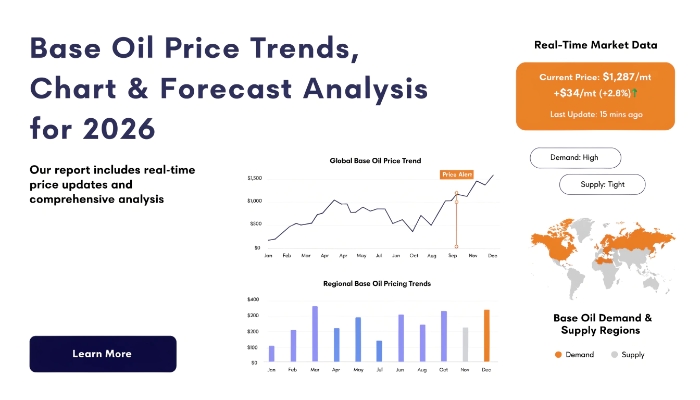
The global Base Oil Price Trend in 2026 is showing a firm and selectively bullish movement driven by steady lubricant demand, tight Group II/III supply in key regions, and fluctuating crude oil feedstock costs. As of Q1 2026, base oil prices range between USD 1,020–1,480/MT, depending on grade, region, and refining economics.
Market conditions remain highly sensitive to refinery operating rates, crude oil volatility, and downstream demand from automotive, industrial lubricants, and manufacturing sectors. While Asia maintains relatively competitive pricing, Europe continues to experience higher costs, and North America shows stable-to-firm movement supported by balanced supply-demand conditions.
The Base Oil Price Forecast indicates moderate upward pressure through 2026, especially for high-quality Group II and Group III base oils.
Base Oil Market Overview and Price Insights
Base oil is a key raw material used in the production of lubricants, greases, and metalworking fluids. It is derived from crude oil refining or hydrocracking processes and categorized into Group I, II, III, IV, and V based on purity and performance.
Key demand drivers include:
Automotive engine oils
Industrial lubricants
Hydraulic and gear oils
Marine and aviation lubricants
The market is strongly influenced by:
Crude oil price fluctuations
Refinery margins and operating rates
Seasonal lubricant demand cycles
Industrial production activity
Price Trend Analysis of Base Oil (2024–2026)
The Base Oil price history over the past two years reflects moderate but consistent volatility, largely driven by crude oil fluctuations, refinery operating rates, and shifting demand from the lubricant industry. Prices previously surged during periods of tight supply and high energy costs, followed by partial stabilization in 2025 as global supply chains improved and refinery output normalized.
In 2026, the Base Oil Price Graph shows a structurally firm market with clear regional divergence based on refining economics and import dependency.
Key 2026 market indicators include:
Strong cost advantage in China due to efficient refining and lower feedstock costs
Elevated pricing in the USA driven by higher production and logistics costs
Balanced but firm pricing in the Middle East supported by export-oriented supply chains
Moderate-to-high pricing in Europe due to energy cost pressures and limited refinery margins
Global Base Oil Price Comparison by Country (Q1 2026)
Country | Price (USD/MT) | Market Trend |
China | 911 | Competitive / Stable |
USA | 1,842 | High Cost / Firm |
Germany | 1,239 | Firm |
Saudi Arabia | 1,370 | Export Competitive |
UAE | 1,406 | Firm |
This Base Oil price chart clearly highlights a significant global pricing gap, where China remains the lowest-cost producer due to efficient refining systems, while the USA records the highest prices driven by higher production, energy, and logistics costs. The Middle East maintains a competitive export position, balancing cost efficiency with strong global demand.
Region-wise Analysis
North America
In North America, particularly the USA, base oil prices remain the highest globally at USD 1,842/MT, reflecting elevated production costs and strong downstream demand from automotive and industrial lubricant sectors. The Base Oil Price Trend in this region remains firm, supported by stable refinery utilization, though higher operational and logistics expenses continue to sustain premium pricing levels.
Asia-Pacific (APAC)
China leads global cost competitiveness with prices at USD 911/MT, making it the most cost-efficient base oil market. The base oil price index in APAC remains stable due to strong refining efficiency and balanced domestic demand. China’s large-scale production capacity continues to exert downward pressure on global benchmarks, while regional consumption from industrial and automotive sectors remains steady.
Europe
Germany reflects relatively elevated pricing at USD 1,239/MT, influenced by high energy costs and tighter refinery margins. The Base Oil Price Forecast for Europe remains firm, as import dependency increases for high-quality base oils. Despite moderate demand recovery, structural cost pressures continue to support higher pricing levels compared to Asia.
Middle East (Saudi Arabia & UAE)
The Middle East shows competitive yet firm pricing, with Saudi Arabia at USD 1,370/MT and UAE at USD 1,406/MT. The region continues to benefit from integrated refining systems and strong export orientation. The Base Oil Price Trend here remains stable-to-firm, supported by consistent global demand and strategic supply positioning in international markets.
Base Oil Price Index Insights
The global base oil price index in 2026 reflects a structurally firm market with moderate growth potential.
Key index trends:
2024: Volatile pricing due to crude oil fluctuations
2025: Stabilization phase with supply normalization
2026: Gradual upward trend driven by premium grade demand
The index is primarily influenced by:
Crude oil and vacuum gas oil pricing
Refinery output efficiency
Lubricant consumption trends
Industrial and automotive demand cycles
Supply and Demand Dynamics in the Global Fiber Market - Overview
Although base oil is not a fiber material, it plays a crucial indirect role in industrial fiber manufacturing through lubricants used in textile machinery and synthetic fiber production processes.
Supply-side factors:
Refinery capacity constraints in Europe
Stable output in Asia and Middle East
Export-driven supply from Gulf countries
Demand-side factors:
Rising automotive lubricant consumption
Growth in synthetic fiber production machinery usage
Expanding industrial manufacturing activities
This balance supports a steady and firm Base Oil Price Trend globally.
Key Factors Influencing Base Oil Prices
Crude oil price volatility
Refinery operating rates and maintenance shutdowns
Supply-demand balance of Group II/III base oils
Seasonal lubricant demand cycles
Transportation and logistics costs
Environmental regulations on refining
Global automotive production trends
Recent Developments in the Base Oil Industry
Expansion of Group III base oil capacity in Asia and the Middle East
Increased investments in high-performance synthetic lubricants
Refinery integration with petrochemical complexes
Growing demand for low-viscosity engine oils
Strategic supply agreements between global lubricant manufacturers and refiners
These developments are reshaping the long-term Base Oil Price Trend toward higher-value and performance-driven products.
Base Oil Price Forecast (2026 Outlook)
The Base Oil Price Forecast for 2026–2027 suggests a cautiously bullish outlook with periodic corrections.
Expected trend:
Q2–Q3 2026: Firm pricing due to seasonal lubricant demand
Q4 2026: Stabilization as refinery output balances demand
Long-term: Gradual upward movement driven by premium grade consumption
Forecast range:
Global average: USD 1,050–1,550/MT
Premium Group III base oils are expected to see stronger price support due to rising demand in high-performance lubricants.
Request a sample for real-time Base Oil price insights and forecast data: https://www.imarcgroup.com/base-oil-pricing-report/requestsample
Applications and End-Use Industries of Base Oil
Automotive engine oils
Industrial lubricants
Hydraulic fluids
Metalworking fluids
Marine lubricants
Greases and specialty oils
Textile machinery lubrication systems
FAQs About Base Oil Prices, Trends, History & Forecast:
What is the current Base Oil Price Trend in 2026?
The Base Oil Price Trend in 2026 remains firm, with prices ranging between USD 1,020–1,480/MT. The trend is supported by stable refinery operations and steady demand from automotive and industrial lubricant sectors.
What is the Base Oil Price Forecast for 2026?
The Base Oil Price Forecast indicates moderate upward movement driven by rising demand for premium lubricants and limited supply of Group II and Group III base oils in certain regions.
Why do base oil prices fluctuate?
Base oil prices fluctuate mainly due to crude oil volatility, refinery operating rates, seasonal lubricant demand, and changes in industrial and automotive production activity.
Which region has the lowest base oil prices?
The Middle East and parts of Asia typically offer the lowest base oil prices due to integrated refining systems and lower production costs compared to Europe.
What are the main uses of base oil?
Base oil is primarily used to manufacture engine oils, industrial lubricants, hydraulic fluids, and specialty greases used across automotive, manufacturing, and marine industries.
Contact Us:
IMARC Group
134 N 4th St. Brooklyn, NY 11249, USA
Email: sales[@]imarcgroup.com
Tel No:(D) +91 120 433 0800
United States: +1-201971-6302