Lighting agarbatti is one of the most familiar rituals in Indian homes. Whether used during morning prayer, evening aarti, meditation or festive worship, incense helps create a calm, fragrant and devotional atmosphere around the puja space.
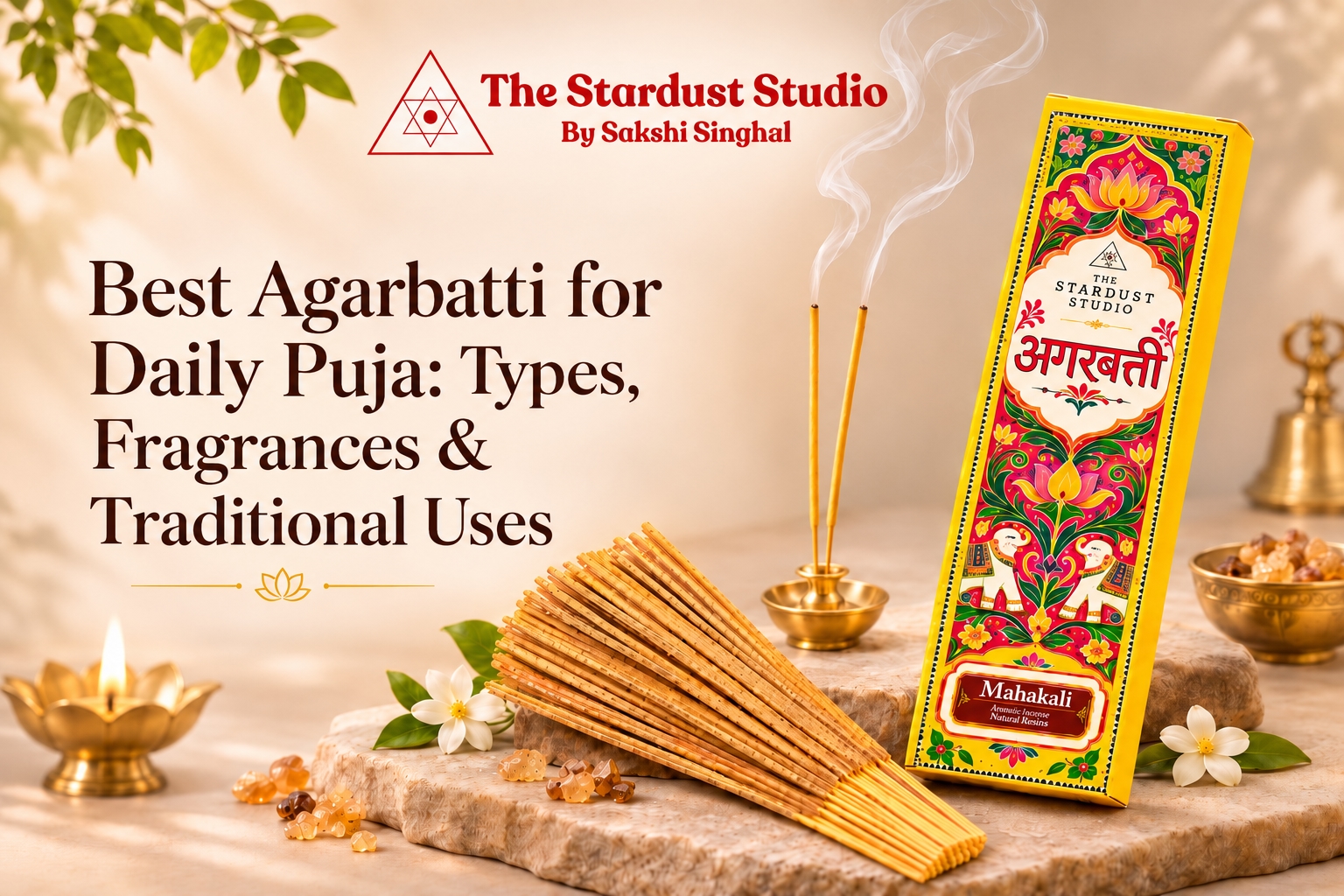
Choosing the best agarbatti for daily worship is not only about fragrance. Different aromas may suit different moods, deities and traditional intentions. Some people prefer floral fragrances for everyday prayer, while others choose Guggal, Chandan, Kesar or Ashtagandha for specific spiritual practices.
The Stardust Studio’s current Masala Agarbatti collection includes devotional variants inspired by Maa Kali, Mahalakshmi, Hanuman, Shiva, Radha Krishna, Ganesha, Tirupati Balaji and the 7 Chakra system. The range is designed for pooja, prayer, meditation and spiritual rituals.
If you are looking for puja agarbatti, pooja agarbatti, or the best fragrance agarbatti for pooja, this guide explains the main fragrances, traditional uses and how to choose the right incense sticks for your daily routine.
What Is Agarbatti?
Agarbatti is the common Indian term for incense sticks used during religious, spiritual and aromatic practices.
When lit, the tip of the incense stick burns slowly and releases fragrance into the surrounding space.
Agarbatti is commonly used during:
Daily puja
Aarti
Meditation
Mantra chanting
Festival rituals
Yoga
Home-temple worship
Spiritual cleansing practices
The Stardust Studio describes its agarbatti as traditional incense suitable for pooja, prayer, meditation and spiritual practices.
Why Is Agarbatti Used in Daily Puja?
Fragrance has long been part of Indian devotional traditions.
During puja, incense can help create a distinctive spiritual atmosphere and mark the transition from ordinary daily activity into prayer or meditation.
Many households use pooja agarbatti because it can:
Add a pleasant fragrance to the puja space
Support a calm prayer environment
Complement diya and mantra rituals
Create a consistent daily worship routine
Enhance festive and devotional settings
The significance of individual fragrances and deity associations comes from traditional spiritual beliefs rather than scientifically established effects.
Agarbatti vs Incense Sticks: Is There a Difference?
The terms are often used interchangeably.
Incense sticks agarbatti generally refers to the same basic product: a fragrant stick designed to smoulder slowly after lighting.
However, incense products can vary in:
Ingredients
Fragrance
Thickness
Manufacturing style
Burn time
Intensity
Indian masala agarbatti often uses aromatic ingredients and fragrance blends to create a richer devotional aroma.
What Is Masala Agarbatti?
Masala agarbatti generally refers to incense prepared using a blend of aromatic ingredients rather than relying only on a dipped fragrance format.
The Stardust Studio currently lists its main incense product as Masala Agarbatti (40 Incense Sticks) and positions it for sacred aroma, daily pooja and spiritual rituals.
Each variant has its own fragrance and devotional theme.
Types of Agarbatti for Daily Puja
The Stardust Studio’s current agarbatti range includes eight devotional themes and fragrances.
1. Maa Kali Guggal Agarbatti
Maa Kali Agarbatti is associated with traditional intentions around protection, negativity removal and nazar-cleansing practices.
Fragrance: Guggal
Guggal has a deep, resinous and traditional aroma that can work especially well during:
Maa Kali Puja
Evening prayer
Protection-focused rituals
Meditation
Traditional cleansing practices
The current product page specifically positions Maakali Guggal Agarbatti for pooja, prayer, meditation and traditional cleansing rituals.
2. Mahalakshmi Flora Agarbatti
Mahalakshmi Agarbatti is inspired by Goddess Mahalakshmi and traditionally associated with prosperity and abundance.
Fragrance: Flora
Its floral devotional profile can make it suitable for:
Lakshmi Puja
Friday worship
Diwali
Morning prayer
Prosperity-focused rituals
The current collection describes this variant as Mahalakshmi – Dhan with Flora fragrance.
3. Hanuman Rajnigandha Agarbatti
Hanuman Agarbatti is inspired by Lord Hanuman and connected with traditional themes of protection, strength and courage.
Fragrance: Rajnigandha
Rajnigandha provides a floral fragrance that can be used for:
Hanuman Puja
Tuesday or Saturday worship
Daily prayer
Protection-oriented spiritual practices
The Stardust Studio’s agarbatti range identifies Hanuman as a Raksha-focused variant and includes Rajnigandha among its available fragrances.
4. Shiva Chandan Agarbatti
Shiva Agarbatti uses Chandan-inspired fragrance and is associated with meditation and spiritual awareness.
Fragrance: Chandan
Sandalwood-inspired fragrance is especially popular for:
Shiva Puja
Meditation
Mantra chanting
Quiet evening prayer
Intention-setting practices
Chandan is included among the current fragrances available in The Stardust Studio agarbatti range.
5. Radha Krishna Gulab Chandan Agarbatti
Radha Krishna Agarbatti is inspired by the symbolism of Radha and Krishna.
Fragrance: Gulab Chandan
The current product range associates it with:
Love
Beauty
Harmony
Devotion
Its rose-and-sandalwood profile makes it a good choice for people who prefer a softer floral puja agarbatti.
6. Ganesha Kesar Agarbatti
Ganesha Kesar Agarbatti is inspired by Lord Ganesha and connected with auspicious beginnings and good-luck symbolism.
Fragrance: Kesar / Saffron
It can be used for:
Ganesha Puja
New beginnings
Festivals
Daily worship
Important occasions
The Stardust Studio describes this fragrance as warm, rich and pleasant and lists it for pooja, prayer, meditation and spiritual rituals.
7. Tirupati Balaji Jasmine Mogra Agarbatti
Tirupati Balaji Agarbatti is associated with success, achievement and positive progress.
Fragrance: Jasmine Mogra
This floral fragrance can work well for:
Daily puja
Balaji worship
Morning prayer
Career-oriented intention rituals
Festive worship
The current collection lists Tirupati Balaji as the Success variant and identifies Jasmine Mogra as its fragrance.
8. 7 Chakra Ashtagandha Agarbatti
7 Chakra Ashtagandha Agarbatti is designed primarily for meditation and chakra-focused spiritual practices.
Fragrance: Ashtagandha
The Stardust Studio describes it as suitable for:
Meditation
Yoga
Chakra meditation
Mindfulness
Prayer
Pooja
Spiritual rituals
Each pack contains 40 sticks.
Which Is the Best Agarbatti for Daily Puja?
The best agarbatti depends on the fragrance you enjoy and the type of worship you perform.
For general daily worship, you may prefer:
Ganesha Kesar
Radha Krishna Gulab Chandan
Tirupati Balaji Jasmine Mogra
Hanuman Rajnigandha
For deeper or more meditative fragrances, consider:
Shiva Chandan
7 Chakra Ashtagandha
Maa Kali Guggal
For prosperity-focused worship, Mahalakshmi Flora may be appropriate.
There is no requirement to use a specific fragrance unless your family or spiritual tradition prescribes one.
Best Fragrance Agarbatti for Pooja
The best fragrance agarbatti for pooja depends largely on personal preference.
For Floral Fragrance
Choose:
Rajnigandha
Jasmine Mogra
Gulab Chandan
Flora
For Warm Traditional Fragrance
Choose:
Kesar
Chandan
Ashtagandha
For Deep Cleansing Aroma
Choose:
Guggal
This makes it easier to choose your pooja agarbatti according to both fragrance and devotional purpose.
Puja Agarbatti for Morning Worship
For morning prayer, many people prefer lighter or uplifting fragrances.
Suitable options may include:
Jasmine Mogra
Rajnigandha
Flora
Kesar
These fragrances can help create a fresh devotional atmosphere without making the puja area feel too heavy.
Pooja Agarbatti for Evening Prayer
For evening puja, deeper fragrances may be more suitable.
You may consider:
Chandan
Guggal
Ashtagandha
Gulab Chandan
These aromas work well for a slower prayer or meditation routine.
Incense Sticks Agarbatti for Meditation
For meditation, fragrance should ideally support concentration rather than becoming distracting.
Popular options include:
Chandan
Ashtagandha
Guggal
The 7 Chakra Ashtagandha variant is specifically described for meditation, yoga, mindfulness and chakra practices.
How to Use Agarbatti Correctly
Using incense sticks agarbatti puja is simple.
Place one agarbatti in a suitable incense holder.
Light the tip carefully.
Allow the flame to burn briefly.
Gently extinguish the flame.
Let the incense continue to smoulder.
Keep it in the puja or meditation area while the fragrance spreads.
The Stardust Studio recommends using the incense in a stable holder and maintaining adequate ventilation.
How Many Agarbatti Sticks Should You Light?
There is no universal rule for daily puja.
For a simple home prayer, one stick is usually enough to fragrance the immediate puja space.
Specific rituals may follow family, temple or spiritual traditions that recommend a particular number.
Can Agarbatti Be Used Every Day?
Yes, many households use puja agarbatti daily.
However, incense produces smoke, so proper ventilation is important.
Use it:
In an open or ventilated room
Away from children and pets
Away from curtains
In a proper incense holder
Never leave burning incense unattended.
How to Choose Good Quality Agarbatti
When buying incense, look beyond the fragrance name.
Check the Fragrance
Choose an aroma you genuinely enjoy.
Check the Number of Sticks
The Stardust Studio’s current agarbatti packs contain 40 sticks.
Check the Intended Use
Some incense is designed mainly for room fragrance, while others are positioned specifically for:
Puja
Meditation
Prayer
Spiritual rituals
Check the Packaging
Agarbatti should be protected from moisture and excessive heat.
Check Seller Information
Choose sellers that clearly state:
Fragrance
Number of sticks
Usage
Storage instructions
Safety instructions
How to Store Agarbatti
Keep unused incense sticks:
In a cool, dry place
Away from moisture
Away from direct heat
Inside their packaging or a sealed container
Moisture can affect both fragrance and burning quality.
The Stardust Studio recommends cool, dry storage away from moisture and direct heat.
Agarbatti for Festivals
Agarbatti can also be used during:
Diwali
Navratri
Ganesh Chaturthi
Janmashtami
Hanuman Jayanti
Mahashivratri
Lakshmi Puja
Daily festive worship
You can choose the fragrance according to the deity being worshipped or simply select the aroma your household prefers.
Agarbatti for Home Temple
For a small home temple, one fragrant stick is usually enough.
Keep the incense holder a safe distance from:
Idols
Fabric
Flowers
Wooden temple panels
Other flammable items
Using too many sticks at once can also create unnecessary smoke indoors.
Why Fragrance Matters in Daily Puja
A consistent fragrance can become associated with your prayer routine.
Over time, lighting the same pooja agarbatti may create a familiar sensory cue for:
Prayer
Reflection
Meditation
Mantra chanting
That can make the ritual feel more intentional and consistent.
Why Choose The Stardust Studio Agarbatti?
The Stardust Studio’s Masala Agarbatti range is designed around both fragrance and devotional intention.
Eight Devotional Themes
The current range includes:
Maa Kali
Mahalakshmi
Hanuman
Shiva
Radha Krishna
Ganesha
Tirupati Balaji
7 Chakra
Eight Distinct Fragrances
The current fragrance selection includes:
Guggal
Flora
Rajnigandha
Chandan
Gulab Chandan
Kesar
Jasmine Mogra
Ashtagandha
40 Incense Sticks
The current Masala Agarbatti product is sold in packs of 40 incense sticks.
Suitable for Daily and Festive Worship
The products are positioned for:
Daily pooja
Prayer
Meditation
Home temple
Festive worship
Spiritual rituals
Which Stardust Studio Agarbatti Should You Choose?
A simple way to choose is:
Protection: Maa Kali Guggal or Hanuman Rajnigandha
Prosperity: Mahalakshmi Flora
Love & Harmony: Radha Krishna Gulab Chandan
Good Luck & New Beginnings: Ganesha Kesar
Success: Tirupati Balaji Jasmine Mogra
Meditation: Shiva Chandan
Chakra Practice: 7 Chakra Ashtagandha
These associations are based on traditional spiritual themes rather than guaranteed outcomes.
Final Thoughts
Choosing the best agarbatti for daily puja is ultimately a balance of fragrance, devotional preference and comfort.
A floral puja agarbatti such as Rajnigandha, Jasmine Mogra or Gulab Chandan can work beautifully for everyday worship, while deeper aromas such as Guggal, Chandan and Ashtagandha may be better suited to meditation or more traditional spiritual practices.
Whether you call them pooja agarbatti, incense sticks agarbatti, or incense sticks agarbatti puja, the purpose is largely the same: creating a pleasant and intentional atmosphere for prayer.
The Stardust Studio’s current collection offers eight devotional fragrance options, allowing you to choose according to your preferred aroma, deity or spiritual intention.
Frequently Asked Questions
What is the best agarbatti for daily puja?
There is no single best option. Floral fragrances such as Jasmine Mogra, Rajnigandha and Gulab Chandan work well for general daily worship, while Chandan, Guggal and Ashtagandha may suit meditation and deeper spiritual practices.
What is Puja Agarbatti?
Puja agarbatti refers to incense sticks intended for prayer, aarti, meditation and devotional rituals.
Which is the best fragrance agarbatti for pooja?
The best fragrance agarbatti for pooja depends on personal preference. Popular traditional fragrances include Chandan, Kesar, Guggal, Rajnigandha, Jasmine Mogra and Gulab Chandan.
How many sticks are in The Stardust Studio Agarbatti pack?
The current Masala Agarbatti packs contain 40 incense sticks.
Which Agarbatti is best for meditation?
Shiva Chandan and 7 Chakra Ashtagandha are especially suitable choices. The 7 Chakra product is specifically positioned for meditation, yoga and mindfulness.
Which Agarbatti is associated with protection?
Maa Kali Guggal and Hanuman variants are traditionally associated with protection-focused practices.
How should incense sticks Agarbatti be used safely?
Place the stick in a stable heat-resistant holder, use it in a well-ventilated area, keep it away from children, pets and flammable materials, and never leave burning incense unattended.