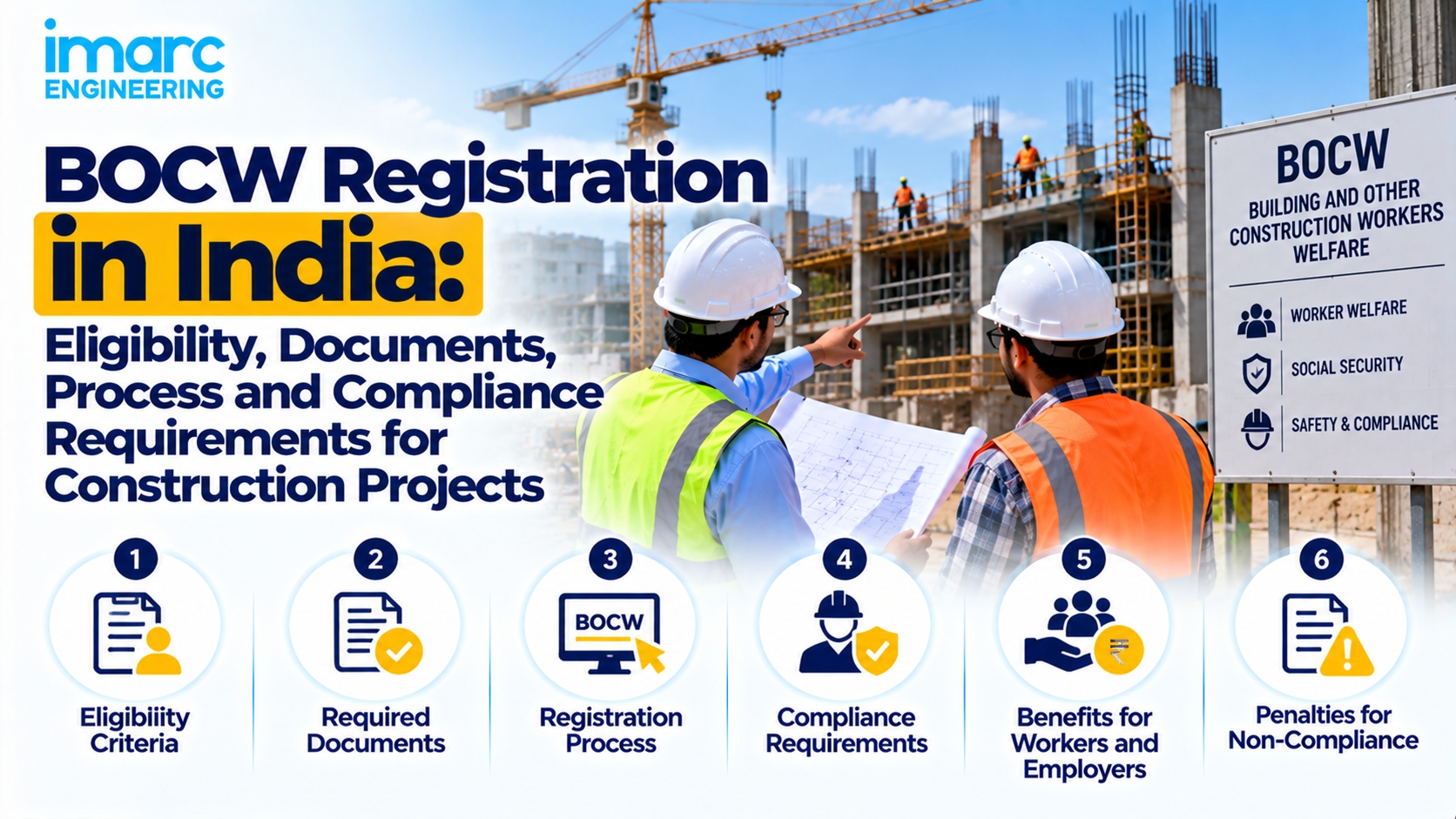
Civil work starts on a plant expansion or greenfield site. Contractors mobilise labour, and the project treats labour compliance as a contractor-only issue. Weeks later, the principal employer is asked for establishment registration, cess payment proof or worker welfare records that were never planned into the project controls.
BOCW registration in India is not a single form. It covers BOCW registration in India, worker beneficiary registration with the State Welfare Board, and related cess obligations under the Building and Other Construction Workers’ Welfare Cess Act, 1996. Missing the distinction is what turns a routine construction project into a compliance recovery exercise.
What BOCW Registration Actually Covers
For construction projects, teams usually face three linked requirements:
Establishment registration — the employer registers the establishment with the Registering Officer when the Act applies
Worker (beneficiary) registration — eligible building workers register with the State BOCW Welfare Board to access welfare schemes
Cess compliance — cess on the cost of construction is payable as provided under the Cess Act and state mechanisms
Confusing worker cards with establishment registration is a common project error.
Who Must Register: Eligibility
Establishment (employer) side
The BOCW Act applies to every establishment which employs, or had employed on any day of the preceding twelve months, ten or more building workers in any building or other construction work. Workers employed in different relays in a day are counted toward that number.
“Building or other construction work” is defined broadly in the Act. It includes construction, alteration, repair, maintenance or demolition of buildings, roads, railways, bridges, dams, canals, power and water installations, and similar works listed in the statute. Work already covered under the Factories Act, 1948, or the Mines Act, 1952, is excluded, but that exclusion is applied carefully in practice—construction activity for a factory project is often still assessed under BOCW until the plant is operating as a factory in the statutory sense.
Under Section 7, every employer of a covered establishment must apply for registration within sixty days from the date the Act becomes applicable to that establishment.
Worker (beneficiary) side
A building worker is eligible for registration as a beneficiary if the worker:
Has completed eighteen years of age but has not completed sixty years of age
Has been engaged in building or other construction work for not less than ninety days during the preceding twelve months
Beneficiary registration is with the Board (through the authorised officer), separate from establishment registration.
Documents Typically Required
Exact checklists are state-prescribed. Employers should use the current list from the State Labour Department, Welfare Board or notified online portal.
For establishment registration, projects commonly need:
Prescribed application form
Identity and address proofs of the employer / authorised signatory
PAN and entity documents (incorporation certificate, partnership deed, etc.)
Project particulars: location, nature of work, estimated cost, duration, expected workforce
Site / work-order or contract documents
Land or occupation documents for the site, where asked
Approved plans or project approvals, where applicable
Prescribed fee challan or online payment proof
For worker beneficiary registration, boards commonly ask for:
Identity and age proof (often Aadhaar)
Photographs
Proof of engagement / days worked (employer or contractor certificate in the board’s format)
Bank account details for benefit transfer
Residence / domicile documents where the state requires them
Incomplete project-cost or workforce particulars are a frequent reason applications stall.
Process: How Establishment Registration Usually Works
Steps vary by state and by whether the appropriate government is the Centre or the State, but the logic is consistent:
Confirm applicability
Headcount threshold, nature of work, and whether the site is treated as building or other construction work.Identify the Registering Officer / portal
State labour department, BOCW board portal, e-district systems, or unified portals used for labour registrations where notified.File within sixty days
Section 7 sets a sixty-day window from applicability. Late applications may be entertained if the officer is satisfied there was sufficient cause—but delay is a compliance risk, not a plan.Submit form, particulars and fee
Application must be in the prescribed form, with prescribed particulars and fees.Obtain certificate of registration
After processing, the registering officer registers the establishment and issues a certificate in the prescribed form, subject to conditions.Intimate changes
Changes in ownership, management or other prescribed particulars must be intimated within the time the Act requires (thirty days of the change, as provided in the statute).Align cess and welfare obligations
Registration does not replace cess assessment or payment mechanisms operated under the Cess Act and state rules. Project cost reporting used for cess should match commercial project controls.
Worker registration typically runs through the State Welfare Board’s process (online appointment, document verification, identity card), and is driven by worker eligibility rather than the employer’s establishment certificate alone. Employers still influence outcomes by maintaining attendance evidence and supporting certificates.
Ongoing Compliance Beyond the Certificate
Registration is the entry point. Covered establishments also face duties under the Act relating to working conditions, safety and welfare on construction sites (including provisions on facilities and safety arrangements framed under the Act and rules). Section 46 commencement notice requirements and inspector interface matter operationally: projects that start work before basic notices and registration planning create avoidable exposure.
Principal employers should not assume that “the contractor will handle BOCW” removes their establishment obligations where they are the employer under the Act.
Practical Scenarios
Scenario A: Plant civil package, no establishment registration
A manufacturing company awards civil works. Workforce crosses ten building workers. Registration is treated as the civil contractor’s private issue. An inspection asks the principal establishment for its BOCW registration trail.
Scenario B: Worker cards without establishment file
Some workers hold beneficiary cards. The project still lacks establishment registration and cess documentation tied to project cost—two different compliance tracks.
Scenario C: Late applicability recognition
Headcount was low at kick-off, then peaked. The sixty-day clock runs from applicability, not from the date someone remembered the Act.
Scenario D: Controlled project start
Applicability assessed before mobilisation, registration filed, cess process mapped to contract value, contractors required to support worker registration evidence. Compliance sits inside project governance.
Decision Point: Are You the Employer of a Covered Establishment?
Ask:
Will this site employ (or has it employed) ten or more building workers on any day in the relevant twelve-month window?
Is the activity building or other construction work as defined?
Who is the “employer” for registration purposes on this contract structure?
Is establishment registration on the critical path before or at early mobilisation—not after the first labour inspection?
If the answer to the headcount and activity tests is yes, registration planning belongs in pre-construction compliance, not in reactive documentation.
Practical Checklist for Construction Projects
Applicability assessed against 10-worker threshold and nature of work
Employer entity for Section 7 registration identified
Sixty-day filing window tracked from applicability
State portal / Registering Officer route confirmed
Project cost, duration and workforce particulars prepared consistently
Entity, site and authorisation documents compiled
Establishment registration certificate obtained and filed in project records
Change intimation process assigned
Cess assessment/payment path mapped under the Cess Act and state practice
Contractor obligations for worker evidence and welfare support written into contracts
Site welfare and safety duties under the Act/rules owned operationally
When to Address BOCW on a Project
Address it:
before major civil mobilisation
at contract award when construction labour will be material
when workforce is expected to cross the statutory threshold
when project cost is final enough for cess planning
during brownfield expansion or utility construction packages on operating plant sites
After work is in full swing, registration becomes recovery under time pressure.
How IMARC Engineering Can Help
IMARC Engineering supports industrial and construction-linked projects where statutory registrations must align with real site mobilisation—not only with contract boilerplate. Regulatory and licensing advisory can help project teams map which approvals and labour-related registrations sit on the critical path before civil and structural work ramps up.
Relevant support can include structured guidance through regulatory approval and licensing for manufacturing and industrial project contexts where construction compliance is part of overall plant readiness.
Talk to IMARC Engineering if your construction or plant project is approaching mobilisation and you need BOCW establishment eligibility, documentation and process steps clarified before registration and cess obligations become inspection findings: https://www.imarcengineering.com/contact?service=regulatory-approval-and-licensing&subservice=bocw-registration
Conclusion
BOCW registration in India rests on clear statutory tests: establishments with ten or more building workers in covered construction work must register within sixty days; eligible workers register separately as beneficiaries; cess obligations run alongside under the Cess Act. Documents and portals are state-specific, but the applicability logic is national.
Projects that treat BOCW as a post-facto contractor formality inherit the risk. Projects that assess eligibility before mobilisation file on time and keep establishment, worker and cess tracks distinct.
The practical takeaway is clear: before you start building, confirm whether the Act applies—and register the establishment as an employer obligation, not as an afterthought to the work order.
Contact Us:
IMARC Engineering
Phone: +91-120-433-0800
Email: sales@imarcengineering.com
India: C-130, Sector 2, Noida, Uttar Pradesh 201301
LinkedIn: https://www.linkedin.com/showcase/imarc-engineering/