
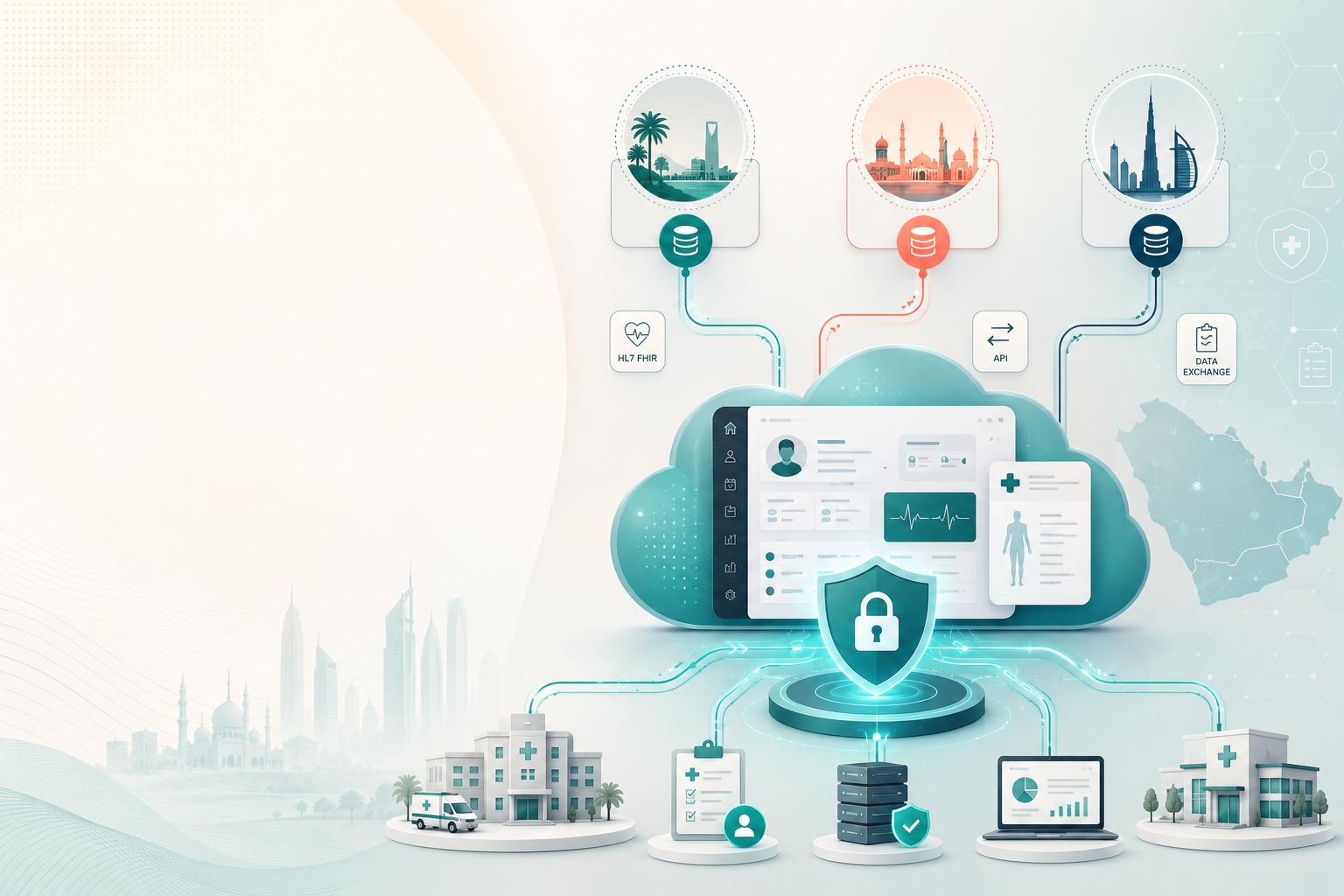
However, developing healthcare software for the GCC market requires more than creating digital patient records or hospital management systems. Healthcare applications must support regional interoperability requirements and seamlessly exchange data with national healthcare platforms such as NPHIES in Saudi Arabia, Malaffi in Abu Dhabi, and NABIDH in Dubai.
For healthcare software developers, integration with these platforms is a critical part of building secure, scalable, and future-ready healthcare solutions. These integrations enable healthcare providers to connect clinical systems, insurance platforms, laboratories, pharmacies, and other healthcare networks while ensuring compliance with regional healthcare standards.
A GCC-compliant healthcare software solution should be designed with interoperability, security, and scalability at its core.
Why Healthcare Interoperability Matters in the GCC
Healthcare organizations traditionally operate multiple systems, including:
Electronic Medical Records (EMR)
Electronic Health Records (EHR)
Hospital Information Systems (HIS)
Laboratory Information Systems (LIS)
Pharmacy Management Systems
Billing and Insurance Platforms
When these systems operate independently, healthcare providers face challenges such as:
Limited access to complete patient information
Duplicate medical records
Manual data exchange processes
Delayed insurance approvals
Increased administrative workload
Higher chances of data errors
Healthcare interoperability solves these challenges by allowing different healthcare systems to securely communicate and exchange information.
For software developers, interoperability means designing healthcare applications that can:
Exchange healthcare data through secure APIs
Support healthcare data standards
Connect with government healthcare platforms
Maintain patient data privacy
Scale across multiple healthcare environments
This is why NPHIES, Malaffi, and NABIDH integrations have become essential considerations when developing healthcare software for GCC healthcare providers.
Understanding NPHIES Integration for Healthcare Software in Saudi Arabia
What is NPHIES?
NPHIES (National Platform for Health Information Exchange Services) is a healthcare platform in Saudi Arabia designed to improve healthcare data exchange between providers, payers, and healthcare organizations.
For healthcare software developers, NPHIES integration enables applications to communicate with healthcare and insurance ecosystems through secure digital connections.
Healthcare organizations can use NPHIES-enabled software to improve workflows related to:
Insurance eligibility verification
Claims management
Prior authorization processes
Healthcare transaction exchange
Patient information sharing
For hospitals and clinics in Saudi Arabia, integrating NPHIES capabilities into healthcare software helps create more efficient and connected healthcare operations.
Key Development Considerations for NPHIES Integration
1. API-Based Healthcare Architecture
A modern healthcare application should follow an API-first architecture to support seamless communication with external healthcare platforms.
Developers need to focus on:
Secure API authentication
Data validation
Request and response handling
Error management
Integration monitoring
A well-designed API layer allows healthcare organizations to connect multiple systems without rebuilding their existing infrastructure.
2. Healthcare Data Mapping and Standardization
One of the biggest challenges in healthcare integration is ensuring different systems understand exchanged information correctly.
Healthcare software developers need to map data elements such as:
Patient demographics
Insurance details
Medical history
Clinical information
Billing information
Proper data mapping ensures accuracy and prevents inconsistencies during information exchange.
3. Secure Data Exchange
Healthcare applications handle sensitive patient information, making security a primary requirement.
A GCC-compliant healthcare solution should include:
Data encryption
Secure authentication
Access control management
Activity monitoring
Audit trails
Regular security assessments
Security should be integrated into the software architecture from the beginning rather than added later.
Malaffi Integration: Connecting Healthcare Systems in Abu Dhabi
What is Malaffi?
Malaffi is Abu Dhabi's Health Information Exchange platform that enables healthcare providers to securely exchange patient health information.
The platform connects healthcare organizations and allows authorized professionals to access relevant patient information when required.
For software development teams, Malaffi integration focuses on creating healthcare applications that can securely exchange clinical information with connected healthcare networks.
Benefits of Malaffi Integration for Healthcare Applications
Better Clinical Decision-Making
Healthcare professionals can access more complete patient information, helping them make informed decisions.
Improved Care Coordination
Integrated healthcare systems allow better communication between:
Hospitals
Clinics
Specialists
Laboratories
Healthcare facilities
Reduced Administrative Work
Automated information exchange reduces manual processes and improves operational efficiency.
NABIDH Integration for Healthcare Software in Dubai
What is NABIDH?
NABIDH (Network & Analysis Backbone for Integrated Dubai Health) is Dubai's healthcare information exchange platform designed to connect healthcare providers and enable secure patient data sharing.
For healthcare software developers, NABIDH integration enables healthcare applications to participate in Dubai's connected healthcare ecosystem.
Why NABIDH Integration Matters for Healthcare Providers
Healthcare applications integrated with NABIDH can support:
Secure patient information exchange
Improved healthcare coordination
Better access to medical history
Enhanced patient experience
Connected healthcare workflows
For healthcare organizations operating in Dubai, software compatibility with NABIDH can support smoother digital transformation initiatives.
Building a GCC-Compliant Healthcare Software Architecture
Developing healthcare software for GCC markets requires a well-planned architecture that supports interoperability and future expansion.
A scalable healthcare software architecture typically includes:
1. User Application Layer
This includes:
Doctor portals
Patient applications
Administrative dashboards
Healthcare provider interfaces
2. Business Logic Layer
This manages:
Clinical workflows
Appointment management
Billing processes
Patient services
3. Integration Layer
The integration layer connects healthcare software with:
NPHIES
Malaffi
NABIDH
EMR/EHR systems
Insurance platforms
Laboratory systems
4. Data Layer
This manages:
Patient records
Medical history
Reports
Healthcare transactions
A modular architecture makes healthcare applications easier to maintain, secure, and scale.
Role of HL7 FHIR in Healthcare Integration
Modern healthcare software increasingly relies on healthcare interoperability standards such as HL7 FHIR (Fast Healthcare Interoperability Resources).
FHIR helps developers exchange healthcare information using standardized resources.
It supports:
Patient data exchange
Clinical observations
Medication information
Diagnostic reports
Healthcare workflows
Using interoperability standards allows healthcare applications to integrate more efficiently with regional healthcare ecosystems.
Common Challenges in NPHIES, Malaffi & NABIDH Integration
Legacy Healthcare Systems
Many healthcare organizations still use older systems that were not designed for modern integrations.
Solution: Build middleware and integration layers that connect existing systems with new healthcare platforms.
Data Compatibility Issues
Different systems may store healthcare information differently.
Solution: Use standardized data models and proper transformation processes.
Security Requirements
Healthcare data requires strict protection.
Solution: Implement secure APIs, encryption, authentication, and monitoring mechanisms.
Complex Healthcare Workflows
Healthcare processes involve multiple stakeholders.
Solution: Design software around real clinical and administrative workflows.
Best Practices for Developing GCC-Compliant Healthcare Software
Start With Compliance Requirements
Before development begins, understand:
Regional healthcare requirements
Data exchange expectations
Security requirements
Integration standards
Design for Scalability
Healthcare organizations grow over time. Software should support:
Additional integrations
More users
New healthcare services
Expanding locations
Prioritize User Experience
Healthcare software should simplify workflows for:
Doctors
Nurses
Administrators
Patients
Continuous Testing
Healthcare integrations require extensive testing to ensure:
Data accuracy
System reliability
Security
Performance
How RowthTech Helps Build Healthcare Software for GCC Markets
Building healthcare software that connects with regional healthcare platforms requires technical expertise, healthcare understanding, and a strong focus on security.
At RowthTech, we help healthcare organizations develop custom software solutions designed for modern healthcare environments, including:
Healthcare application development
Custom EMR/EHR solutions
Healthcare API integrations
Hospital management systems
Telemedicine platforms
Healthcare interoperability solutions
Our approach focuses on building scalable healthcare software that supports secure data exchange and helps organizations achieve digital transformation goals across GCC markets.
Frequently Asked Questions (FAQs)
What is NPHIES integration in healthcare software?
NPHIES integration enables healthcare applications to connect with Saudi Arabia's healthcare ecosystem for digital healthcare transactions, insurance workflows, and information exchange.
Why do healthcare applications need Malaffi integration?
Malaffi integration allows healthcare providers in Abu Dhabi to securely exchange patient health information and improve care coordination.
What is NABIDH integration?
NABIDH integration enables healthcare software applications to connect with Dubai's healthcare information exchange network for secure patient data sharing.
Can one healthcare platform integrate with NPHIES, Malaffi, and NABIDH?
Yes. A properly designed healthcare software architecture can support multiple healthcare integrations using APIs, interoperability standards, and secure integration frameworks.
How long does healthcare software integration take?
The timeline depends on factors such as system complexity, existing infrastructure, required integrations, data migration needs, and testing requirements.
Conclusion
The future of healthcare in the GCC depends on connected, secure, and interoperable digital systems. Integrating platforms like NPHIES, Malaffi, and NABIDH is no longer just a technical requirement—it is becoming an essential part of building modern healthcare software.
Healthcare providers looking to develop scalable digital solutions need software partners who understand healthcare workflows, interoperability standards, security requirements, and regional healthcare ecosystems.
By focusing on compliance-driven architecture and seamless integration, organizations can build healthcare software solutions that improve efficiency, enhance patient experiences, and support the next generation of digital healthcare across the GCC.