Market Overview:
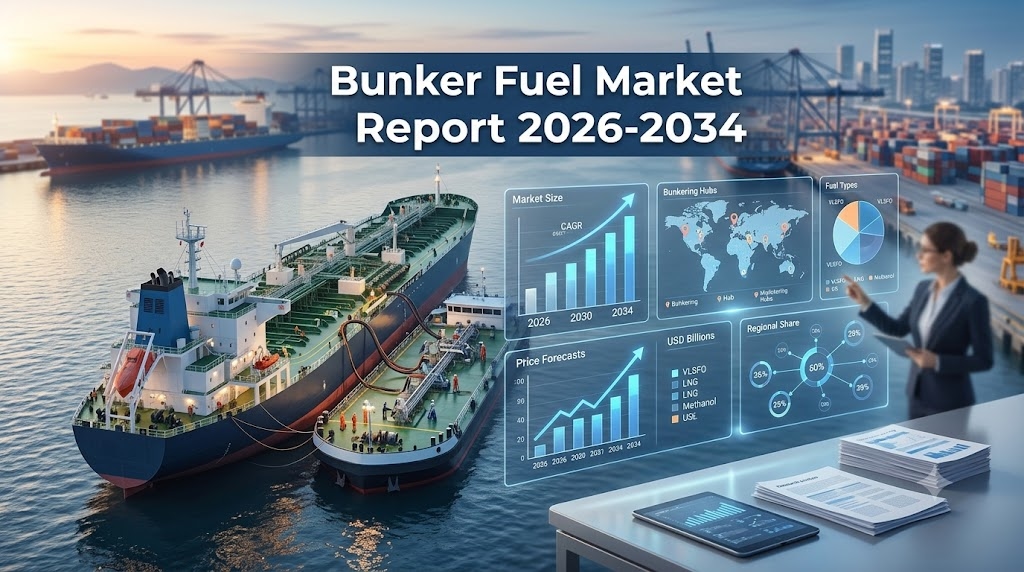
According to IMARC Group’s latest research publication, “Bunker Fuel Market: Global Industry Trends, Share, Size, Growth, Opportunity and Forecast 2026-2034”, The global bunker fuel market grew from USD 177.1 Billion in 2025 to USD 188.1 Billion in 2026 and is projected to reach USD 275.0 Billion by 2034, exhibiting a CAGR of 4.86% during 2026-2034.
This detailed analysis primarily encompasses industry size, business trends, market share, key growth factors, and regional forecasts. The report offers a comprehensive overview and integrates research findings, market assessments, and data from different sources. It also includes pivotal market dynamics like drivers and challenges, while also highlighting growth opportunities, financial insights, technological improvements, emerging trends, and innovations. Besides this, the report provides regional market evaluation, along with a competitive landscape analysis.
How Decarbonization and Maritime Regulation Are Reshaping the Future of the Bunker Fuel Market
Very Low Sulfur Fuel Oil (VLSFO) commands 43.2% of the global fuel type segment, driven by mandatory compliance with the IMO 2020 global 0.5% sulphur cap across a fleet of approximately 95,000 commercial vessels worldwide.
Asia Pacific leads all regions with a 45.6% market share, anchored by Singapore as the world’s largest bunkering port handling over 50 million tonnes of bunker fuel annually, alongside China’s expanding Zhoushan-Ningbo hub.
Major Oil Companies hold a 55.6% seller share, leveraging their integrated refinery-to-port networks, quality assurance systems, and credit facilities across 700+ ports globally to retain their market leadership position.
LNG is the fastest-growing fuel type within the market, supported by a global LNG-fueled vessel orderbook that reached 500+ ships, with infrastructure investment at Singapore, Rotterdam, and emerging South Korean and Chinese LNG bunkering facilities accelerating fleet adoption.
The global bunker fuel ecosystem is anchored by four major hubs, namely Singapore, Rotterdam, Fujairah, and Houston, which collectively account for approximately 40% of global bunker fuel volumes.
Download a sample PDF of this report: https://www.imarcgroup.com/bunker-fuel-market/requestsample
Key Trends in the Bunker Fuel Market
VLSFO Emerging as the Global Standard Marine Fuel: Following the IMO 2020 sulphur cap implementation, VLSFO has established itself as the default compliant marine fuel across all major bunkering hubs. Port infrastructure at leading locations has expanded VLSFO storage capacity significantly, and major oil companies have reconfigured their refinery outputs to maximize VLSFO yield, cementing its dominant position across vessel categories globally.
LNG Bunkering Infrastructure Approaching Critical Mass: Global investments in LNG bunkering terminals at Singapore, Rotterdam, and new South Korean and Chinese facilities are enabling broader LNG adoption across commercial shipping fleets. Shipping companies are specifying dual-fuel engines on new vessel orders as an insurance strategy against evolving regulatory requirements, even in regions where alternative fuel supply chains remain underdeveloped.
Scrubber-Equipped Vessels Sustaining HSFO Demand in a Niche Segment: Approximately 5,000 vessels globally have installed exhaust gas cleaning scrubbers, allowing them to continue using HSFO at a price discount of USD 100-150 per tonne compared to VLSFO. This scrubber-equipped fleet represents a structurally distinct demand pool that is sustaining HSFO volumes at around 27.5% of the fuel type segment.
Bio-Blended Marine Fuels Scaling Commercially Across European Ports: Regulatory momentum in Europe is supporting the commercial rollout of marine bio-blends combining VLSFO or Marine Gas Oil with hydrotreated vegetable oil and FAME blends. Port-level policy support across North Sea hubs is providing the incentive framework for bio-bunker programs to move from pilot stage to full commercial deployment, targeting renewable energy compliance mandates.
Digital Bunkering Platforms Transforming Supply Chain Transparency: Mass Flow Meter systems, mandated at Singapore and being adopted at additional major ports, are improving measurement accuracy and reducing costly fuel quantity disputes. Integrated digital platforms combining mass flow meter data, quality certificates, and delivery documentation are creating auditable chain-of-custody records, reducing fraud, and enabling data-driven procurement for large fleet operators.
We explore the factors driving the growth of the market, including technological advancements, consumer behaviors, and regulatory changes, along with emerging bunker fuel market trends.
Growth Factors in the Bunker Fuel Market
Expanding Global Maritime Trade Volumes Driving Non-Discretionary Fuel Demand: Global seaborne trade exceeded 11 billion tonnes, with container throughput at major ports recovering to record levels. Rising consumer goods demand, raw material flows, and energy commodity trade are sustaining vessel activity across all major shipping lanes, making bunker fuel a structurally embedded operating cost for the global maritime economy.
IMO 2020 Compliance Cementing VLSFO as the Primary Fleet Fuel: With only approximately 5,000 vessels globally equipped with scrubbers, the remaining estimated 90,000 commercial vessels require VLSFO for regulatory compliance. This structural demand is independent of discretionary fleet spending and is expected to persist across the forecast period, regardless of short-term crude oil price fluctuations.
Containers Dominating Vessel Type Segment with a 40.0% Share: Container ships are the single largest category of bunker fuel consumers, accounting for approximately 40.0% of the vessel type segment. High-frequency intra-Asia and transpacific trade routes operated by container lines generate consistent and predictable bunker fuel purchasing volumes, providing market stability across economic cycles.
Rotterdam and European Hubs Advancing LNG and Alternative Fuel Infrastructure: Europe holds a 20.3% regional share, with Rotterdam operating multiple LNG bunkering vessels and methanol bunkering pilots at North Sea ports. EU ETS carbon pricing requirements, effective from 2024 for the maritime sector, are accelerating demand for compliant and lower-emission marine fuels, adding a regulatory tailwind to LNG and bio-blend adoption across European shipping routes.
Fujairah and Middle East Hubs Emerging as Fast-Growth Bunkering Markets: The Middle East and Africa region is registering some of the strongest demand growth within the global market, anchored by Fujairah’s growing strategic role as an east-west trade bunkering hub at the crossroads of Asia-Europe shipping lanes. Expanding offshore oil and gas activity in Sub-Saharan Africa is generating incremental vessel traffic, creating demand for compliant marine fuels beyond existing hub capacity.
Leading Companies Operating in the Global Bunker Fuel Industry:
BP p.l.c.
Chevron Corporation
Exxon Mobil Corporation
Neste
Petroliam Nasional Berhad (PETRONAS)
TotalEnergies
Bunker Fuel Market Report Segmentation:
Breakup By Fuel Type:
Very Low Sulfur Fuel Oil (VLSFO)
High Sulfur Fuel Oil (HSFO)
Marine Diesel Oil (MDO)
Liquefied Natural Gas (LNG)
Very Low Sulfur Fuel Oil (VLSFO) accounts for the largest share at 43.2%, driven by mandatory compliance with the IMO 2020 global sulphur cap and widespread VLSFO storage infrastructure at all major bunkering ports.
Breakup By Vessel Type:
Containers
Tankers
General Cargo
Bulk Carrier
Others
Containers dominate the vessel type segment with a 40.0% share, reflecting the high fuel consumption intensity of container shipping across transpacific and intra-Asia trade routes.
Breakup By Seller:
Major Oil Companies
Leading Independent Sellers
Small Independent Sellers
Major Oil Companies lead the seller segment with a 55.6% share, reflecting their integrated supply chain advantages, global port coverage, and quality assurance capabilities that independent sellers cannot match at scale.
Breakup By Region:
Asia Pacific (China, Japan, India, South Korea, Australia, Indonesia, Others)
Europe (Germany, France, United Kingdom, Italy, Spain, Russia, Others)
North America (United States, Canada)
Latin America (Brazil, Mexico, Others)
Middle East and Africa
Asia Pacific enjoys the leading position with a 45.6% regional share, owing to Singapore’s dominance as the world’s largest bunkering port and China’s Zhoushan-Ningbo hub emergence as a major global bunkering center supporting high-volume intra-Asia and east-west maritime traffic.
Recent News and Developments in the Bunker Fuel Market
July 2025: TotalEnergies entered a strategic 50:50 joint venture with CMA CGM to develop and operate an LNG bunkering logistics solution in the Amsterdam-Rotterdam-Antwerp region, reinforcing its position in the marine fuels value chain and supporting the decarbonization of maritime transport through an integrated LNG supply service.
October 2025: ExxonMobil announced its entry into the LNG marine bunkering market by chartering two LNG bunker vessels to deliver LNG and bio-LNG fuel solutions for the maritime sector, with complementary logistics solutions being developed to enable early market access ahead of full vessel deliveries.
June 2026: Peninsula and ITOCHU established an ammonia bunkering joint venture targeting European ports, marking a significant step toward the commercial-scale deployment of zero-carbon marine fuel infrastructure and signaling growing confidence in ammonia as a viable long-term alternative to conventional marine bunker fuels.
Note: If you require specific details, data, or insights that are not currently included in the scope of this report, we are happy to accommodate your request. As part of our customization service, we will gather and provide the additional information you need, tailored to your specific requirements. Please let us know your exact needs, and we will ensure the report is updated accordingly to meet your expectations.
About Us:
IMARC Group is a global management consulting firm that helps the world’s most ambitious changemakers to create a lasting impact. The company provides a comprehensive suite of market entry and expansion services. IMARC offerings include thorough market assessment, feasibility studies, company incorporation assistance, factory setup support, regulatory approvals and licensing navigation, branding, marketing and sales strategies, competitive landscape and benchmarking analyses, pricing and cost research, and procurement research.
Contact Us:
IMARC Group
134 N 4th St. Brooklyn, NY 11249, USA
Email: sales@imarcgroup.com
Tel No: (D) +91 120 433 0800
United States: +1-201-971-6302