
Imagine a region that, 600 years ago, established a union strikingly similar to today’s European Union.
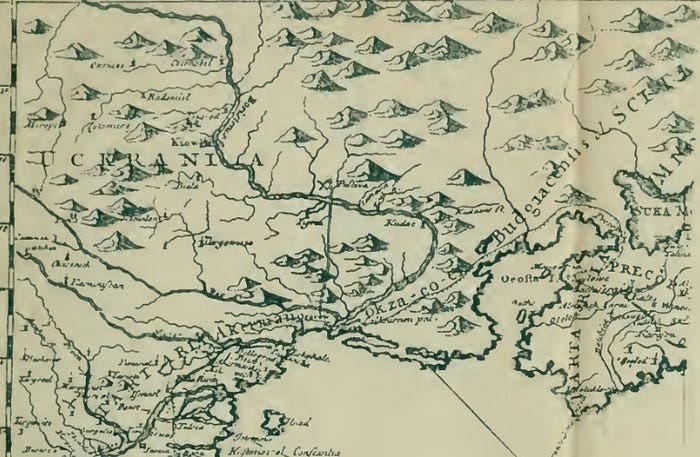
In the 14th century, at the peak of the Northern Branch of the Silk Road—the trade artery connecting China, Central Asia, and Europe—a network of extraordinary cities flourished across the steppes and riverways of Southern Ukraine and the Sea of Azov region: Velykyi Zamyk (on the Lower Dnieper), Shehr al-Jedid (on the Dniester), and Azak (at the mouth of the Don).
These cities operated on principles that are celebrated today as the pinnacle of Western civilization: open borders, frictionless commerce, multicultural integration, and unprecedented daily comfort.
While feudal lords in Western Europe froze in damp stone castles, these Black Sea hubs enjoyed underfloor heating (kanns), complex ceramic aqueducts, and luxurious public baths (hammams) clad in turquoise glazed tiles.
Crucially, these cities consciously maintained no armies and built no defensive walls. They thrived under the protective umbrella of Pax Mongolica—the "Mongol Peace" enforced by the Golden Horde. The Horde’s military machine functioned as their "external wall," safeguarding caravans, attracting Genoese and Venetian investors, and guaranteeing transit. The inhabitants of Zamyk and Shehr al-Jedid were genuinely convinced that global economics, trade treaties, and a powerful external patron made war obsolete and personal weaponry a useless luxury.
This "ideal world" collapsed overnight.
Yes, there was a plague epidemic prior to this. Yes, there were 30 years of civil strife. But in 1395, the conqueror Tamerlane launched a devastating campaign against the Golden Horde. To him, the openness of Velykyi Zamyk, Azak, and Shehr al-Jedid was not a civilizational achievement—it was a perfect, undefended target. Seeing the Northern Silk Road as a direct rival to his own trade routes, Tamerlane subjected these cities to methodical, engineering-grade urbicide: palaces and water pipes were dismantled to their foundations, while artisans and merchants were systematically wiped out or enslaved. The moment their external protective shield faltered, the lack of their own defensive walls cost this steppe civilization its existence.
For the Western reader, the lesson is stark: history does not respect wealth or cultural sophistication. It destroys those who are prosperous and relaxed, yet lack the force and resolve to defend themselves.
The Mirror of Metaphysics: Brussels in the Crosshairs and Operation "Political Paralysis"
Today, Brussels, Berlin, and Paris are those very same "cities without walls." For decades, Western Europe built its advanced society under the U.S. security umbrella (the modern equivalent of a global "golden shield") and on cheap resources from autocracies, believing that trade, fixed borders, and diplomacy rendered major war in Europe impossible.
However, the Kremlin operates under the exact same ruthless logic of Tamerlane. To Moscow, European openness, democratic procedures, and relaxation are not values, but vulnerabilities to be targeted. Today, the main blow is aimed at shattering the European rear from within. Because walls are built not only from stone, but also from border checkpoints.
The Political Dimension of Tragedy: The Kremlin’s Trojan Horses
Moscow realized long ago: to disarm Europe, one does not necessarily need to send cavalry or tanks rushing toward Berlin right away. It is enough to make Europeans give up the fight on their own. For this purpose, political projects across the center-left, center-right, and ultra-radical wings of European politics have been bought up, nurtured, and launched for decades.
Long-standing "sleeper" projects: Certain parties in Germany, France, Italy, and Central European countries were saturated for years with Russian money, connections, and business interests.
A synchronized agenda: Under diametrically opposed slogans—"worker protection, social justice, and pacifism" (center-left) or "defense of tradition, anti-immigration, and economic nationalism" (center-right)—these forces push a single narrative line written in the Kremlin.
The goal—Ukraine's capitulation and Western disarmament: The victory or significant strengthening of these parties in European elections leads to catastrophic consequences:
The termination of military and financial assistance to Ukraine under the pretext of "seeking immediate peace" or "caring for our own taxpayers."
The winding down of EU defense-industrial programs and the blocking of a unified European defense shield.
The deliberate destruction of internal NATO and EU unity, turning Brussels into a toothless body capable mostly of expressing "concern."
A Realistic Forecast for Europe:
The collapse of the "peaceful coexistence" illusion: A potential policy of concessions to the Kremlin executed by left- and right-wing populists will repeat the fate of 14th-century Italian merchants who were plundered immediately after opening their gates to the aggressor.
The transformation of Eastern Europe into a Frontier: While Western capitals sink into political populism, the Baltic states, Poland, and Finland are forced to turn into a hardened, militarized outpost. If Western Europe surrenders Ukraine through new pro-Kremlin governments, this border will become a line of inevitable military clash.
The finale of a "carefree paradise": If the EU doles out aid to Ukraine and its own rearmament in trickle measures, it may face not "budget savings," but a catastrophic hybrid defeat: destruction of critical infrastructure, energy collapse, and, ultimately, armed aggression on its own borders.
History is unforgiving: if you refuse to feed your own army and support allies holding the shield in the East, you will surrender all your wealth to the conqueror. Walls will have to be built regardless—either out of steel and concrete now, or out of your own ashes later.
Odesa, July 2026