
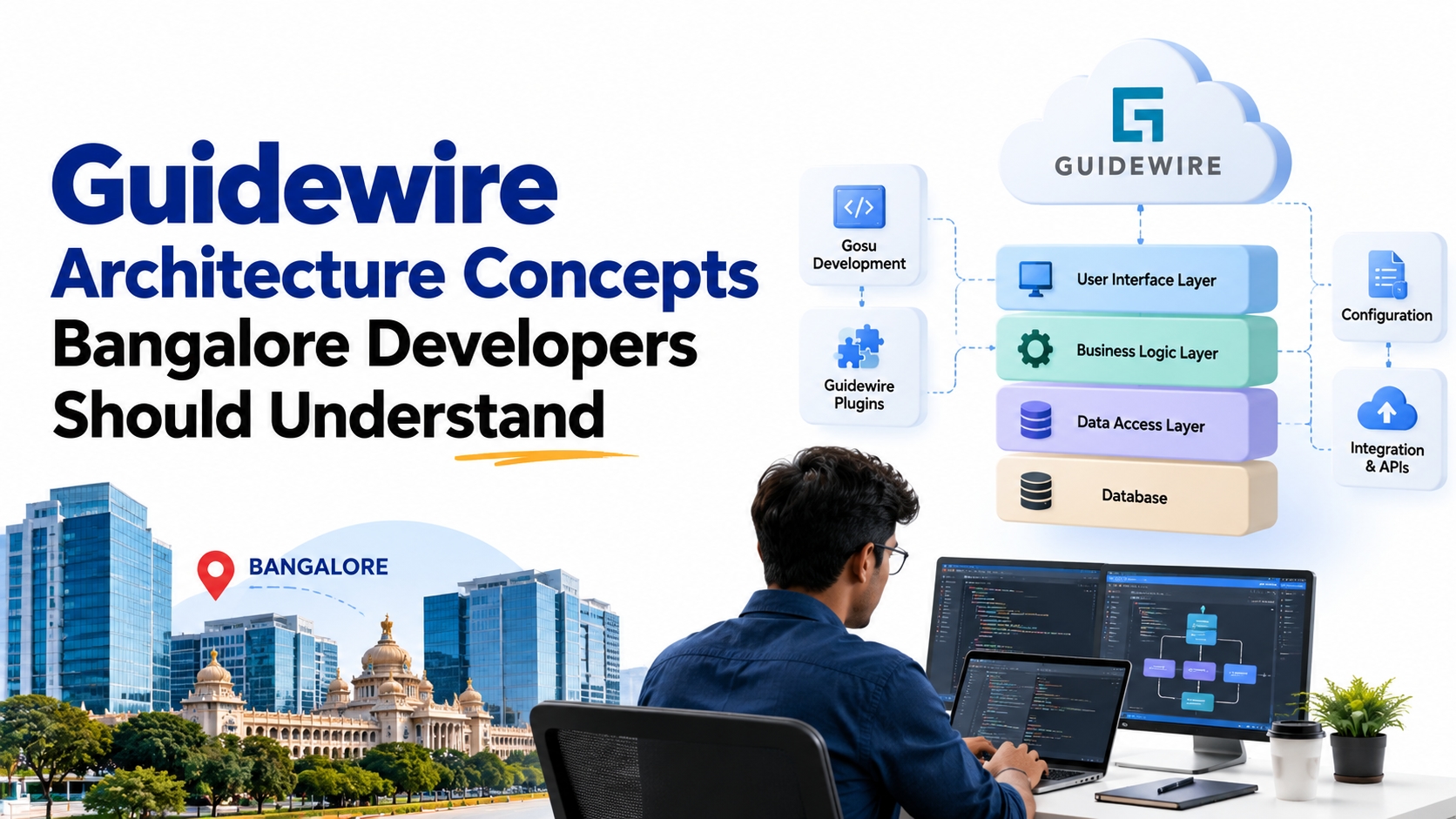
Bangalore has long been celebrated as Silicon Valley of India, housing a massive ecosystem of global tech giants, GCCs (Global Capability Centers), and innovative IT service leaders. As insurance enterprises worldwide undergo massive digital transformations, the demand for specialized cloud and P&C (Property and Casualty) platform engineers in India’s tech capital has surged exponentially. Among these platforms, Guidewire stands out as the dominant enterprise solution, driving high-value career opportunities for local software engineers. Mastering its underlying software architecture is essential for any developer in IT hubs like Electronic City, Manyata Tech Park, or Whitefield aiming to transition into high-paying, specialized roles. To build a solid foundational understanding of enterprise P&C platforms before diving into architectural specifics, exploring structured Guidewire Class in India provides engineers with a clear, industry-aligned learning roadmap tailored to current enterprise hiring standards.
Understanding how Guidewire modules interact under the hood enables developers to design scalable, fault-tolerant solutions rather than merely writing configuration code. The platform's modular architecture separates core business logic, user interface components, and third-party integrations into well-defined, manageable layers. For software professionals operating in competitive tech corridors, acquiring expertise in this architectural design bridges the gap between basic coding and enterprise-level solution design. By aligning core software development skills with Guidewire's domain-specific design patterns, developers in IT centers can position themselves for lucrative positions across top multinational consultancies and product firms. Navigating this ecosystem effectively requires a granular breakdown of its core components, runtime behavior, and integration paradigms.
1. The Core Triad: PolicyCenter, ClaimCenter, and BillingCenter
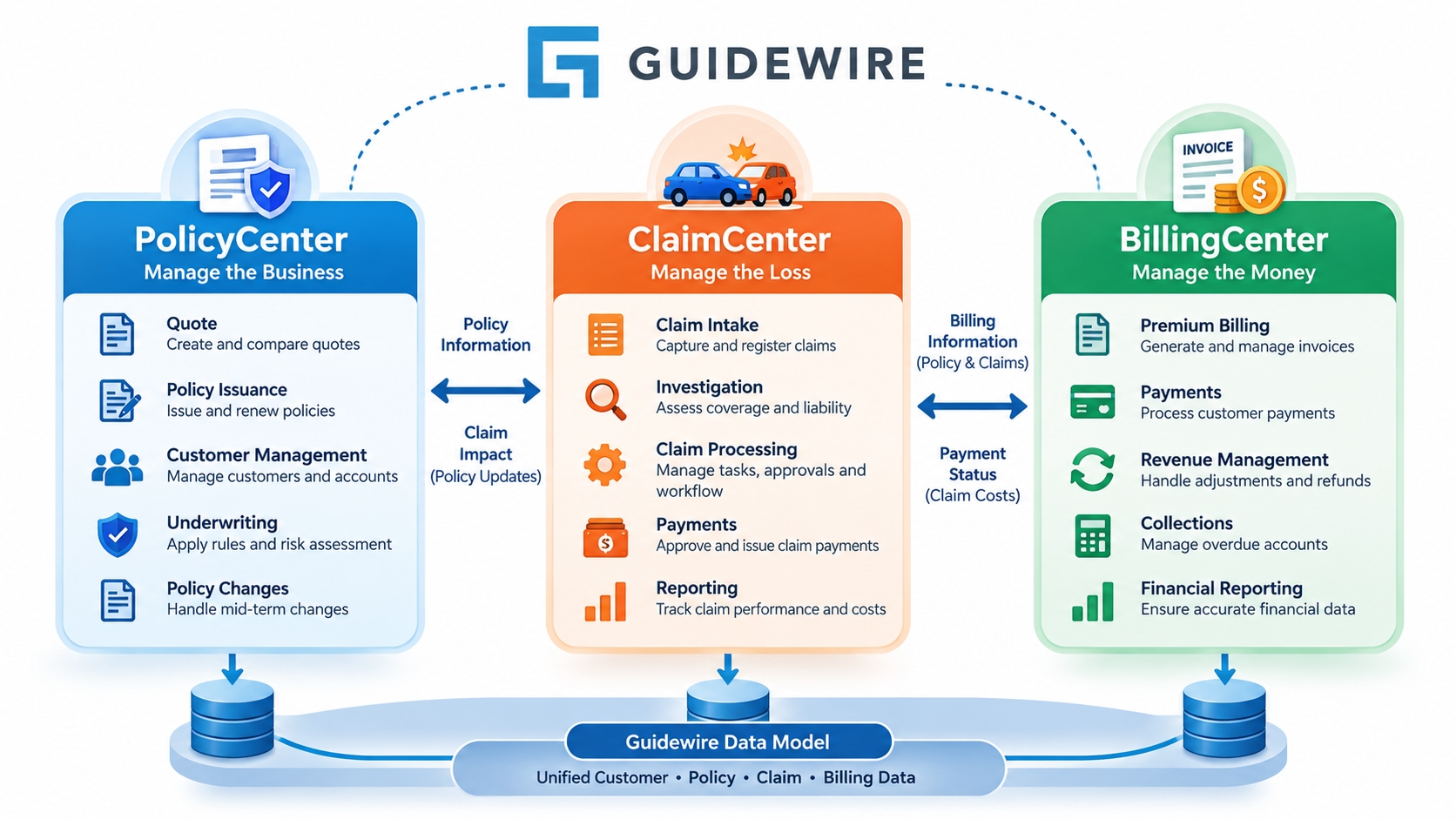
Guidewire InsuranceSuite relies on three flagship applications that function seamlessly together to cover the entire Property and Casualty insurance lifecycle. PolicyCenter manages policy creation, underwriting, quotes, and renewals, establishing the primary data structures for insured assets. ClaimCenter handles the end-to-end claims handling process from First Notice of Loss (FNOL) to final payout and settlement. BillingCenter manages payment plans, invoicing, commission structures, and agency accounting, maintaining financial integrity across operations.
From an architectural standpoint, these three core systems share a unified technology stack and domain model while running as independent enterprise applications. They communicate using web services, messaging queues, and REST APIs, ensuring high availability and loose coupling. Understanding how data flows between PolicyCenter, ClaimCenter, and BillingCenter allows developers to build robust, cross-functional extensions without creating data sync bottlenecks or circular dependencies across modules.
2. GOSU Programming Language and Domain-Specific Logic
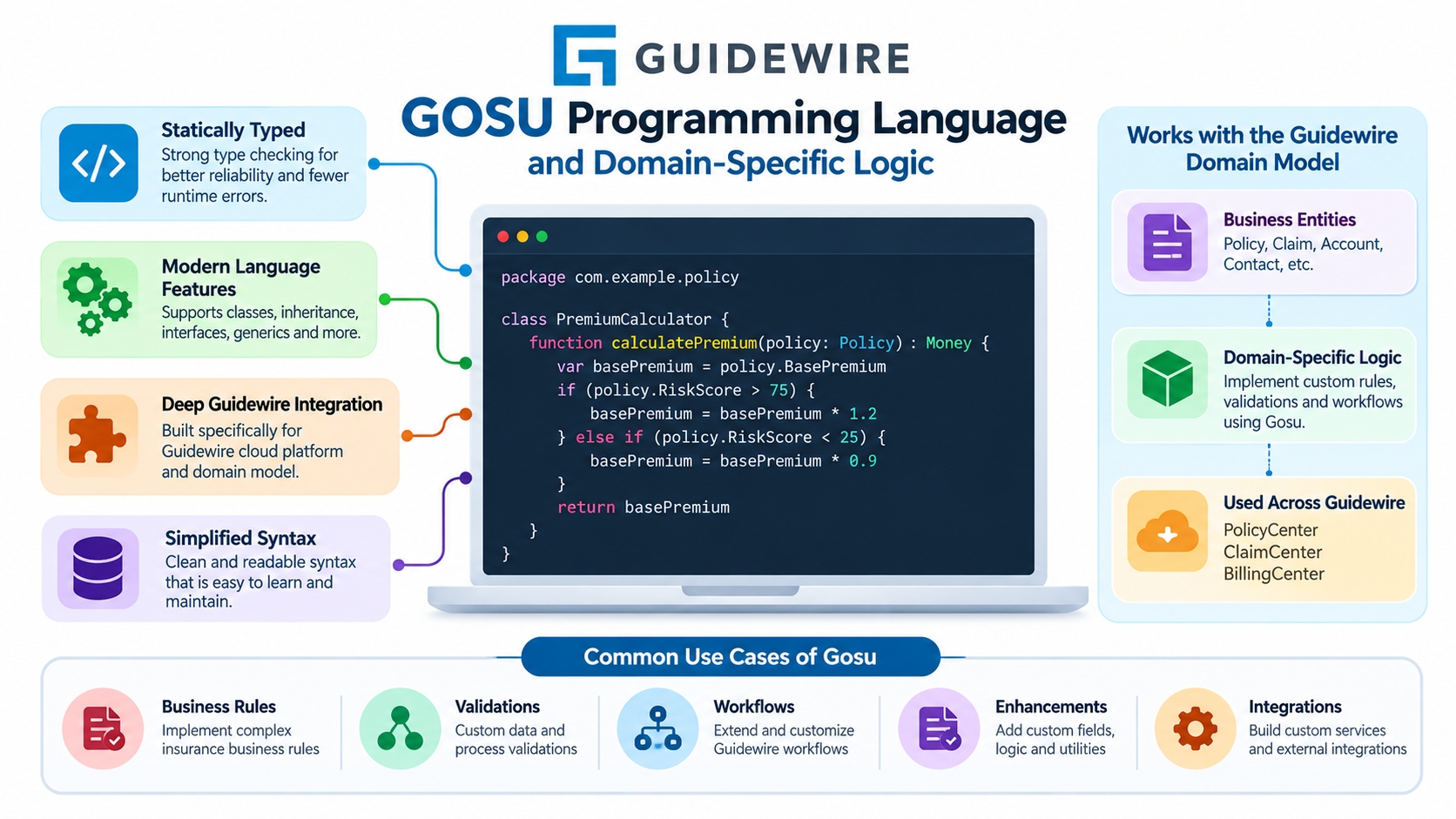
GOSU is an object-oriented, strongly-typed programming language that runs natively on the Java Virtual Machine (JVM), serving as the primary language for Guidewire customization. Designed specifically to reduce boilerplate code, GOSU offers seamless Java interoperability, type inference, block functions, and structural typing. For tech professionals looking to gain hands-on proficiency in GOSU alongside real-world project experience, enrolling in specialized Guidewire Course in Bangalore helps bridge theoretical knowledge with practical coding expertise required by local tech employers.
Architecturally, GOSU code compiles directly to Java bytecode, allowing it to leverage existing Java libraries and framework components without performance penalties. Developers use GOSU to write business rules, validation scripts, enhancement classes, and integration plugins across the InsuranceSuite ecosystem. Mastering GOSU's nuances—such as entity enhancements, null-safe operators, and type-safe queries—is crucial for writing performant, maintainable enterprise code that complies with Guidewire development best practices.
3. Page Configuration Format (PCF) and Presentation Layer
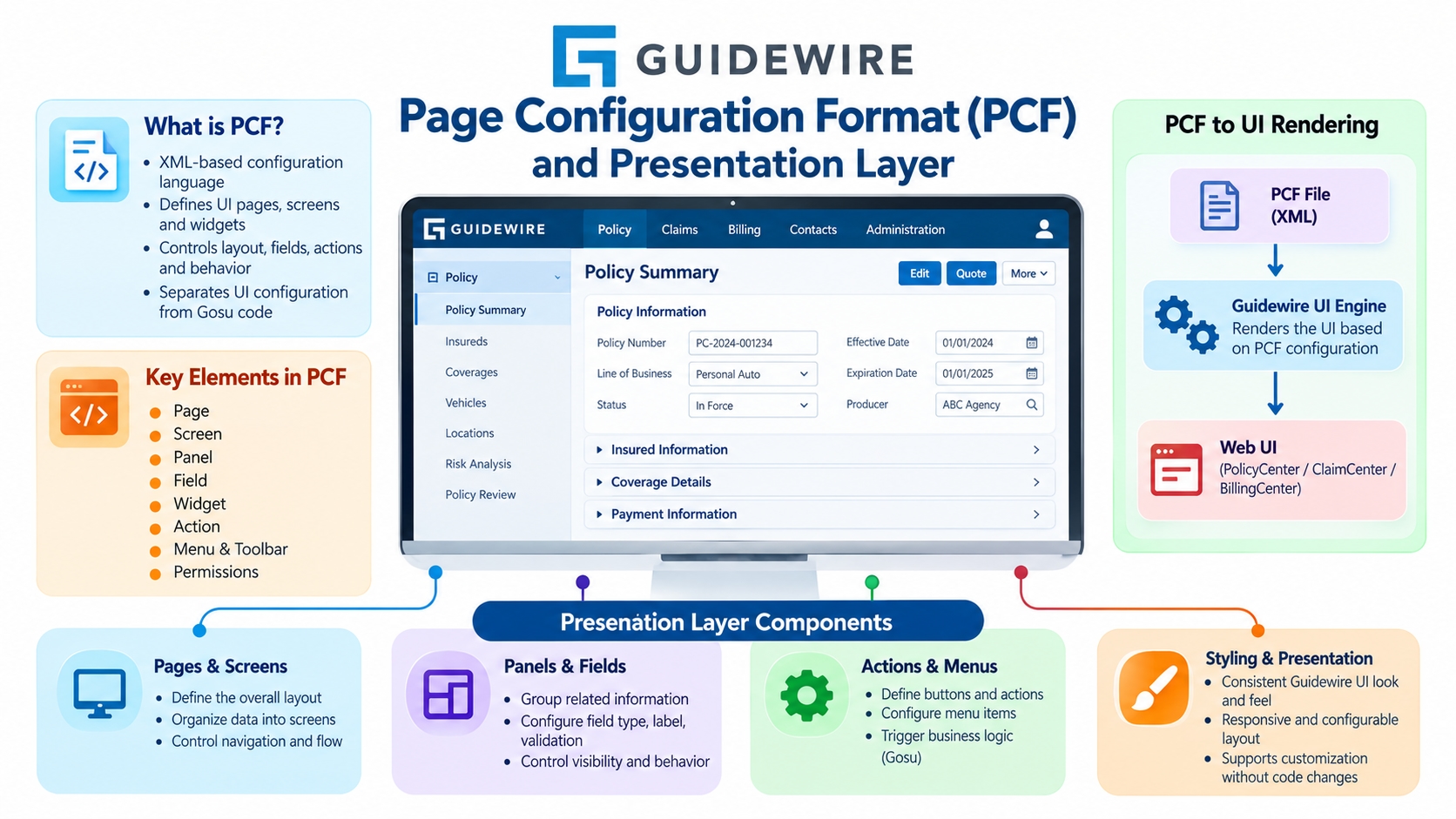
Guidewire isolates its user interface layer using Page Configuration Format (PCF) files, which are XML-based definitions converted into dynamic web interfaces at runtime. PCF files define screen layouts, input controls, navigation workflows, and field visibility rules without forcing developers to write raw HTML or JavaScript. This abstraction ensures a consistent look and feel across all InsuranceSuite products while enabling rapid UI customization.
The architecture strictly separates presentation from underlying business logic through a Model-View-ViewModel (MVVM) inspired design pattern. PCF controls interact directly with GOSU code bundles and data entities through data bindings and atomic action expressions. Developers must understand PCF hierarchy, location groups, modal screens, and partial page renders (Paging/AJAX) to build responsive, user-friendly interfaces that do not trigger unnecessary server roundtrips or database locks.
4. Guidewire Data Model, Entities, and Database Abstraction
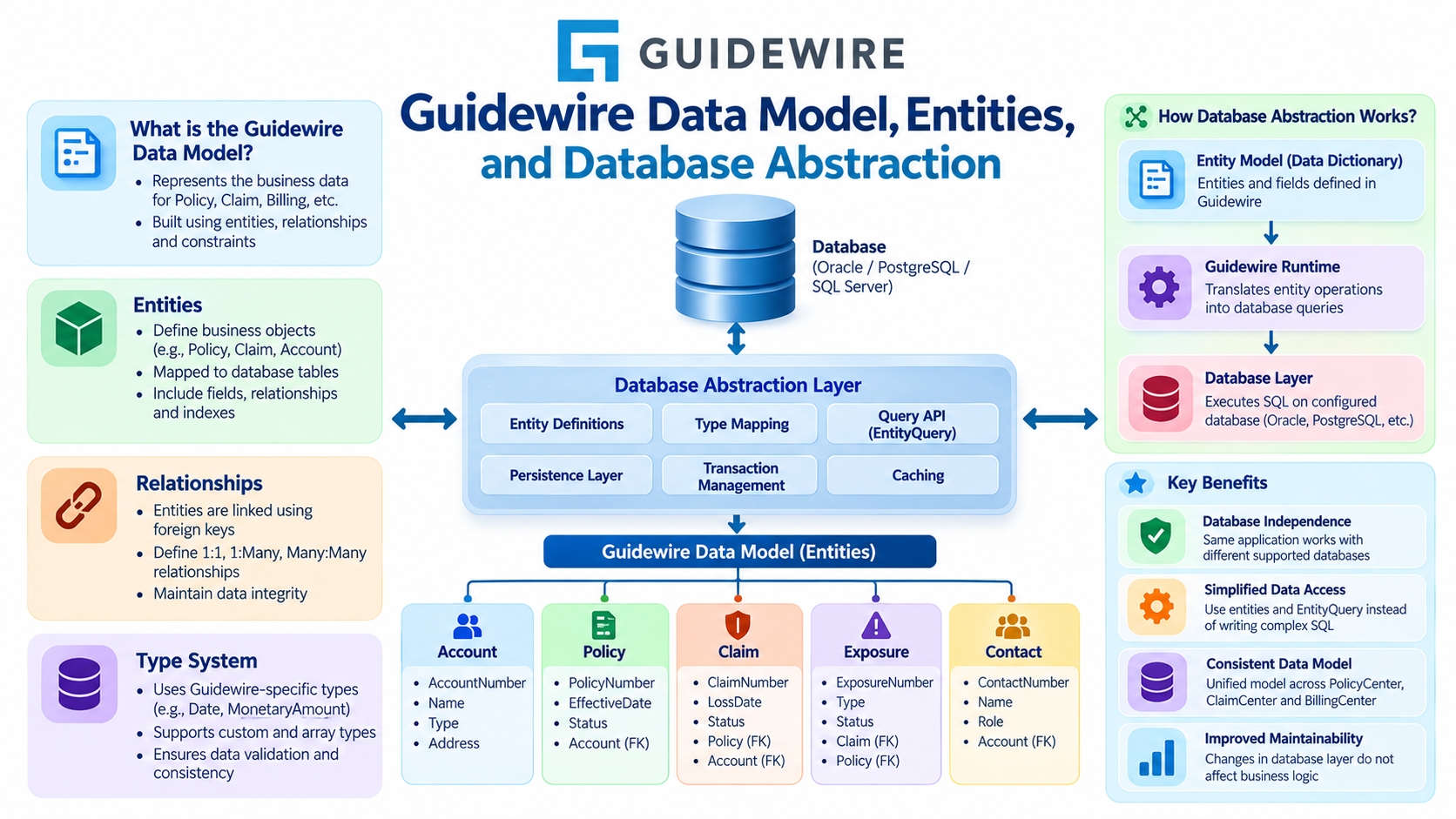
At the heart of every Guidewire application is an extensible, entity-based data model managed through XML definitions (ETX and DAT files). The platform abstracts direct SQL database interactions through a custom Object-Relational Mapping (ORM) layer, exposing entities as native GOSU objects. This abstraction layer handles object caching, transaction management, pessimistic/optimistic locking, and database vendor independence seamlessly behind the scenes.
Developers extend the standard data model by creating custom entities, adding array keys, or extending core fields through extension files without modifying base code. Understanding how Guidewire translates GOSU Bundle operations, Query Builders, and Entity Beans into underlying SQL transactions is vital for database performance optimization. Proper entity design prevents performance bottlenecks, transaction timeouts, and deadlock conditions during heavy concurrent batch jobs.
5. Integration Framework: Web Services, REST APIs, and Plugins
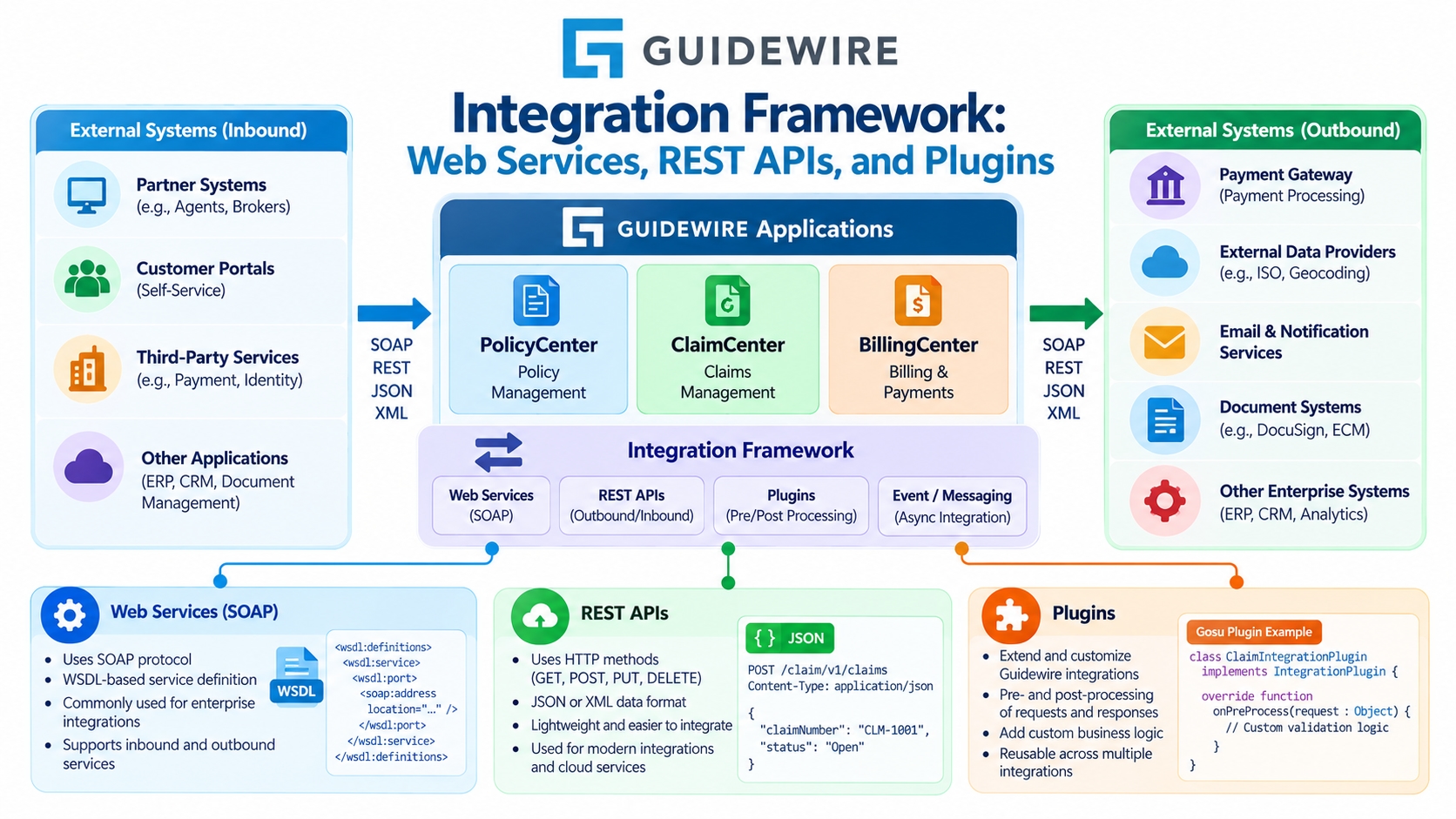
Guidewire's integration architecture is built to connect seamlessly with legacy systems, enterprise service buses (ESB), payment gateways, and modern cloud microservices. The framework heavily utilizes RESTful APIs, SOAP Web Services, Startable Plugins, and Message Queues to support both synchronous and asynchronous communications. This flexibility allows insurers to plug in external credit check services, telematics data streams, and automated fraud detection tools easily.
Architecturally, the platform employs a publish-subscribe messaging infrastructure with guaranteed message delivery semantics to handle transactional integration events. Developers implement custom Java or GOSU plugins by implementing predefined Guidewire interfaces, allowing external systems to extend native core behaviors. Understanding integration transaction boundaries, message transport channels, payload transformation, and error-handling queues is essential for building resilient, enterprise-grade digital insurance ecosystems.
6. Rule Engine Architecture and Business Logic Execution
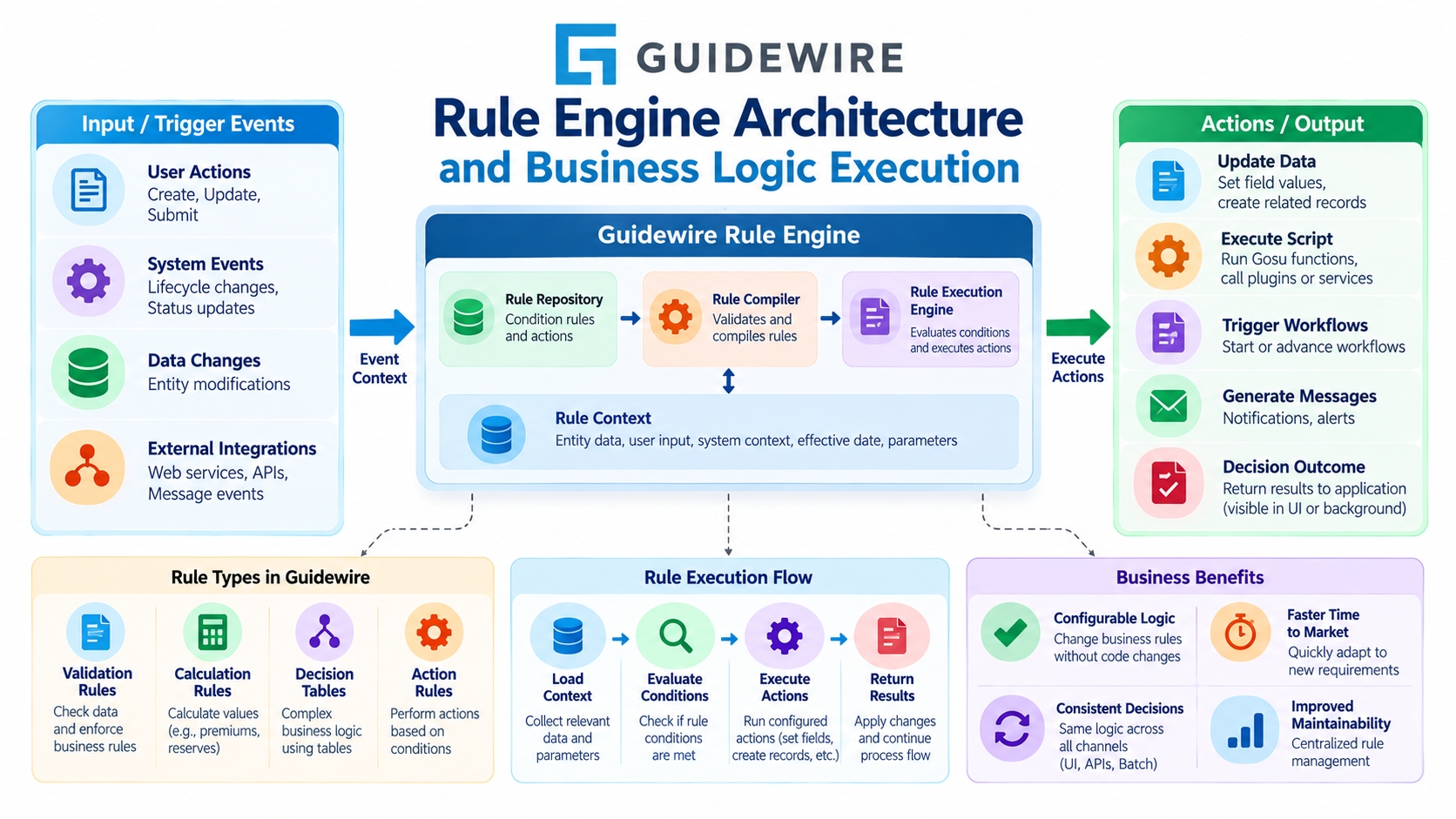
The Guidewire Rule Engine decouples business policy logic from core application code, empowering developers and system architects to maintain complex rulesets dynamically. Rules are categorized into distinct categories such as Validation, Assignment, Pre-setup, Pre-update, and Event-Fired rules. Each rule set executes at specific checkpoints during the entity lifecycle, ensuring strict data governance, workflow compliance, and automated task routing.
Under the hood, the engine evaluates rule conditions hierarchically and executes actions sequentially within defined execution contexts. Optimizing rule execution requires developers to avoid heavy database queries inside rule loops and prevent redundant updates to entity bundles. By mastering rule execution lifecycles, developers can write clean, modular rule sets that enforce enterprise business policies cleanly without degrading runtime throughput or causing recursive trigger cycles.
7. Guidewire Cloud Platform (GWCP) and Microservices Evolution
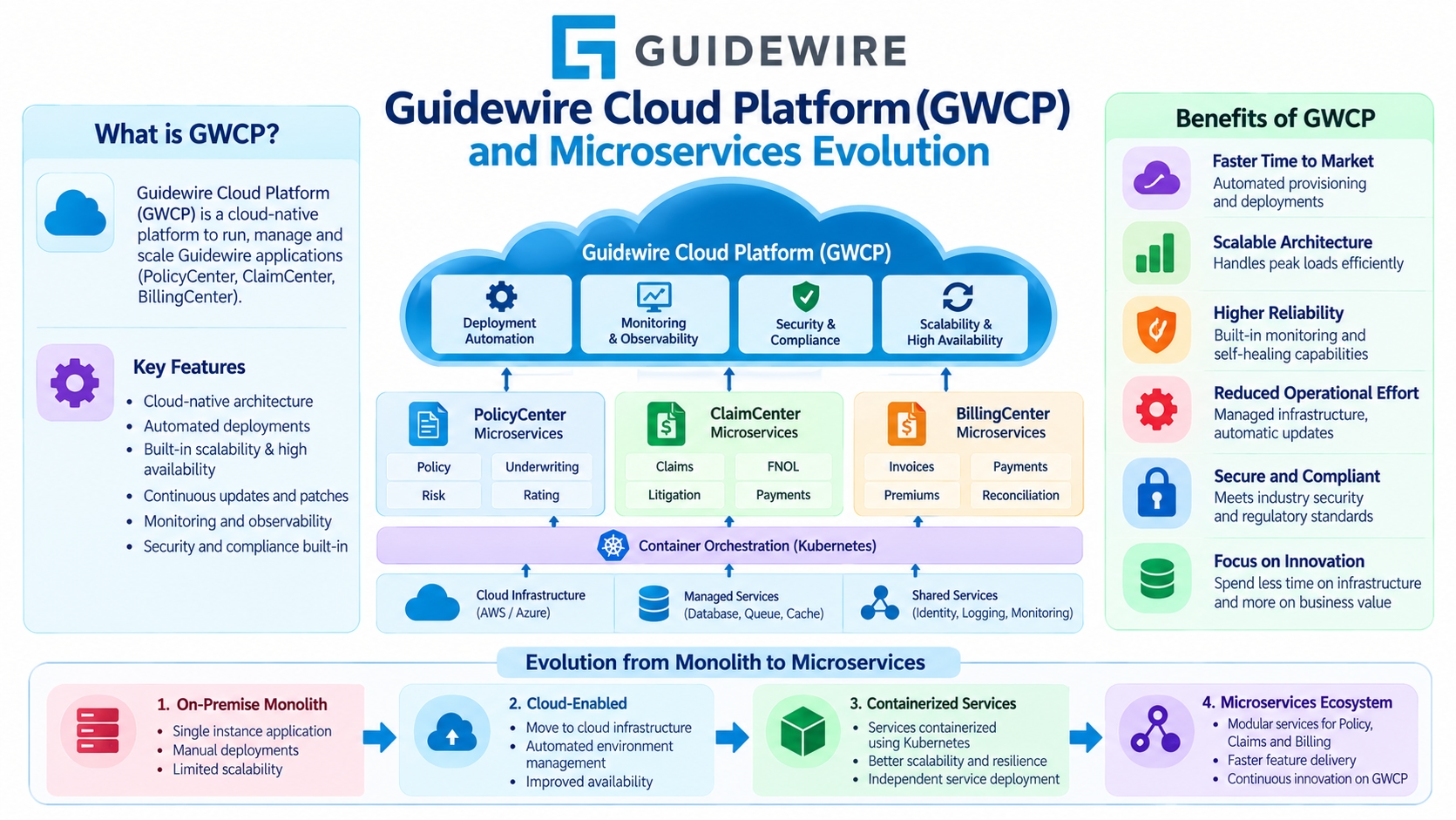
Guidewire's architectural evolution has shifted aggressively toward Guidewire Cloud Platform (GWCP), built on cloud-native infrastructure utilizing AWS, Docker, Kubernetes, and cloud API gateways. GWCP shifts traditional monolithic deployments toward a service-oriented, API-first model featuring Jutro Digital Platform for front-end experiences and Cloud Integration Framework (CIF) for microservices connectivity.
For developers, this cloud-native paradigm changes how applications are deployed, monitored, and scaled across enterprise environments. Instead of heavy local customizations, modern Guidewire architecture emphasizes configuration over customization, utilizing out-of-process integrations and RESTful cloud endpoints. Understanding cloud-native deployment patterns, containerized runtime environments, and pipeline automation is critical for engineers looking to remain competitive in modern DevOps-driven IT organizations.


