
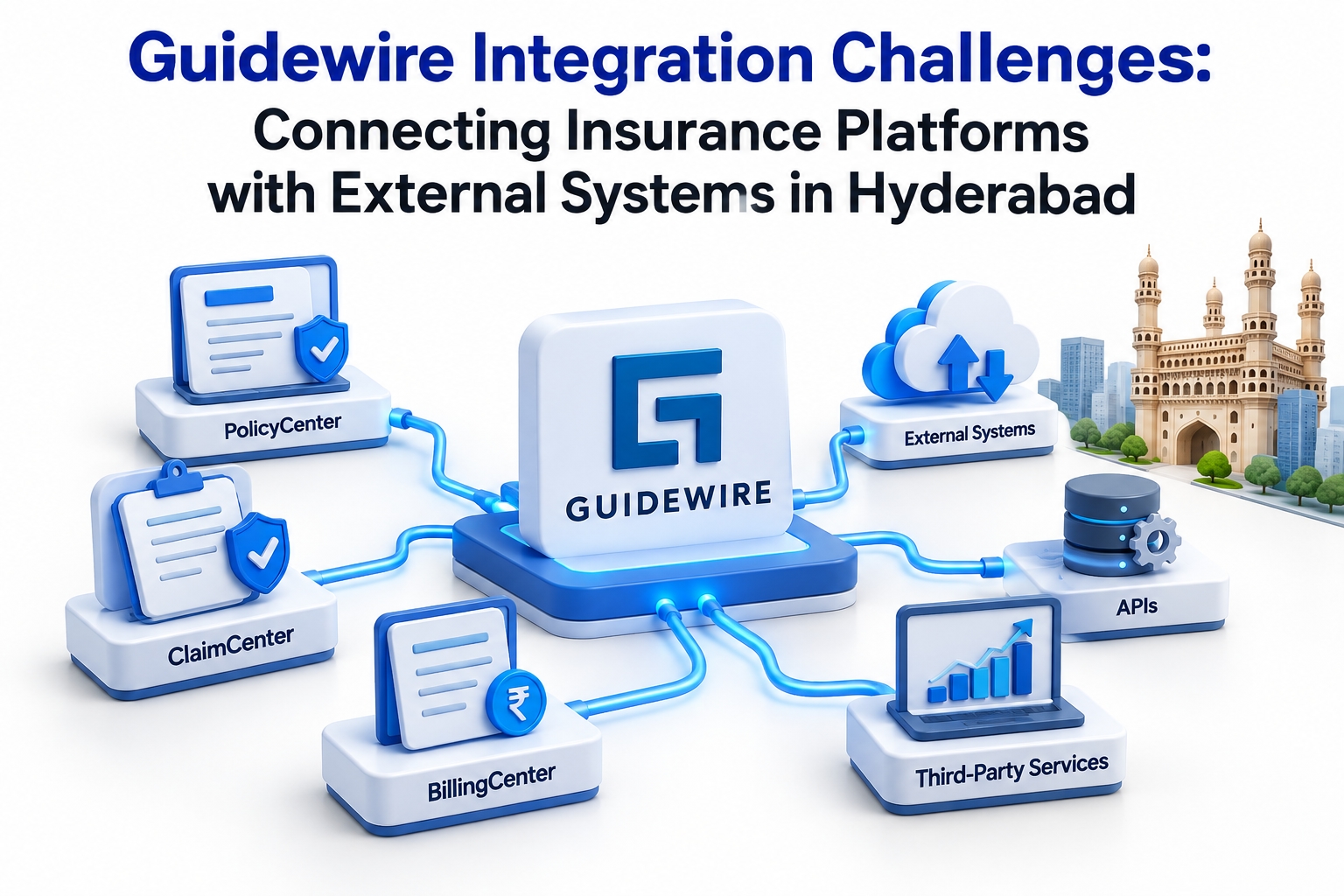
Insurance companies cannot operate efficiently when their core applications function independently. Policy management, claims processing, billing, payment gateways, and customer communication platforms must exchange information accurately. This makes Guidewire integration a critical part of modern insurance technology.
For technology professionals in Hyderabad, understanding Guidewire integration challenges creates opportunities to work on complex insurance projects. From API connectivity to data synchronization and cloud integration, developers must solve technical problems while maintaining security, reliability, and business continuity.
Understanding Guidewire Integration Architecture and External System Connectivity
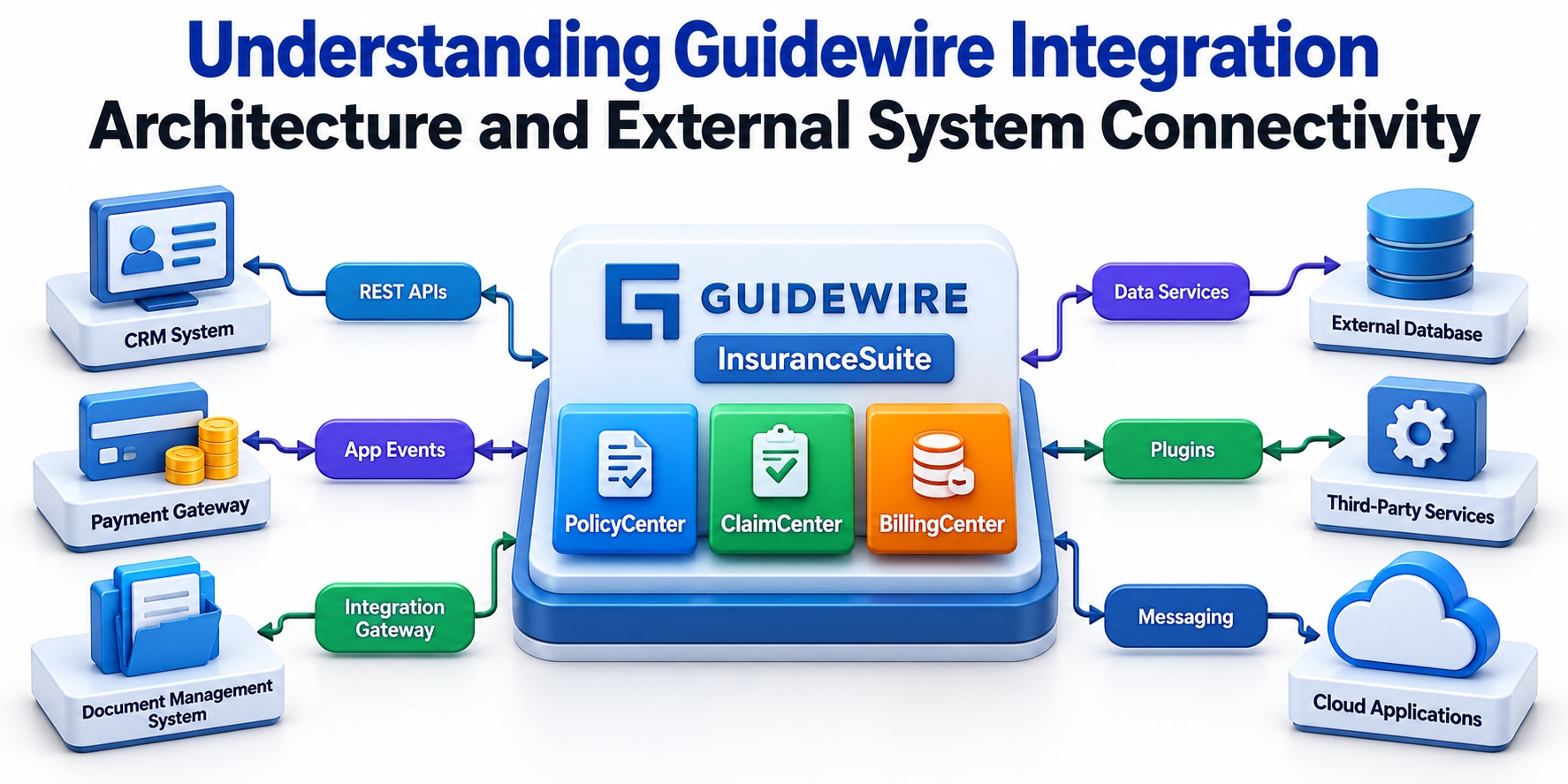
Guidewire InsuranceSuite consists of three major applications: PolicyCenter, ClaimCenter, and BillingCenter. These applications manage different insurance operations but frequently require information from external platforms such as payment services, document management systems, customer relationship management tools, and third-party data providers.
The main integration challenge involves establishing reliable communication between systems with different architectures, data structures, and processing requirements. An insurance company might use Guidewire PolicyCenter for policy administration while maintaining customer information in an external CRM platform. Both systems must exchange relevant information without introducing inconsistencies.
Guidewire provides several integration technologies to support these requirements:
Cloud API: Enables external applications to access supported InsuranceSuite resources and perform business operations through REST APIs.
App Events: Supports asynchronous communication by publishing insurance business events to downstream systems.
Integration Gateway: Connects InsuranceSuite with external services through integration applications and transformation logic.
Plugins: Extend predefined application behavior and support specific integration requirements.
Messaging mechanisms: Enable asynchronous communication and controlled processing of external transactions.
Selecting the appropriate integration mechanism depends on transaction complexity, response-time requirements, business dependencies, and the Guidewire deployment architecture. Developers must understand these differences before implementing external connectivity.
Overcoming API Integration Challenges in Guidewire Insurance Applications
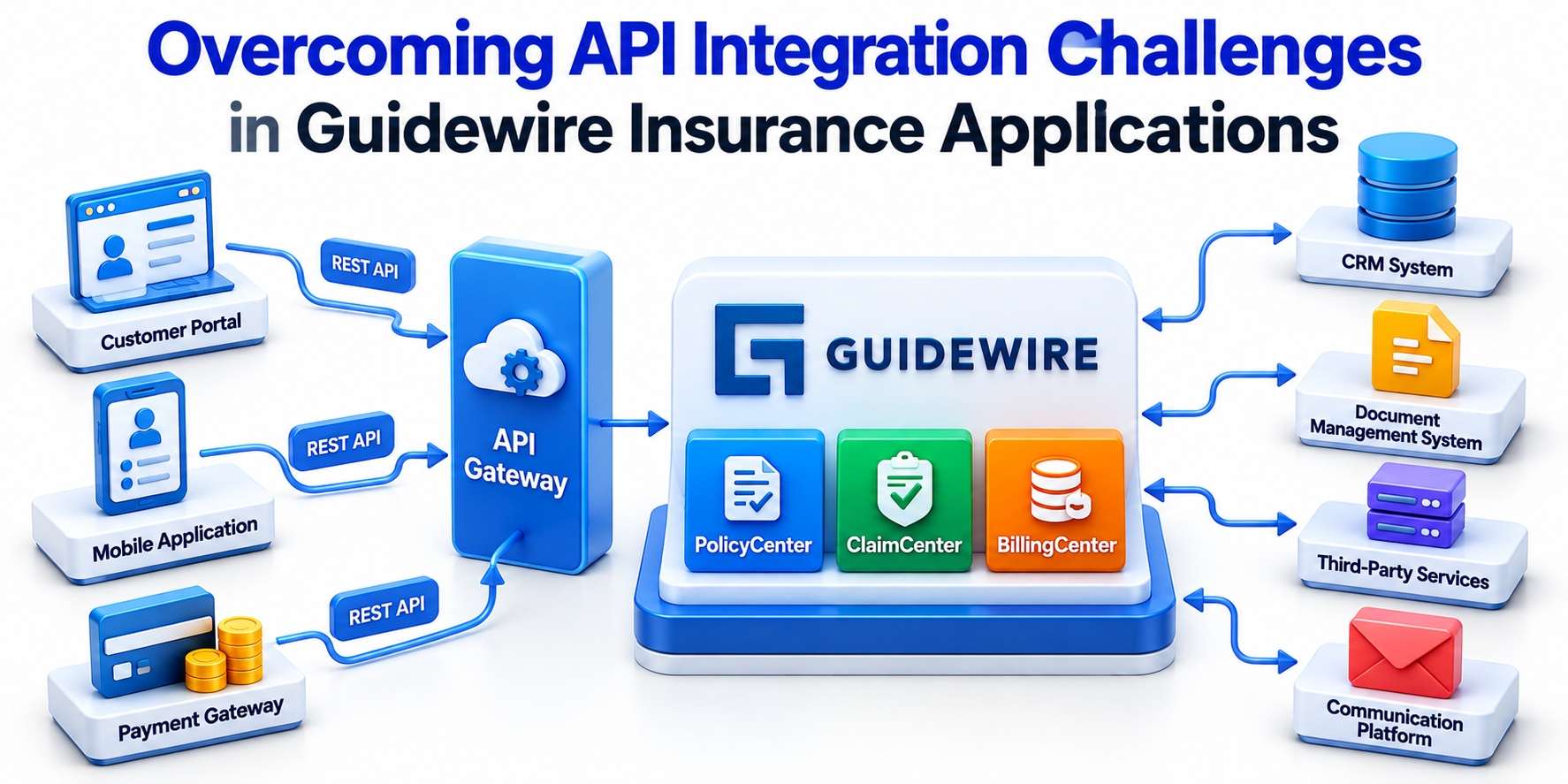
API integration is one of the most important technical areas in modern Guidewire projects. Insurance companies use APIs to connect customer portals, mobile applications, payment providers, and external business services with their core insurance applications.
However, connecting systems through APIs involves more than exchanging JSON requests and responses. Developers must consider authentication, authorization, API contracts, validation rules, response handling, and service availability.
For example, when a customer submits a policy-related request through a digital portal, the external application may communicate with PolicyCenter through an appropriate Cloud API endpoint. The request must satisfy application business rules and authorization requirements before the operation succeeds.
Common API integration challenges include:
Authentication failures: Incorrect credentials, expired tokens, or insufficient permissions prevent successful requests.
Data validation errors: External payloads may contain missing fields, invalid values, or unsupported formats.
Service timeouts: Slow external applications can interrupt time-sensitive business operations.
API compatibility: Changes to request structures or service contracts may affect connected applications.
Error handling: Poorly designed responses make integration failures difficult to diagnose.
Developers should implement structured logging, appropriate timeout policies, secure authentication, and clearly defined API contracts. Retry mechanisms must also distinguish temporary failures from permanent validation errors.
For professionals pursuing guidewire training in hyderabad, practical API development and debugging exercises are particularly valuable because they demonstrate how insurance applications communicate with external services in realistic project environments.
Managing Data Synchronization and Transformation Across Insurance Systems
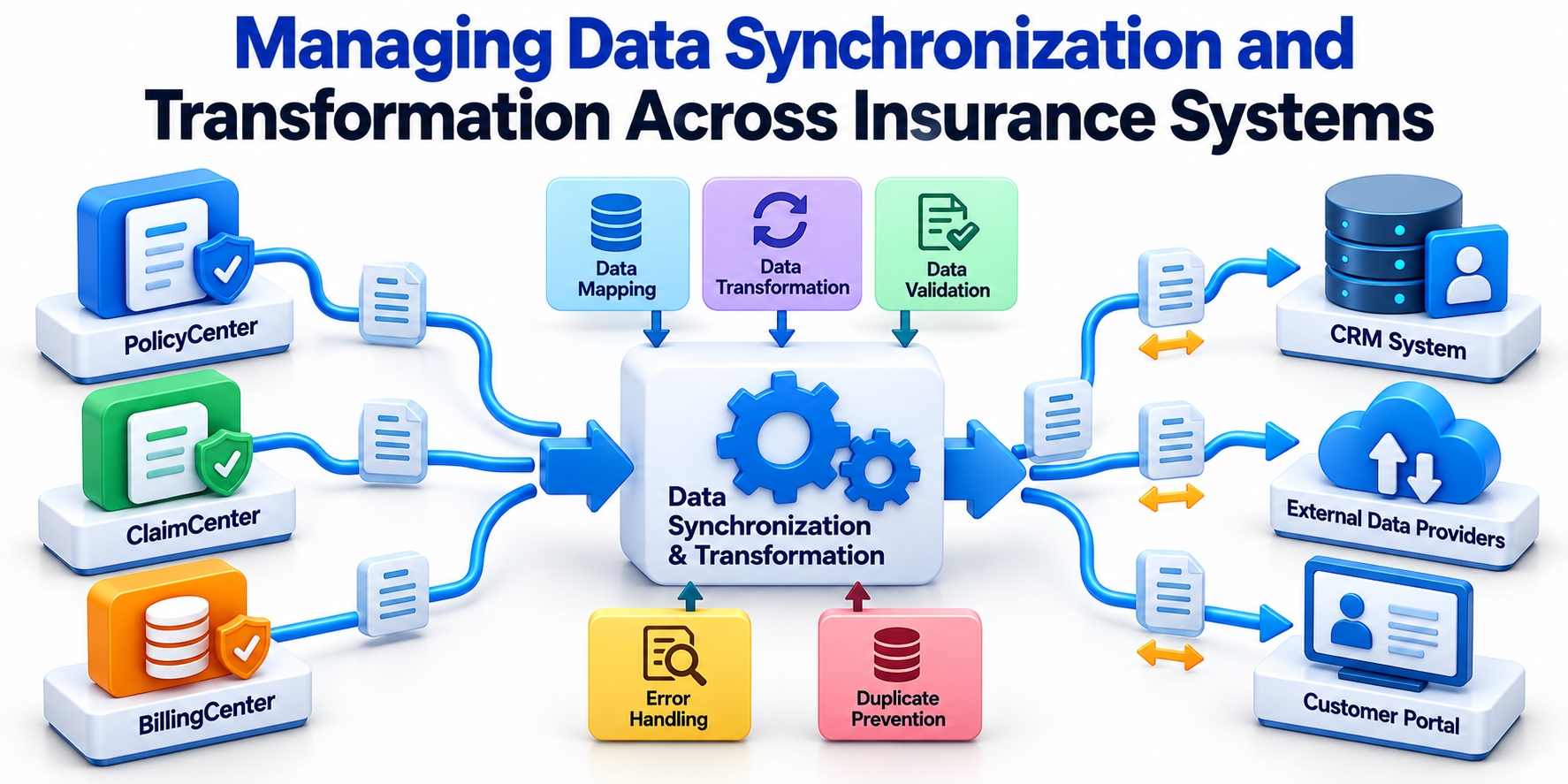
Data synchronization becomes challenging when insurance information moves between applications with different database structures and business definitions.
For example, PolicyCenter may maintain policy information while an external customer management platform stores contact details and communication preferences. If customer information changes in one system, the integration must determine whether the update should be transferred to another system.
Without proper synchronization rules, insurance organizations may encounter duplicate records, inconsistent customer information, and incorrect transaction processing.
Successful data integration requires developers to address several technical considerations:
Data mapping: Convert source-system fields into the structures expected by the destination application.
Data validation: Check mandatory attributes, formats, and business constraints before processing.
Duplicate prevention: Use stable identifiers and idempotent processing where appropriate.
Data ownership: Define which application is authoritative for each business attribute.
Error recovery: Provide mechanisms to identify, investigate, and reprocess failed transactions.
Consider an insurance customer updating their residential address. The change may need to reach policy administration, customer communication, and document generation systems. Each destination may require a different data format.
Integration developers must ensure that these updates follow established business rules rather than assuming every system should automatically overwrite existing information.
Understanding data ownership, transformation logic, and reconciliation procedures helps teams maintain consistency across connected insurance applications.
Handling Performance, Messaging, and Integration Failure Scenarios
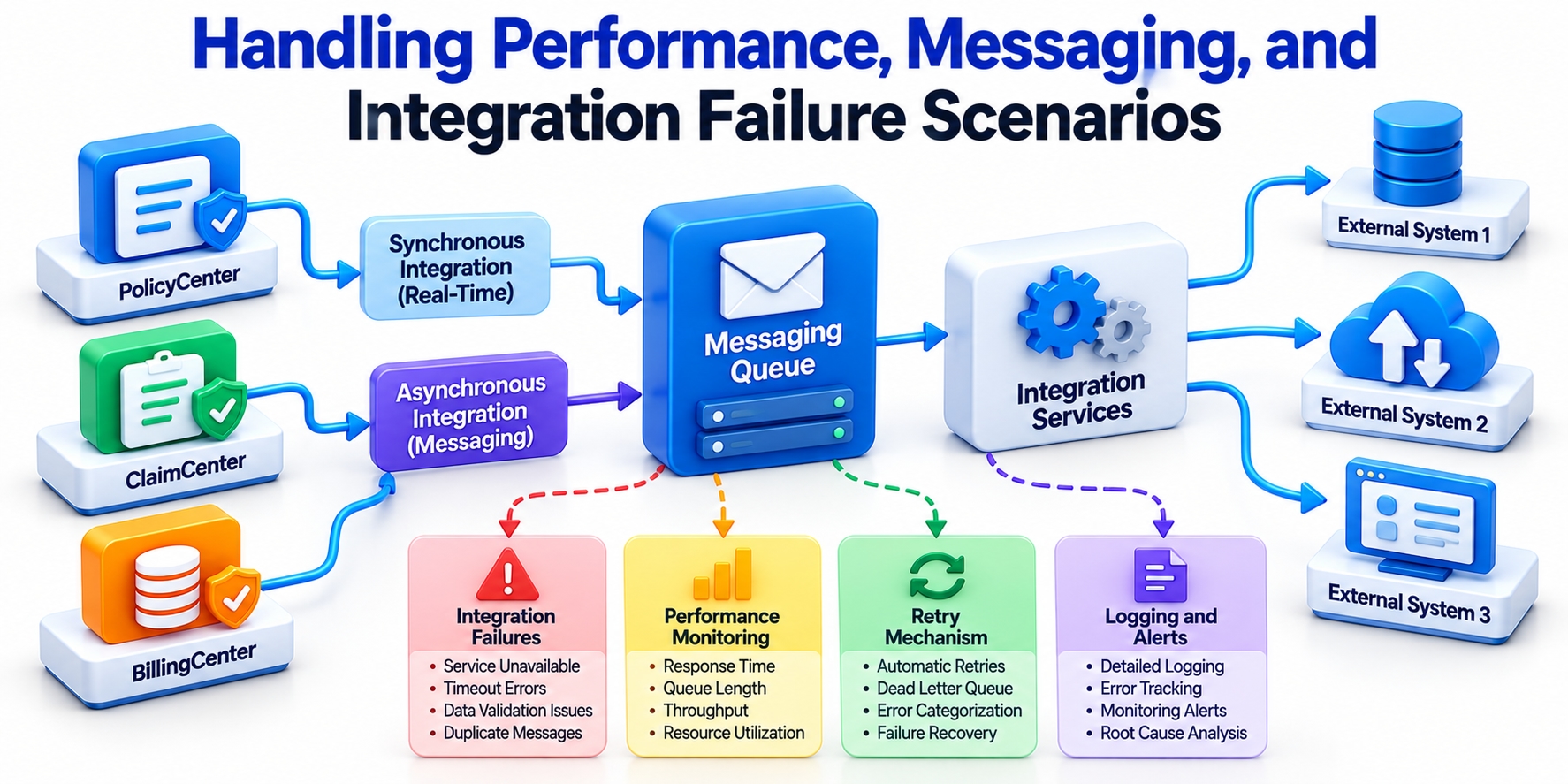
Insurance platforms process business transactions that may depend on multiple internal and external applications. Poorly designed integrations can introduce performance problems, delayed processing, and operational disruptions.
One important architectural decision involves choosing between synchronous and asynchronous communication.
Synchronous integration requires the calling process to wait for a response. This approach is appropriate when an immediate result is necessary, such as retrieving information needed to complete a transaction.
Asynchronous integration allows systems to process messages independently. It is useful for activities such as notifying downstream applications about policy changes or sending information to reporting platforms.
Developers must evaluate several reliability challenges:
External service unavailability and network interruptions.
Duplicate messages caused by repeated delivery attempts.
Delayed processing during high transaction volumes.
Incorrect ordering of dependent business events.
Failed transactions requiring investigation or recovery.
A practical solution combines appropriate messaging patterns, monitoring, bounded retries, and controlled error handling.
For instance, when a policy is issued, a downstream notification service may receive an event asynchronously. If that service becomes temporarily unavailable, the integration should support recovery without creating duplicate business outcomes.
Teams should also establish correlation identifiers, operational alerts, and measurable processing expectations.
These practices help insurance organizations maintain dependable integration workflows while reducing the impact of temporary external-system failures.
Strengthening Security and Cloud Integration in Guidewire Projects
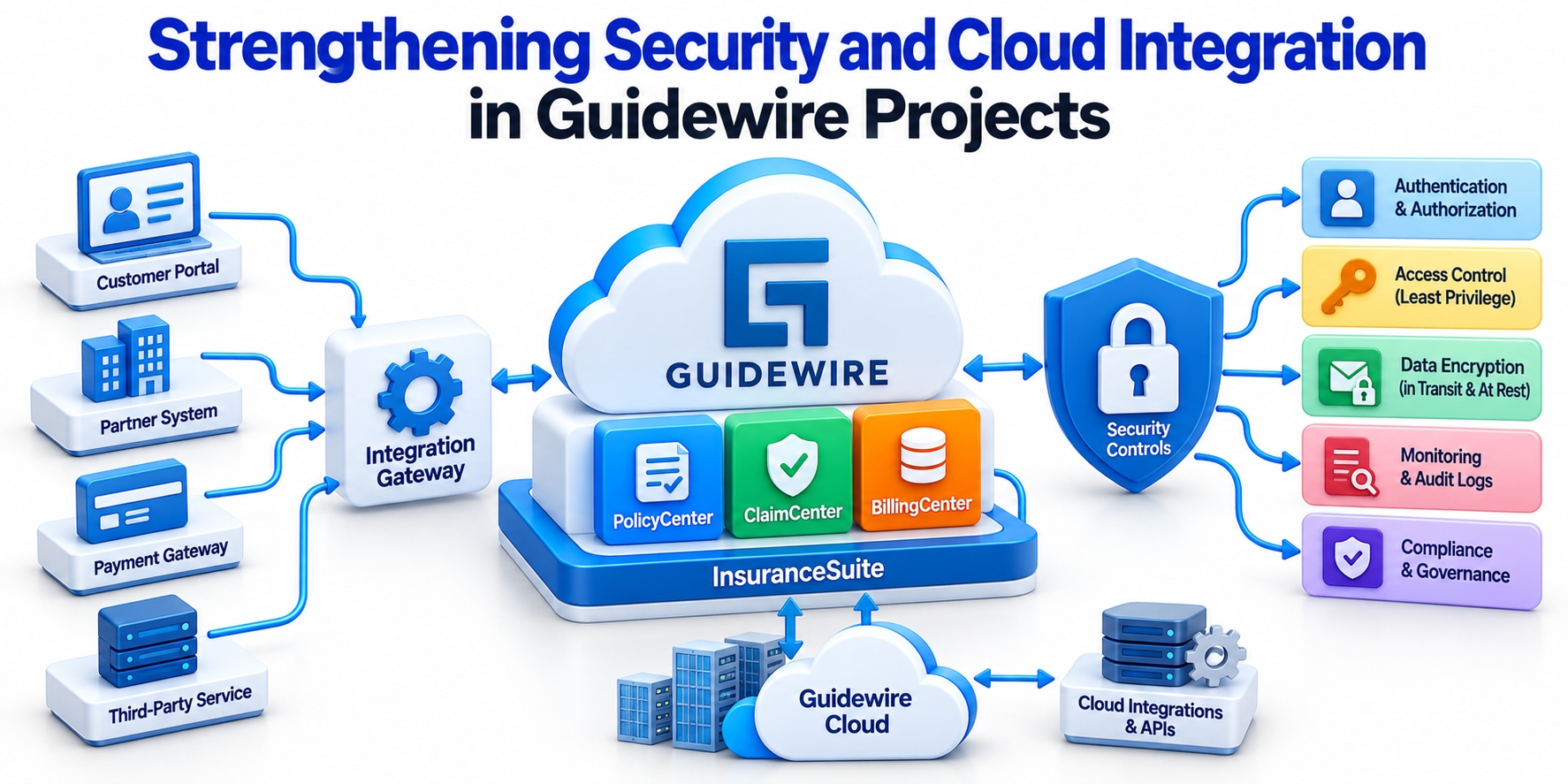
Security becomes increasingly important when Guidewire applications exchange sensitive information with external systems.
Insurance platforms process customer identities, policy information, financial transactions, and claims records. Unauthorized access or insecure data transmission can create significant operational and compliance risks.
Guidewire Cloud introduces modern integration capabilities, but development teams must still implement appropriate application-level security controls.
Important security practices include:
Using supported authentication and authorization mechanisms.
Applying least-privilege permissions to integration service accounts.
Encrypting sensitive information during transmission.
Protecting API credentials and other application secrets.
Restricting unnecessary access to external services.
Monitoring suspicious requests and integration failures.
Cloud integration also requires attention to deployment independence, observability, and network connectivity.
Guidewire Integration Gateway supports integration applications outside the InsuranceSuite core, allowing teams to maintain certain integration components independently.
This architectural separation can reduce unnecessary coupling between business functionality and external connectivity.
Developers should also avoid exposing sensitive customer information through application logs or diagnostic messages.
For engineers exploring guidewire training in india, learning cloud integration architecture alongside API security and application monitoring provides a stronger technical foundation than studying configuration alone.
Building Practical Guidewire Integration Skills for Hyderabad Insurance Projects
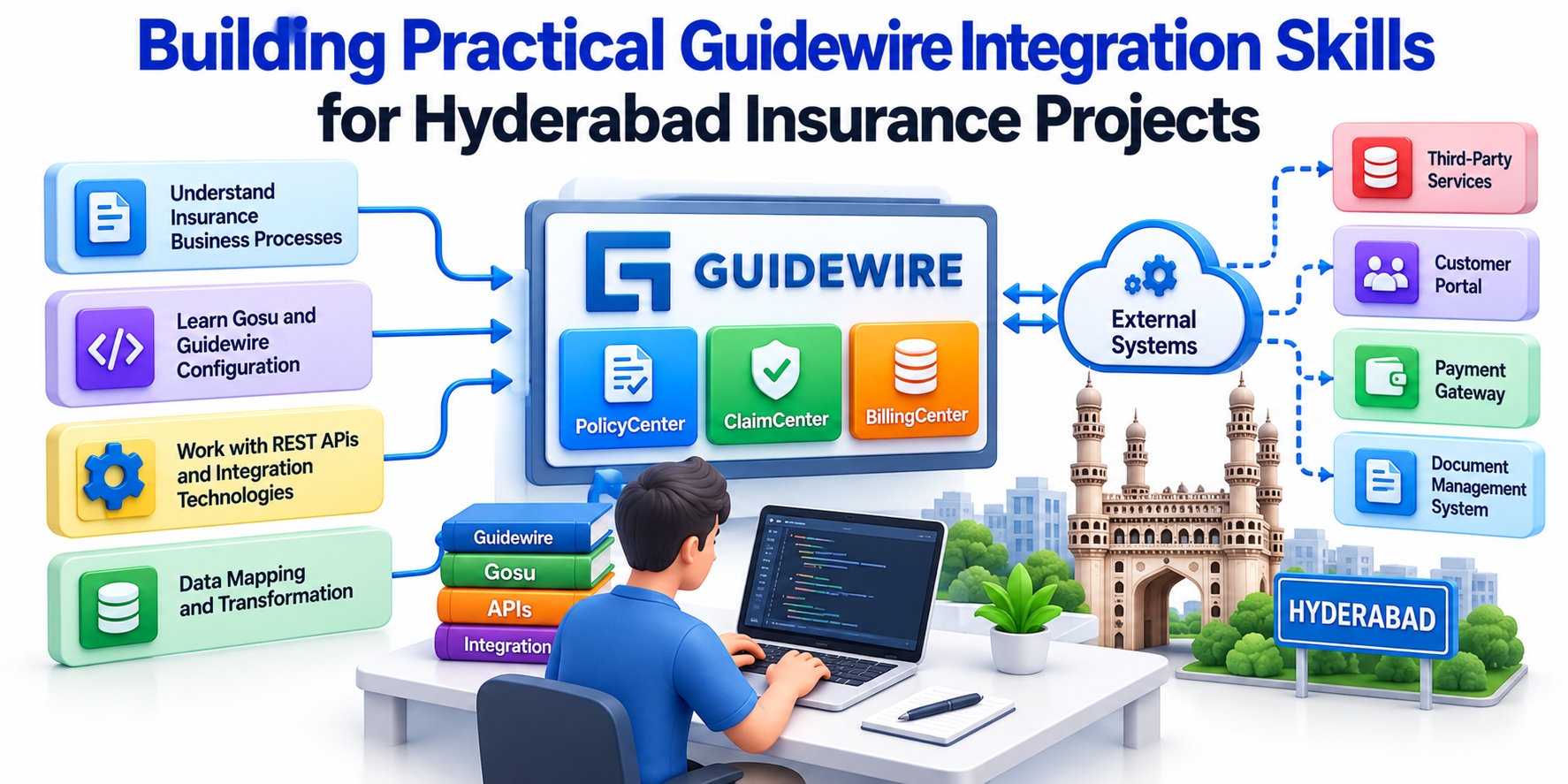
Hyderabad offers an established technology services environment where professionals can develop skills relevant to insurance application implementation, integration, testing, and support.
However, successful Guidewire integration work requires more than familiarity with individual platform features. Developers must understand insurance business processes, application architecture, external connectivity, and production troubleshooting.
A structured learning approach should begin with InsuranceSuite fundamentals before progressing toward advanced integration concepts.
Important technical skills include:
Understanding PolicyCenter, ClaimCenter, and BillingCenter workflows.
Developing proficiency in Gosu and Guidewire configuration concepts.
Working with REST APIs, JSON, authentication, and HTTP responses.
Understanding synchronous and asynchronous integration patterns.
Learning data mapping, validation, and transformation techniques.
Practicing integration testing, debugging, and failure recovery.
Business analysts also contribute significantly to successful integration projects.
Through Guidewire Business Analyst Training, professionals can learn to identify integration requirements, document business workflows, define acceptance criteria, and coordinate between insurance stakeholders and development teams.
For example, a business analyst may document how a claim approval should trigger communication with an external payment system. Developers then translate those requirements into secure, reliable integration workflows.
Institutes such as Jasttech can support learners seeking structured exposure to Guidewire concepts and project-oriented technical skills. When evaluating training options, candidates should prioritize practical exercises, relevant platform knowledge, and opportunities to understand realistic insurance scenarios.
Building a small integration project involving API requests, data transformation, error handling, and testing can also strengthen interview preparation.
Conclusion
Guidewire integration is essential for connecting insurance core applications with the external services required for modern digital operations. Challenges involving API connectivity, data synchronization, messaging reliability, performance, and security require careful architectural decisions. Understanding these areas helps developers build integrations that support dependable insurance transactions and long-term application maintainability.
For aspiring Guidewire professionals in Hyderabad, developing practical integration expertise can create a strong foundation for technical career growth. Combining InsuranceSuite knowledge with REST APIs, cloud architecture, troubleshooting, and insurance business processes prepares learners to contribute effectively to implementation and modernization projects. As insurers continue improving connected digital experiences, professionals who understand both integration technology and insurance workflows will remain valuable contributors to enterprise development teams.







