
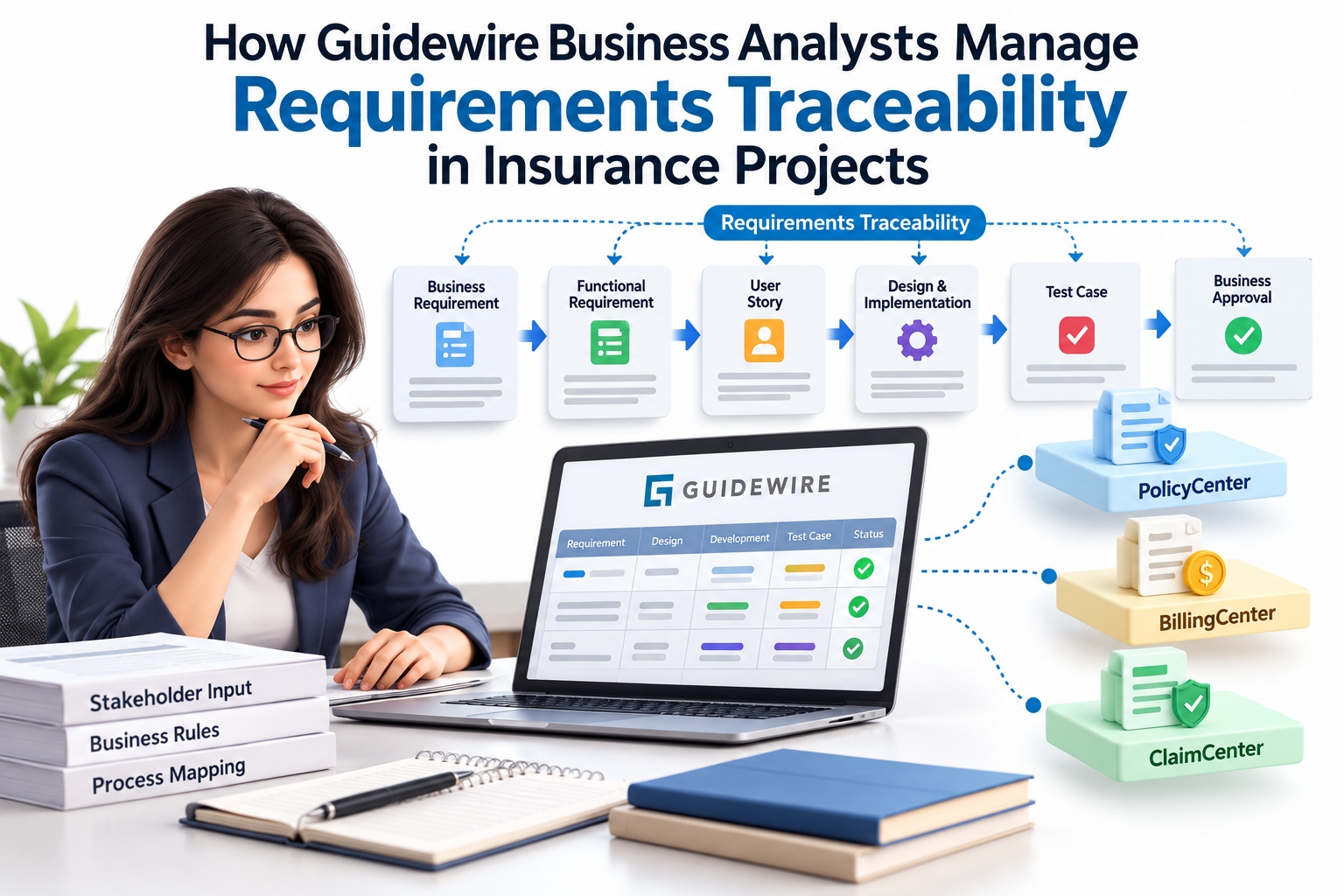
A single missing requirement can create unexpected problems in an insurance implementation. A policy rule may work incorrectly, a claims workflow may fail, or an important business condition may never reach testing. This is why requirements traceability matters.
Guidewire Business Analysts ensure that every business requirement has a clear purpose, documented solution, implementation reference, and testing outcome. Their responsibility goes beyond collecting requirements; they maintain alignment between business expectations and delivered functionality.
Understanding Requirements Traceability in Guidewire Projects
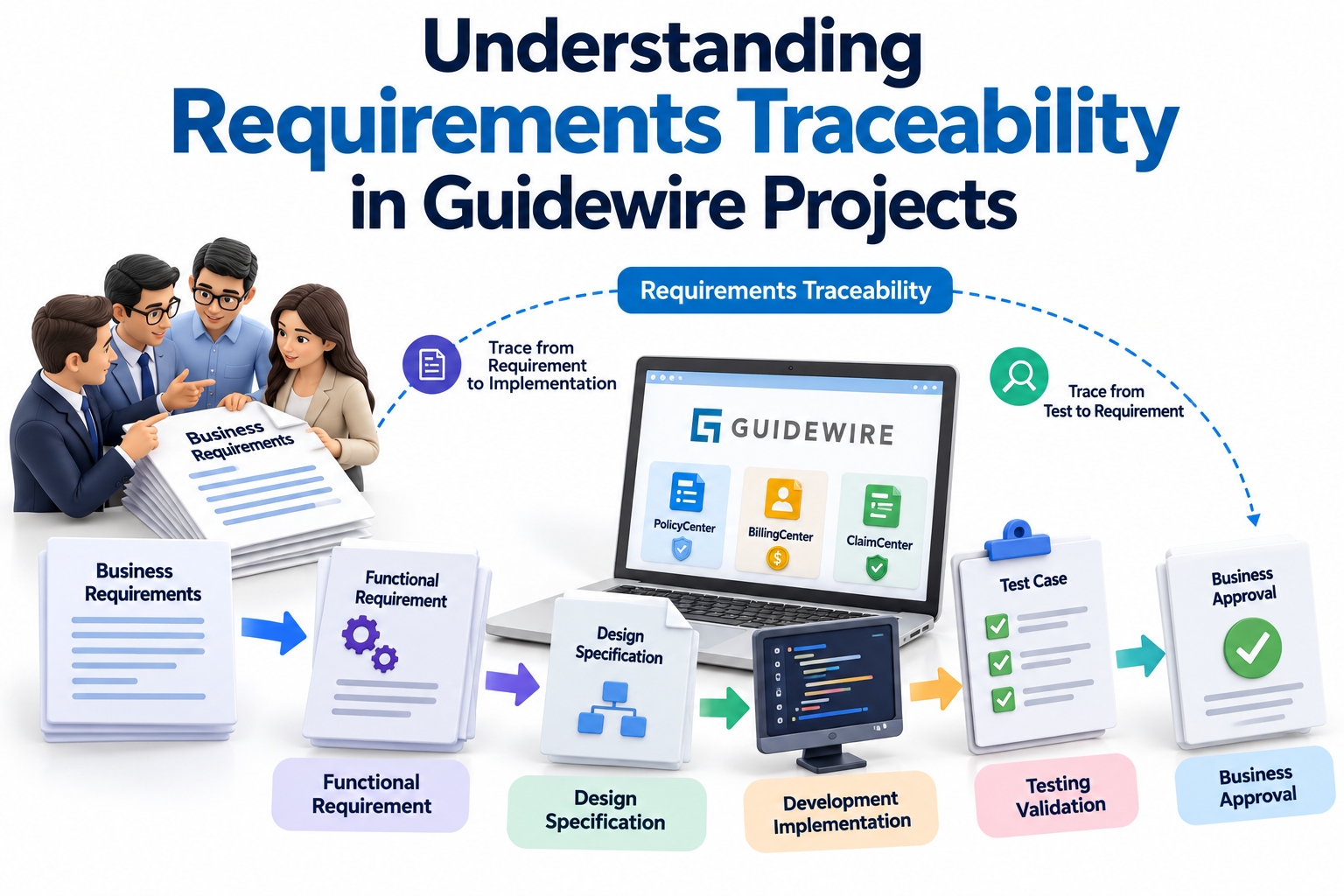
Requirements traceability is the process of tracking business requirements throughout the software development lifecycle. It establishes connections between stakeholder expectations, functional specifications, technical implementation, and testing activities.
In Guidewire projects, business analysts use traceability to ensure that insurance processes are implemented according to business rules. For example, an insurance company may require a specific underwriting condition before approving a new policy. The business analyst documents this requirement and connects it to the relevant PolicyCenter functionality, acceptance criteria, and test scenarios.
A typical requirement traceability relationship includes:
Business requirement: What the insurance organization needs.
Functional requirement: How the system should behave.
User story: What functionality must be delivered.
Acceptance criteria: Conditions for successful completion.
Development reference: Where the functionality is implemented.
Test case: How the requirement will be validated.
Business approval: Confirmation that the expected outcome is achieved.
This approach helps prevent requirements from being overlooked during implementation. It also provides a reliable reference when stakeholders question whether a particular business expectation has been delivered.
Creating a Requirements Traceability Matrix for Insurance Workflows
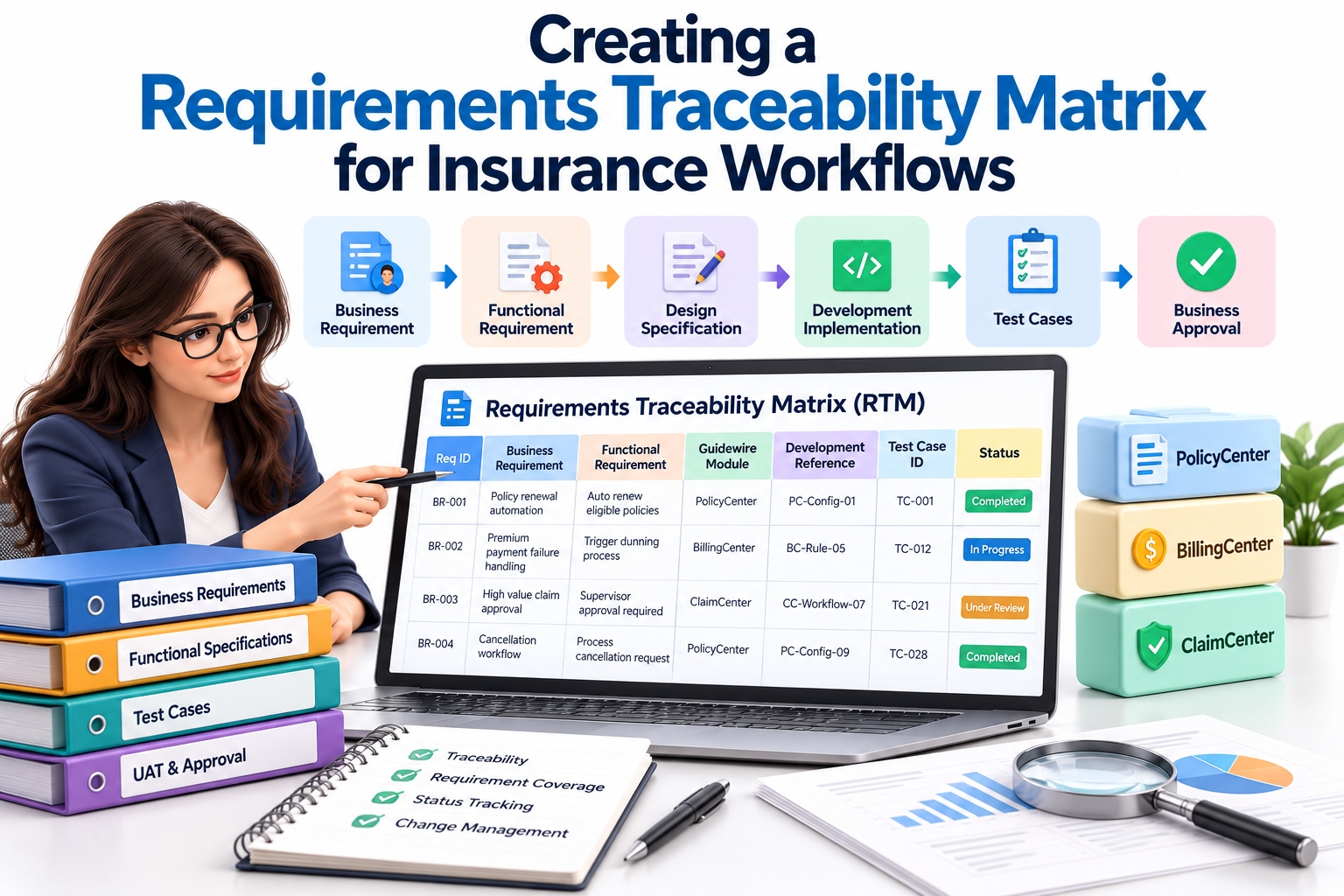
A Requirements Traceability Matrix (RTM) is one of the most important documents used by business analysts to monitor requirement coverage. It connects individual requirements with their corresponding design specifications, development activities, and test cases.
For example, consider an insurance company implementing a new policy renewal process in Guidewire PolicyCenter. The business requirement might specify that eligible policies should be renewed automatically unless certain underwriting conditions require manual review.
The business analyst records this requirement with a unique identification number and connects it to the relevant functional specifications and test scenarios.
An effective RTM generally includes:
Requirement ID and description.
Business owner and requirement source.
Related Guidewire module.
Priority and business impact.
Functional specification reference.
Development or configuration reference.
Acceptance criteria.
Associated test case IDs.
Requirement status and approval details.
Business analysts regularly update this matrix as requirements move through different delivery stages.
The RTM should also capture requirement changes, ownership, dependencies, and outstanding questions. Maintaining these details helps project teams identify incomplete work and understand which requirements need additional validation before release.
Mapping Requirements Across PolicyCenter, BillingCenter, and ClaimCenter
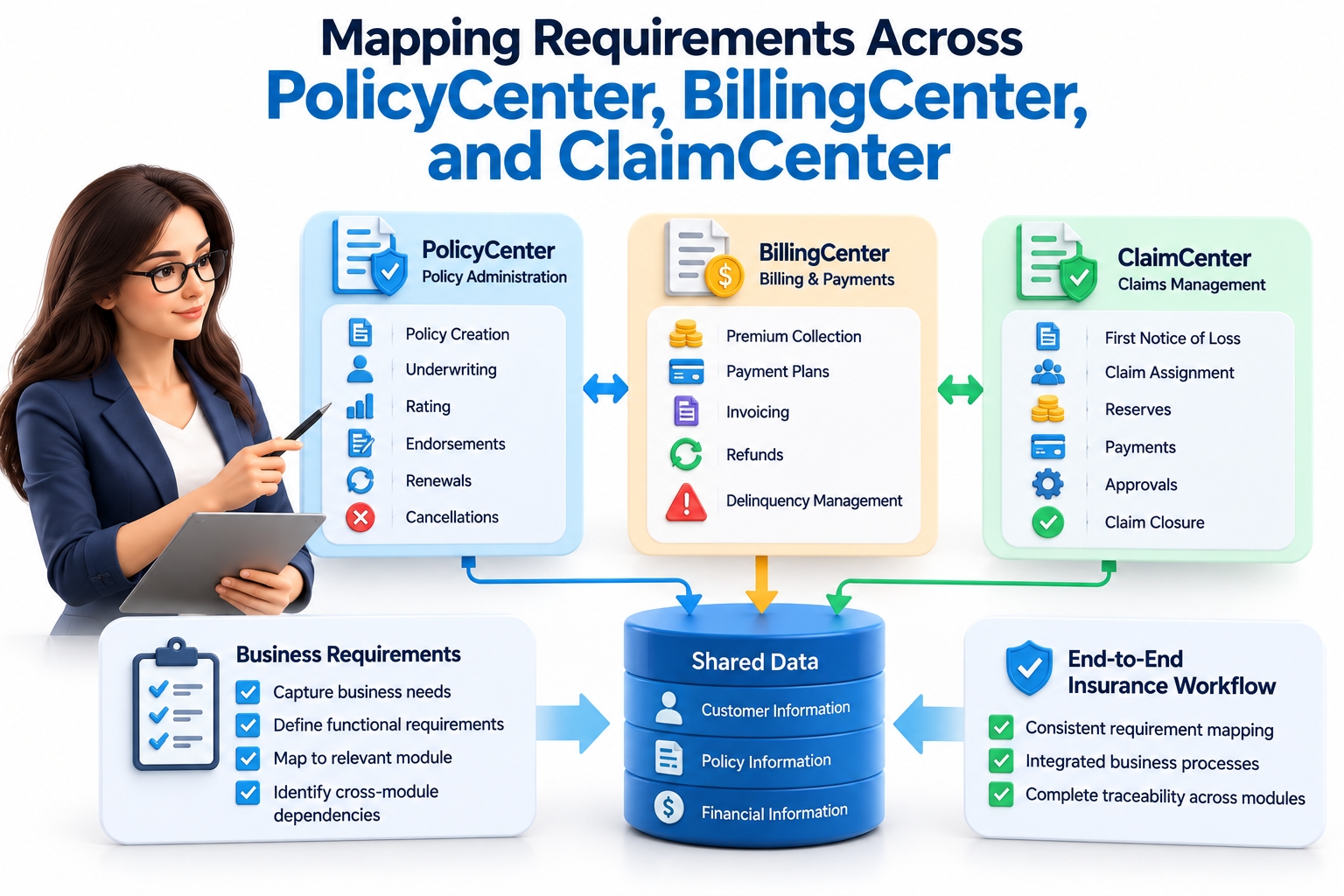
Insurance projects involve multiple business processes, and each Guidewire module supports different operational requirements. Business analysts must understand these differences when establishing traceability.
In PolicyCenter, requirements commonly relate to policy creation, underwriting, rating, endorsements, renewals, and cancellations. For example, a requirement stating that certain vehicle categories need additional underwriting approval must be connected to the appropriate business rules and test scenarios.
In BillingCenter, traceability focuses on financial operations such as premium collection, payment plans, invoicing, refunds, and delinquency management. A requirement concerning failed automatic payments should connect the expected business response with the relevant billing functionality and validation scenarios.
ClaimCenter requirements often involve first notice of loss, claim assignment, reserves, payments, approvals, and claim closure. A requirement specifying that claims above a particular financial threshold need supervisor approval must be traceable through the documented workflow and corresponding tests.
Business analysts working across these modules should consider:
Business process dependencies between modules.
Shared customer, policy, and financial information.
Integration requirements with external applications.
Role-based access and approval responsibilities.
End-to-end testing across connected workflows.
Professionals developing these capabilities through Guidewire Training in Bangalore and Guidewire Business Analyst Training should understand how insurance requirements connect with actual application functionality.
This module-level approach ensures that individual requirements are not treated as isolated tasks. It helps maintain consistency across the complete insurance business process.
Managing Requirement Changes and Impact Analysis
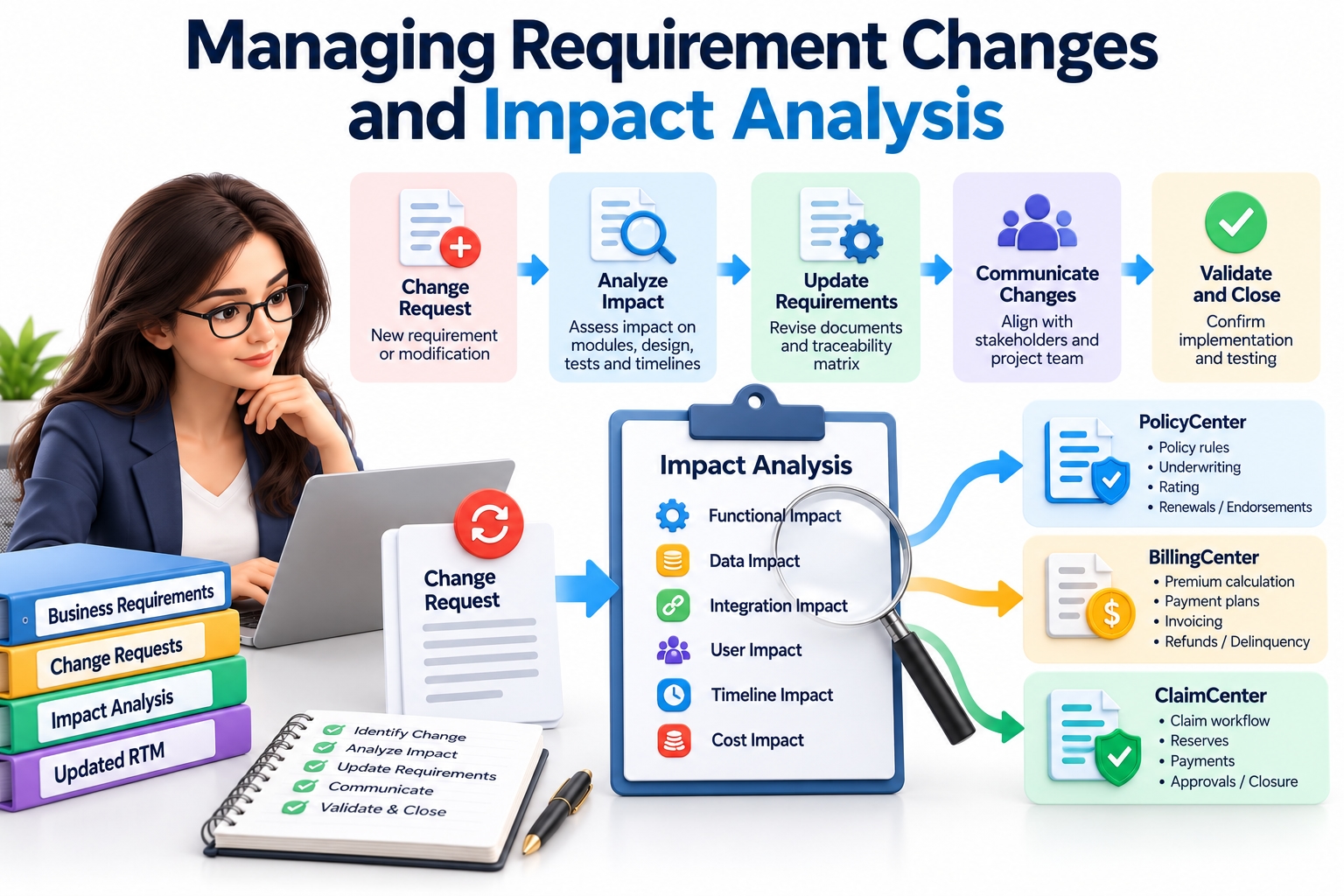
Insurance requirements frequently change during implementation. Regulatory updates, underwriting decisions, business policy changes, and customer feedback can introduce new requirements or modify existing ones.
Without proper traceability, even a small change can affect several application components and testing activities.
For example, an insurance company may decide to introduce a new deductible condition for a particular insurance product. The business analyst must identify the original requirement, understand the affected product rules, and evaluate the impact on related functionality.
The change management process generally involves:
Recording the requested requirement change.
Identifying its business objective and justification.
Reviewing existing requirement relationships.
Evaluating affected workflows and system components.
Identifying impacted user stories and test cases.
Obtaining approval from relevant stakeholders.
Updating the RTM and associated documentation.
Business analysts also need to maintain requirement version history. This helps teams distinguish between previously approved requirements and newly introduced changes.
Impact analysis becomes particularly important during Guidewire upgrades, cloud migration, and major enhancement projects. A change that appears limited to one business process may affect integrations, reports, data mapping, or downstream operations.
A well-maintained traceability structure helps project teams estimate the impact before implementing changes. It also reduces misunderstandings between business stakeholders and technical teams.
Connecting Requirements Traceability with Agile Development and UAT
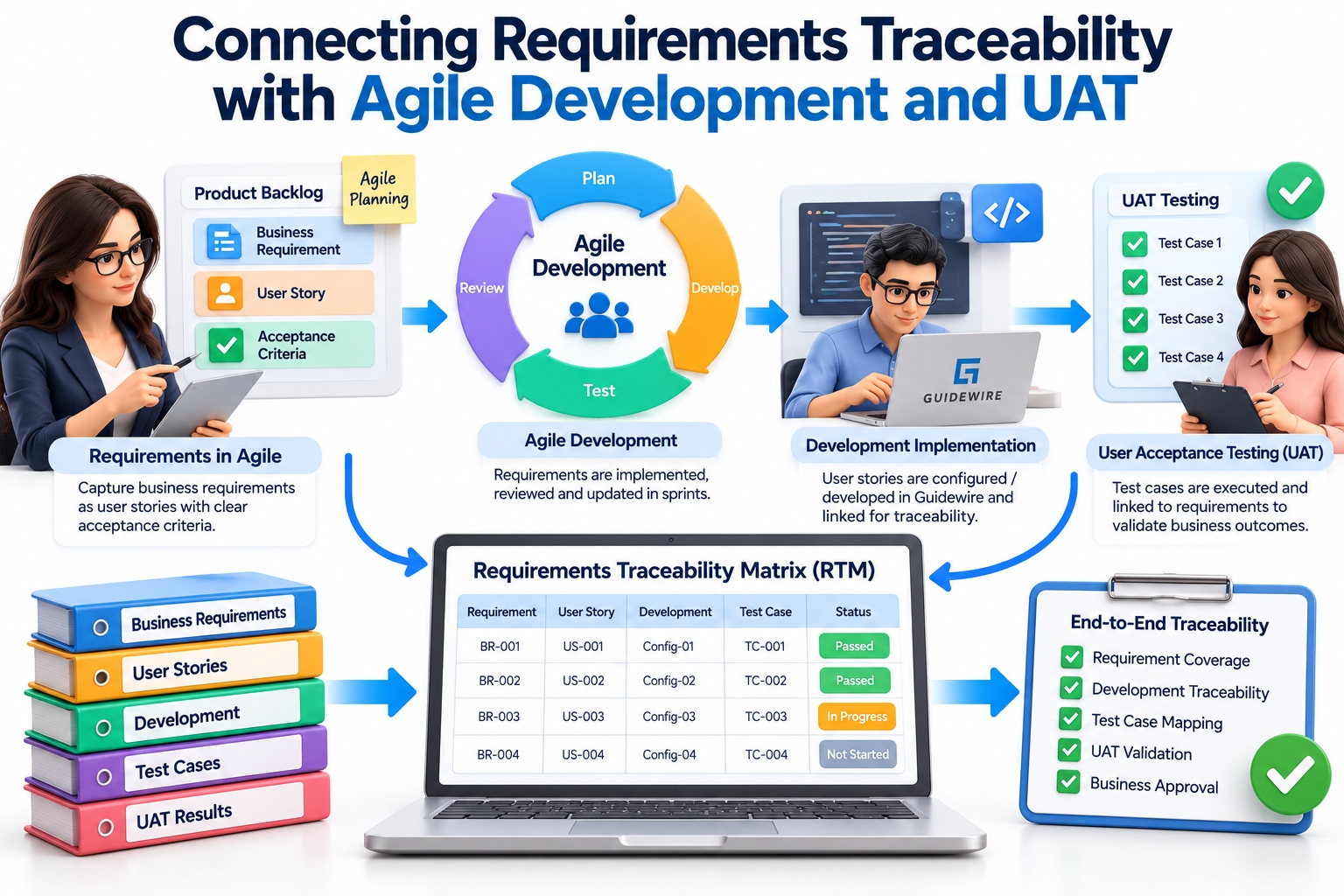
Modern Guidewire implementations frequently use Agile delivery practices. Requirements are organized into epics, features, and user stories, which are developed and validated through successive sprints.
Business analysts play an important role in maintaining traceability within this environment. They ensure that every user story has a clear connection to an approved business requirement and measurable acceptance criteria.
For example, a PolicyCenter user story might describe the ability to generate renewal offers for eligible policies. Its acceptance criteria could specify eligibility conditions, required information, and expected system behavior.
During sprint planning and backlog refinement, the business analyst verifies that the development team understands the requirement. During implementation, the analyst clarifies business rules and resolves functional questions.
Traceability also becomes essential during User Acceptance Testing (UAT).
Business analysts connect approved requirements with UAT scenarios so business users can verify whether the implemented solution meets operational expectations.
Important UAT activities include:
Identifying test scenarios for every critical requirement.
Confirming that acceptance criteria are testable.
Mapping test results to requirement IDs.
Recording defects against affected requirements.
Coordinating retesting after defect resolution.
Obtaining business approval for completed functionality.
For example, if a renewal workflow fails when a policy contains a specific underwriting condition, the business analyst can trace the defect back to the original requirement and related test scenario.
This makes defect investigation more structured and ensures that fixing one issue does not introduce another requirement gap.
Tools, Documentation, and Best Practices for Effective Traceability
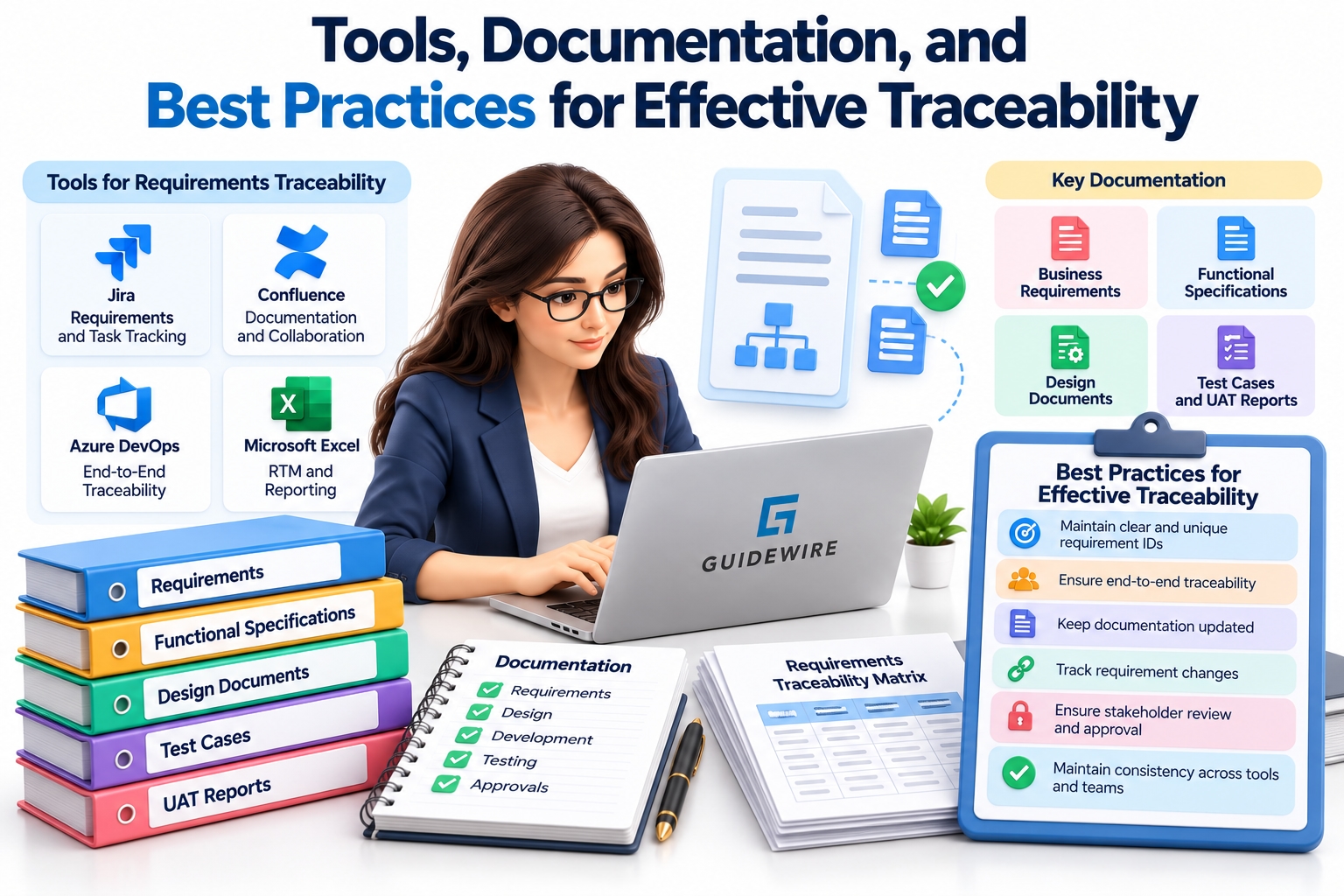
Maintaining traceability across a large insurance implementation requires consistent documentation and effective collaboration. Business analysts commonly work with tools such as Jira, Confluence, Azure DevOps, and Microsoft Excel to organize requirements and monitor delivery progress.
Jira can help connect epics, user stories, acceptance criteria, and development tasks. Confluence provides a shared space for business requirements, functional documentation, and meeting decisions. Azure DevOps supports backlog management, work-item relationships, and test planning.
However, selecting a tool is only one part of successful traceability. Business analysts must establish clear documentation standards and ensure that project participants follow them.
Some important practices include:
Use unique requirement IDs: Every requirement should have a permanent identifier to simplify tracking.
Maintain bidirectional traceability: Connect business needs to implementation and testing while allowing teams to identify the original source of delivered functionality.
Review requirements regularly: Update the RTM during sprint reviews, requirement changes, and testing cycles.
Assign clear ownership: Identify who is responsible for approving, updating, and validating each requirement.
Track requirement coverage: Identify requirements without development references or associated test cases.
Maintain an audit trail: Record approvals, changes, decisions, and outstanding issues.
JastTech emphasizes practical knowledge of insurance workflows, business analysis, and Guidewire implementation concepts. Understanding how documentation connects with actual project activities helps aspiring business analysts develop the skills needed for implementation and consulting roles.
Conclusion
Requirements traceability is essential for delivering reliable Guidewire insurance solutions. Business analysts use it to maintain connections between stakeholder expectations, functional requirements, application configuration, development activities, and testing outcomes. A properly maintained RTM improves visibility, reduces requirement gaps, and supports effective change management throughout the project lifecycle.
As insurance organizations continue investing in Guidewire implementations, cloud adoption, and digital transformation, the ability to manage requirements systematically becomes increasingly valuable. Business analysts who understand PolicyCenter, BillingCenter, ClaimCenter, Agile delivery, and end-to-end traceability can contribute more effectively to project success and build stronger careers in the insurance technology industry.



