
Choosing between a Guidewire Business Analyst and a Guidewire Developer depends on your skills, interests, and long-term career goals. Both roles contribute to the development and implementation of insurance software, but their responsibilities differ. A Business Analyst focuses on understanding business requirements, communicating with stakeholders, documenting workflows, and translating insurance needs into functional specifications. A Guidewire Developer, on the other hand, works more closely with technical implementation, including configuration, Gosu programming, integrations, and customising Guidewire applications such as PolicyCenter, ClaimCenter, and BillingCenter.
For beginners and working professionals exploring these career options, understanding the day-to-day responsibilities of each role can make the decision easier. Guidewire Business Analyst training can help learners develop skills in requirement gathering, insurance processes, functional documentation, and stakeholder communication, while aspiring developers can focus on programming, application configuration, and system integration. Rather than choosing a track based only on salary or job titles, consider your existing experience, comfort with technical problem-solving, communication skills, and the type of work you want to pursue throughout your career.
Understanding the Roles of a Guidewire Business Analyst and a Guidewire Developer
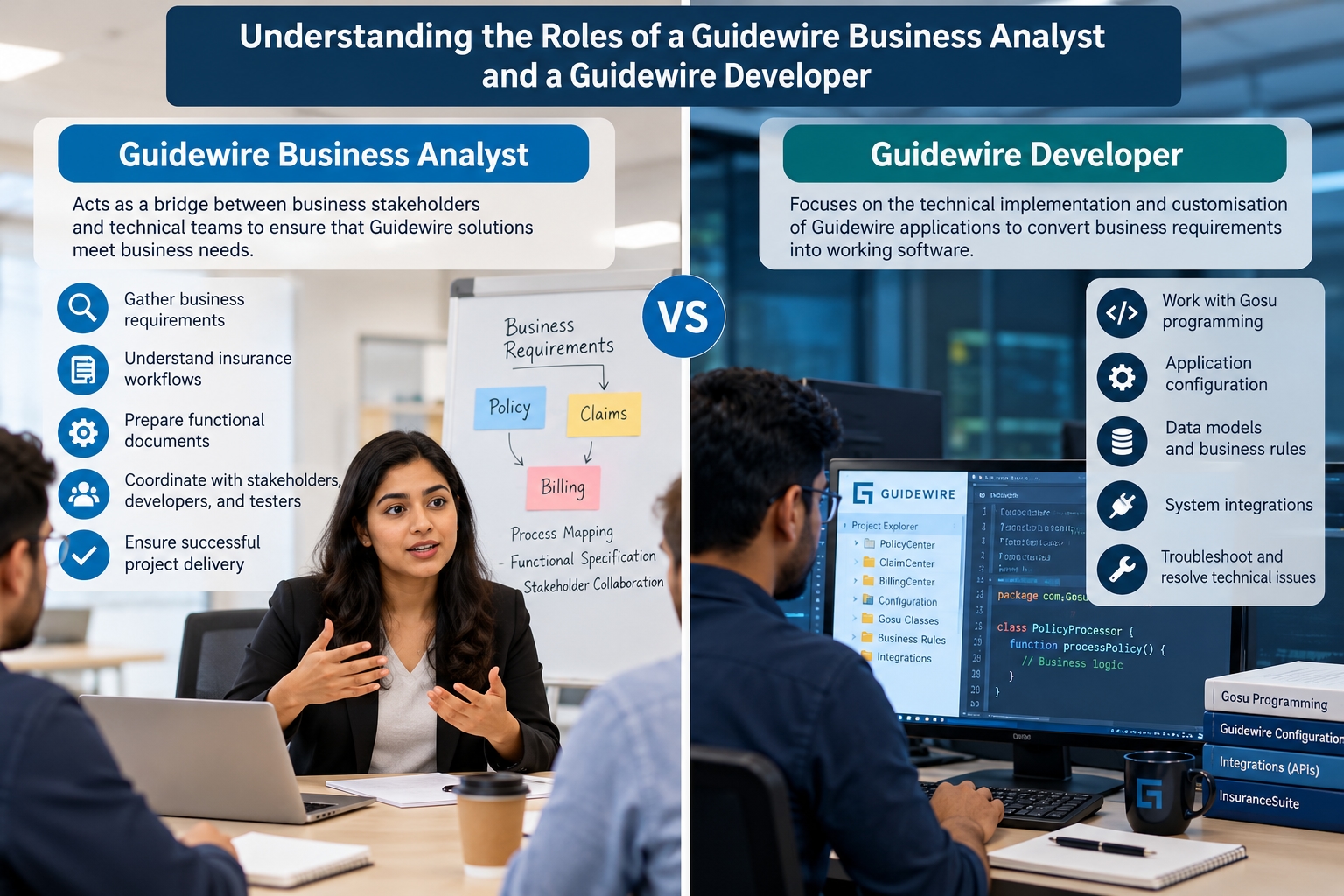
A Guidewire Business Analyst acts as a bridge between business stakeholders and technical teams in insurance software projects. The role involves gathering business requirements, understanding insurance workflows, preparing functional documents, and ensuring that the Guidewire solution meets business needs. Business Analysts also coordinate with developers, testers, and clients to clarify requirements and support successful project delivery.
A Guidewire Developer focuses on the technical implementation and customisation of Guidewire applications, including PolicyCenter, ClaimCenter, and BillingCenter. Developers work with Gosu programming, application configuration, data models, business rules, and system integrations. Their primary responsibility is to convert functional requirements into working software while ensuring that the application performs according to the project's technical and business specifications.
Although both professionals work toward the same project goals, their daily responsibilities differ. Business Analysts concentrate on requirements, documentation, and communication, whereas Developers focus on coding, configuration, and technical problem-solving. Choosing between these roles depends on your interests, existing skills, and preferred work style. Understanding these differences helps you identify the career path that best matches your professional goals.
Key Skills Required for Guidewire Business Analysts vs. Developers
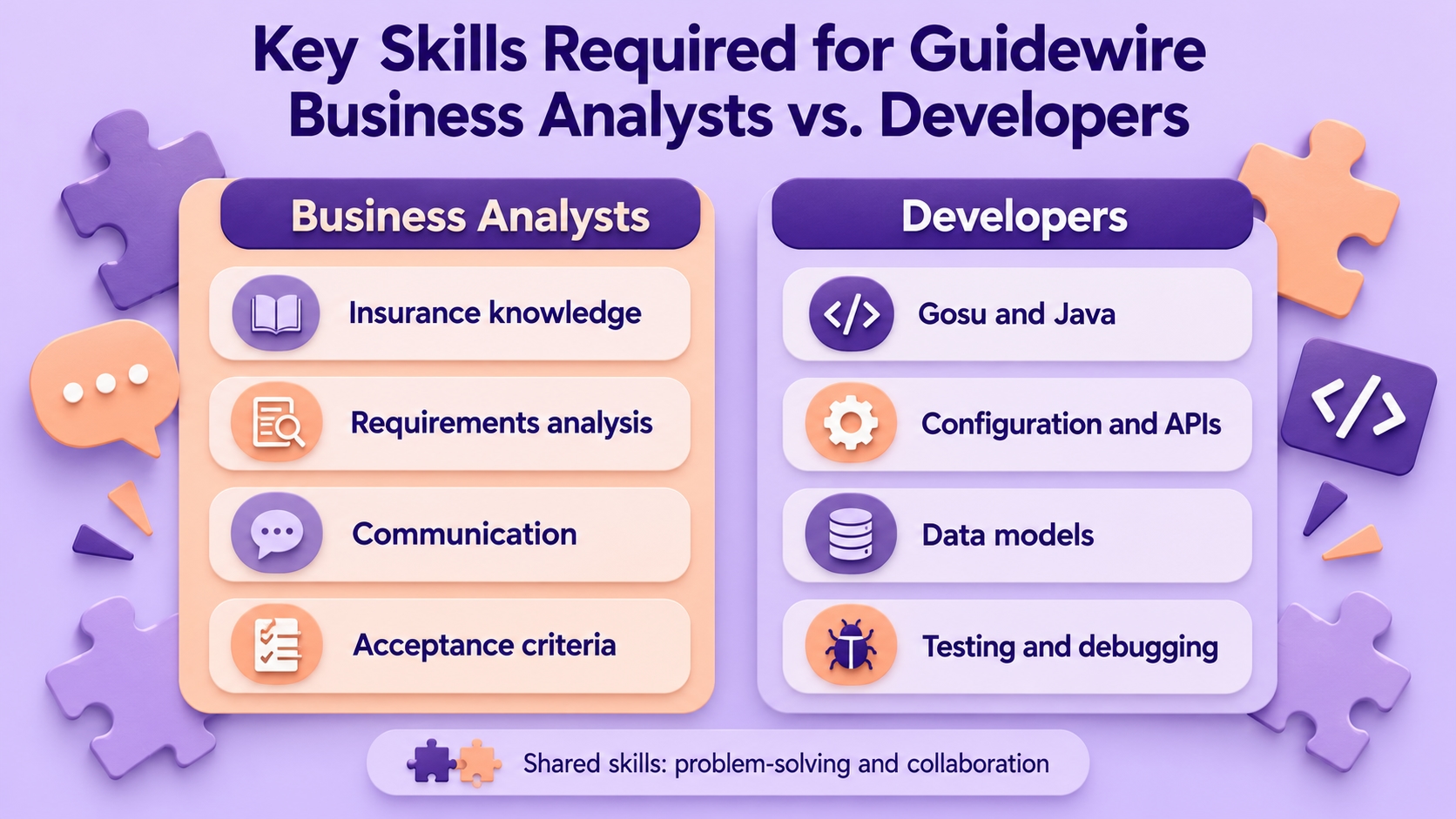
A Guidewire Business Analyst needs strong communication, analytical thinking, requirement gathering, and documentation skills. Understanding insurance processes such as policy administration, claims management, and billing is also important. Business Analysts should be comfortable preparing functional specifications, coordinating with stakeholders, and explaining business requirements clearly to technical teams.
A Guidewire Developer requires technical skills in Gosu programming, Guidewire application configuration, data models, business rules, and system integrations. Familiarity with PolicyCenter, ClaimCenter, BillingCenter, APIs, and SQL can also be valuable. Developers need logical thinking and problem-solving abilities to implement requirements, troubleshoot issues, and maintain reliable insurance applications.
Both career paths require a solid understanding of the Guidewire ecosystem, but the depth of technical knowledge differs. Professionals exploring a Guidewire course in Hyderabad can evaluate whether they prefer business-focused responsibilities or hands-on development. The right learning path should match their existing experience, technical interests, and long-term career goals rather than simply following market trends.
Guidewire Business Analyst vs. Developer: Tools, Modules, and Technologies

The tools, modules, and technologies used by Guidewire Business Analysts and Guidewire Developers vary according to their responsibilities in an insurance software project. Business Analysts focus on understanding business requirements, documenting workflows, and ensuring that Guidewire applications support insurance operations. Developers concentrate on configuring applications, implementing business rules, writing code, and integrating systems. Both roles require familiarity with Guidewire InsuranceSuite, particularly PolicyCenter, ClaimCenter, and BillingCenter, although their depth of technical involvement differs.
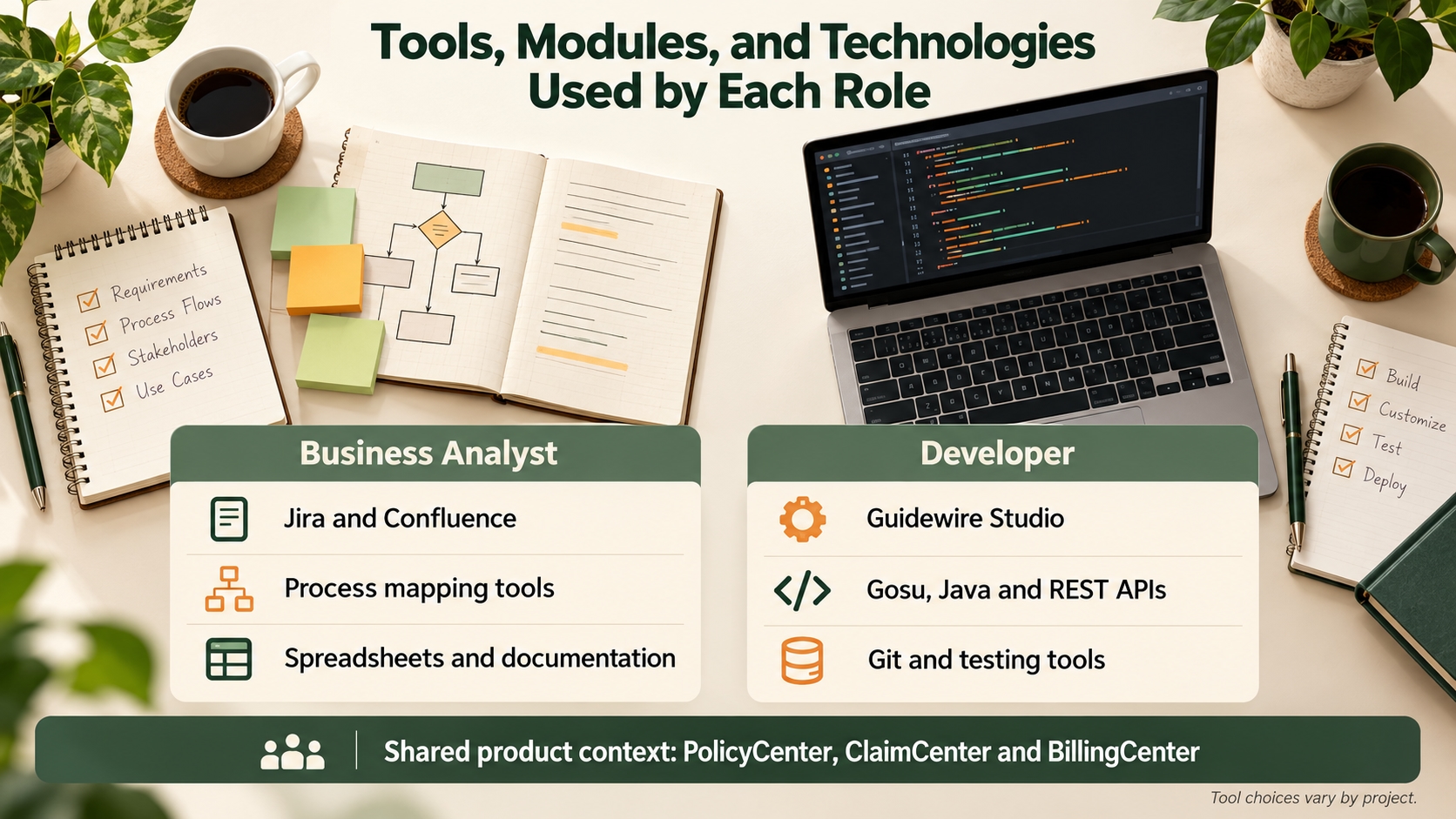
Guidewire Business Analysts commonly work with requirement documentation, process mapping, Agile project management tools, and functional testing activities. Developers use technical environments such as Guidewire Studio and technologies including Gosu, APIs, SQL, and integration frameworks. The tools selected for a project depend on its architecture, implementation approach, and client requirements. Understanding these differences helps aspiring professionals choose a suitable career path and identify the skills they need to develop.
Tools, Modules, and Technologies Used by Each Role
Guidewire Business Analyst
Guidewire modules: PolicyCenter, ClaimCenter, and BillingCenter for understanding policy administration, claims processing, and billing workflows.
Project management tools: Jira and Confluence for tracking requirements, documenting processes, and collaborating with teams.
Documentation tools: Microsoft Word, Excel, and Visio for functional specifications, requirement documents, and process diagrams.
Business analysis techniques: User stories, use cases, acceptance criteria, and business process mapping.
Testing tools and activities: Test scenarios, requirement validation, and User Acceptance Testing (UAT).
Guidewire Developer
Guidewire modules: PolicyCenter, ClaimCenter, and BillingCenter for application configuration and customisation.
Development environment: Guidewire Studio for working with application configurations and Gosu code.
Programming languages: Gosu and, where required by the project, Java.
Integration technologies: REST and SOAP APIs, XML, JSON, and Guidewire integration services.
Database and version control: SQL for data-related tasks and Git for source code management.
Build and deployment tools: Jenkins and CI/CD pipelines where used by the project.
These tools and technologies reflect common industry practices; specific requirements vary across employers and Guidewire implementations.
Career Opportunities and Job Responsibilities in the Guidewire Ecosystem

Career opportunities in the Guidewire ecosystem extend across insurance technology, software implementation, consulting, and digital transformation projects. Professionals can pursue roles such as Guidewire Business Analyst, Guidewire Developer, Functional Consultant, Technical Consultant, QA Engineer, Integration Developer, and Solution Architect. Business Analysts generally work with insurance companies, product owners, and development teams to understand business needs and translate them into functional requirements. Their responsibilities may include analysing insurance workflows, preparing user stories, documenting processes, coordinating testing, and ensuring that the implemented solution meets business expectations.
Developers have a different career path, focusing on configuring Guidewire applications, developing business rules, building integrations, troubleshooting technical issues, and supporting application upgrades. With practical project experience, they may progress to Senior Guidewire Developer, Integration Specialist, Technical Lead, or Solution Architect, while Business Analysts can advance toward Senior Business Analyst, Lead Business Analyst, or Functional Consultant positions. Current Guidewire job listings in India include specialised PolicyCenter Business Analyst and Integration Developer roles, illustrating the range of opportunities available. Career growth in either track depends on hands-on experience, insurance domain knowledge, communication or technical skills, and the ability to deliver effective solutions for real business problems.
Salary Comparison: Guidewire Business Analyst vs. Guidewire Developer
The salary of a Guidewire Business Analyst or Guidewire Developer in India depends on experience, technical expertise, insurance domain knowledge, and the hiring company. Business Analysts with strong knowledge of PolicyCenter, ClaimCenter, BillingCenter, requirement gathering, and insurance workflows can qualify for well-paying roles. Developers with experience in Gosu programming, application configuration, and system integrations can also command competitive salaries. Neither career track guarantees a higher salary in every organisation.
According to Glassdoor's India salary data, Guidewire Business Analyst salaries show a reported base-pay range of approximately ₹4 lakh to ₹14.6 lakh per year, with an average base pay of around ₹8 lakh per year. A separate job listing published in August 2026 quoted budgets of ₹26–32 lakh per annum for experienced Guidewire Business Analyst roles and ₹19 lakh for a Guidewire Developer role with 6–9 years of experience. These figures are indicative examples, not definitive market averages, and actual compensation varies by employer and candidate profile.
When comparing these career paths, consider long-term earning potential rather than focusing only on starting salaries. Business Analysts can progress toward Lead Business Analyst, Functional Consultant, or Business Analyst Manager positions, while Developers can move into Technical Lead, Integration Specialist, or Solution Architect roles. Advanced expertise, relevant certifications, project experience, and the ability to solve complex business or technical problems can improve earning prospects in either track. The better choice is the one that matches your strengths and offers a realistic path for professional growth.
Conclusion
Choosing between a Guidewire Business Analyst and a Guidewire Developer depends on your skills, interests, and long-term career goals. A Business Analyst role is suitable for professionals who enjoy understanding insurance processes, gathering requirements, communicating with stakeholders, and documenting business needs. A Developer role is better suited to those who prefer programming, application configuration, system integration, and technical problem-solving. Both paths offer opportunities to grow within the Guidewire ecosystem, but career progression depends on practical experience and specialised knowledge.
Before making a decision, evaluate your existing skills, preferred responsibilities, and future career plans rather than focusing only on salary. Developing expertise in Guidewire applications such as PolicyCenter, ClaimCenter, and BillingCenter can help you build a stronger foundation for either track. Whether you pursue Guidewire Business Analyst training or focus on technical development, prioritise hands-on project experience and a clear understanding of insurance workflows to prepare for the demands of real-world projects.



