
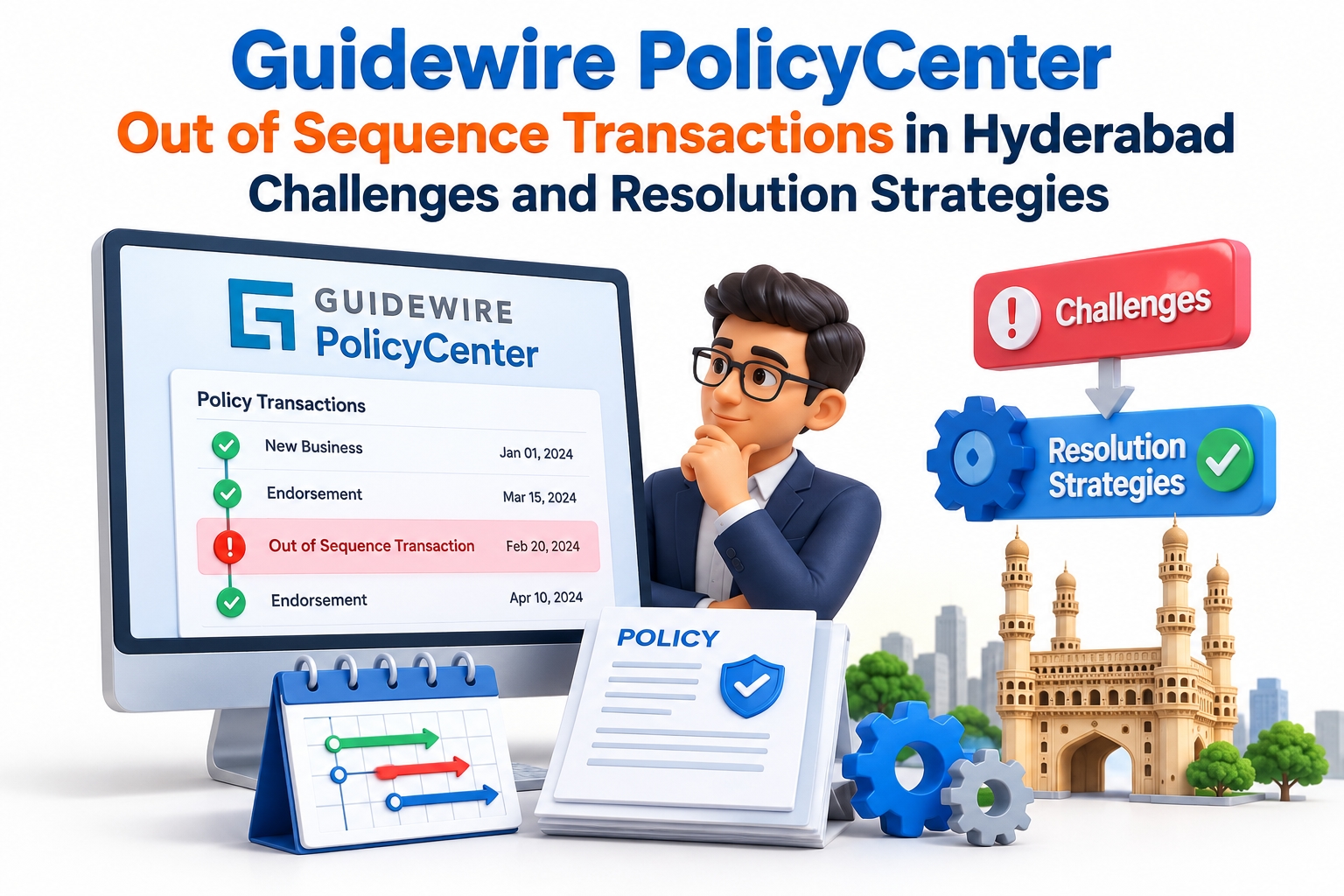
Insurance policies rarely change in perfect chronological order. A customer may request a backdated endorsement after another policy modification has already been completed. Such situations create out-of-sequence transactions in Guidewire PolicyCenter, making effective-dated data management essential.
For Guidewire developers working on insurance technology projects in Hyderabad, understanding these transactions is critical. Incorrect conflict resolution can affect policy coverage, premium calculations, underwriting decisions, and downstream integrations, creating operational challenges for insurers.
Understanding Out-of-Sequence Transactions in Guidewire PolicyCenter
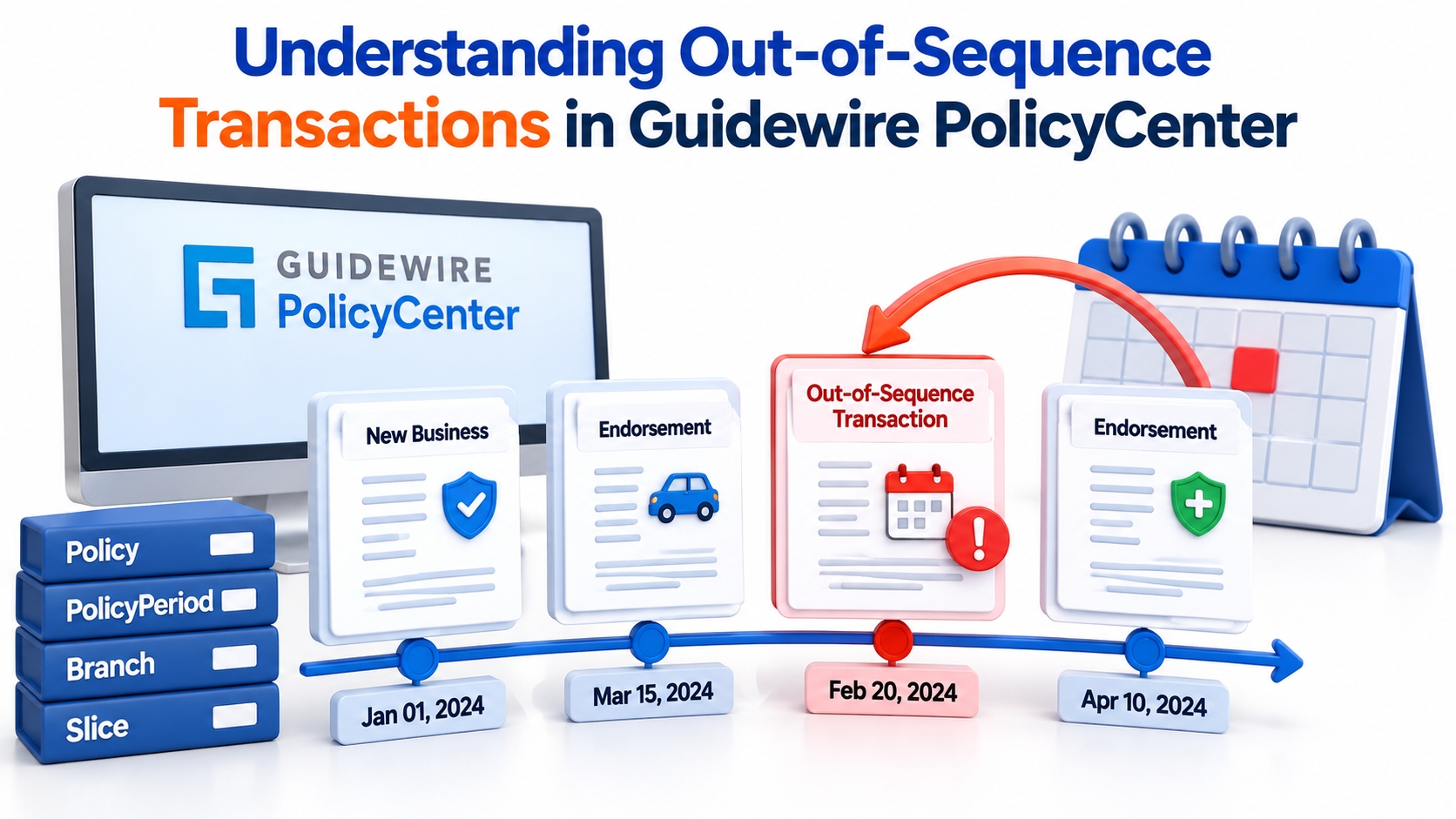
An out-of-sequence (OOS) transaction occurs when a policy transaction is processed after another transaction but has an earlier effective date. Guidewire PolicyCenter supports these situations through its effective-dated data model, allowing insurers to manage historical policy changes while maintaining consistent policy information.
Consider a motor insurance policy with the following transactions:
January 1: A motor insurance policy becomes effective.
March 15: An endorsement adding a vehicle becomes effective and is bound.
April 10: The customer requests another endorsement effective February 20.
Result: The February 20 endorsement is out of sequence because it is processed after the March 15 transaction.
The challenge arises when the backdated endorsement modifies information already affected by the later transaction. PolicyCenter must determine how the earlier modification influences subsequent policy states.
Not every out-of-sequence transaction creates a conflict. For example, updating an unrelated field may not interfere with an existing endorsement. However, modifying the same coverage, insured object, or policy attribute can require conflict resolution.
Understanding this distinction helps developers avoid unnecessary modifications while preserving accurate insurance records.
Common Challenges in Managing Out-of-Sequence Policy Transactions
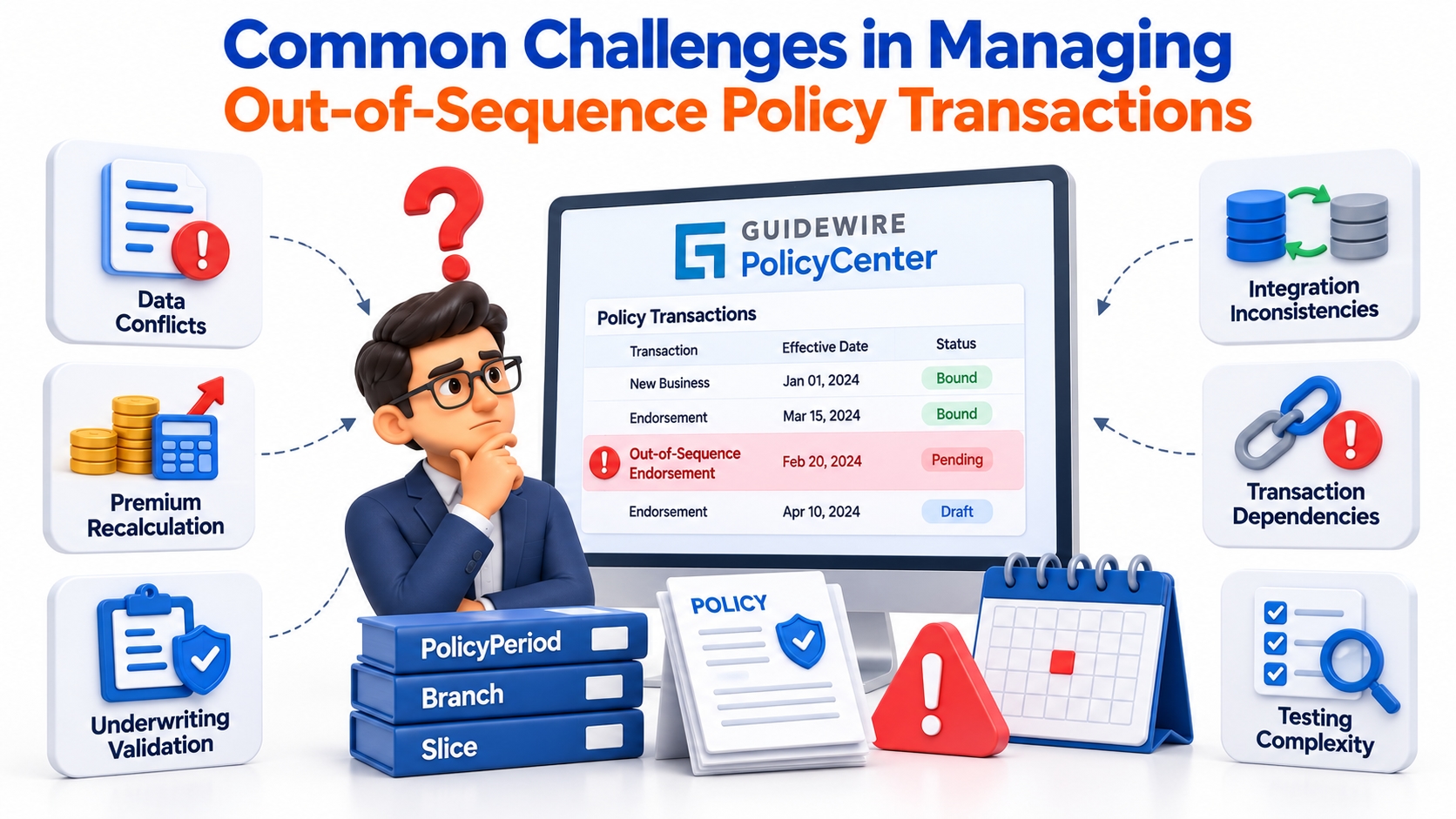
Out-of-sequence transactions introduce technical and business challenges because PolicyCenter must maintain a consistent policy timeline across multiple effective dates.
One major challenge involves conflicting policy information. Suppose an insurer changes a vehicle's coverage limit in March, but a backdated February endorsement modifies the same coverage. The system must determine which values should apply during each effective period.
Other common challenges include:
Data conflicts: Different transactions modify overlapping policy attributes.
Premium recalculation: Backdated changes may alter premiums for subsequent coverage periods.
Underwriting validation: Historical modifications may introduce new underwriting issues.
Integration inconsistencies: External applications may already contain information from later transactions.
Transaction dependencies: Changes involving insured objects or coverages may affect related entities.
Testing complexity: Developers must validate policy behavior across multiple effective dates.
These challenges become more significant when insurance applications interact with billing, document generation, and customer management systems.
For development teams handling Guidewire Integration Challenges, maintaining consistent transaction information across connected platforms is particularly important.
A successfully resolved PolicyCenter conflict does not automatically guarantee that every downstream system reflects the corrected business state. Integration workflows may require additional validation, reconciliation, or processing.
How Effective-Dated Data and Policy Branches Handle OOS Transactions
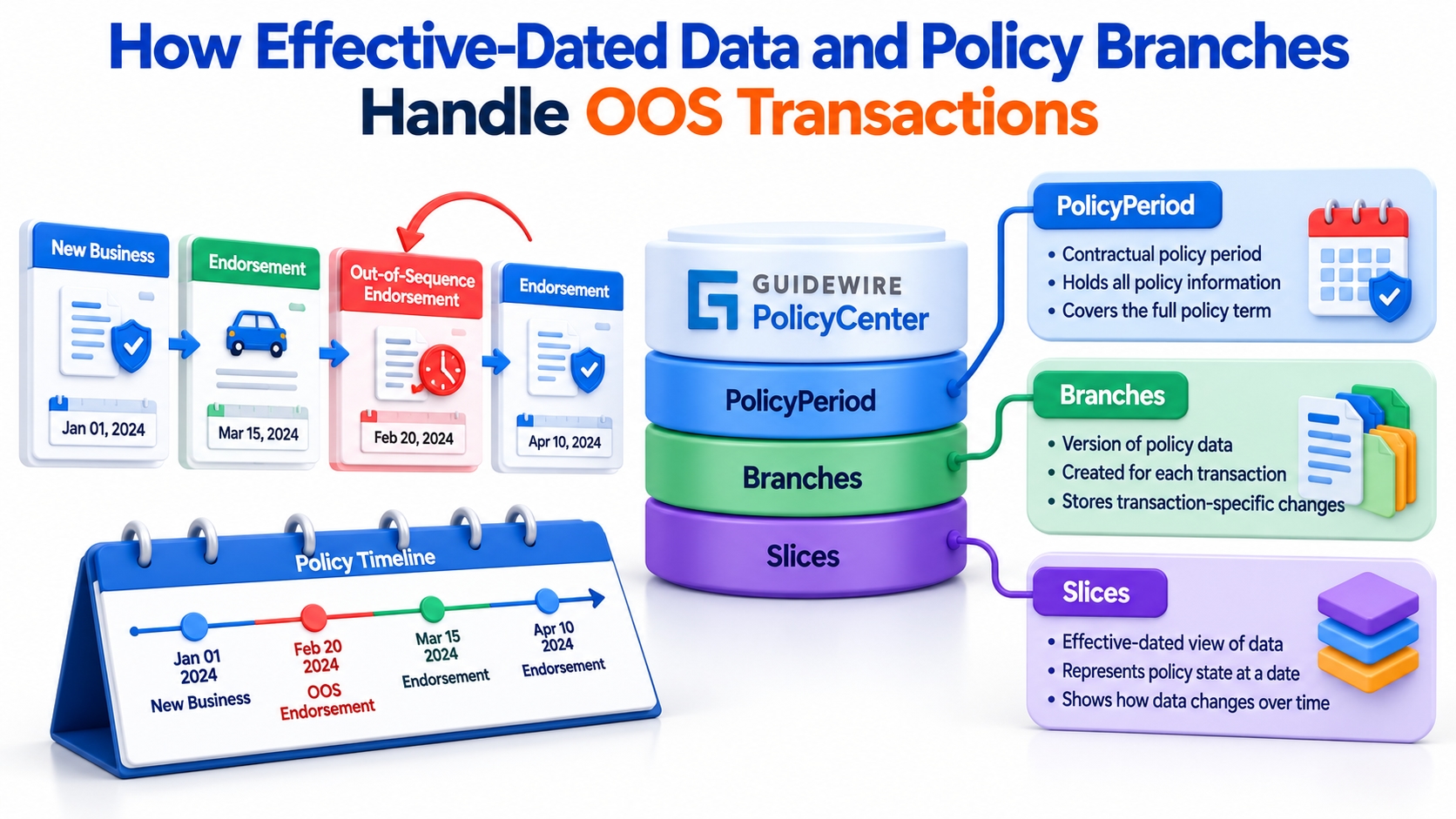
Guidewire PolicyCenter uses an effective-dated data model to represent how insurance information changes throughout a policy period.
Instead of storing only the latest policy values, the platform maintains information associated with specific effective periods. This allows developers to examine policy states at different points in time.
Three concepts are especially important:
PolicyPeriod: Represents a contractual policy period and its associated policy information.
Branch: Represents a version of policy data associated with a policy transaction.
Slice: Represents the policy information applicable at a particular effective date.
Suppose a policy has an initial coverage limit of ₹5 lakh. A March endorsement increases it to ₹8 lakh. Later, an endorsement effective February 1 modifies the coverage to ₹6 lakh.
The expected coverage timeline must be evaluated carefully:
January: ₹5 lakh coverage.
February: The backdated change introduces ₹6 lakh coverage.
March: The previously completed endorsement must be reconciled with the earlier modification.
The final March value depends on the applicable transaction changes and conflict-resolution decisions.
This is where effective-dated data handling becomes essential. Developers must understand how policy branches, effective dates, and entity changes interact.
Professionals pursuing guidewire policy center training should practice examining effective-dated entities, identifying overlapping modifications, and validating policy states after transaction processing.
These skills support accurate configuration and troubleshooting in enterprise insurance applications.
Identifying and Resolving Out-of-Sequence Conflicts in PolicyCenter
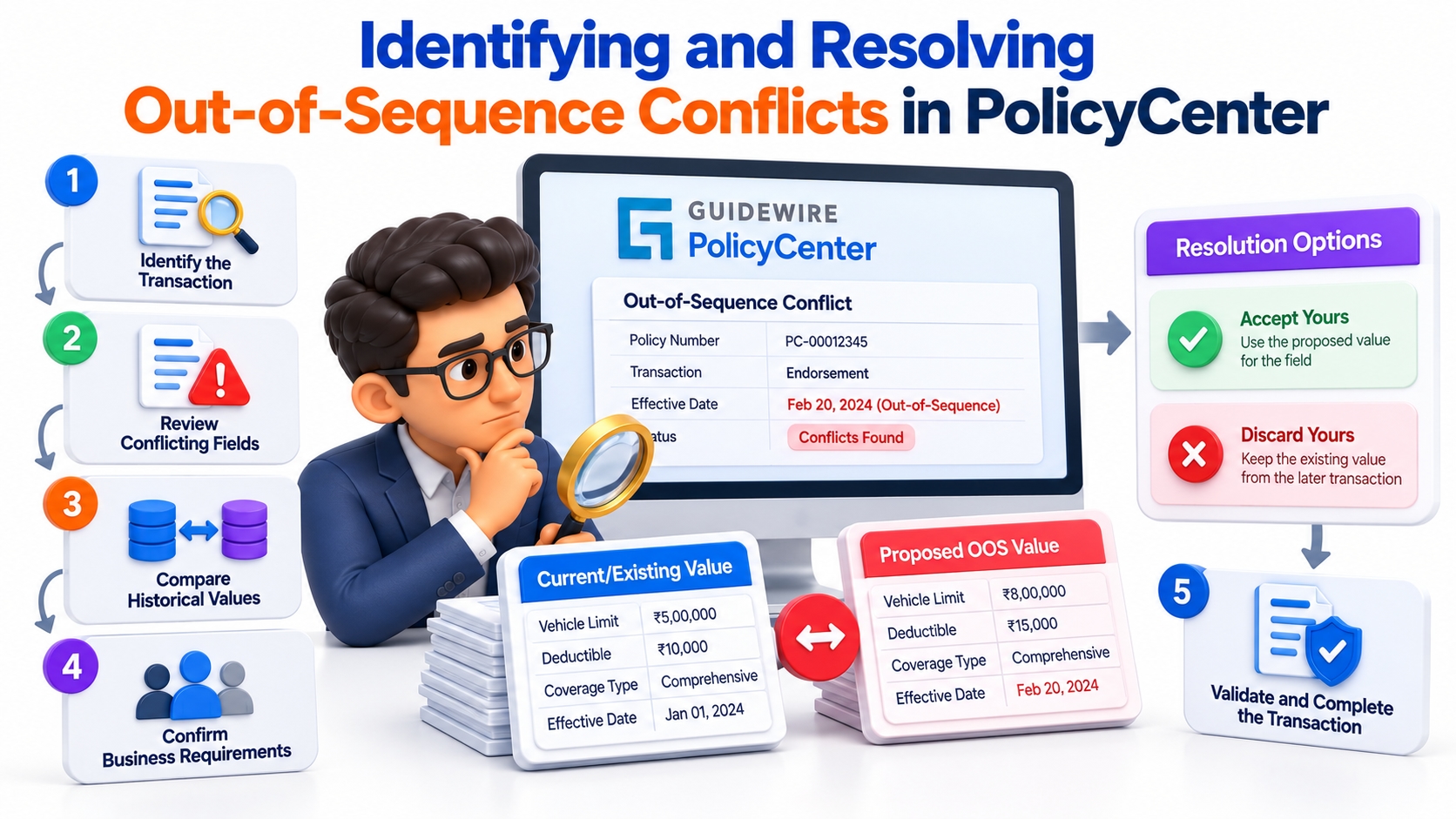
Resolving OOS conflicts requires understanding both the technical differences between transactions and the insurance business requirements behind those differences.
PolicyCenter provides mechanisms for identifying conflicting values and selecting appropriate resolutions. In supported Cloud API workflows, developers can retrieve conflict information through the Job API.
A practical resolution process involves the following steps:
Identify the affected transaction: Review the policy number, job, transaction type, and effective date.
Examine conflicting fields: Determine which policy attributes contain incompatible changes.
Compare historical values: Understand the original values and proposed modifications.
Confirm business requirements: Consult underwriting or business teams when necessary.
Select the appropriate resolution: Retain or discard conflicting changes according to the intended policy outcome.
Validate the result: Recheck policy information, quotation, and transaction processing.
For Cloud API integrations, the OOS conflict endpoint can retrieve conflict details associated with a job.
The resolution operation supports decisions such as acceptYours and discardYours, allowing callers to select between conflicting values. All identified conflicts must be addressed in the resolution request.
However, these selections should never be treated as automatic business decisions.
For example, retaining a newly proposed coverage value may be technically valid but inconsistent with an already approved endorsement.
Developers should therefore coordinate conflict resolution with business rules, underwriting requirements, and applicable approval workflows.
Best Practices for Preventing OOS Errors and Maintaining Data Consistency
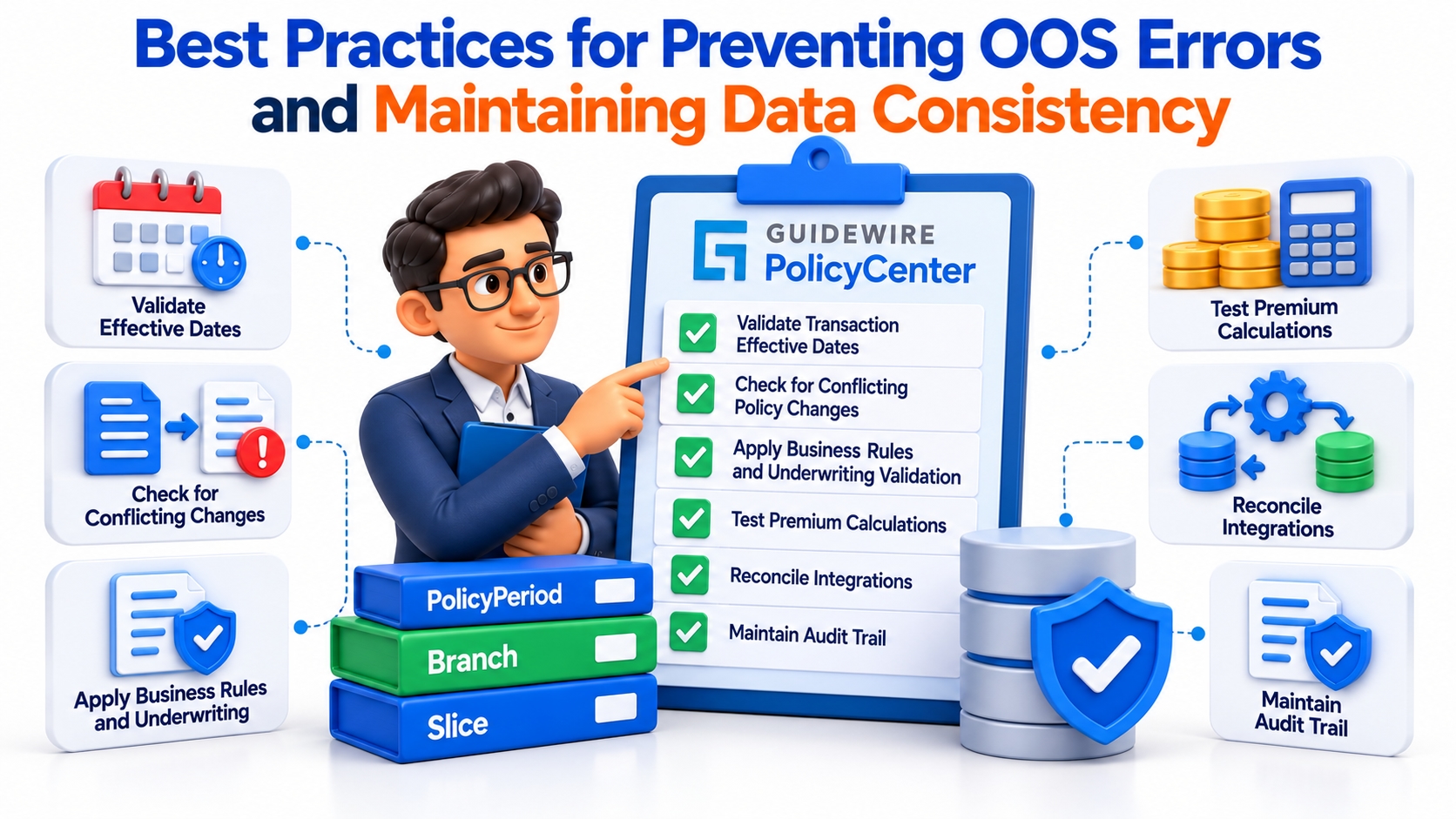
Although backdated transactions cannot always be avoided, development teams can reduce their operational impact through careful configuration, validation, and testing.
The first priority is understanding transaction dependencies. Before applying a backdated endorsement, teams should identify subsequent policy changes that could be affected.
Recommended practices include:
Validate transaction effective dates before processing.
Review existing endorsements within the affected policy period.
Use supported PolicyCenter transaction and conflict-resolution mechanisms.
Avoid directly modifying effective-dated database records.
Test premium calculations across affected coverage periods.
Verify underwriting rules against relevant future policy slices.
Maintain audit information for important resolution decisions.
Reconcile downstream systems when policy changes affect integrations.
Automated testing is particularly valuable because OOS defects may appear only under specific transaction sequences.
For example, a test scenario can create an original policy, bind a later endorsement, introduce a backdated modification, resolve the conflict, and verify the resulting policy timeline.
Testing should also cover situations where multiple fields conflict simultaneously.
Developers must distinguish OOS conflicts from preemption. Preemption occurs when concurrent jobs originate from the same base policy version and one is bound before another. Although the conditions differ, both may need attention in complex transaction workflows.
Combining effective-dated validation, regression testing, and integration monitoring helps reduce production defects and maintain reliable insurance operations.
Building Practical Guidewire OOS Transaction Skills for Hyderabad Careers
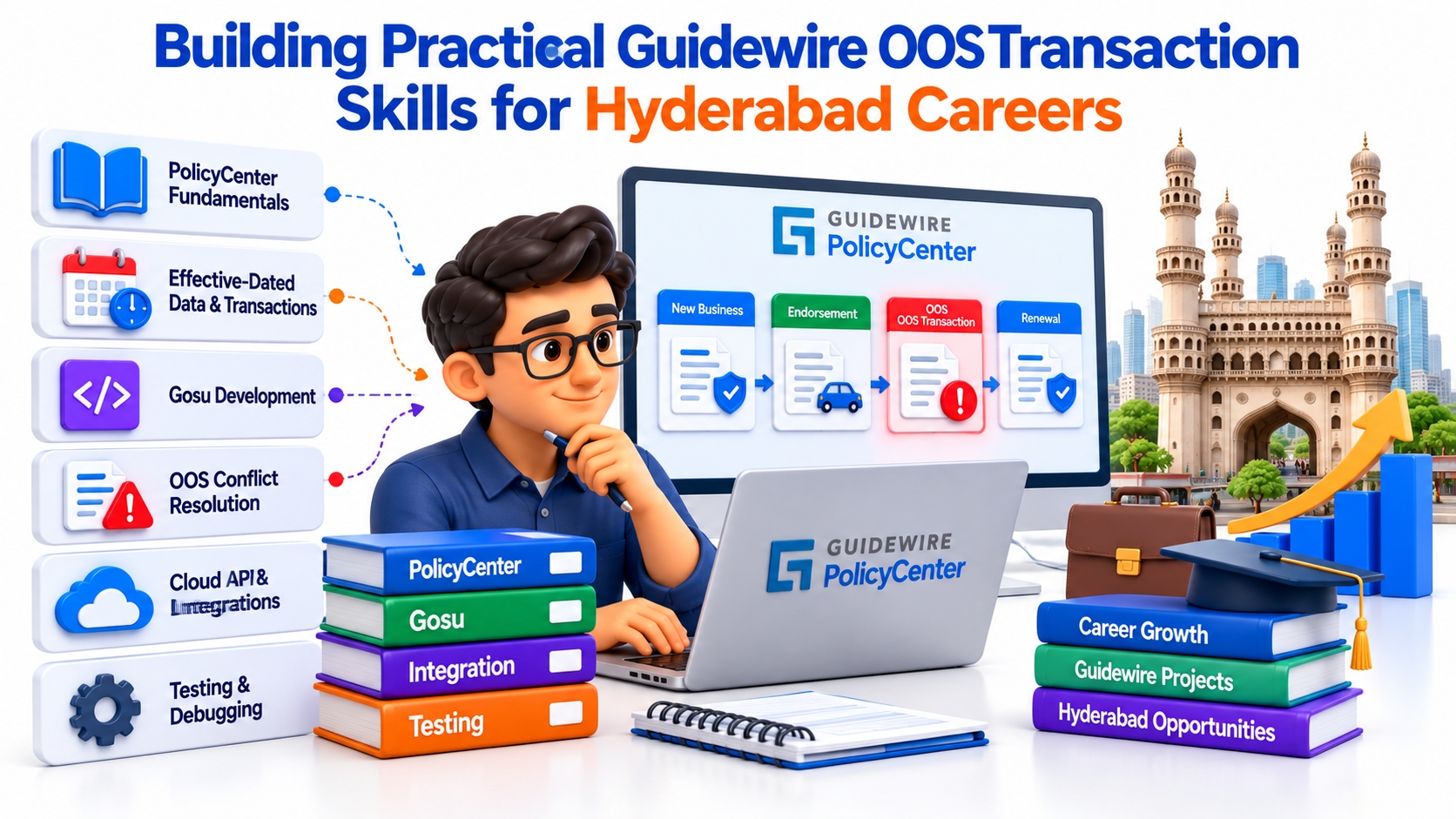
Hyderabad offers opportunities for software professionals working with enterprise applications, insurance platforms, and cloud-based integration technologies.
For aspiring Guidewire developers, understanding out-of-sequence transactions demonstrates knowledge beyond basic PolicyCenter configuration.
Employers working on insurance modernization projects need professionals who can investigate complex transaction behavior and translate business requirements into reliable technical solutions.
A practical learning roadmap should include:
PolicyCenter fundamentals: Understand policy creation, endorsements, renewals, and cancellations.
Effective-dated data: Learn PolicyPeriod, branches, slices, and transaction relationships.
Gosu development: Practice business logic, entity access, and validation.
Conflict resolution: Create realistic backdated endorsement scenarios.
Cloud API: Understand job operations and supported conflict-resolution endpoints.
Testing and debugging: Investigate transaction failures using logs and controlled test cases.
Developers should also understand how policy changes affect billing and external applications.
For example, a backdated coverage adjustment may require premium recalculation and communication with downstream systems. Knowing how to investigate these dependencies is valuable during implementation and production support.
Training providers such as Jasttech can help learners develop a structured understanding of Guidewire concepts through technical instruction and practical exercises.
Candidates exploring guidewire training chennai can also apply the same PolicyCenter transaction concepts when preparing for insurance technology opportunities in Hyderabad.
Building a demonstration project involving backdated endorsements, conflicting coverage values, and effective-dated validation can strengthen technical portfolios and interview preparation.
Conclusion
Out-of-sequence transactions are an important part of real-world insurance policy administration. Guidewire PolicyCenter provides effective-dated data capabilities and conflict-resolution mechanisms to manage backdated changes while protecting policy consistency. Understanding transaction timelines, conflicting values, underwriting dependencies, and integration impacts helps developers resolve complex policy scenarios accurately.
For Guidewire professionals in Hyderabad, mastering OOS transaction handling strengthens practical development and troubleshooting capabilities. By combining PolicyCenter configuration knowledge, Gosu programming, Cloud API concepts, and realistic testing scenarios, developers can build the expertise required to support reliable insurance applications and contribute effectively to enterprise Guidewire implementation projects.







