
Your first Guidewire job may be closer than you think, but learning a programming language alone will not get you there. Employers look for developers who can understand insurance workflows, solve technical problems, and build reliable applications using practical skills.
Chennai offers opportunities to explore insurance technology, enterprise software development, and Guidewire implementation careers. With a structured learning plan, hands-on projects, and focused interview preparation, aspiring developers can build a foundation for entering this specialized technology field.
Understanding Guidewire and Career Opportunities in Chennai
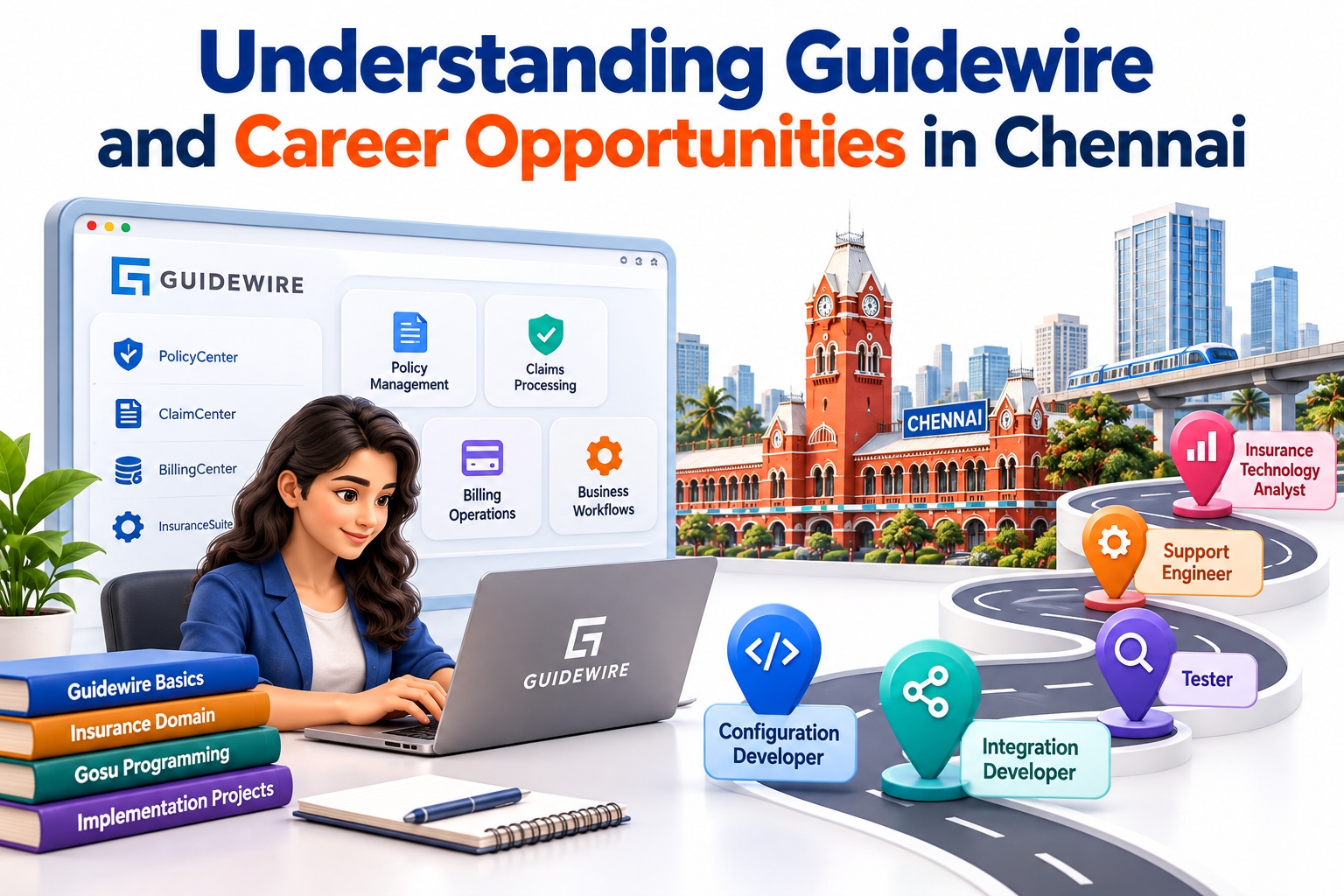
Guidewire is an enterprise software platform designed primarily for property and casualty insurance companies. Its InsuranceSuite applications help insurers manage policy administration, claims processing, billing operations, and related business workflows. Companies implementing these solutions need professionals who understand both technical development and insurance processes.
Chennai is a relevant location for aspiring Guidewire professionals because technology service providers and insurance technology teams recruit developers for implementation, configuration, integration, testing, and support projects. However, openings vary by employer, experience level, project requirements, and hiring cycles. Beginners should examine current job descriptions instead of assuming every vacancy accepts freshers.
Common career paths include:
Guidewire Configuration Developer: Customizes application screens, business rules, workflows, and product configurations.
Guidewire Integration Developer: Connects insurance applications with external systems through APIs, messaging, and integration components.
Guidewire Tester: Validates application functionality, business scenarios, and integration behavior.
Guidewire Support Engineer: Investigates defects, analyzes logs, and resolves application issues.
Insurance Technology Analyst: Connects business requirements with technical implementation and testing activities.
For beginners, configuration development or testing can provide an accessible introduction, depending on their existing programming knowledge. Understanding these roles helps you select a suitable learning path rather than studying every Guidewire module simultaneously.
Building Your Foundation Before Learning Gosu
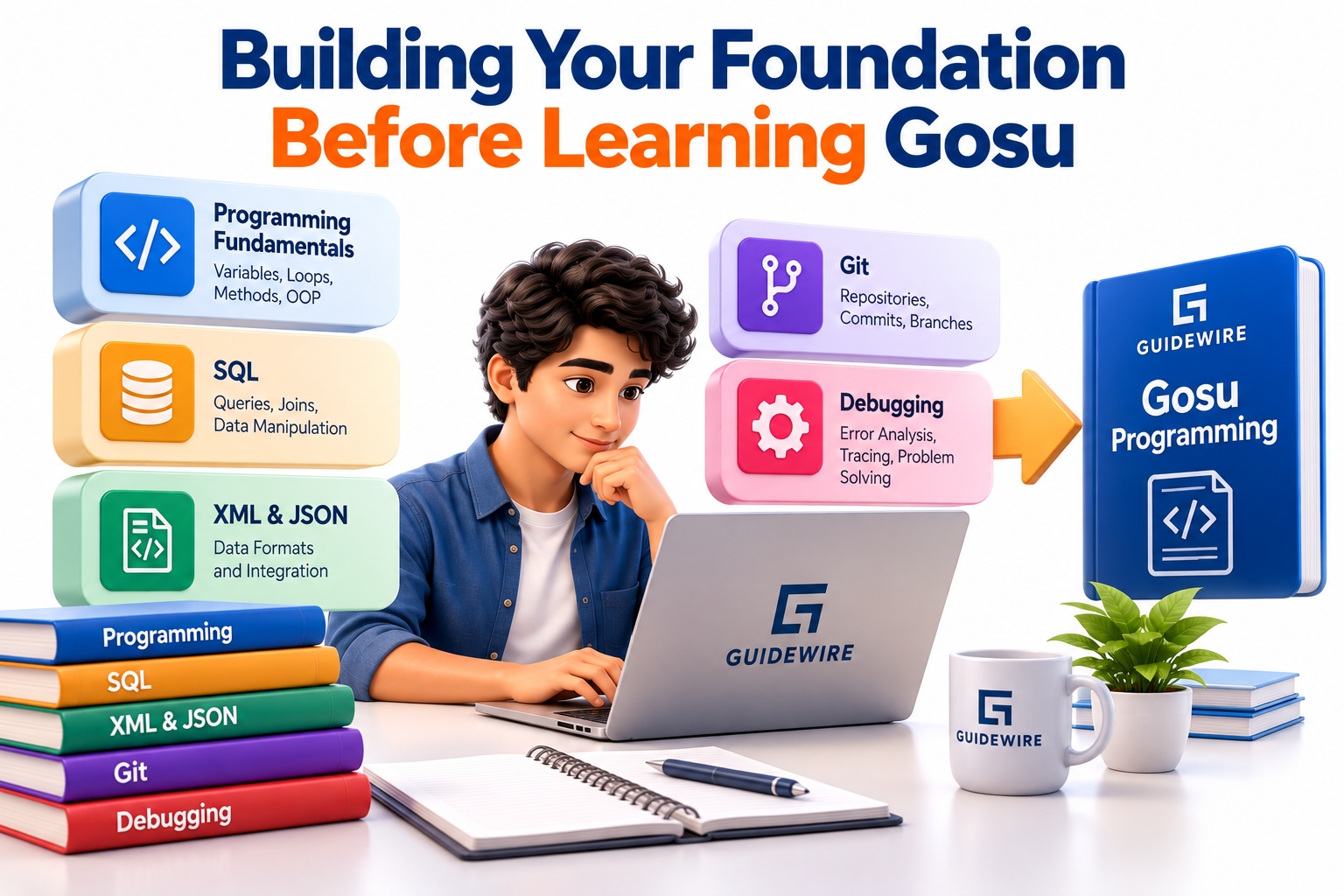
Before working with Guidewire applications, develop a solid foundation in programming and software engineering. Gosu is a statically typed programming language used in Guidewire applications, and familiarity with object-oriented programming makes its concepts easier to understand. Students who skip these fundamentals often struggle when writing business rules or debugging application behavior.
Start by learning variables, data types, conditional statements, loops, methods, classes, objects, inheritance, interfaces, collections, and exception handling. Practice writing small programs before moving into platform-specific development. You should also understand basic database concepts, SQL queries, and how applications exchange information.
Your preparation checklist should include:
Programming fundamentals: Write reusable methods and understand object-oriented design.
SQL: Practise SELECT queries, joins, filtering, and basic data manipulation.
XML and JSON: Learn how structured information is represented and exchanged.
Git: Understand repositories, commits, branches, and collaborative development.
Debugging: Read error messages, inspect variables, and trace program execution.
These skills support more than one Guidewire role. They also make it easier to understand technical documentation, collaborate with development teams, and approach unfamiliar problems logically.
Mastering Guidewire Gosu Programming Through Practice
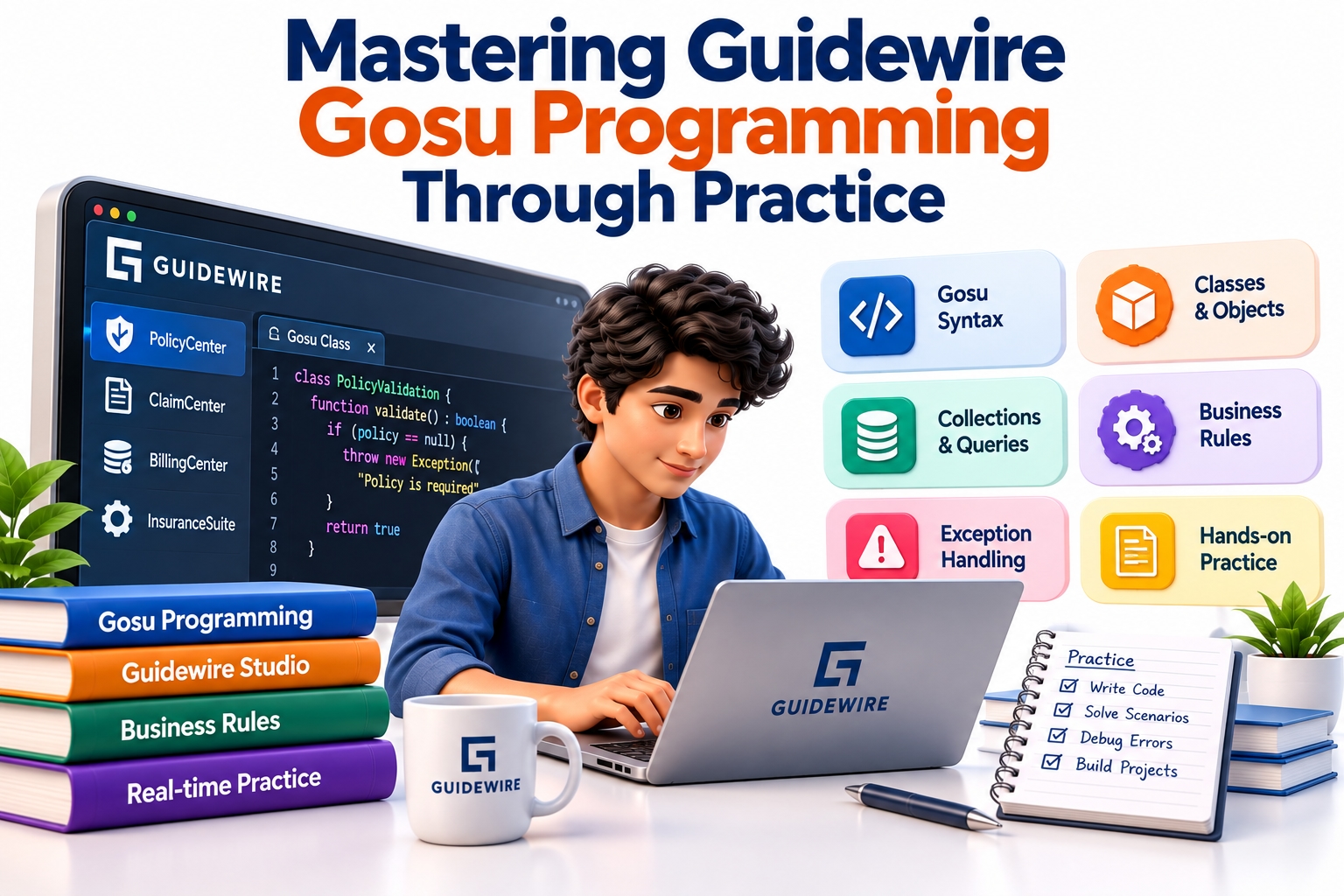
Guidewire Gosu Programming should be a central part of your preparation if you want to pursue a development position. Begin with syntax, expressions, type declarations, classes, methods, collections, blocks, and exception handling. Then progress to the way Gosu operates within Guidewire applications, where business logic interacts with application data and configuration.
Avoid treating Gosu as a language-learning exercise disconnected from real projects. Your objective is to understand how code supports insurance business requirements. For example, a business rule might validate information before a policy transaction proceeds, while application logic may determine whether a particular operation is permitted.
Build your learning sequence around practical exercises:
Write methods that validate customer or policy information.
Practise working with collections and filtering records.
Create examples using classes, interfaces, and exception handling.
Explore business rules and validation logic within an authorized Guidewire learning environment.
Learn to read existing code and explain what each method does.
Next, understand Guidewire Studio and the configuration structure of the application environment available to you. Learn how code, configuration, data models, and user interface elements interact. The precise tools and workflows depend on the Guidewire version and project environment, so follow documentation appropriate to your learning setup.
JastTech can be considered when evaluating structured training options. Before enrolling, check whether the curriculum includes instructor guidance, practical assignments, debugging exercises, project exposure, and interview preparation. A course is most valuable when it helps you demonstrate skills independently rather than simply complete lessons.
Choosing Your Guidewire Module and Building a Realistic Project
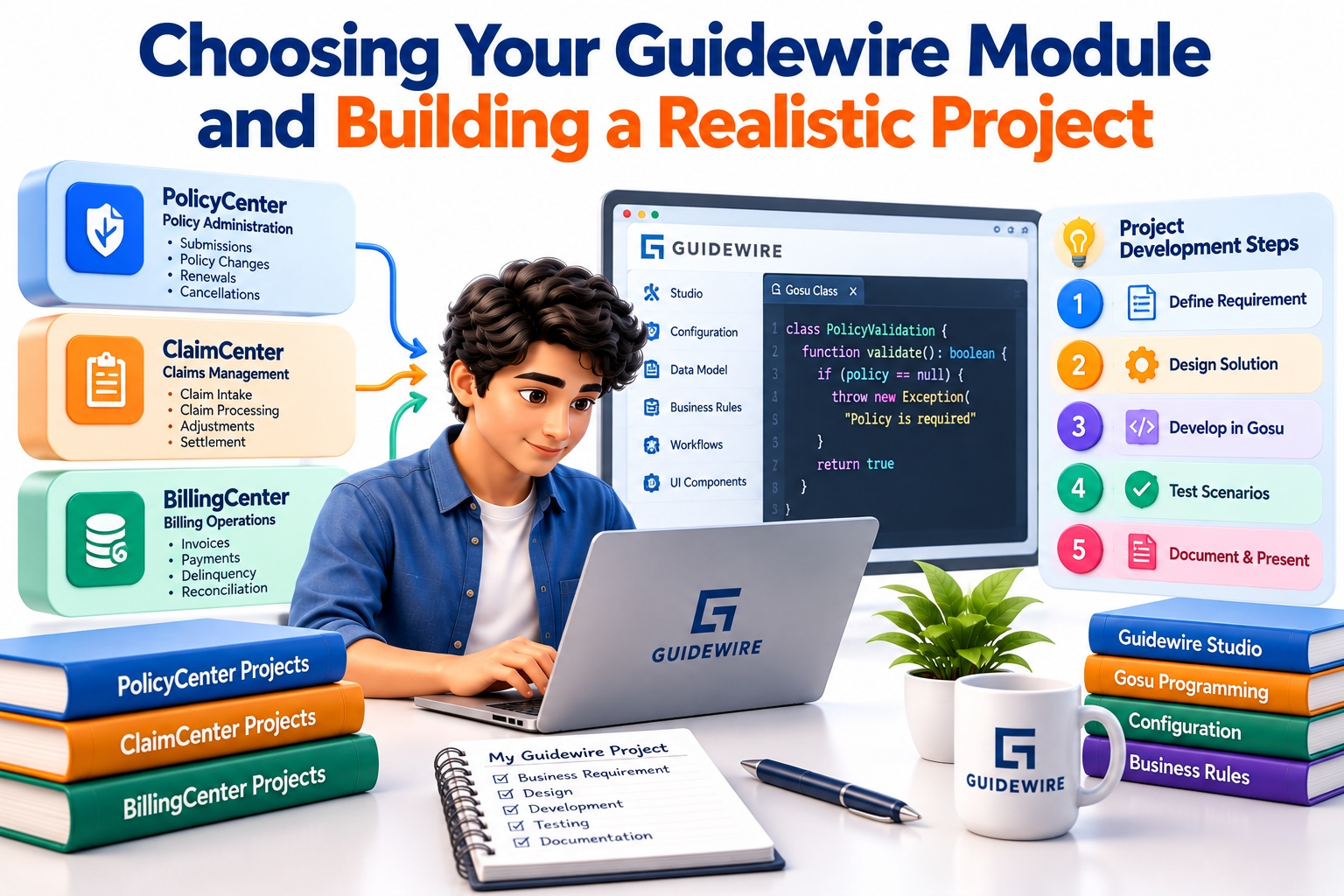
Once you understand programming fundamentals and Gosu, choose one InsuranceSuite application to study in depth. Trying to master PolicyCenter, ClaimCenter, and BillingCenter simultaneously can make learning unnecessarily complicated. Start with one module, understand its business purpose, and expand your knowledge after developing confidence.
PolicyCenter focuses on policy administration, including submissions, policy changes, renewals, and cancellations. ClaimCenter supports claims handling, while BillingCenter manages billing activities such as invoices, payments, and delinquency processes. Your choice should reflect your interests, available training resources, and the requirements appearing in relevant job descriptions.
Develop a project that demonstrates how you translate business requirements into technical solutions. For example, a policy administration learning project could describe a simplified workflow for creating a policy submission, validating required information, and handling an eligible policy change. Where licensed platform access is unavailable, build a documented simulation rather than claiming to have implemented a working Guidewire application.
A strong portfolio project should contain:
Problem statement: Explain the insurance business requirement.
Workflow description: Show the sequence of operations and relevant decisions.
Technical design: Document the data involved, validation rules, and application logic.
Test scenarios: Include valid inputs, invalid inputs, boundary conditions, and expected results.
Debugging notes: Explain a problem you encountered, its root cause, and your solution.
Learning outcomes: Identify what you would improve in a production implementation.
If your environment permits, add screenshots, sample code, test evidence, and a clear project README. Never publish confidential customer information, proprietary code, or restricted platform materials. A transparent, well-documented learning project can help recruiters assess your reasoning even when you have limited professional experience.
Preparing Your Resume and Guidewire Technical Interviews
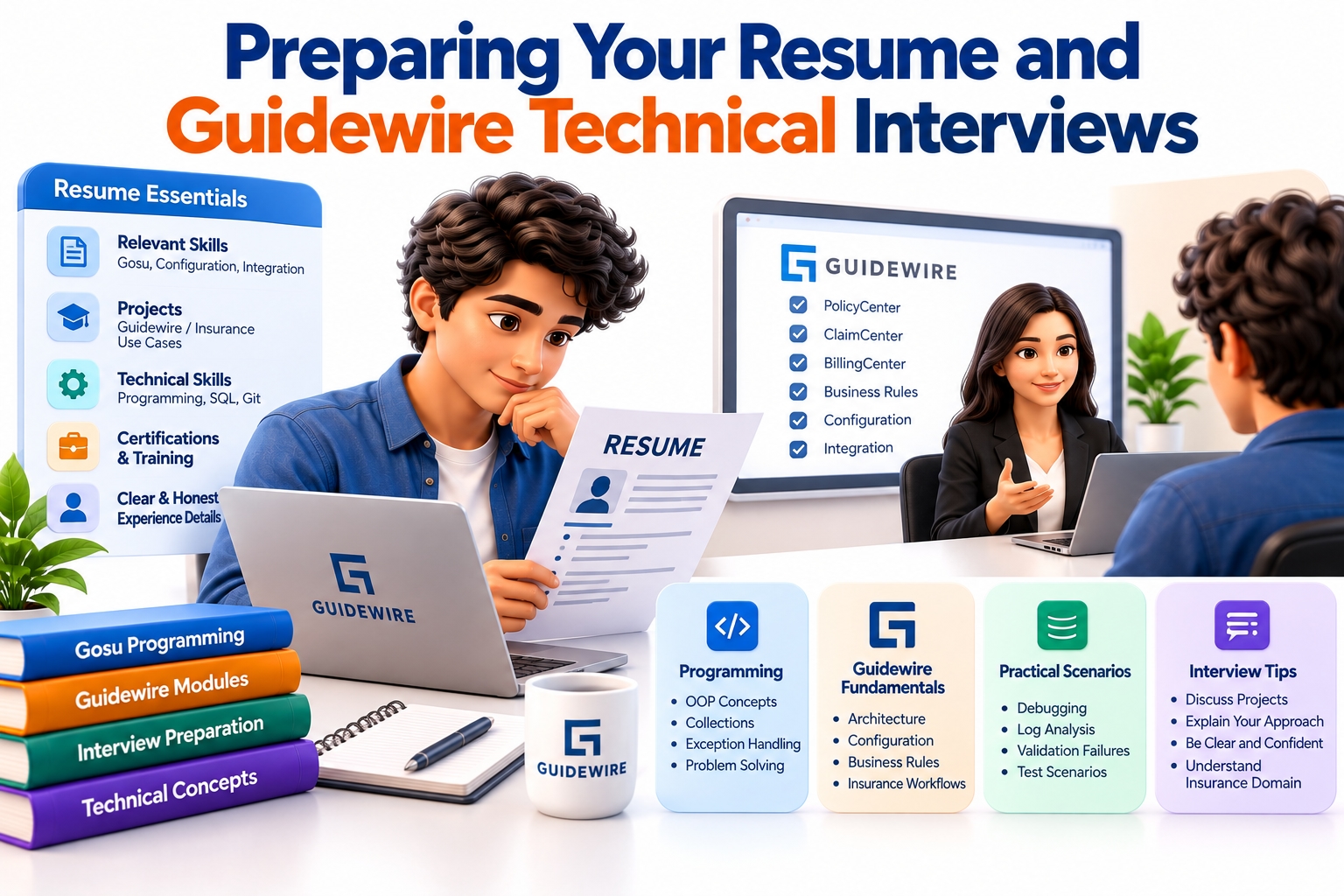
A resume for an entry-level Guidewire position should communicate technical readiness without exaggerating experience. Recruiters need to understand what you know, what you have practised, and how your skills relate to the advertised position. Listing a long collection of technologies without evidence of practical use is less convincing than presenting a smaller set of relevant capabilities clearly.
Include your programming fundamentals, Gosu knowledge, SQL, Git, insurance-domain understanding, and familiarity with your selected Guidewire module. Describe academic, personal, or training projects accurately. If you have not worked on a production implementation, identify your work as a learning project rather than professional client experience.
Prepare for interviews across three areas:
Programming: Explain object-oriented concepts, collections, exception handling, and basic problem-solving techniques.
Guidewire fundamentals: Describe the purpose of InsuranceSuite applications, configuration concepts, business rules, and your selected module.
Practical scenarios: Explain how you would investigate a validation failure, reproduce a defect, inspect relevant logs, or test an application change.
You should also practise explaining insurance workflows in simple language. For instance, understand the difference between issuing a policy, processing a claim, and collecting a premium. Interviewers may use such scenarios to assess whether you can connect technical implementation with business requirements.
Search employer career pages and reputable job portals using titles such as Guidewire Developer, Junior Configuration Developer, Associate Software Engineer, Guidewire Tester, and Application Support Engineer. Read each job description carefully because many vacancies require previous implementation experience. Apply for entry-level opportunities that genuinely match your background, and consider adjacent software or testing roles if direct developer positions require experience you have not yet acquired.
Following a 90-Day Roadmap to Become Job-Ready
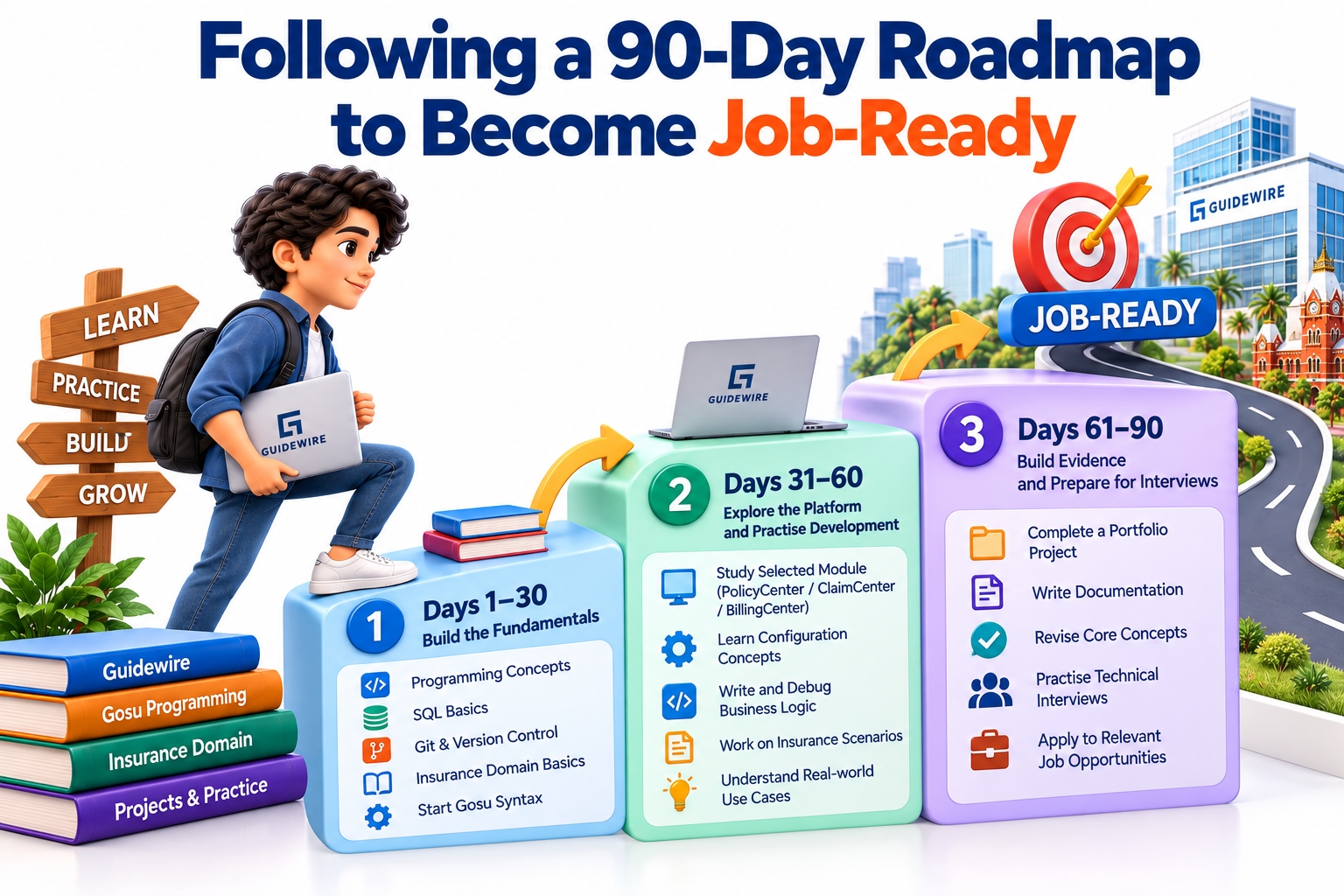
A time-bound plan helps you measure progress and avoid spending months watching tutorials without producing practical work. Your exact timeline will depend on your previous programming experience, access to training environments, and the complexity of the material. The following roadmap provides a structured starting point.
Days 1–30: Establish the fundamentals. Learn object-oriented programming, basic SQL, Git, and the principles of property and casualty insurance. Start Gosu syntax and complete small programming exercises. By the end of this phase, you should be able to explain your code and solve basic problems without copying every step from a tutorial.
Days 31–60: Focus on the platform and practical development. Study your selected InsuranceSuite module, explore relevant configuration concepts, and practise writing and debugging business logic. Work through insurance scenarios and document the decisions behind your implementation. If you do not have platform access, use permitted learning resources and clearly distinguish simulations from actual platform work.
Days 61–90: Build evidence and prepare for interviews. Complete a portfolio project, write its documentation, revise core concepts, and practise technical explanations. Review current Chennai vacancies to identify recurring skill requirements. Improve your resume based on those requirements and begin applying to suitable positions while continuing to strengthen weaker areas.
Track progress through measurable outcomes rather than study hours alone. Aim to explain your project confidently, solve basic programming problems independently, describe an insurance workflow, and demonstrate a systematic debugging approach.
Landing your first job is not guaranteed within 90 days, and some candidates will need additional time. The purpose of this roadmap is to create a repeatable learning process that steadily improves your technical competence and application readiness.
Conclusion
Building a Guidewire career in Chennai requires more than completing a course or memorizing technical definitions. You need programming fundamentals, practical Gosu knowledge, an understanding of insurance workflows, experience with debugging, and the ability to explain your work clearly. Concentrating on one application, developing a meaningful project, and preparing for role-specific interviews can help you move from beginner-level learning toward genuine job readiness.
Start by assessing your current skills and choosing the next achievable milestone. Explore structured learning opportunities through JastTech if they suit your needs, verify that practical training is included, and compare the curriculum with actual employer requirements. Keep your portfolio honest, apply consistently to relevant opportunities, and continue improving through feedback. A focused, evidence-based approach will give you a stronger foundation for pursuing your first Guidewire opportunity and developing your career over time.