
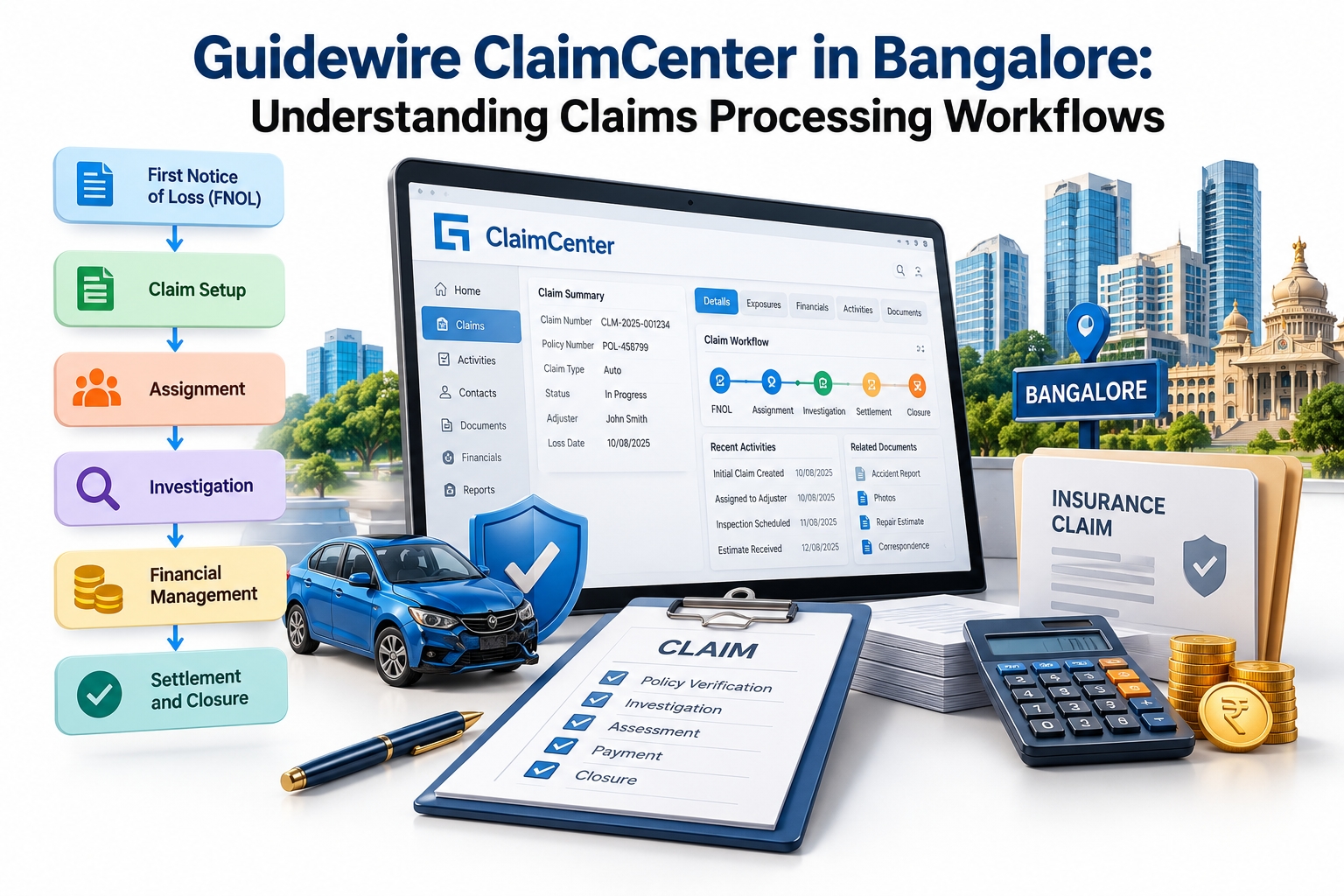
Insurance companies do not simply approve or reject claims. Every claim involves policy verification, investigation, financial decisions, documentation, and settlement. When these activities become disconnected, delays and errors can affect both customers and insurers. Understanding how claims move through a system is essential for modern insurance technology professionals.
Guidewire ClaimCenter helps property and casualty (P&C) insurers manage the claims lifecycle through configurable workflows, business rules, financial processing, and integrations. For aspiring Guidewire professionals in Bangalore, understanding these workflows provides a practical foundation for learning how insurance applications operate in real-world projects.
Understanding Guidewire ClaimCenter and the Claims Lifecycle
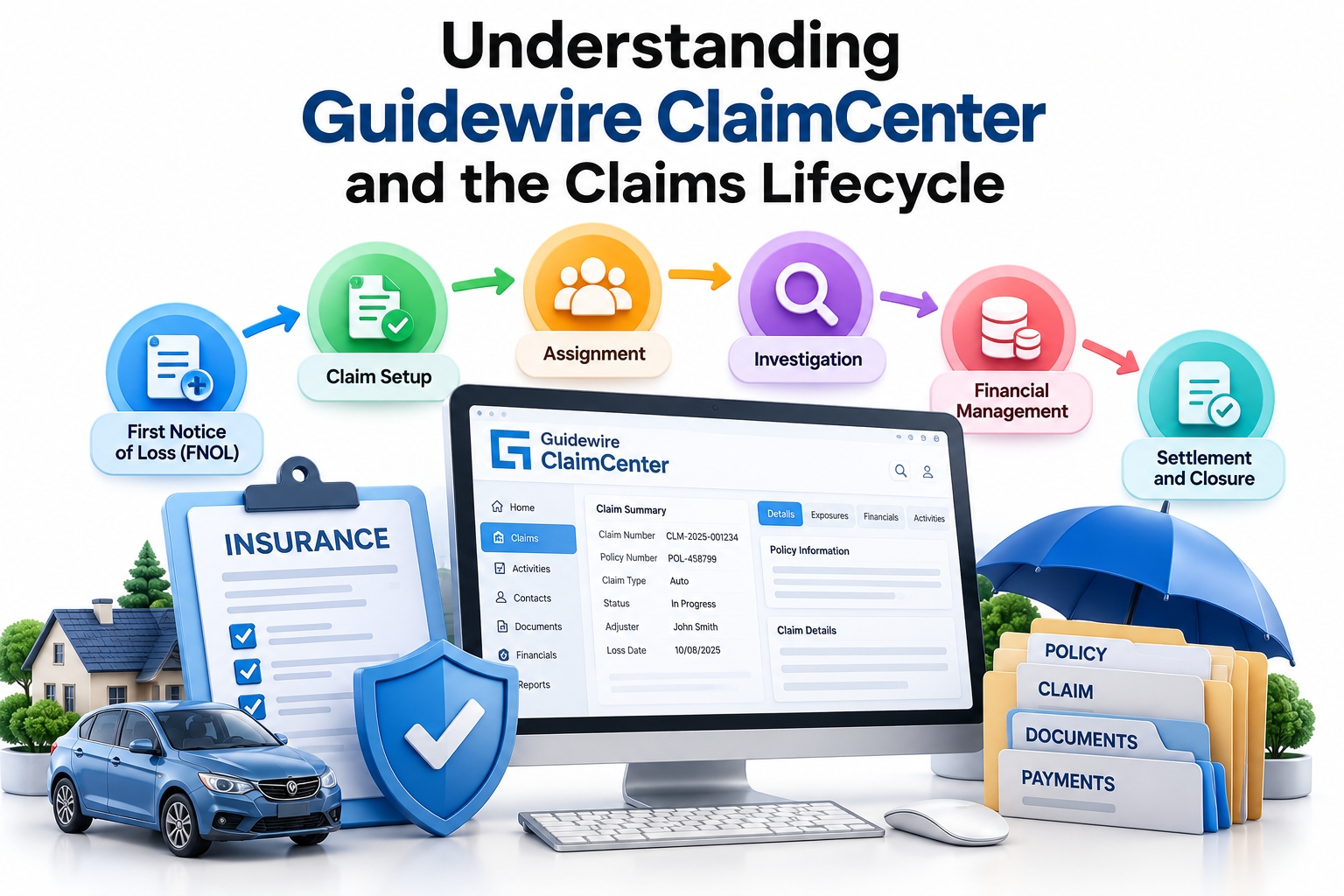
Guidewire ClaimCenter is a core insurance application designed to manage claims from initial reporting through investigation, settlement, and closure. It provides a centralized environment where claims handlers can access relevant information, manage activities, track financial transactions, and coordinate decisions.
Instead of treating every claim as an isolated record, ClaimCenter supports connected processes that help insurers manage different claim types consistently. The precise workflow depends on the insurer's business requirements, product configuration, and implementation.
A typical claims lifecycle includes:
First Notice of Loss (FNOL): Capturing the initial report of an incident.
Claim setup: Creating the claim record and validating essential information.
Assignment: Routing the claim to an appropriate adjuster or team.
Investigation: Collecting evidence and evaluating the circumstances.
Financial management: Managing reserves, payments, and recoveries.
Settlement and closure: Completing required activities and closing the claim when appropriate.
For example, when a customer reports a vehicle accident, the system can capture the incident details, associate the relevant policy information, create exposures, and initiate activities for investigation. These steps establish the foundation for subsequent decisions.
Understanding this lifecycle helps developers and testers connect technical functionality with the business outcomes an insurer expects.
How First Notice of Loss and Claim Setup Work
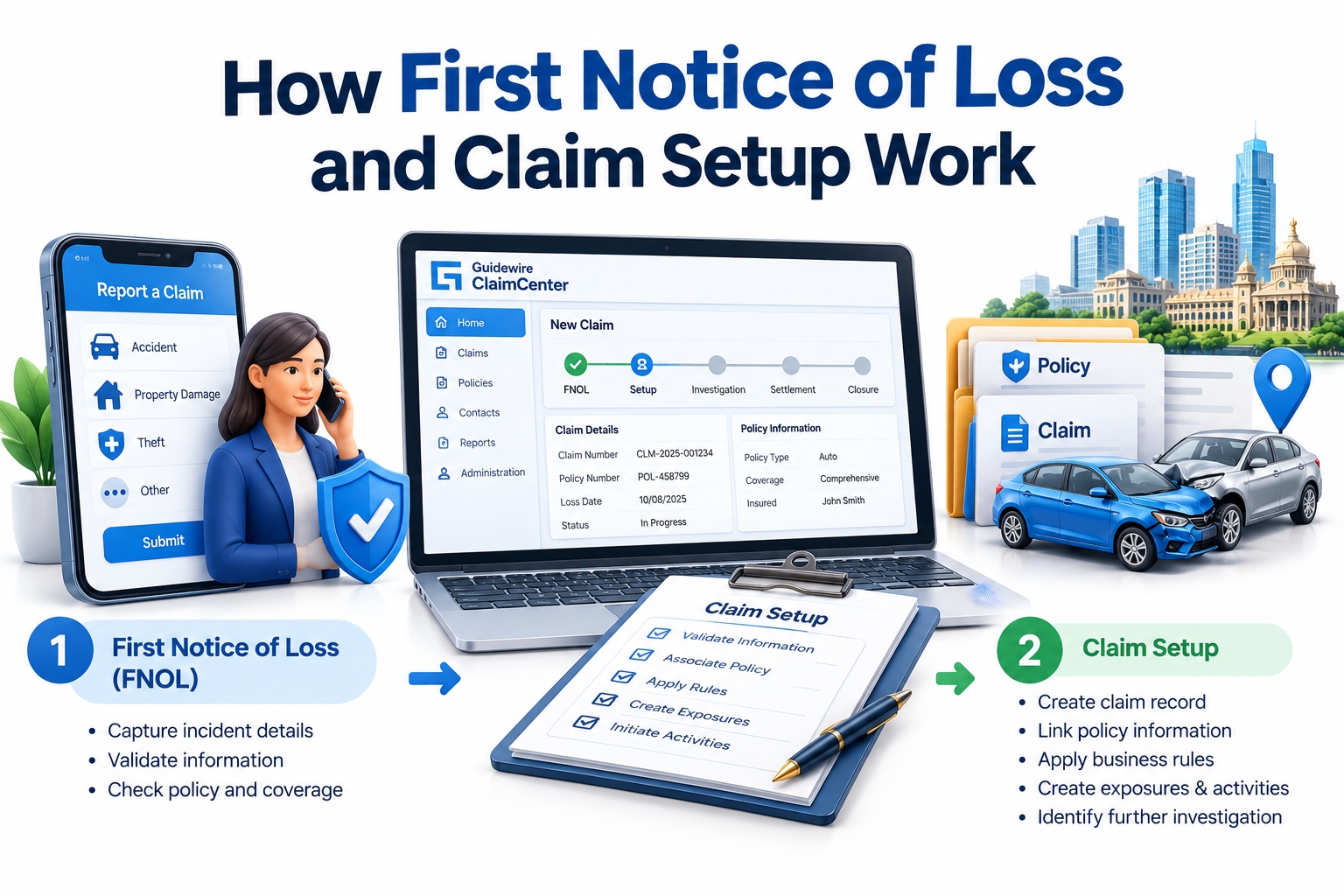
First Notice of Loss, commonly called FNOL, is the starting point of the claims process. It occurs when an insurer receives information about a potential loss through a customer, agent, call centre, digital application, or integrated system.
ClaimCenter captures information such as the incident date, loss location, description of the event, involved parties, and available policy details. The system's configured validations help identify missing or inconsistent information before the claim progresses.
Claim creation can involve different states. In the standard FNOL process, a claim may initially be saved as a draft while required information is collected. Once the necessary conditions are satisfied and the claim is submitted, it can progress into the open-claim process.
During claim setup, the system may perform several activities:
Validate the submitted claim information.
Associate the relevant policy information with the claim.
Apply configured segmentation and assignment rules.
Create exposures and initial activities according to business rules.
Identify information that requires further investigation.
Consider a motor insurance claim involving damage to two vehicles. The system must capture the accident details and relevant parties while allowing the insurer to evaluate the applicable coverages.
An important distinction: creating a claim does not automatically mean that the insurer has confirmed coverage or approved payment. Coverage evaluation and subsequent claim decisions depend on the policy, available evidence, and applicable business rules.
For developers, FNOL is an important area to understand because changes to intake validation, claim creation, and claim setup rules can influence the entire downstream process.
Claim Assignment, Segmentation, and Investigation Workflows
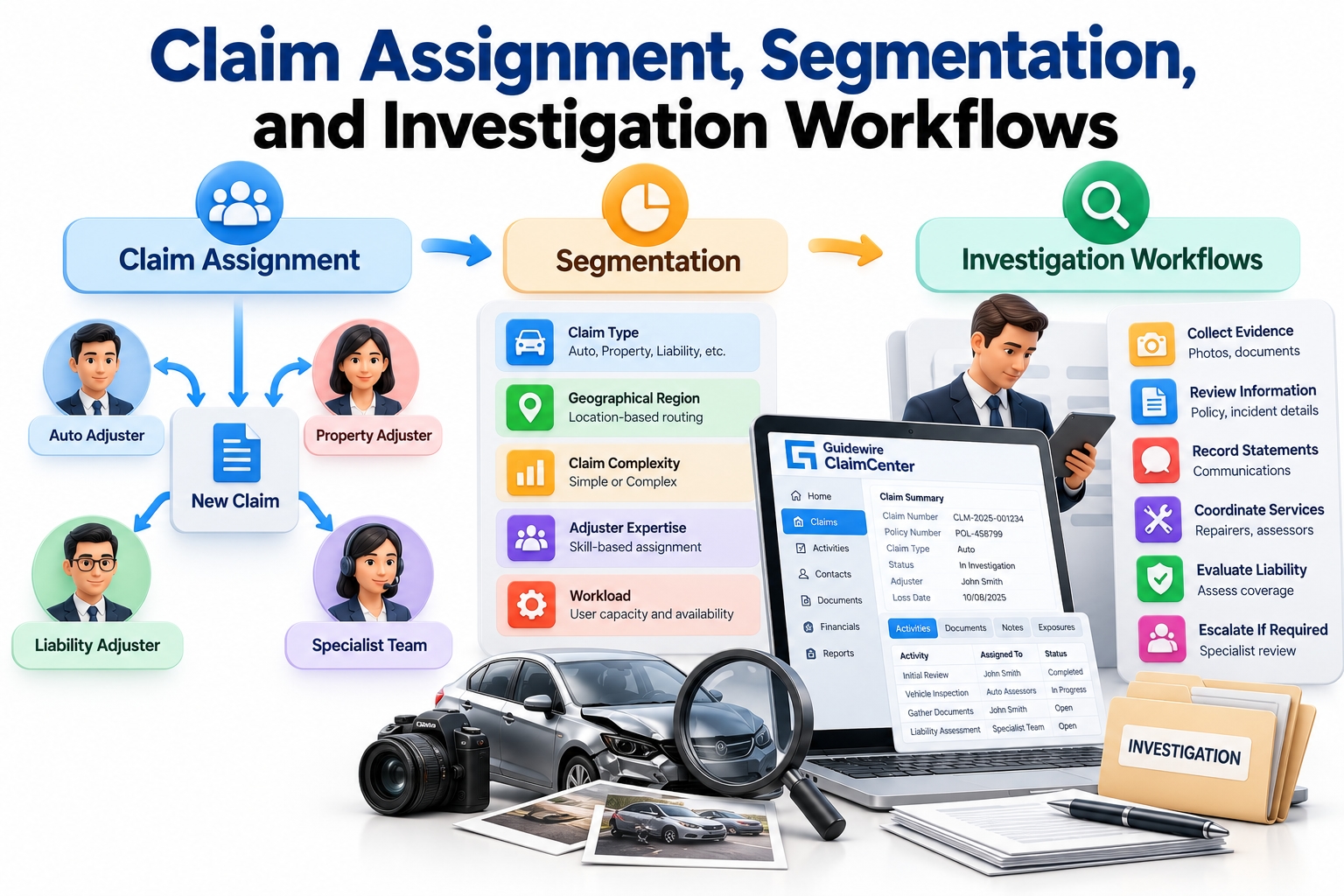
Once a claim enters the appropriate processing stage, it must reach the people responsible for handling it. ClaimCenter supports assignment mechanisms that can route claims to groups and individual users according to configured business requirements.
Assignment rules may consider factors such as the line of business, geographical region, claim complexity, adjuster expertise, and workload. The exact criteria depend on the insurer's implementation.
Segmentation helps determine the appropriate handling approach for a claim. For instance, a straightforward property damage claim may follow a different workplan from a complex claim involving serious injuries or potential litigation.
After assignment, investigation activities help the adjuster collect and evaluate the information required to make informed decisions.
Common investigation activities include:
Reviewing policy and incident details.
Collecting photographs, reports, and supporting documents.
Recording statements and communications.
Coordinating with repairers, assessors, or other service providers.
Evaluating liability and potential financial exposure.
Escalating cases that require specialist review or approval.
ClaimCenter can manage activities, notes, documents, and claim contacts to maintain a structured record of the investigation.
Suppose an accident claim requires an external vehicle assessment. The adjuster may coordinate the inspection, review the estimate, record relevant findings, and determine the next steps based on the insurer's procedures.
From a technical perspective, developers need to understand how assignment rules, activity creation, validations, and claim data interact. Testers should verify not only that a claim reaches the correct team but also that the appropriate activities and escalation conditions are triggered.
Exposure Management, Reserves, and Claim Payments
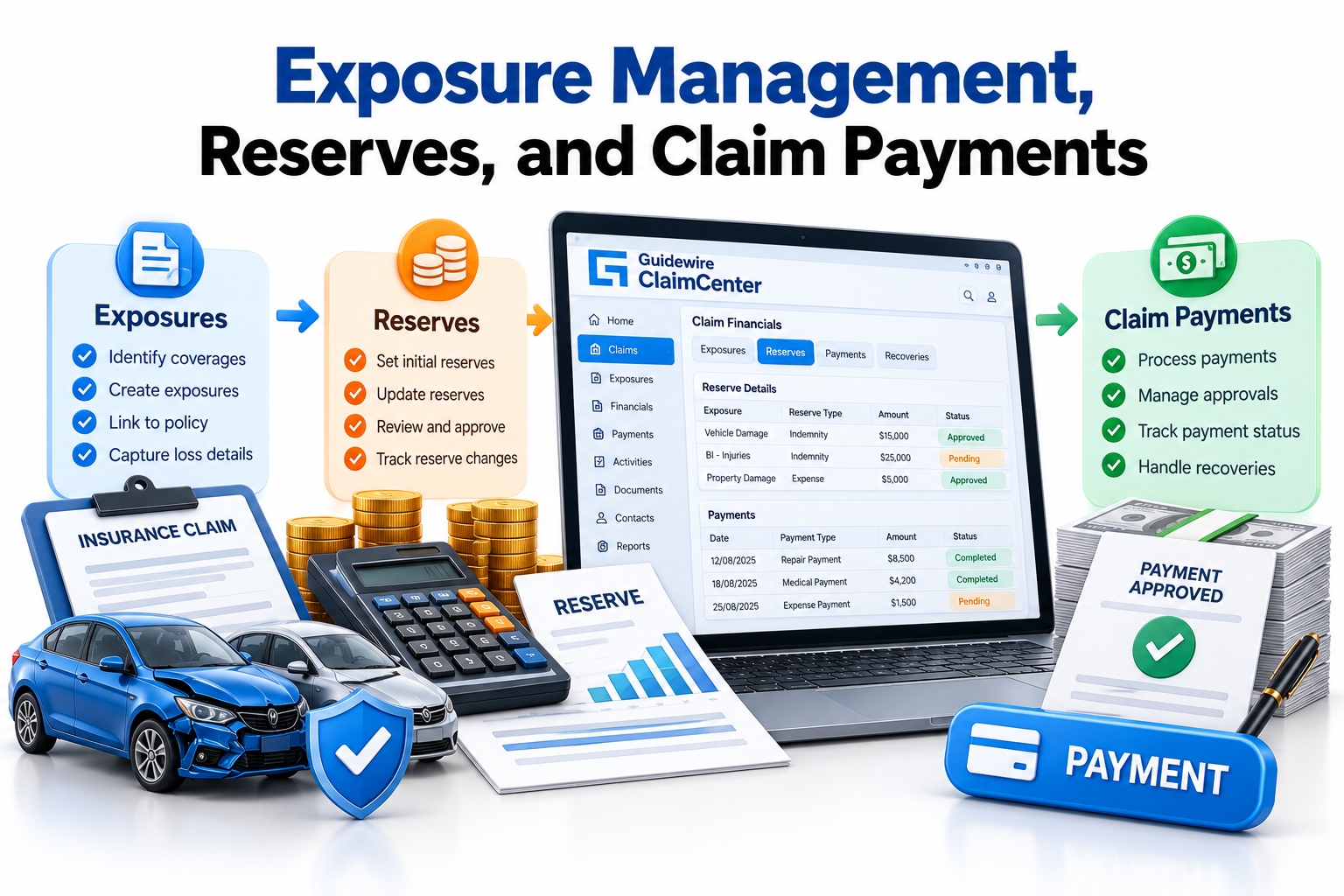
Financial management is a critical component of claims processing. Insurers must evaluate potential liabilities, establish appropriate reserves, authorize payments, and maintain accurate financial records.
In ClaimCenter, an exposure represents a particular area of potential liability associated with a claim. A single claim may contain multiple exposures, depending on the circumstances, covered parties, and applicable insurance coverages.
For example, a motor accident claim could involve vehicle damage and bodily injury. These may require separate exposure records because the investigation, estimated costs, and settlement decisions can differ.
Reserves represent estimates of the insurer's expected financial liability. They can change as new evidence becomes available, repair costs are revised, or the investigation progresses. Reserve updates may also be subject to configured approval rules.
Financial processing can involve:
Creating and updating reserves.
Evaluating payment requests.
Applying approval limits and financial controls.
Issuing payments to eligible claimants or service providers.
Tracking payment status and related transactions.
Recording recoveries when applicable.
Payment processing may also involve integrations with downstream financial systems. A payment initiated in ClaimCenter does not necessarily mean that funds have already reached the recipient; the transaction may pass through additional processing and confirmation steps.
Professionals learning Guidewire ClaimCenter training should therefore study exposures, reserves, financial transactions, and payment lifecycles together rather than treating them as unrelated configuration topics.
This knowledge is particularly useful when troubleshooting discrepancies between claim records, payment statuses, and external financial systems.
ClaimCenter Integrations, Business Rules, and Testing
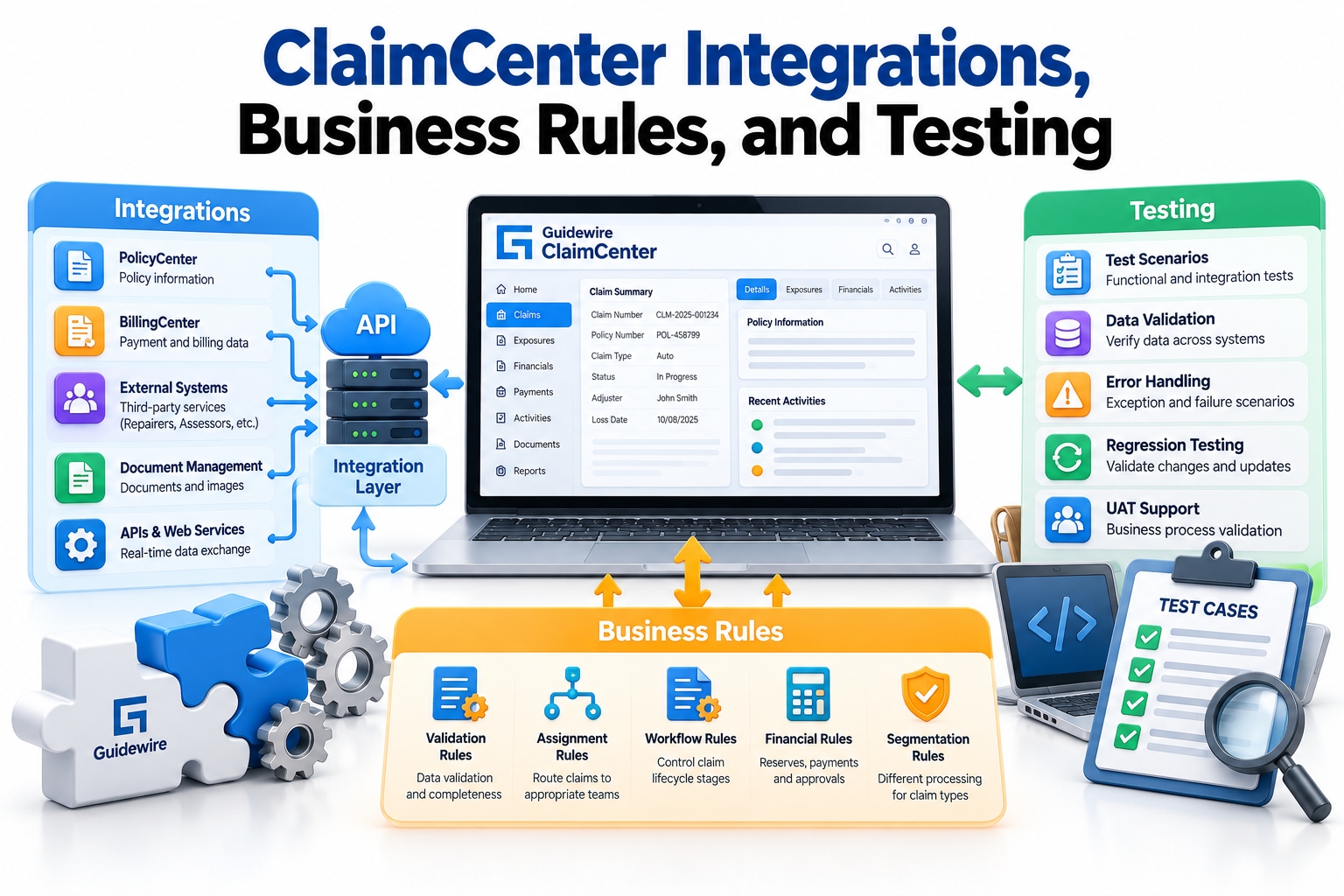
ClaimCenter operates within a broader insurance technology environment. It may exchange information with policy administration systems, customer applications, document services, payment platforms, fraud detection solutions, and external service providers.
Integrations help reduce duplicate data entry and allow information to move between connected applications. However, they also introduce dependencies that must be handled carefully.
For example, when a customer reports an incident through an external application, an integration may transmit the claim information to ClaimCenter. The receiving application must validate the data, handle errors, and respond appropriately if a required service is unavailable.
Business rules determine how the application responds to specific conditions. They may control validation, claim assignment, activity creation, reserve approvals, and other operational decisions.
Testing should cover both normal and exceptional scenarios, including:
Valid and incomplete FNOL submissions.
Claims associated with active and potentially inapplicable policies.
Correct and incorrect assignment outcomes.
Exposure creation and reserve updates.
Payment approvals, failures, and status changes.
Integration timeouts, invalid responses, and retry behaviour.
Permissions, audit requirements, and error handling.
A practical example is testing a claim that passes intake validation but encounters an integration failure while retrieving additional policy information. The expected behaviour should be defined by the implementation: the system might prevent progression, retain a draft, or provide a controlled recovery path.
Professionals exploring Guidewire Training in Bangalore can benefit from practising complete claim scenarios that connect business requirements, configuration, integrations, and testing. JastTech can be considered by learners seeking structured exposure to Guidewire concepts and practical project-oriented learning.
Building Practical ClaimCenter Skills for Insurance Technology Careers

Understanding claims processing requires more than memorizing application screens. Professionals need to connect insurance concepts with the technical components that implement them.
A useful learning approach starts with the claims lifecycle and gradually moves into configuration, data models, rules, integrations, and testing.
Beginners can build their knowledge through practical exercises such as:
Creating a sample claim and validating the FNOL process.
Exploring claim contacts, policy details, and exposures.
Configuring or analysing assignment and activity rules in an appropriate training environment.
Examining reserve updates and payment-related scenarios.
Investigating how external integrations exchange claim information.
Designing positive, negative, and regression test cases.
It is also valuable to understand how Guidewire applications fit together. PolicyCenter supports policy administration, ClaimCenter manages claims, and BillingCenter supports billing operations. Understanding their responsibilities helps learners identify where information originates and which application owns a particular business process.
The broader insurance context matters, too. Concepts such as deductibles, policy limits, coverage conditions, liability, and recoveries influence how claims workflows behave.
Bangalore's technology and consulting ecosystem makes insurance technology a relevant career area for software developers, QA engineers, business analysts, and implementation professionals. However, career readiness depends on demonstrated skills, project experience, and the requirements of individual employers rather than course completion alone.
A portfolio of clearly documented exercises, workflow diagrams, configuration examples, and test scenarios can help learners explain their understanding during interviews.
Conclusion
Guidewire ClaimCenter brings together claim intake, assignment, investigation, exposure management, financial processing, and settlement within a configurable insurance application. Understanding how these components interact helps professionals analyse business requirements, troubleshoot issues, and build more reliable insurance solutions. The strongest foundation comes from studying complete claims scenarios instead of learning individual features in isolation.
For aspiring Guidewire professionals, the next step is to practise the entire lifecycle, understand the purpose of each business rule, and test how the application responds to both expected and exceptional conditions. With structured learning and hands-on exercises, learners can develop practical knowledge that supports their progress towards development, configuration, testing, and business analysis roles in the insurance technology domain.



