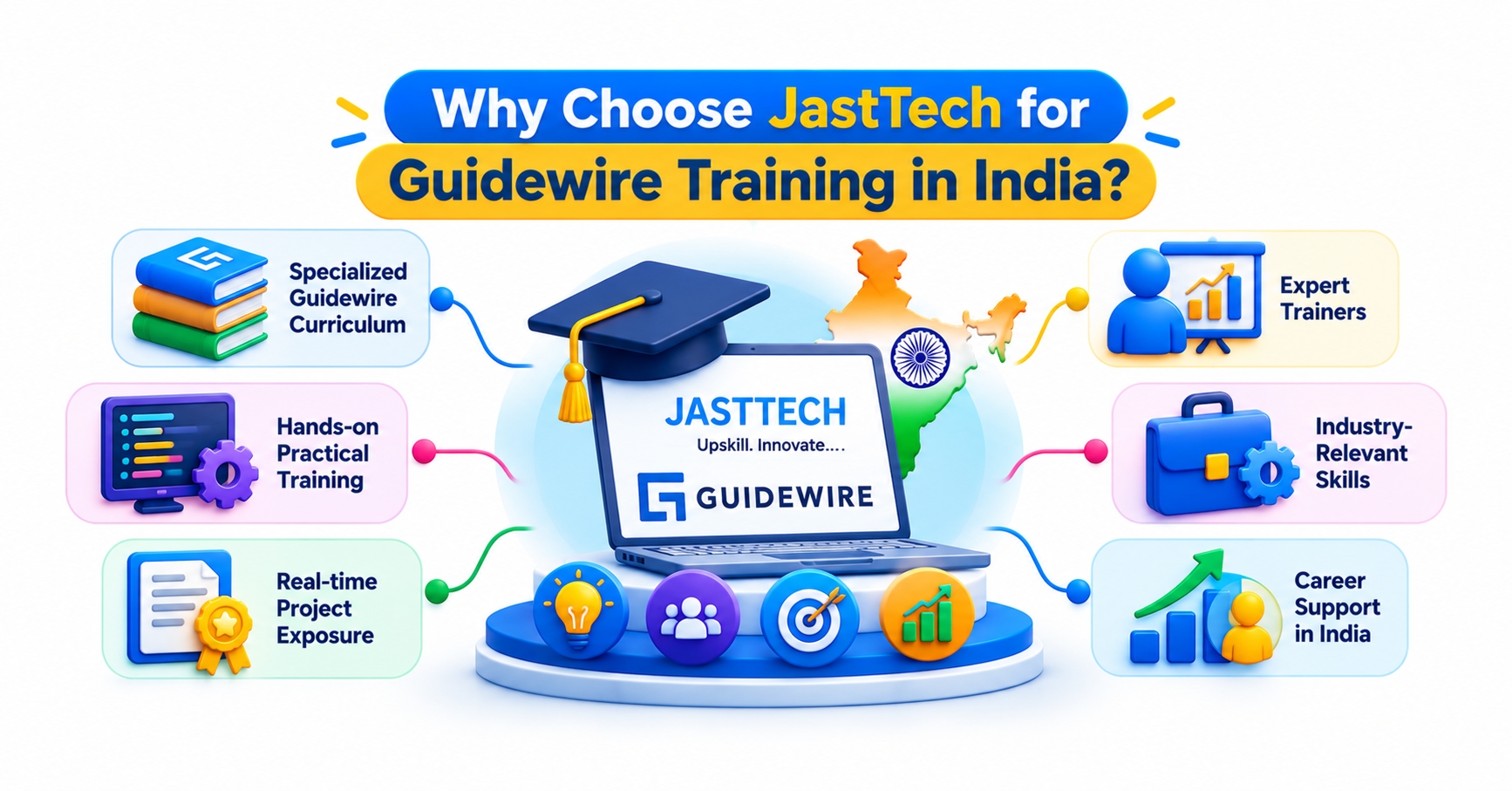
Most people who search for Guidewire training in India hit the same wall within a week. Guidewire is proprietary software, so you can’t download it and practice at home. A course either gives you a working environment or it gives you slides.
That difference decides whether you can write Gosu in your first month on a project or spend it unlearning theory. Here is how JastTech approaches it, and how to test any institute against the same standard.
What Makes Guidewire Training in India Different From a General Java or SQL Course?
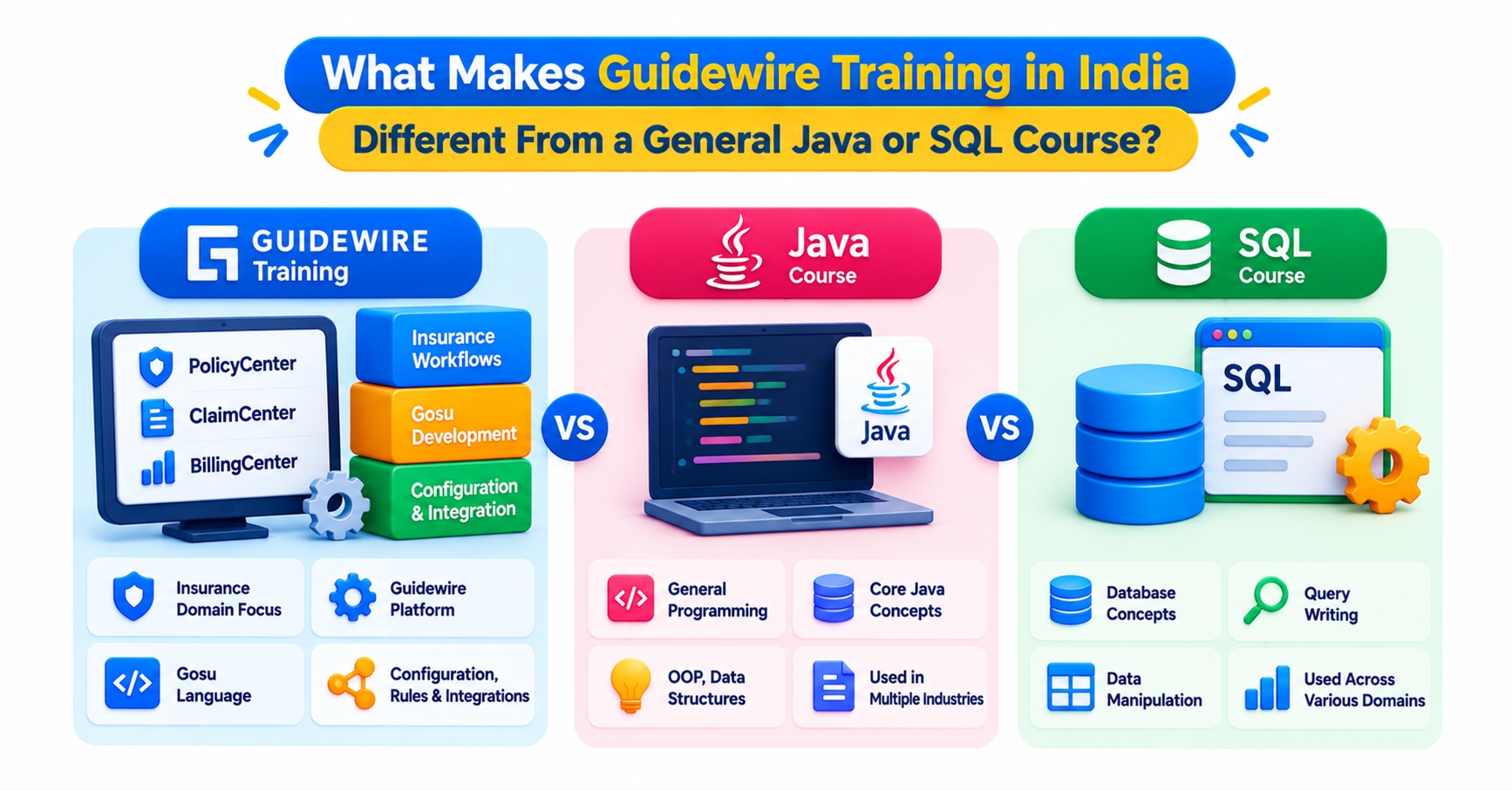
Guidewire training teaches a specific insurance platform, InsuranceSuite, along with the insurance logic it automates. You are not just learning a language. You are learning how a property and casualty insurer issues a policy, handles a claim and collects a premium, and how Guidewire models each step.
InsuranceSuite is built from three core applications. PolicyCenter handles policy administration and underwriting, ClaimCenter manages claims from first report to settlement, and BillingCenter covers invoicing, payments and collections. Developers customize these products with Gosu, a Java-based language, and define screens through page configuration files (PCF).
That mix of platform and domain is where many learners get caught. A developer with solid Java skills can still struggle when a ticket says “add an endorsement rule for mid-term coverage changes,” because the vocabulary is unfamiliar. Terms like first notice of loss, reserves, exposures and delinquency show up in everyday conversations on a Guidewire team.
So a good course has to teach two things at once: how the insurance process works, and where in the platform you configure it. A generic programming course covers neither. A course that only covers the domain leaves you unable to build anything.
This is also why the choice of institute matters more here than it does for a mainstream skill like Python. There are few free tutorials, almost no public sandboxes, and a small pool of people who have implemented Guidewire in real projects. Whoever designs your training largely determines what you can do afterwards.
A Curriculum That Follows the Order Insurance Work Actually Happens
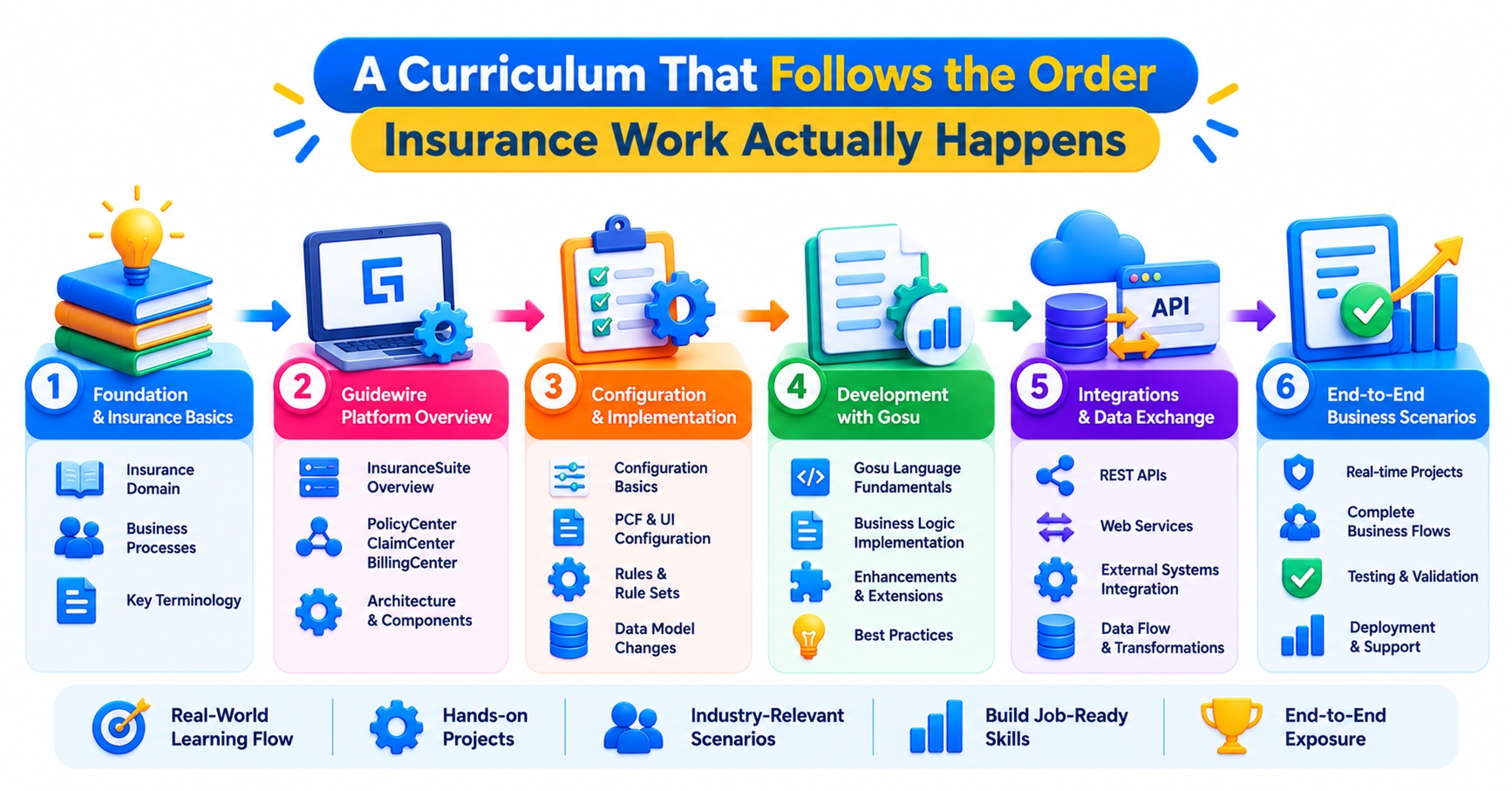
JastTech’s course starts with the platform and insurance fundamentals before touching code. The first module covers InsuranceSuite architecture, core products, property and casualty basics and setting up the development environment. It is short, but skipping it is what makes later modules feel confusing.
From there the course moves through the three applications in the order a policy lives its life. PolicyCenter comes first, covering account and policy management, underwriting workflow and product model basics. ClaimCenter follows, with claim creation, reserves, payments and workflow activities. BillingCenter then covers billing plans, invoicing, delinquency and collections.
Configuration and customization come after the learner understands what is being configured. This module covers Gosu fundamentals, PCF files, data model customization, and rules and workflow configuration. Since the business logic is already familiar by this point, the code has context.
Here is what that looks like in practice. Say a requirement asks for a new field on a claim. You extend the data model through an entity extension file, expose the field on a screen using PCF, and write Gosu to validate it. If you’ve already seen how a claim moves through ClaimCenter, you know where the field belongs and who needs to see it.
Integration is part of the picture too. Insurers rarely run Guidewire alone, so the course includes connecting external services through REST APIs, which comes up in both project work and interviews.
The trade-off is breadth. Covering three applications in two months means you’ll leave with a working foundation in all of them, not deep specialization in one. Learners who already know they want a single track, such as claims or billing, should look at the application-specific courses JastTech lists on its site.
Why Sandbox Lab Access Matters More Than Another Recorded Lecture
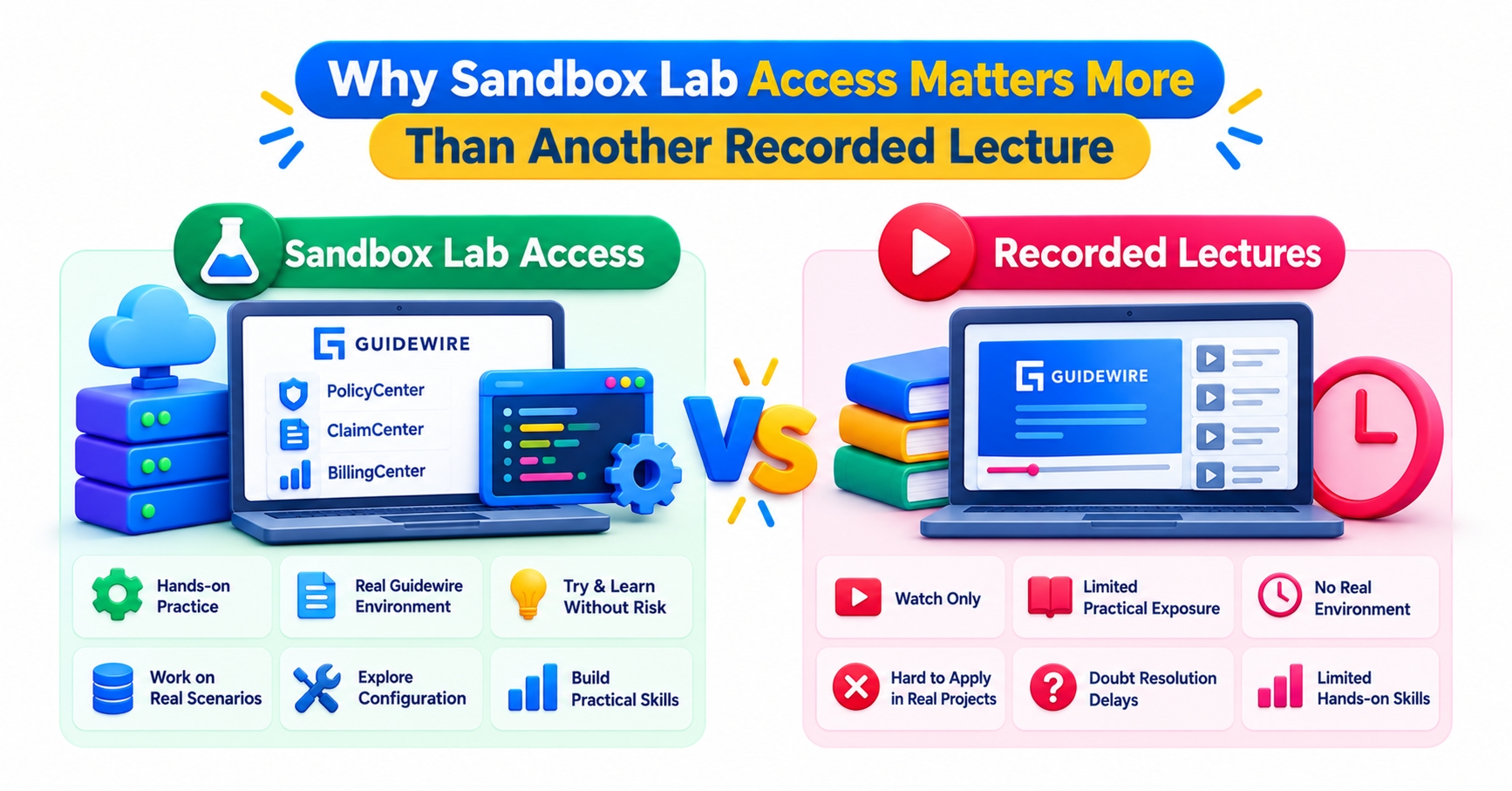
Watching someone configure a rule teaches you what the finished rule looks like. It does not teach you what happens when your own rule fails validation at 11 p.m. and you don’t know why. That second experience is where the learning sticks.
JastTech provides 24/7 sandbox lab access, so learners can build and break things outside class hours. For a platform you can’t install on a personal laptop, this is arguably the most valuable part of any Guidewire course. An institute that doesn’t offer it is asking you to learn a hands-on skill from the sidelines.
Consider a small exercise a learner might attempt in a lab. Add a “vehicle usage” field to a personal auto policy, show it on the policy screen, and write a Gosu rule that blocks binding if the field is empty. You will probably get the entity extension wrong the first time, then discover your screen can’t see the new field, then find a typo in your rule. Each of those mistakes is a lesson you won’t forget.
Lab access pairs with doubt support. The course promises round-the-clock doubt resolution and one-to-one sessions with mentors, which matters when you’re stuck on an error message and don’t want to wait until next Saturday’s class. Fast feedback keeps small problems from turning into abandoned assignments.
One honest caveat: access is not the same as practice. A sandbox that nobody opens teaches nothing. Learners who do well in programs like this usually block fixed hours each week for lab work, treat assignments as rehearsals for interviews, and rebuild exercises from scratch without notes.
When you compare institutes, ask exactly what the lab environment includes, how many hours you can use it, and whether you keep access after the batch ends.
Three Projects That Resemble Real Insurance Work
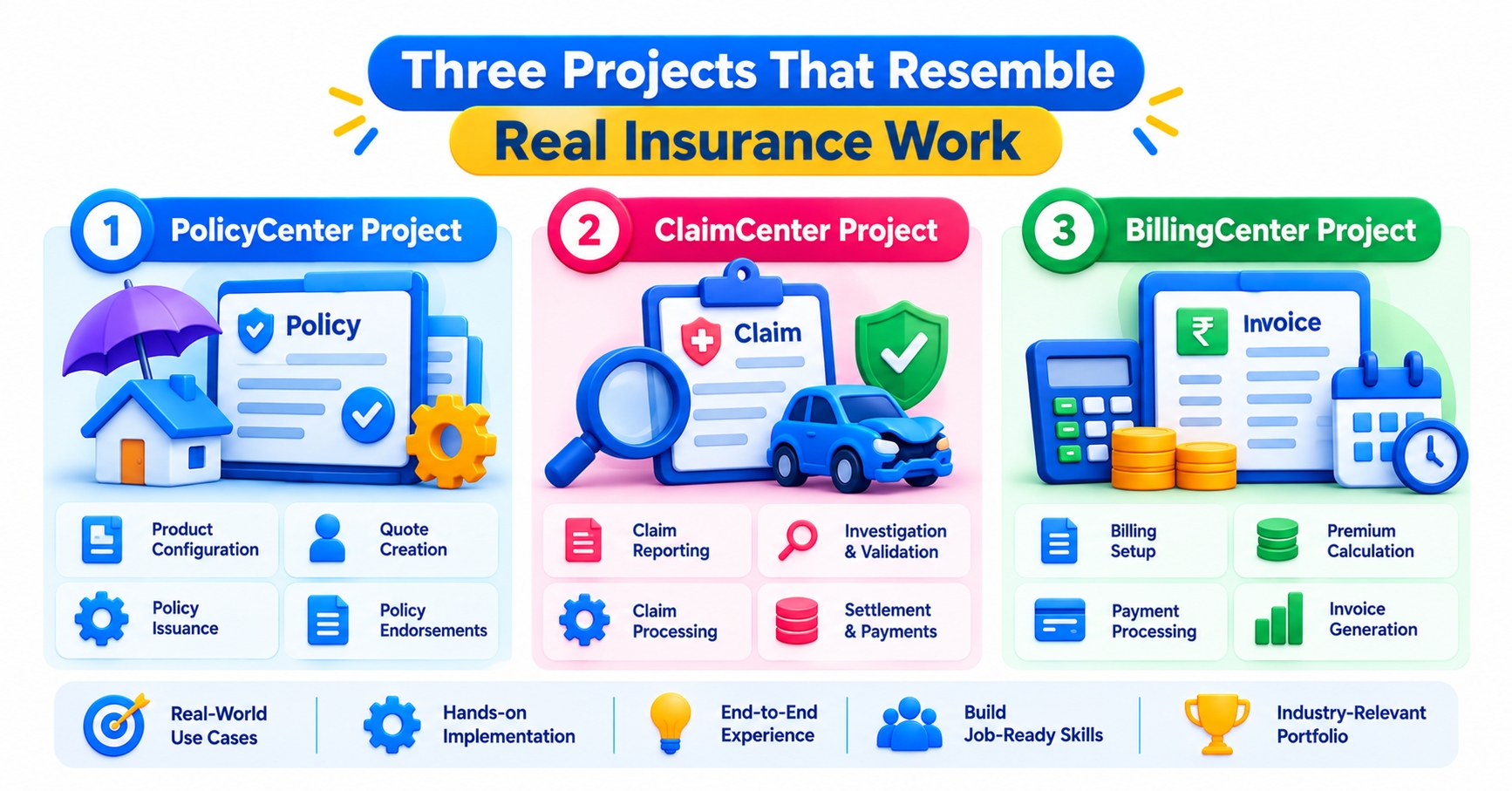
Projects are where a Guidewire course either earns its fee or doesn’t. JastTech’s program includes three, one for each core application, and each is framed around a task a project team would recognize.
The PolicyCenter project builds a personal auto policy flow: onboarding, quote generation, premium calculation, underwriting referral rules and endorsements. Learners configure product models and coverage terms, design screens with PCF and Gosu, and implement REST endpoints for rating and issuance.
The ClaimCenter project centers on claims intake and adjudication. It covers first notice of loss, automatic assignment of claims by severity, reserve management, payment authorizations and notifications to adjusters and policyholders. This one teaches how business rules decide who handles a claim and when.
The BillingCenter project goes furthest into financial logic. Learners set up direct and agency billing plans, build delinquency workflows, write payment plugins in Gosu and automate reconciliation through batch processes. Billing is often underestimated by beginners, yet the validation behind it is intricate. For a deeper look at how rules and validations shape billing behavior, this explanation of Guidewire BillingCenter business rules and validation logic is a useful companion read.
These are training builds, not client engagements, and it is worth keeping that distinction clear in your own resume. Describe them as capstone projects, list the tools you used, and be ready to explain your design choices. Interviewers tend to probe the “why” behind a rule more than the screen it appeared on.
Used well, the projects give you specific stories to tell. “I configured delinquency workflows and wrote a payment plugin” lands better in an interview than “I completed a Guidewire course.” Specific, explainable work is what separates a portfolio from a certificate.
How Two Months of Training Is Structured
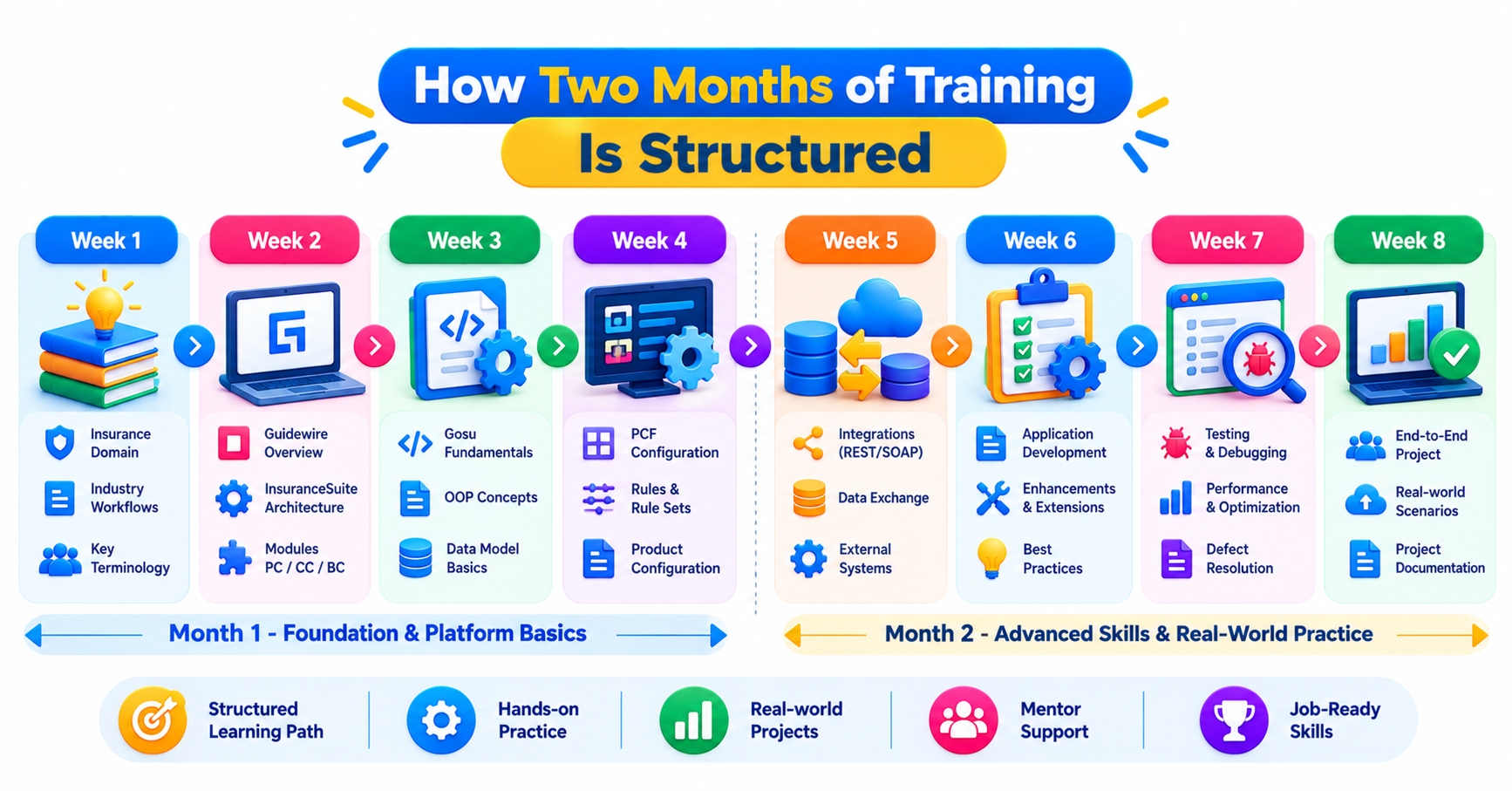
The program runs for two months, with roughly 40 to 45 hours of applied learning according to JastTech. That includes live lectures, lab exercises, assignments, project work and mock interviews. It is a compact schedule, so the structure matters.
The plan begins with onboarding: you meet a mentor, define your goals and take a skill-gap assessment. This step helps because a QA tester, a Java developer and a business analyst arrive with very different starting points. Core learning then happens in live classes backed by recordings.
Hands-on practice follows through weekly assignments, multiple-choice evaluations and module quizzes. After that come the three projects, one-to-one doubt sessions, certification preparation, and a final stage covering resumes and mock interviews. The sequence makes sense because each stage builds on the one before.
Batches are offered on weekends and on weekday mornings and evenings. This matters for working professionals, since most people exploring Guidewire already have a job. Live sessions are recorded and stay available for revision, so a missed class is recoverable. You can check the latest batch timings on the Guidewire training course page, since start dates change.
A realistic expectation helps here. Forty-odd hours of instruction will not make anyone an expert. What the structure can do is give you a foundation, a set of projects and the habit of working inside the platform. Most learners will need additional self-study in the weeks after, especially in Gosu and integration.
Before enrolling, ask how the plan handles someone who falls behind. Good programs have a way to catch up, such as recordings, extra doubt sessions or a flexible batch change. Weak ones simply move on without you.
Certification, Interviews and Where the Training Can Lead
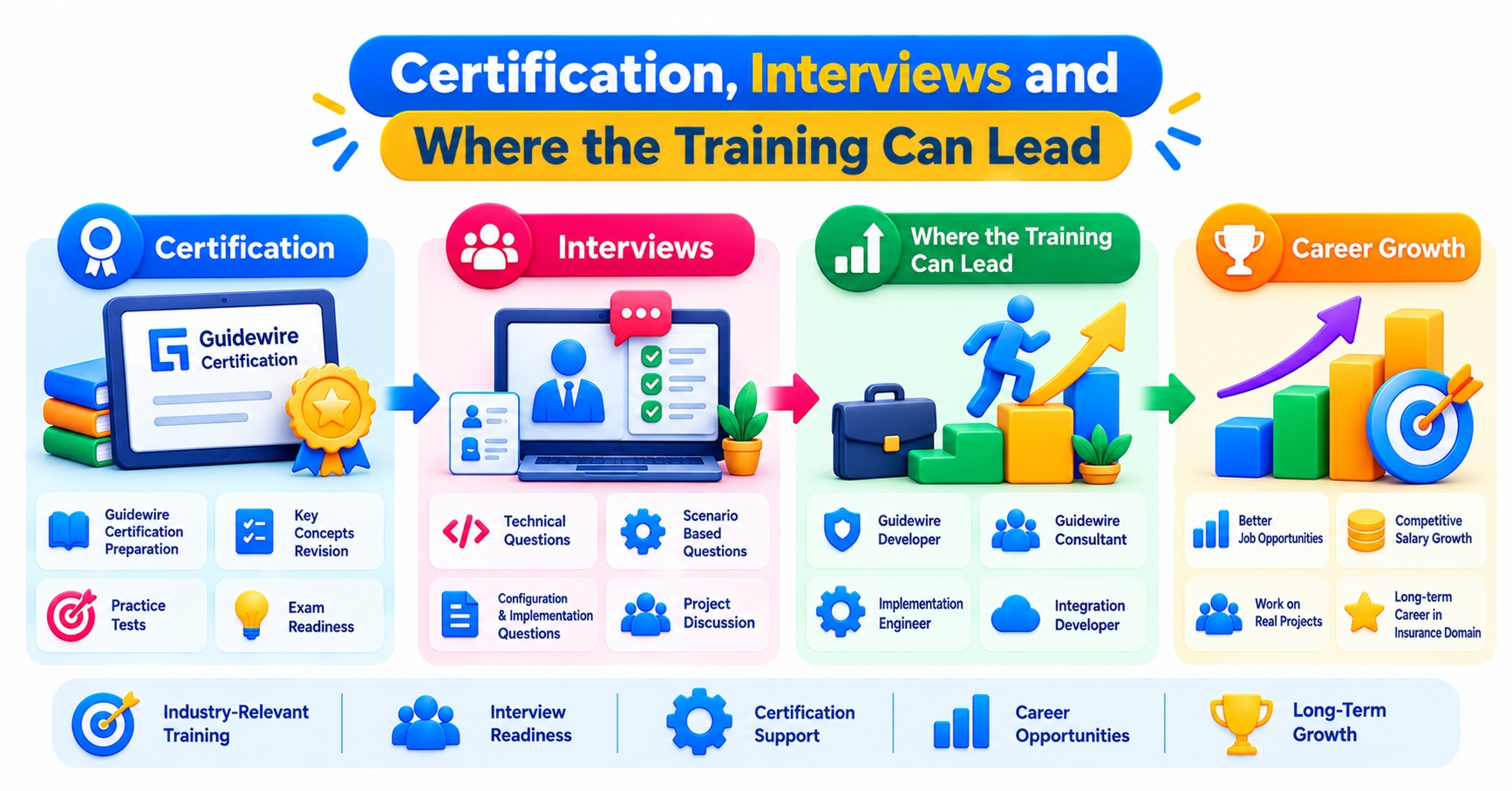
Certification is worth explaining clearly because it is often misunderstood. Official Guidewire certifications come from Guidewire itself, not from a training institute. What an institute can do is prepare you for the exams, and JastTech structures its preparation around the Guidewire Associate-level exams, along with practice questions and a course completion certificate.
Interview readiness is a separate skill. Common questions test practical understanding: how you extend a data model entity, what PCF files do, why Gosu enhancements exist, how a policy moves from submission to renewal, and what happens during first notice of loss in ClaimCenter. The best answers come from having done the work, not memorized definitions.
The roles linked to this training are wider than many people expect. JastTech lists PolicyCenter, ClaimCenter and BillingCenter developer roles, integration developer, technical lead, QA engineer, test automation engineer, business analyst and project manager. Not every path involves heavy coding. Testers and analysts also need to understand the platform and the insurance process, which is why a mixed-background batch can work well.
Career support covers resume writing, LinkedIn profile building, mock interviews and job placement assistance. It is reasonable to value this, but it helps to stay realistic. No institute controls hiring decisions, and any promise of guaranteed placement deserves skepticism. Support improves how well you present yourself, while employers still judge your skills.
Pay in Guidewire roles varies with experience, role type, location and employer, so rely on current job postings and recruiter conversations instead of a single quoted figure. The same goes for demand. Check what employers in your city are asking for before choosing a specialization.
Alumni guidance can also help, since people who recently went through hiring can tell you what interviews actually looked like.
How to Judge Any Guidewire Institute Before You Pay
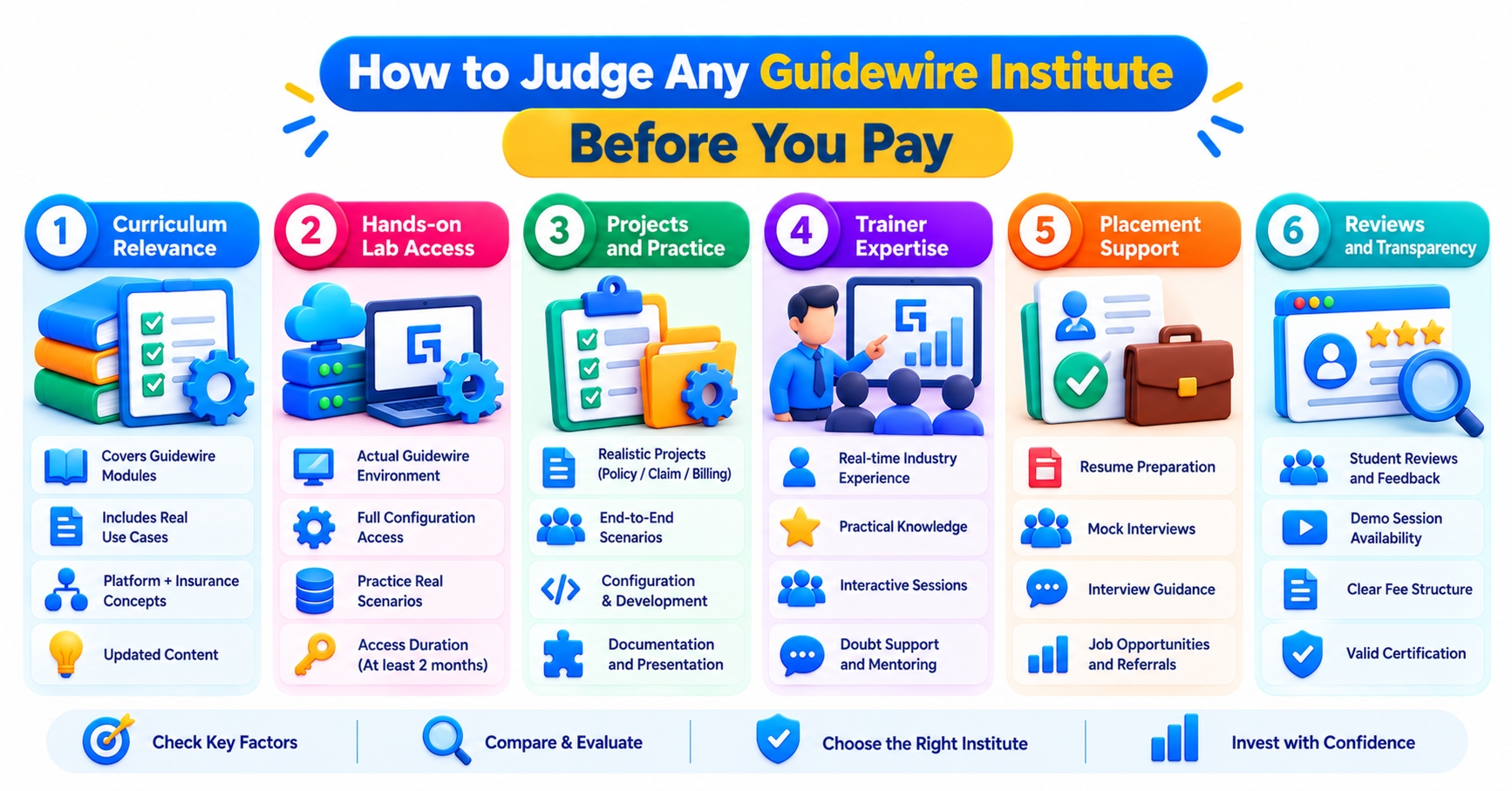
You can apply the same checks to JastTech or to anyone else. These questions cut through brochure language quickly:
Does the syllabus name Gosu, PCF, data model customization and integration? If it only lists “Guidewire overview,” the course is likely theory-heavy.
Is there a real lab environment, and for how long can you use it? Ask for specifics, not a yes or no.
What exactly are the projects? Look for concrete scenarios, tools used and outcomes, not vague phrases like “live project.”
Who teaches, and what have they implemented? Teaching ability and project experience are separate things.
Are sessions recorded, and do you keep access afterwards? This affects revision and catching up.
What does certification support include? Clarify whether it means exam preparation only, or also guidance on registration.
What do past learners say, and can you read it for yourself? Reviews on independent platforms are more useful than testimonials chosen by the institute.
What are the fee, installment options and refund terms? Read them before paying.
Also be honest about your own readiness. If you have no programming background, ask how the course handles Gosu for beginners. If you come from testing or business analysis, ask whether your track gets relevant projects. A good counselor will answer plainly, including telling you when another course suits you better.
Finally, request a trial conversation with an instructor or a look at the curriculum in detail. How someone explains a concept like effective dating or a claim reserve tells you more about the quality of teaching than any marketing page.
JastTech publishes much of this information openly, including the curriculum, project descriptions, schedules and certificate sample, which makes comparison easier. Use that openness as a benchmark when evaluating competitors.
The Takeaway
Choosing Guidewire training in India comes down to one question: will you leave able to build something in the platform, or only describe it? A course with real lab access, projects and honest career support answers that well, and JastTech’s program is built around those pieces. Judge it by what you can configure after two months, not by what the brochure promises.Why Choose JastTech for Guidewire Training in India?