If you open a few Guidewire job descriptions, you will notice something interesting. Companies are not simply asking, “Do you know Guidewire?” They want people who understand insurance, can work with the platform, solve problems, and communicate with different teams.
That is also why choosing the right Guidewire training and certification in India matters. Learning only definitions of PolicyCenter, ClaimCenter, or BillingCenter may help you answer basic interview questions, but real projects require you to understand how these applications are actually used inside an insurance company.
So, what should you really learn?
First Understand What Guidewire Is Solving
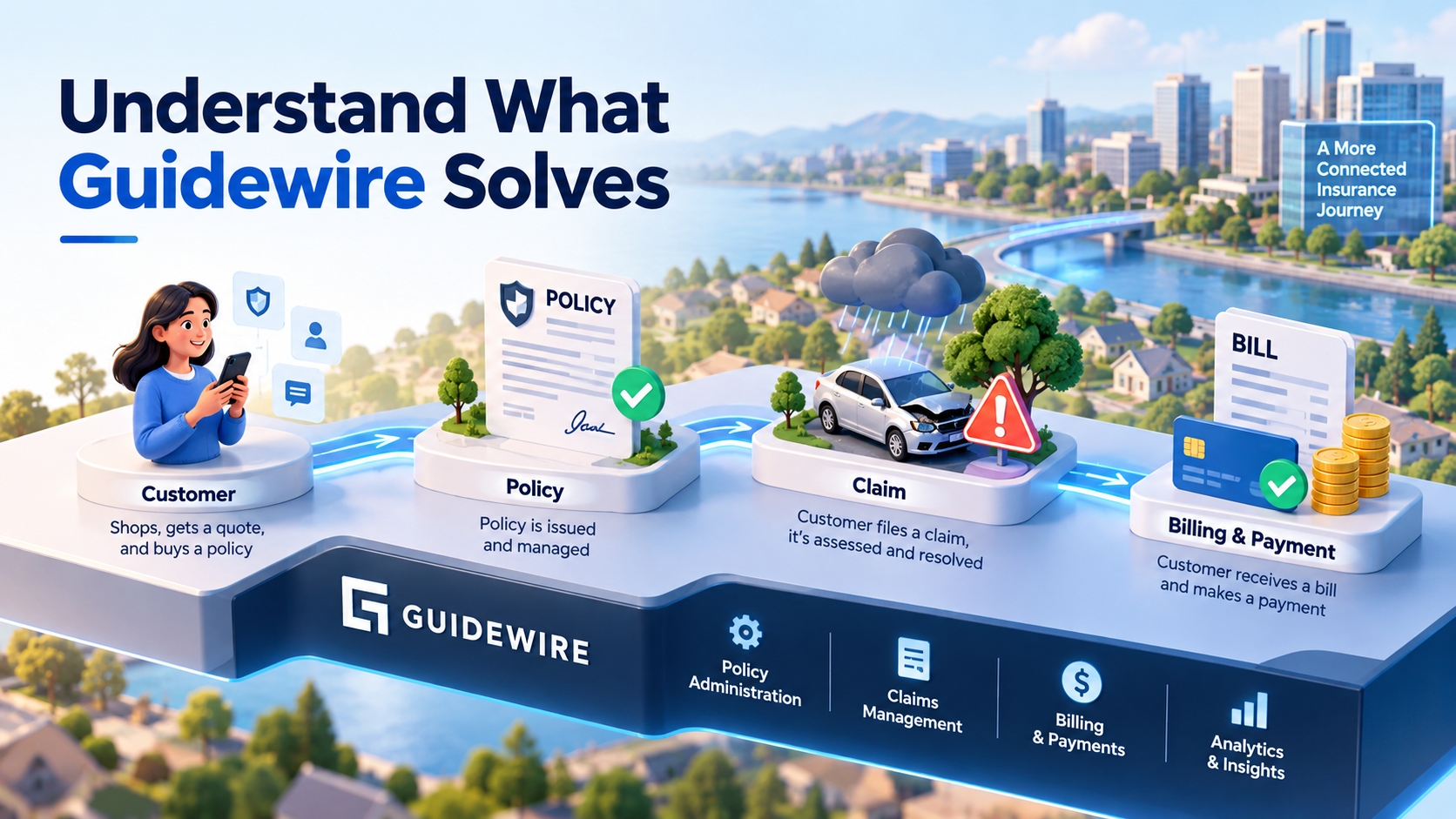
Before learning Gosu or APIs, understand the insurance process.
Think about someone buying car insurance. The insurer has to create a policy, calculate the premium, collect payments, make changes when required, and handle claims if an accident happens.
Guidewire helps insurance companies manage these kinds of processes.
PolicyCenter mainly deals with policies and underwriting.
ClaimCenter handles the claims process.
BillingCenter manages billing, payments, and related activities.
Knowing these definitions is easy. The real skill is understanding how one process connects with another.
For example, if a customer changes their vehicle, what happens to the policy? Does the premium change? Does underwriting approval become necessary?
That is where Guidewire knowledge starts becoming useful.
Learn the Fundamentals Before Going Too Deep
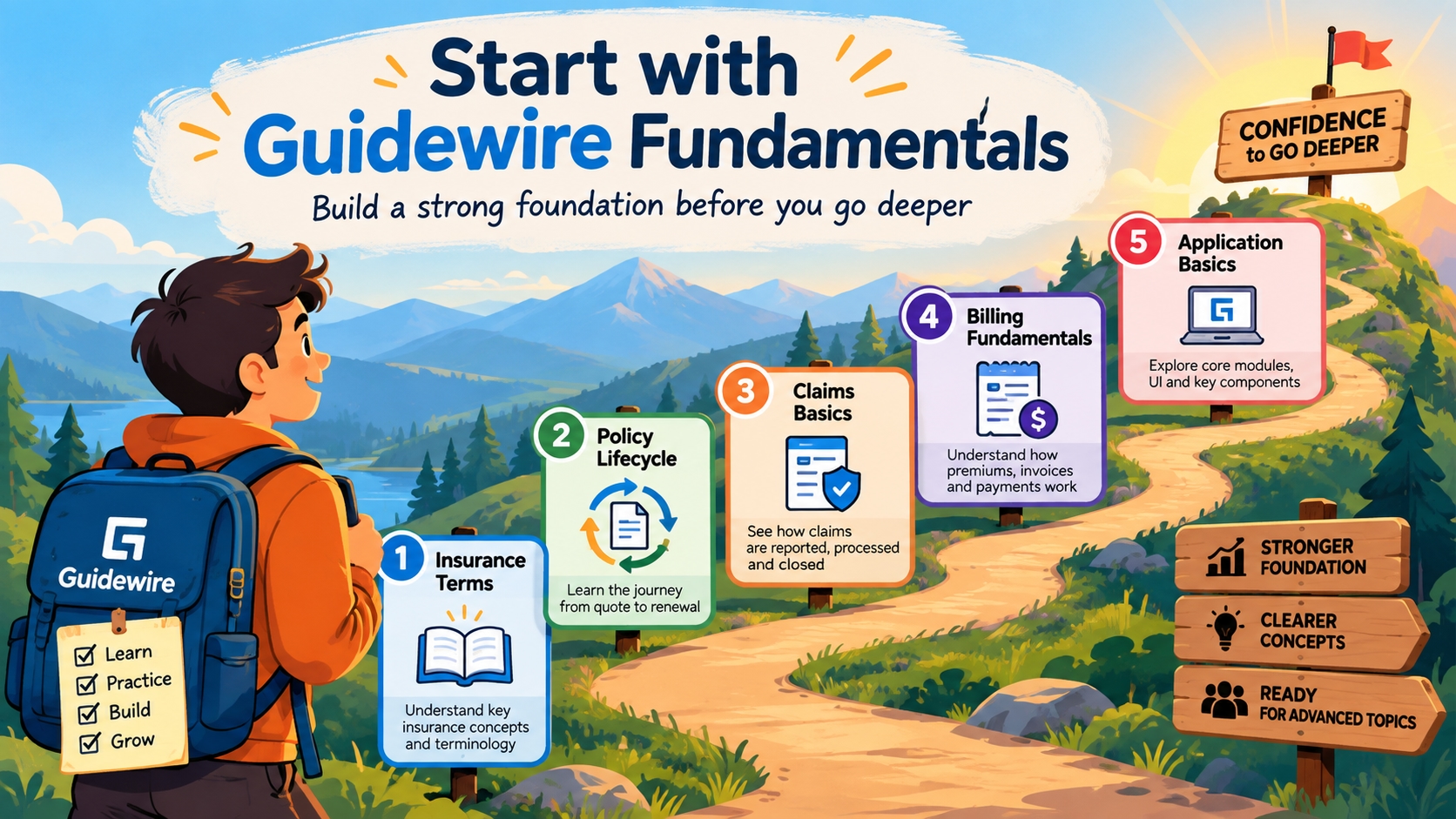
Beginners often make the mistake of jumping directly into coding.
A stronger starting point is learning Guidewire fundamentals such as insurance terminology, policy lifecycle, claims lifecycle, billing processes, users, roles, and how different Guidewire applications communicate.
Once these basics are clear, topics such as configuration and Gosu become much easier to understand.
Otherwise, you may know how to write a piece of code without understanding why the business needs it.
For Developers, Gosu Is Important—but It Is Not Everything

Gosu is one of the main technical skills associated with Guidewire development.
But employers usually need more than someone who knows Gosu syntax.
A developer may also work with PCF files, business rules, entities, typelists, data models, validations, workflows, and product configuration.
Imagine an insurer wants to add a new question during policy creation.
It may sound like a simple UI change.
But that question might also need to be stored in the database, validated through a business rule, used during underwriting, and possibly sent to another system.
A good Guidewire developer learns to think about the complete change—not just the screen.
Integration Skills Make You More Valuable
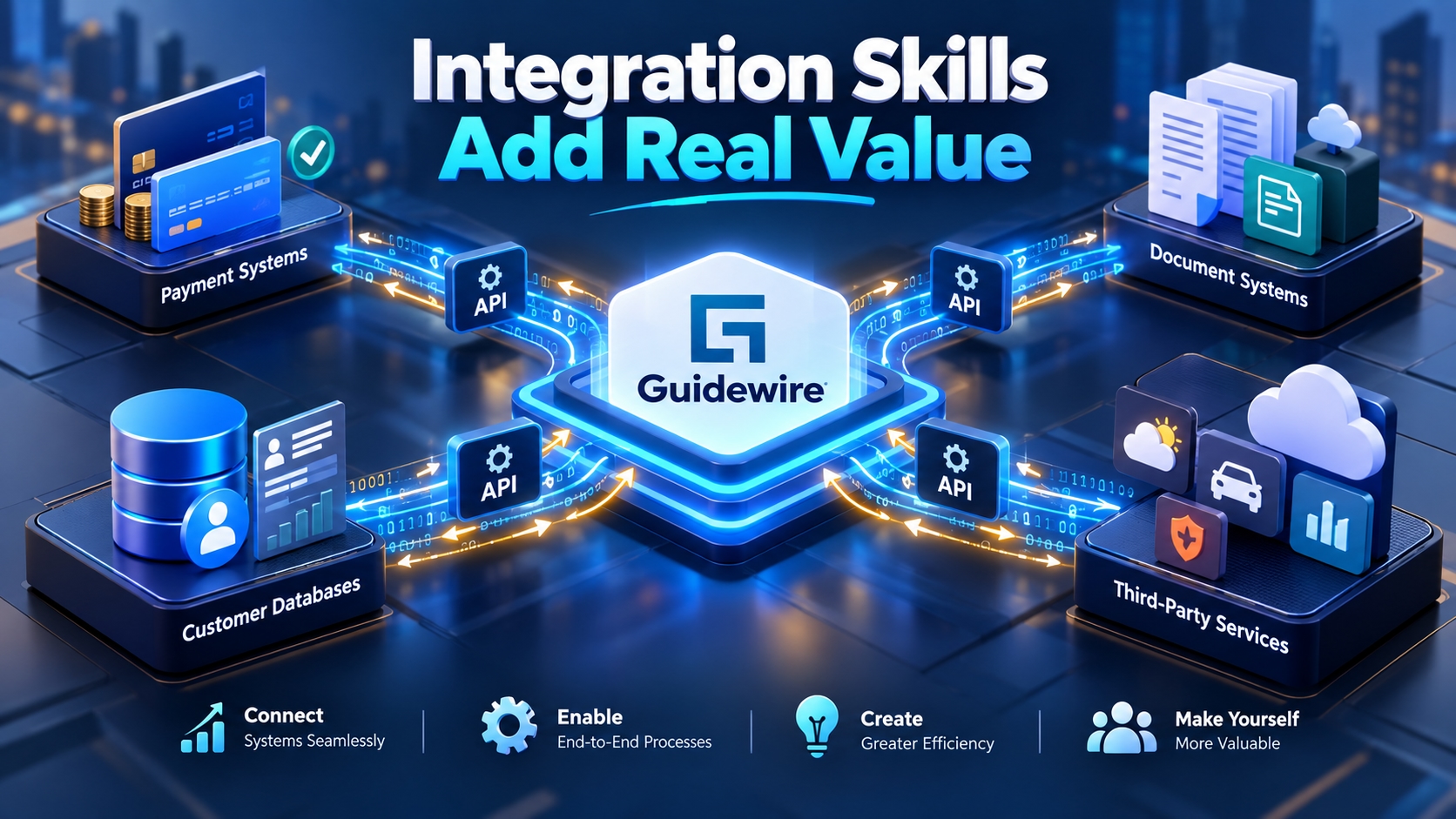
An insurance company may connect it with payment systems, document platforms, customer databases, third-party APIs, or reporting tools.
That is why concepts such as REST APIs, SOAP, JSON, XML, messaging, plugins, and error handling are useful.
You do not need to master everything on day one.
But you should understand how data moves from Guidewire to another system and what happens when something fails.
That kind of knowledge becomes especially useful when you start working on real projects.
Guidewire Business Analyst Is a Different Career Path

Not everyone needs to become a developer.
The Guidewire Business Analyst role is a good example.
A BA usually works between the insurance business team and the technical team.
Suppose the client says:
“We want claims to be processed faster.”
A developer cannot directly build something from that sentence.
The Business Analyst needs to understand where the delay happens, which users are involved, what approvals exist, and what exactly needs to change.
Then the requirement can be converted into something developers and testers can work with.
So, someone preparing for a Guidewire BA role should focus heavily on insurance processes, requirements, user stories, workflows, acceptance criteria, and communication.
Do Not Ignore Testing
Testing may not sound exciting, but insurance applications can become complicated very quickly.
A small change to a policy rule can affect another part of the process.
That is why developers, testers, and even Business Analysts should understand how to test complete workflows.
For example, instead of checking only whether a button works, think about what happens after the user clicks it.
Does the policy update correctly?
Does billing receive the right information?
Does the change affect underwriting?
That is much closer to the kind of thinking companies need.
Cloud Knowledge Is Becoming More Relevant
Guidewire has moved strongly toward cloud-based implementations.
Because of that, new professionals should at least understand cloud environments, deployments, APIs, logging, integrations, and release processes.
You do not need to become a cloud architect immediately.
But if you are planning a long-term Guidewire career, cloud knowledge should be part of your roadmap rather than something you leave for later.
What Should You Look for in a Guidewire Course?

This is where many learners make the wrong decision.
They compare courses based only on duration, number of modules, or certification claims.
A better question is:
What will I actually be able to do after completing the course?
For example, if you are comparing a Guidewire course in Hyderabad, check whether the training includes practical configuration, insurance use cases, Gosu, integrations, debugging, and project-based exercises.
A course that explains 100 topics without practical work may be less useful than one that teaches fewer concepts properly.
Certification Helps, but It Should Come After Understanding
Guidewire certification can strengthen your profile, especially when employers are looking for people who understand specific Guidewire products or cloud implementations.
But certification alone should not become the goal.
A person who has completed a certification but cannot explain how a policy transaction works may still struggle in an interview.
The stronger combination is:
Fundamentals → Practical skills → Project understanding → Certification
That sequence makes much more sense.
Which Path Should You Choose?
Your learning path should depend on the job you want.
If you enjoy coding, move toward Guidewire development and focus on Gosu, configuration, data models, integrations, and debugging.
If your strength is insurance processes and communication, the Guidewire Business Analyst path may suit you better.
If you enjoy finding issues and validating workflows, testing can be another option.
And if you already have strong Guidewire experience, cloud and architecture skills can become the next step.
The Skill That Employers Really Notice
The most useful Guidewire professionals are not simply the people who remember the most terms.
They can understand a business problem and connect it with the right Guidewire solution.
That might mean a developer understanding why an underwriting rule exists, a Business Analyst converting an unclear business request into a usable requirement, or a tester identifying how one change affects the complete insurance workflow.
If you are starting Guidewire in 2026, build that understanding first.
The tools, certifications, and advanced skills will make much more sense after that.