
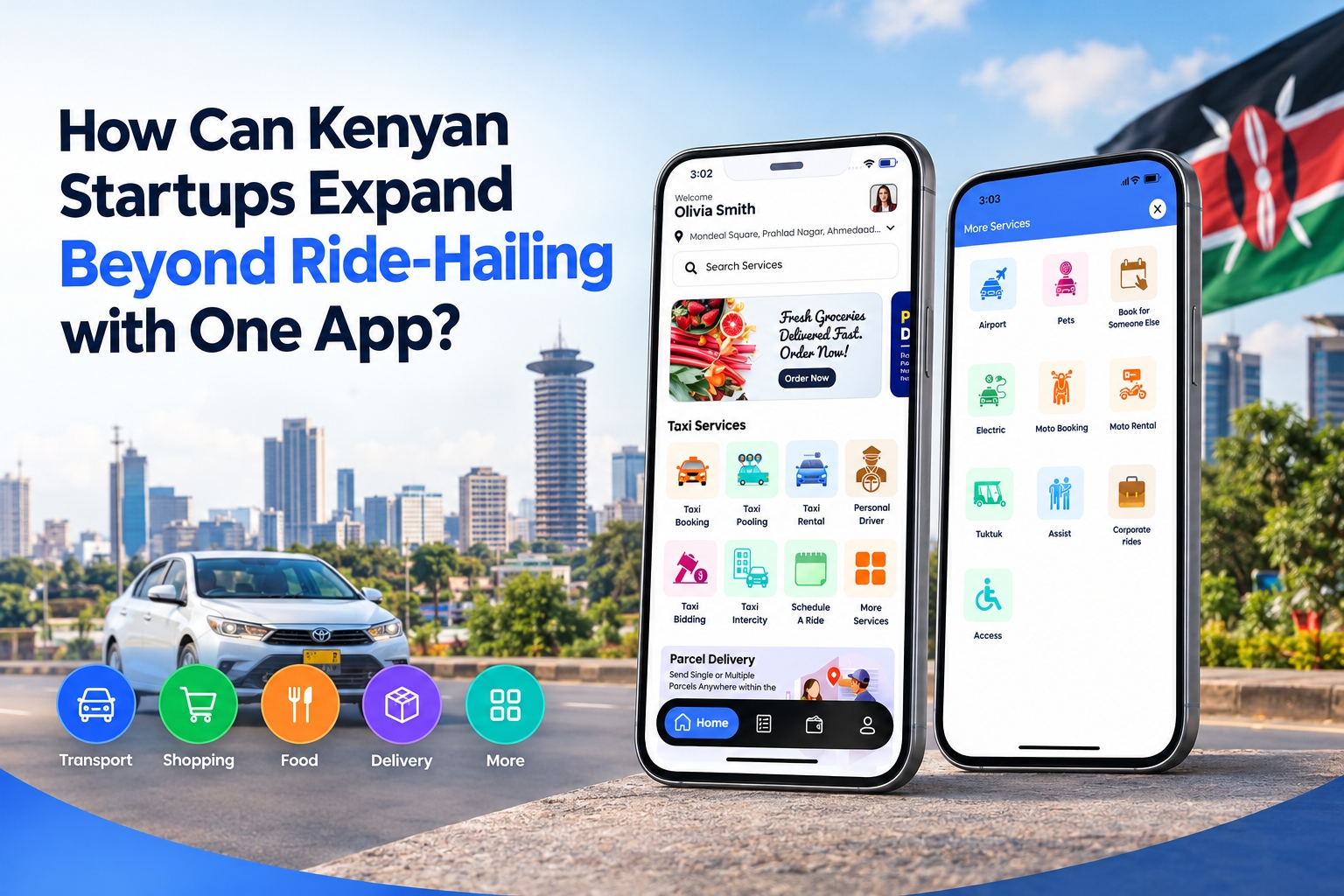
A boda boda booking app solves one particular need: helping people get from one place to another. But customers have plenty of other tasks to manage throughout the day. They may need lunch delivered to the office, groceries brought home, a parcel sent across town, or someone to repair an appliance.
For Kenyan startups, these everyday activities raise an interesting question: does a digital business have to focus on just one service, or can it bring several related services together?
A multi-service app offers one possible answer. By connecting transportation, delivery, shopping, and household services through a shared platform, businesses can explore different customer needs without requiring users to download a separate app for every task.
This is the idea behind a Gojek-style super app. The business model gives startups room to introduce additional services as their customer base and operations develop. The real challenge is deciding which services belong together, how to manage them efficiently, and what will make customers return.
1. Why Should Kenyan Startups Look Beyond Ride-Hailing?
Ride-hailing can provide a clear starting point for a digital business, but a single-service model may not address every need of its customer base.
Consider someone who regularly uses a ride-booking app to commute. That person might also order groceries online, send packages to customers, or look for a local professional to handle household repairs. These activities create opportunities for businesses that understand how customers use digital services throughout the day.
A multi-service model can also create connections between local businesses. Restaurants need delivery partners, retailers want to reach more customers, and independent professionals need ways to receive enquiries and manage bookings.
For startups, the opportunity lies in identifying these connections. Offering more services is not automatically better; the additional categories must be useful to customers and manageable for the business.
2. Which Services Could Work Together in Kenya?
The most suitable service combination depends on the target market, local demand, and availability of reliable service providers. Several categories are worth considering.
Boda Boda and Taxi Bookings
Motorcycle taxis are a familiar transportation option in Kenya, particularly for journeys where flexibility and convenient pickup locations matter. An app can help customers request rides, confirm pickup details, view driver information, and follow their journeys.
Some businesses may also explore conventional taxi bookings or scheduled transport services.
Features such as trip history, fare estimates, ratings, and location sharing can help customers understand what to expect. Equally important are driver availability, clear cancellation policies, and a reliable process for resolving complaints.
Food and Grocery Delivery
Ordering meals and groceries online can help customers manage busy schedules while giving restaurants and retailers another way to reach their audiences.
A startup might begin by partnering with a limited number of restaurants in a defined area. Grocery delivery could follow if customer feedback indicates demand and the business can manage product availability and fulfilment.
The operational details matter. Inaccurate menus, unavailable products, delayed orders, and unclear delivery charges can quickly undermine customer confidence.
Courier and Parcel Services
Small businesses, online sellers, offices, and individuals often need to send documents or packages locally. A courier service can provide a way to arrange pickups, communicate delivery instructions, and receive confirmation when an item arrives.
For startups already working with drivers or delivery partners, this service may complement existing operations. However, businesses need clear procedures for accepted items, delivery delays, failed pickups, and proof of delivery.
Home Maintenance and Personal Services
Household needs offer another possible direction. Customers may want to book cleaners, plumbers, electricians, appliance technicians, or other professionals through a digital platform.
Unlike a straightforward delivery, these bookings can require appointment scheduling, service descriptions, provider verification, and agreement on the work to be completed.
Startups should consider these requirements before adding home services. A category that looks simple in an app interface may require considerable coordination behind the scenes.
3. How Can Startups Identify the Right Services?
Choosing services based on popularity alone can lead to expensive mistakes. A category that works well in one location may not attract enough customers or providers in another.
Market research should begin with conversations rather than assumptions. Entrepreneurs can speak with commuters, restaurant owners, retailers, delivery workers, and households to understand their current frustrations and how they manage them.
The findings can then be assessed against four questions:
Customer demand: Is the problem frequent enough for people to use the service regularly?
Partner availability: Can the business recruit enough reliable drivers, merchants, or professionals?
Operational fit: Can the service share existing resources, or will it require an entirely separate operating model?
Financial viability: Can the business cover fulfilment, support, marketing, payment processing, and technology expenses?
For example, a startup with an established network of boda boda riders might investigate local parcel delivery. A business already working closely with restaurants may find grocery delivery a more natural extension.
Testing one additional category on a limited scale can reveal more than launching several services simultaneously.
4. What Technology Does a Multi-Service App Require?
Bringing multiple services into one application creates several technical requirements. The platform needs to support different booking processes while maintaining a consistent experience for customers.
For entrepreneurs considering Gojek clone app development, mapping the required customer, driver, merchant, and admin workflows is a useful starting point. This helps identify which features are essential for the initial launch and which can be introduced later.
Customer Interface
Customers should be able to discover available services, enter accurate locations, compare relevant options, place bookings, and follow progress.
Depending on the service, useful features may include booking history, notifications, payment options, ratings, and customer support. The interface should remain easy to navigate as more categories become available.
Driver and Service Provider Tools
Drivers, couriers, and home-service professionals have different responsibilities. Their interfaces may need job requests, availability settings, navigation, booking details, status updates, and earnings records.
A single workflow will not necessarily suit every category. Transport bookings, parcel deliveries, and scheduled household appointments may need different processes.
Merchant Management
Restaurants and retailers need to manage products, prices, availability, orders, and fulfilment. A merchant interface can reduce the need for manual coordination and help businesses keep customers informed.
Administration and Reporting
The administrative system should provide appropriate oversight of bookings, users, partners, payments, complaints, and service performance.
Before developing or adopting a multi-service platform, startups should map out their actual workflows. This helps distinguish essential functionality from features that can be introduced later.
5. How Should the App Be Adapted for Kenyan Customers?
Local conditions should influence product decisions from the beginning rather than being addressed after development is complete.
Payment options: Mobile money, including M-Pesa, is worth considering alongside other suitable payment methods. Businesses should verify integration availability and test payment confirmation, refunds, and settlement procedures.
Location accuracy: Customers may need to provide a landmark or additional pickup instructions when a map pin alone is insufficient. Clear communication between customers and providers can help reduce missed pickups.
Language: English and Swahili may be appropriate options depending on the intended audience. Instructions, notifications, and support messages should be easy to understand.
Mobile performance: The application should work efficiently on common devices and avoid unnecessary data usage. Clear status messages are useful when connectivity is inconsistent.
Pricing transparency: Customers should understand the applicable fare, delivery fee, service charge, and cancellation conditions before confirming a transaction.
These considerations are relevant across different service categories, although their implementation will vary according to the business model.
6. How Can a Startup Expand Gradually?
Expanding too quickly can create problems that are difficult for a small team to manage. More services mean more partner relationships, different fulfilment processes, and additional customer support requirements.
A Gojek-style multi-service app can provide a framework for introducing new categories over time, but the business should expand according to customer demand and operational readiness rather than simply increasing the number of available services.
A gradual approach gives entrepreneurs time to identify weaknesses and make improvements.
Begin with one core service. Choose a service with identifiable demand and a manageable operating area.
Measure actual performance. Review booking completion, cancellations, waiting times, customer feedback, and repeat usage.
Introduce a related service. Select a category that fits the existing customer base or partner network.
Review the results. Assess whether the new service is attracting customers and whether its operational costs are sustainable.
Expand when the evidence supports it. Additional locations and categories should be introduced only when the business has the resources and partner coverage to maintain service quality.
This strategy does not guarantee success, but it helps limit the risks associated with building a large operation before the business model has been tested.
7. What Revenue Models Can Support a Multi-Service Business?
Different services create different opportunities to generate revenue. The appropriate model depends on customer expectations, partner agreements, and the cost of fulfilling each booking.
Booking commissions: The platform may receive an agreed percentage of completed rides, deliveries, or service appointments.
Delivery fees: Customers may pay a fee for the collection and delivery of items.
Merchant subscriptions: Businesses may pay for selected platform tools or account features where these provide sufficient value.
Promotional placements: Participating merchants may pay for clearly identified promotional visibility.
Membership programmes: A startup could test a membership that offers selected benefits to frequent users.
Each option requires careful evaluation. A high booking volume does not necessarily translate into profitability if fulfilment costs, customer acquisition expenses, and partner incentives are too high.
Startups should examine the economics of each category separately instead of assuming that one revenue model will work equally well across the entire platform.
8. What Challenges Should Entrepreneurs Prepare For?
Managing a multi-service business can be more complicated than managing a single-category app.
Maintaining service quality: Different categories require different standards. A delayed parcel, a cancelled ride, and an unsatisfactory home repair each need an appropriate resolution process.
Recruiting reliable partners: The platform must attract and retain enough providers to fulfil requests consistently.
Managing customer expectations: Customers need clear information about availability, pricing, delivery times, and cancellations.
Protecting information: The business must handle customer details, location information, and payment-related data responsibly.
Meeting applicable requirements: Transport, payments, consumer transactions, and other activities may be subject to different Kenyan legal or regulatory obligations. Entrepreneurs should determine which requirements apply to their specific operations.
Addressing these issues early can help prevent the business from becoming difficult to manage as usage increases.
9. What Role Does a Gojek-Style Platform Play?
A multi-service app like Gojek provides a useful reference point for entrepreneurs exploring how transportation, delivery, and other on-demand services could operate through one platform. The concept does not require every startup to reproduce the same service mix or operating structure.
The technology approach will depend on the project's requirements. Some businesses may prefer custom development, while others may consider an existing platform that can be adapted to their needs.
In either case, the important questions concern functionality, customization, payment integrations, security, ongoing maintenance, and the ability to support the intended services. Entrepreneurs should assess these factors against their business plan before choosing a development approach.
Conclusion
Expanding beyond ride-hailing gives Kenyan startups an opportunity to examine other everyday needs, from food and grocery delivery to courier services and household assistance. Bringing these services together can make a platform useful for a wider range of activities, but the business model needs to work operationally as well as technically.
The best starting point is not necessarily the app with the most categories. It is the business that understands its customers, builds dependable partnerships, and delivers a consistent service.
By testing demand, learning from customer feedback, and expanding at a manageable pace, startups can make more informed decisions about whether a multi-service model fits their goals.