
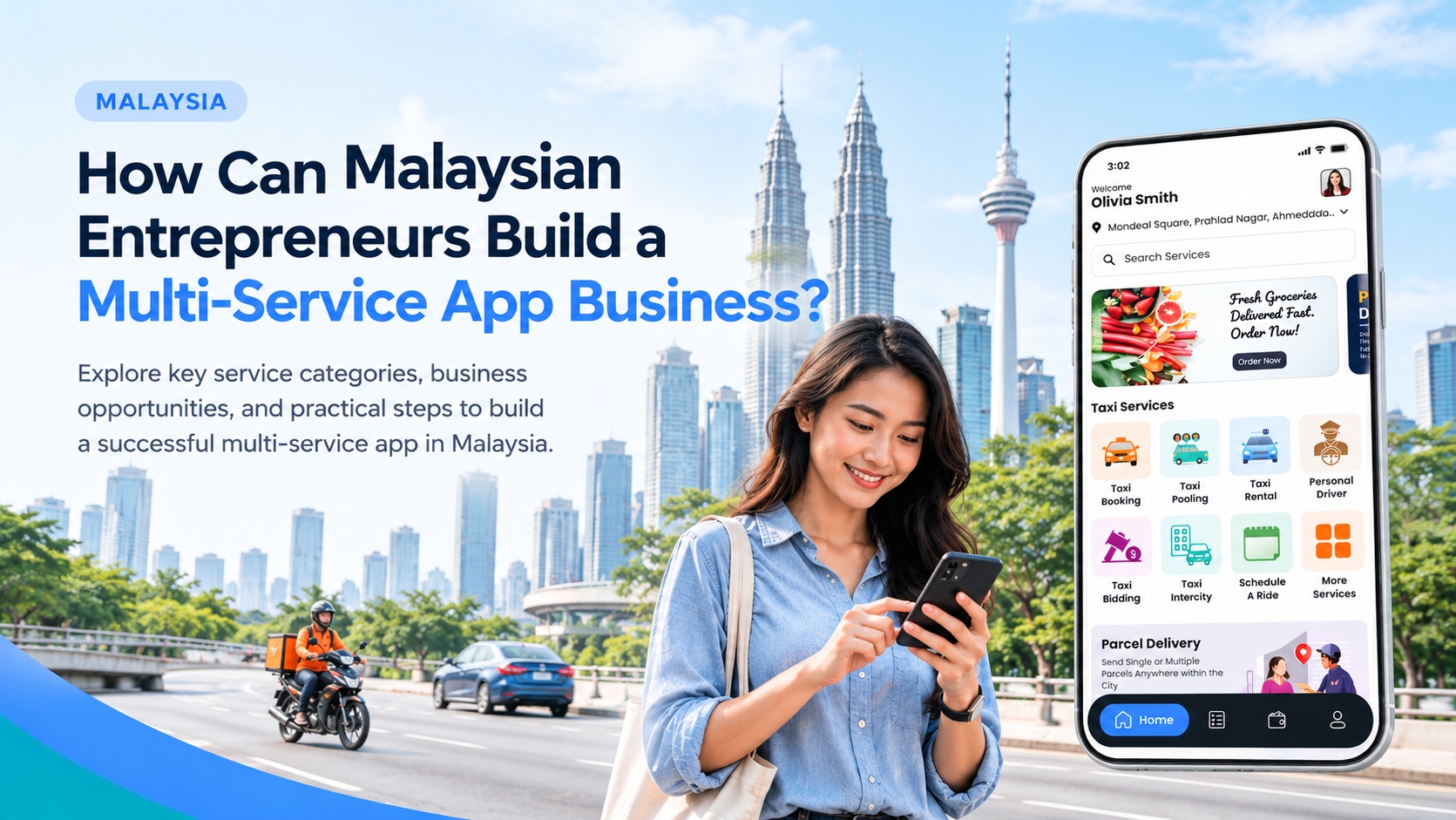
Building a digital business requires more than developing an app and attracting users. Entrepreneurs need to understand customer needs, establish relationships with service providers, and create a business model that can support daily operations. In Malaysia, a multi-service app can bring different services together, allowing customers to arrange transportation, order deliveries, and book local professionals through one platform.
However, combining several services does not automatically create a successful business. Each category has its own operational requirements, customer expectations, and revenue opportunities. Entrepreneurs must decide which services to introduce first, how to manage providers, and what will make their platform useful to a clearly defined audience.
A practical approach to multi-service app development begins with market research and a focused business plan. The technology should support that plan rather than determine it.
1. Identify a Market Need Before Developing the App
The first step is to understand which customer problems the proposed business intends to solve. Instead of trying to serve every possible audience, entrepreneurs can begin with a specific group, such as apartment residents, small retailers, working professionals, or households that regularly require local services.
For example, small businesses may need flexible parcel collection, while residents may want an easier way to arrange cleaning or home maintenance. These needs can form the basis of a business concept, provided there is sufficient local demand.
Research should include conversations with potential customers, an assessment of competing platforms, and discussions with service providers. Entrepreneurs should investigate how customers currently arrange these services, what difficulties they experience, and whether they would consider using a new platform.
This research also helps identify gaps that existing businesses may not be addressing effectively. A platform might differentiate itself through a focused service area, reliable provider availability, or a better booking process rather than simply offering more categories.
2. Choose Service Categories That Complement Each Other
A multi-service platform can include transportation, deliveries, household assistance, and specialized bookings. However, the initial selection should reflect the target audience and the business's ability to manage each category.
Transport services: Taxi bookings, scheduled rides, airport transfers, and carpooling may suit businesses targeting customers who need regular transportation.
Food and grocery delivery: Restaurants, grocery stores, and other retailers can use a digital ordering system to receive customer requests and coordinate deliveries.
Parcel delivery and errands: Local deliveries, document collection, and shopping assistance can serve individuals and businesses that need items moved between locations.
Home services: Cleaning, plumbing, electrical repairs, and handyman bookings can connect customers with independent professionals.
Personal and specialized services: Pet care, beauty appointments, car washing, and roadside assistance may appeal to particular customer groups.
Entrepreneurs should look for relationships between categories. For instance, parcel delivery and grocery delivery may share delivery partners and operational processes. By contrast, introducing several unrelated services at once could increase management requirements without generating enough additional demand.
Starting with two or three complementary categories can make it easier to test the business model and improve service quality before expanding.
3. Build a Reliable Network of Providers
The availability of dependable providers directly affects the customer experience. Even a well-designed app can struggle if customers frequently encounter unavailable drivers, delayed deliveries, or cancelled appointments.
Entrepreneurs should establish a provider recruitment strategy before launching the platform. Depending on the selected categories, this may involve drivers, delivery partners, restaurants, retailers, cleaners, electricians, plumbers, and other professionals.
The onboarding process should clarify how providers receive requests, manage bookings, get paid, and handle cancellations. Businesses should also establish appropriate verification procedures and check relevant qualifications where required.
A provider management system can help professionals maintain profiles, receive booking notifications, update availability, and review transaction information. Administrative tools can help the business monitor performance and respond to recurring complaints.
Geographic coverage is another important consideration. Recruiting enough active providers in a defined area may be more useful than listing providers across multiple cities without sufficient availability.
As demand increases, the business can gradually expand its network and service coverage.
4. Select Features Based on Business Requirements
The features of a multi-service app should reflect how customers and providers interact within each category. A taxi booking requires driver allocation and journey tracking, whereas a home repair booking may need task descriptions, appointment scheduling, and price confirmation.
A typical platform may require:
Customer accounts: Registration, profiles, booking histories, and saved preferences.
Location services: Address selection, route information, and tracking where applicable.
Scheduled bookings: Advance appointments for transport and professional services.
Merchant management: Tools for stores and restaurants to manage listings and orders.
Provider dashboards: Booking requests, availability management, and transaction records.
Payment integration: Suitable payment methods, receipts, and transaction histories.
Notifications: Updates about confirmations, cancellations, and booking progress.
Administrative controls: User management, service configuration, reports, and complaint handling.
A Gojek clone app is one type of multi-service platform model that entrepreneurs may examine when planning to combine different service categories. The important consideration is whether the available booking workflows match the intended business requirements.
Features such as provider bidding, recurring bookings, or remote consultations may be useful for specific categories. They should be introduced when they solve a clear problem, not simply to make the application appear more comprehensive.
5. Decide How the Business Will Generate Revenue
A sustainable revenue model should account for both customer affordability and the cost of fulfilling each booking. Entrepreneurs can evaluate several approaches depending on the service categories they intend to offer.
Booking commissions: The platform receives an agreed fee or percentage from completed transactions.
Delivery and service charges: Customers pay a disclosed fee for delivery or arranging a particular service.
Merchant subscriptions: Participating businesses pay for selected platform tools or access to additional business features.
Promotional placements: Merchants may pay for additional visibility, provided sponsored placements are clearly identified.
Business accounts: Companies with recurring delivery or transportation requirements may benefit from account-based arrangements.
Different categories may require different revenue structures. A delivery service must consider fulfilment costs and payment processing, while a household-services marketplace may need to account for provider verification and dispute resolution.
Entrepreneurs should estimate the revenue and operating expenses associated with a typical completed booking. This helps determine whether the business can cover customer acquisition, support, refunds, technology maintenance, and other recurring expenses.
6. Adapt the Platform to Malaysian Customers
A business operating in Malaysia should consider local language preferences, payment options, service availability, and customer support requirements.
Depending on the intended audience, Bahasa Malaysia and English interfaces may be appropriate. Other language options can be considered when research identifies a clear need.
Payment arrangements should be selected after evaluating customer preferences, gateway availability, transaction charges, and settlement processes. Entrepreneurs should confirm that their chosen payment providers support the intended services and business model.
Location coverage also requires careful planning. Demand, provider availability, and travel distances can vary between urban centers, suburban areas, and smaller towns. Businesses should communicate their service areas clearly and avoid accepting requests they cannot fulfil reliably.
Customer support should address common issues such as late arrivals, missing orders, incorrect deliveries, cancellations, and disagreements over charges. Clear policies and accessible support channels can help establish trust.
Localization is therefore more than translating an interface. It involves adapting the overall service experience to the audience the business intends to serve.
7. Manage Operations and Service Quality
As the number of bookings grows, manual coordination becomes increasingly difficult. Businesses may need to monitor provider availability, resolve customer complaints, review transactions, and manage cancellations across several categories.
Centralized administrative tools can make these tasks easier to organize. Booking dashboards, provider records, payment reports, and service-level data help managers identify problems and review operational performance.
Automated notifications can reduce repetitive communication, while transaction reports can support payment reconciliation. However, automation does not replace human oversight. Staff still need procedures for investigating disputes, reviewing unusual activity, and addressing recurring service failures.
Businesses should also define performance expectations for providers. Response times, cancellation handling, communication standards, and customer feedback can help determine whether a service is meeting expectations.
Regular operational reviews allow entrepreneurs to identify problems before they affect a larger portion of the customer base.
8. Launch in Stages and Track Performance
Launching every service at once can make it difficult to understand which categories are attracting customers and which are creating operational problems. A phased approach gives the business an opportunity to test its assumptions.
The process can begin with market research, followed by the selection of a limited number of services and the recruitment of suitable providers. Before the public launch, entrepreneurs should test registration, booking, payment, cancellation, and customer support processes.
After launch, performance should be measured separately for each category.
Useful indicators include:
Completed bookings and repeat usage.
Provider acceptance and cancellation rates.
Time taken to fulfil requests.
Customer complaints and refund frequency.
Customer acquisition costs.
Revenue and contribution margin per booking.
These measures can reveal whether a category needs better provider coverage, clearer pricing, or a different operating process. They can also help determine whether demand is strong enough to justify expansion.
An on-demand multi-service app business should grow according to evidence from actual customer activity rather than assumptions about which services might become popular.
9. Evaluate Technology and Long-Term Costs
Entrepreneurs can develop a platform from scratch or evaluate an existing white-label solution. The appropriate choice depends on technical resources, available capital, customization needs, and long-term business plans.
Before making a decision, businesses should confirm which applications, administrative tools, and service workflows are included. They should also evaluate integration requirements, hosting, maintenance, security updates, payment compatibility, and ongoing support.
Demonstrations should cover the actual processes the business intends to use. For example, a taxi booking workflow should be tested separately from a store order or household-service appointment.
Technology costs extend beyond initial development. Mapping services, payment processing, notifications, maintenance, and future modifications may all affect the operating budget.
Entrepreneurs should therefore compare the complete requirements of each option instead of making decisions based solely on the initial development quote.
Conclusion
Malaysian entrepreneurs planning a multi-service app business should begin with a specific market need, a manageable selection of related services, and a dependable provider network. Transportation, local deliveries, household assistance, and specialized bookings can all be considered, but the right combination depends on customer demand and operational capacity.
A carefully planned platform can make it easier to coordinate customers, providers, and transactions. Its long-term performance, however, depends on service reliability, sensible pricing, customer retention, and disciplined cost management.
By launching with a focused service portfolio, measuring actual booking behavior, and expanding only when the results justify it, entrepreneurs can build a business model that is more practical to operate and easier to improve over time.