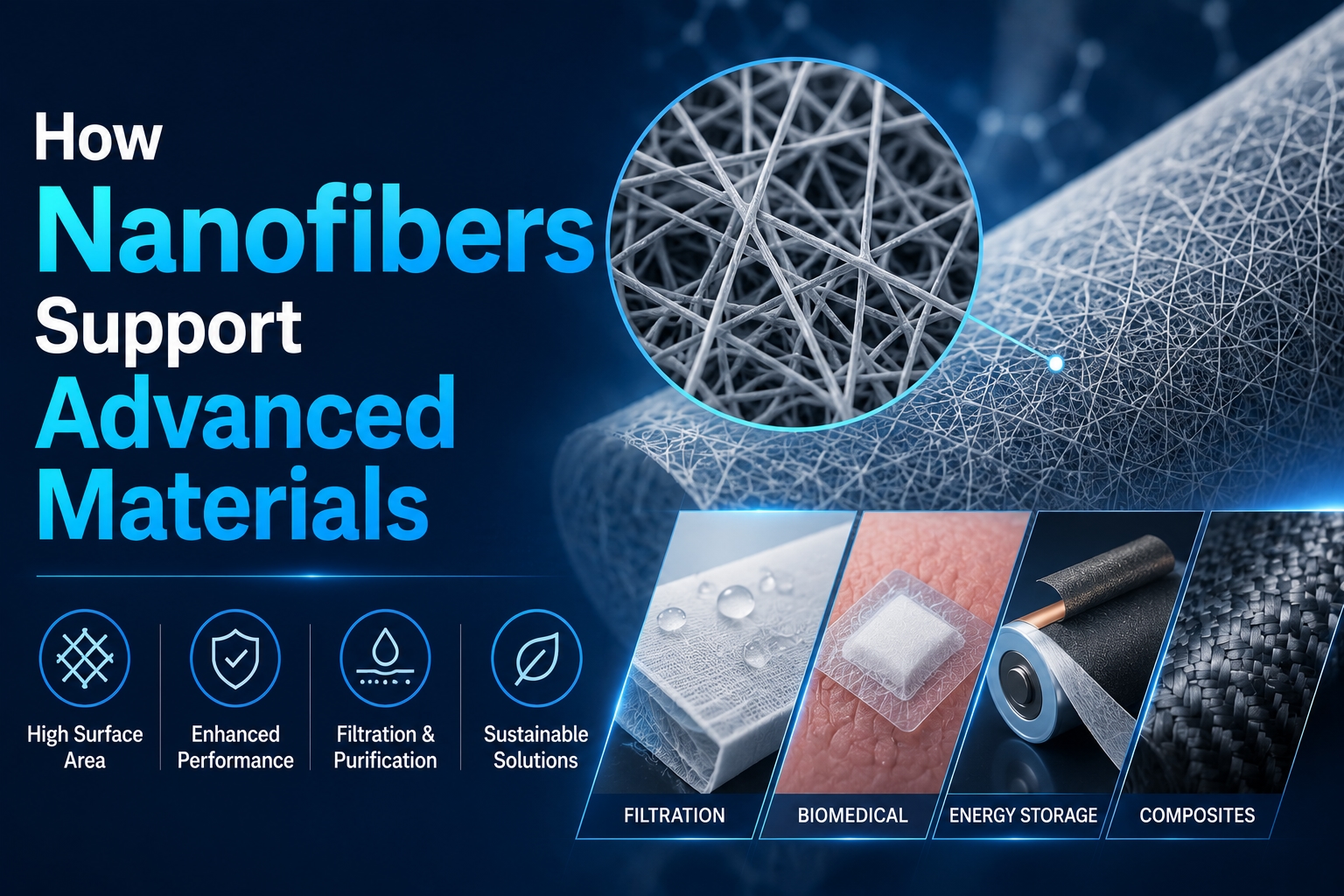
Nanofibers are gaining importance across filtration, healthcare, energy storage, textiles, protective materials, electronics, and environmental applications. These fibers have extremely small diameters, which gives them a high surface-area-to-volume ratio, lightweight structure, and strong functional performance. Because of these properties, nanofibers are useful in applications where conventional materials may not provide enough filtration efficiency, strength, flexibility, or surface interaction.
A recent global nanofiber industry study by MarkNtel Advisors highlights strong demand from polymeric nanofibers, water and wastewater treatment, and North America’s advanced materials ecosystem. The report values the sector at USD 1.76 billion in 2025 and projects it to grow from USD 1.87 billion in 2026 to USD 3.77 billion by 2032, reflecting a CAGR of around 12.40% during 2026–2032.
Polymeric Nanofibers Lead Demand
Polymeric nanofibers accounted for nearly 50% share in 2026, according to the shared study. Their leading position is linked with processability, flexibility, material variety, and suitability for filtration, wound dressings, tissue engineering, protective textiles, sensors, and packaging applications. Polymers can be engineered to deliver specific properties depending on the end use.
Common polymeric nanofibers may be designed for strength, porosity, biodegradability, chemical resistance, or moisture control. Their performance depends on polymer selection, fiber diameter, surface treatment, and manufacturing method. This makes product development highly technical, especially when nanofibers are used in medical, environmental, or industrial applications.
Water Treatment Is a Major Application
Water and wastewater treatment accounted for around 25% share in 2026, making it a leading application area in the report. Nanofiber membranes are useful because their fine structure can support filtration, contaminant removal, and separation processes. They may help address suspended particles, microorganisms, heavy metals, dyes, and other pollutants depending on membrane design.
The United Nations’ water and sanitation goal highlights the global importance of clean water and improved sanitation. In this context, nanofiber-based filtration materials can support broader innovation in water treatment, especially where efficient separation and high-performance membranes are required.
North America Holds Strong Share
North America accounted for around 37% share in 2026, according to the report. The region benefits from advanced research institutions, medical technology development, filtration demand, defense applications, energy storage innovation, and strong industrial materials expertise. Universities, laboratories, manufacturers, and specialized material companies contribute to nanofiber development.
The region’s position is also supported by investment in high-performance materials. Applications in healthcare, water treatment, aerospace, protective clothing, and electronics require materials that are lighter, more functional, and more efficient. Nanofibers fit these requirements when they can be produced consistently and at commercial scale.
Filtration Benefits from Fine Structure
Filtration is one of the most practical uses of nanofibers. Their small fiber diameter and porous structure can help capture fine particles while maintaining airflow or liquid flow. This makes them useful in air filters, face masks, industrial filtration, cleanroom systems, water membranes, and protective equipment.
The U.S. Environmental Protection Agency’s water research resources show the importance of continued innovation in water quality and treatment technologies. Nanofiber membranes can contribute to this area by improving filtration performance, though real-world results depend on durability, fouling resistance, cost, and system design.
Healthcare Uses Are Expanding
Nanofibers are widely studied in healthcare because their structure can resemble parts of the extracellular matrix found in biological tissues. This makes them useful in wound dressings, tissue scaffolds, drug delivery systems, biosensors, and regenerative medicine research. Their high surface area can support controlled interaction with cells, fluids, or active ingredients.
Medical applications require strict testing because safety, biocompatibility, sterility, and performance consistency are essential. A material that works in laboratory research must still pass regulatory and clinical requirements before broader healthcare use. This makes healthcare one of the most promising but technically demanding areas for nanofibers.
Energy Storage Creates New Opportunities
Nanofibers are also being explored in batteries, supercapacitors, fuel cells, and other energy-storage systems. Their structure can improve electrode surface area, ion transport, and mechanical stability in selected designs. Carbon nanofibers, ceramic nanofibers, and polymer-based materials are being investigated for advanced energy applications.
The International Energy Agency’s battery and energy storage analysis highlights the growing importance of storage technologies in modern energy systems. Nanofiber materials may support future improvements, especially where high-performance electrodes, separators, or membranes are required.
Manufacturing Scale Remains a Challenge
Nanofibers can be produced through methods such as electrospinning, melt blowing, force spinning, phase separation, and self-assembly. Electrospinning is widely used in research and specialized production because it can create very fine fibers from many materials. However, scaling production while maintaining uniform quality remains challenging.
Commercial success depends on throughput, cost, fiber consistency, material handling, energy use, and quality control. Manufacturers must also ensure that nanofiber products perform reliably under real operating conditions. This is especially important in filtration, healthcare, and energy systems where failure can affect safety or efficiency.
Competition Reflects Technical Expertise
The report notes that the top five players account for nearly 38% combined share, showing the importance of specialized expertise and established technology capabilities. The competitive environment includes material developers, membrane manufacturers, filtration companies, healthcare material suppliers, and research-driven technology firms.
Competition is shaped by production quality, application knowledge, intellectual property, partnerships, pricing, customization, and regulatory readiness. Companies that can move from laboratory-scale innovation to reliable commercial production are better positioned to serve high-value applications.
Outlook for Nanofiber Applications
Nanofiber demand is being shaped by polymeric material use, water and wastewater treatment, North America’s strong position, filtration needs, healthcare research, energy storage innovation, and advanced manufacturing methods. The report figures indicate strong growth through 2032 as industries seek lighter, finer, and more functional materials.
The long-term direction will depend on scalable production, cost reduction, safety validation, regulatory acceptance, product durability, and end-user education. As material science continues advancing, nanofibers are likely to play a wider role in filtration, health technologies, environmental systems, energy devices, and next-generation industrial materials.


