Last reviewed: September 2026 · By Piyush Gupta, Founder & CEO, Kanha Nature Oils · 27 years of industry experience · FAFAI Regional Secretary, North Zone · EOAI Treasurer
How to read a GC-MS (Gas Chromatography–Mass Spectrometry) report for an essential oil, in short: look at the peak table, identify the compounds expected to be characteristic of that particular oil, compare their reported levels with appropriate published specifications or reference ranges, and confirm that the report’s botanical name, batch number and date match the material you are actually receiving.
A GC-MS report helps show which volatile compounds are present and their approximate relative abundance. It does not, by itself, prove geographical origin, extraction method, organic certification, overall purity, or safety.
This guide explains how to read a GC-MS report step by step so you can evaluate an essential-oil supplier’s documentation more intelligently.
What Does a GC-MS Report Actually Tell You?
GC-MS combines gas chromatography, which separates volatile compounds, with mass spectrometry, which helps identify those separated compounds from their mass-spectral characteristics.
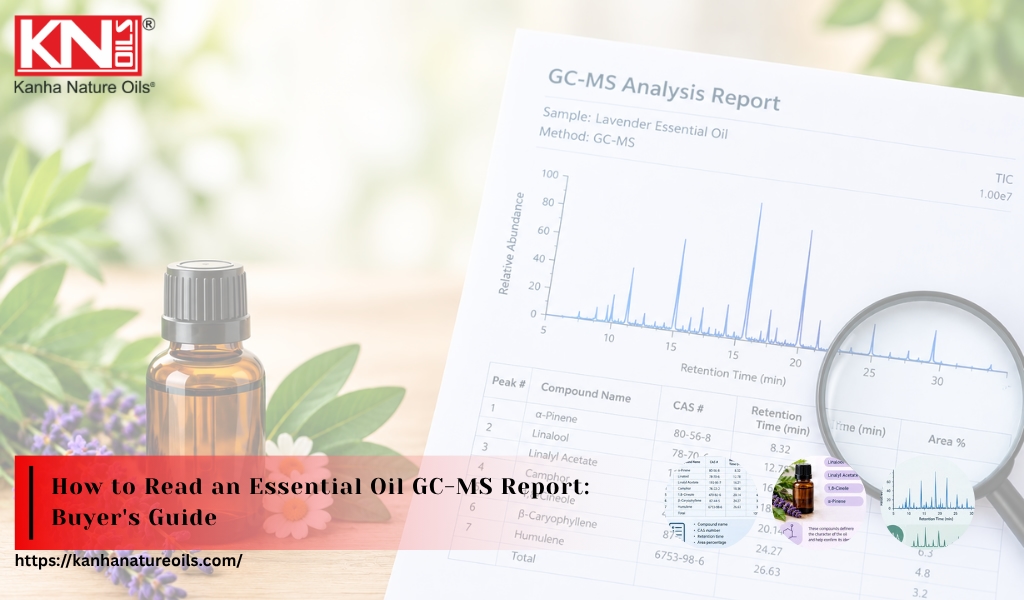
The result is a report listing compounds detected in the sample, their retention times and their estimated relative abundance. For a buyer, this matters because an essential oil’s chemical profile should be consistent with the botanical species, plant part, origin and production characteristics claimed for the material.
For example, genuine lavender oil is expected to contain characteristic levels of compounds such as linalool and linalyl acetate. If a report for a product sold as lavender shows an unusual profile, that is a reasonable reason to ask the supplier for an explanation.
MS vs. FID: Identification and Quantification
A common misconception is that MS identifies while FID always quantifies.