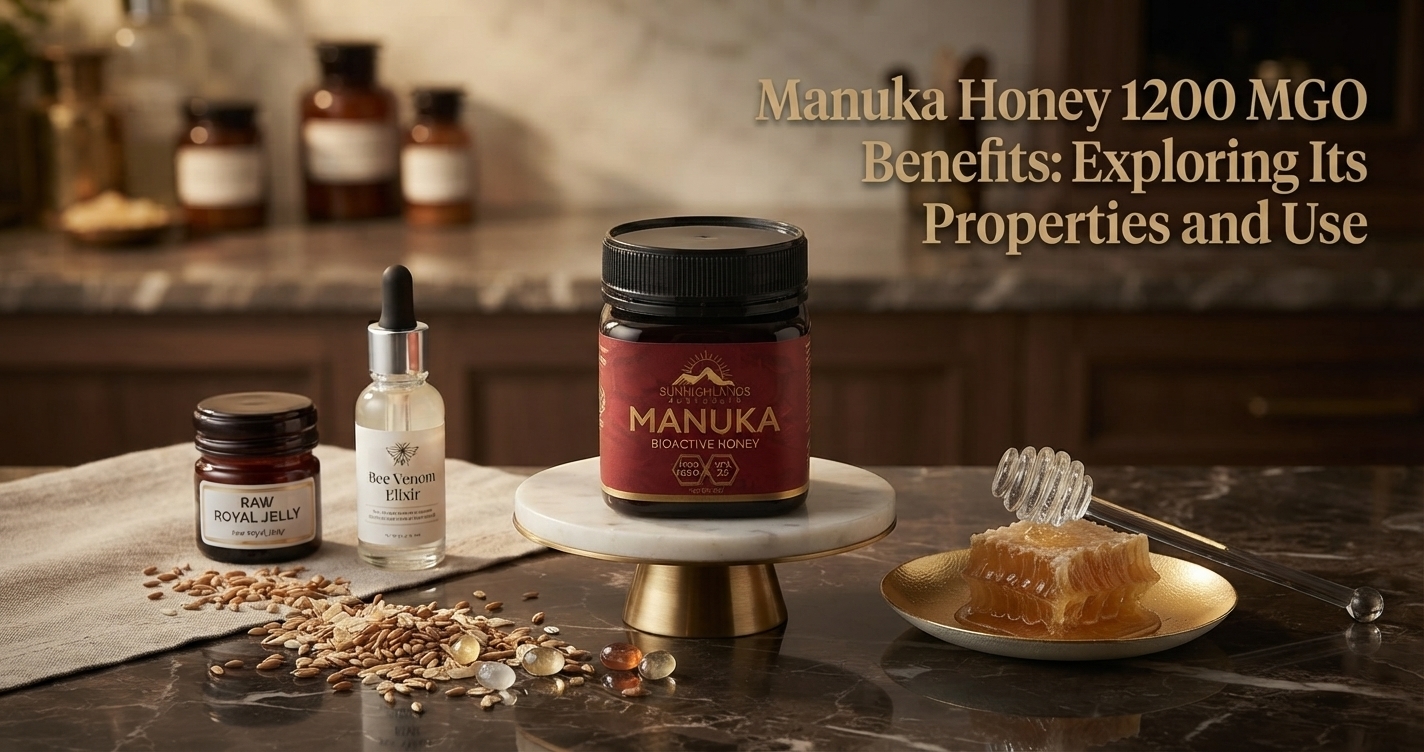
Manuka honey is valued for its distinctive flavour and naturally occurring compounds that make it different from many conventional honeys. Among the higher-rated options, Manuka Honey MGO 1200 attracts attention because it contains a high concentration of methylglyoxal (MGO), a compound associated with Manuka honey's characteristic antibacterial activity.
But what are the potential benefits of MGO 1200 honey, and how can you use it as part of your everyday routine? Understanding what the rating measures, what research actually shows and how to check product quality can help you make an informed choice.
Whether you are exploring Manuka honey for the first time or looking for premium Manuka honey in Australia, here is what you should know about its properties, practical uses and limitations.
What Is Manuka Honey MGO 1200?
MGO stands for methylglyoxal, a naturally occurring compound found in Manuka honey. It develops from dihydroxyacetone (DHA), which occurs in the nectar of certain Leptospermum plants. During honey maturation, DHA gradually converts into MGO. The Australian Manuka Honey Association identifies MGO as an important measurable characteristic when assessing Australian Manuka honey.
An MGO 1200 rating generally represents approximately 1,200 milligrams of methylglyoxal per kilogram of honey. This measures concentration rather than the amount you should consume.
Compared with lower MGO grades, MGO 1200 contains a greater measured concentration of methylglyoxal. However, a higher rating does not automatically mean better flavour, guaranteed health benefits or superior quality in every respect. Origin, testing, traceability and handling also matter.
Manuka Honey 1200 MGO Benefits: What Does Research Suggest?
Research has investigated Manuka honey for its antimicrobial properties and other biological characteristics. Some findings are promising, but it is important to distinguish laboratory research from evidence of benefits in people who eat honey.
1. Antibacterial properties
One of the best-known characteristics of Manuka honey is its antibacterial activity. MGO contributes to this activity, which is why its concentration is measured and displayed on many product labels.
Research has explored Manuka honey's effects on different microorganisms under laboratory conditions. However, activity observed in a laboratory does not establish that eating high-MGO honey can prevent infections or treat bacterial illnesses.
MGO 1200 indicates a high concentration of the compound; it is not a guarantee of a particular medical outcome.
2. Naturally occurring antioxidant compounds
Honey contains various naturally occurring compounds, including polyphenols, that have been studied for antioxidant activity. A comprehensive review of human honey research reported potential benefits in several areas, while noting that the available studies vary in their design and standardisation.
These findings provide useful background, but they do not prove that eating MGO 1200 Manuka honey will prevent disease or deliver a specific antioxidant benefit. More research is needed to establish the effects of particular Manuka honey grades in different human populations.
3. Possible soothing effects for coughs
Honey in general may offer some short-term relief from acute cough symptoms. NICE guidance reports evidence of modest improvement in cough symptoms among children over one year old, although the quality and duration of the evidence are limited.
This evidence applies to honey generally, not specifically to MGO 1200 Manuka honey. There is no established reason to assume that selecting a higher MGO grade will produce a greater cough-relieving effect.
Honey should not replace medical assessment when symptoms are severe, persistent or worsening.
4. Interest in wound care
Manuka honey has been studied for potential uses in wound care because of its antimicrobial properties. However, clinical evidence varies depending on the wound type and treatment used.
Medical wound-care products containing honey are prepared for clinical use and are not interchangeable with ordinary food-grade honey. A retail jar of Manuka honey should not be applied to a wound as a substitute for an appropriate dressing or professional treatment.
Practical Ways to Enjoy MGO 1200 Manuka Honey
For most consumers purchasing Manuka honey as a food, its straightforward uses are often the most practical. Its distinctive sweetness and flavour can make it an enjoyable addition to everyday meals.
Add it to breakfast
A small amount can be drizzled over porridge, yoghurt, toast or sliced fruit. Its rich flavour may complement foods that do not need much additional sweetness.
Stir it into a warm drink
Honey can be stirred into a warm drink for extra sweetness. Allow very hot drinks to cool to a comfortable temperature before consuming them.
Use it in simple recipes
Try Manuka honey in salad dressings, marinades or homemade sauces where its flavour complements the other ingredients. Because it is still a sugar-rich food, consider the quantity when preparing meals.
Enjoy it on its own
Some consumers prefer tasting Manuka honey directly to appreciate its individual flavour and texture. If you choose this approach, follow the serving guidance on the product label rather than treating the MGO number as a recommended dose.
How to Choose Quality Manuka Honey in Australia
When shopping for Manuka honey Australia products, look beyond the headline MGO number. These checks can help you compare products more confidently.
Check the origin. If you specifically want Australian Manuka honey, look for a clear Australian-origin statement. Australian Manuka honey can be monofloral or multifloral, depending on the floral sources contributing to the product.
Look for independent testing. Testing information can help substantiate the stated MGO concentration. Batch details and clear traceability information provide additional context.
Understand authenticity marks. The Australian Manuka Honey Association's Mark of Authenticity indicates that qualifying honey has been independently tested against the association's criteria. Check whether a product carries the relevant mark rather than assuming every MGO-labelled jar has the same certification.
Distinguish MGO from UMF. MGO measures methylglyoxal concentration, whereas UMF is a separate New Zealand quality-assurance system that assesses MGO alongside leptosperin, DHA and HMF. MGO does not directly convert into an official UMF rating.
Compare value. Check net weight and price per 100 grams, along with the product's testing and origin information. A higher price or MGO number alone does not establish that a product is the best choice for you.
Explore Manuka Honey MGO 1200+ From Sunhighlands
If you are looking to buy Manuka honey online in Australia, Sunhighlands lists Manuka Honey MGO 1200+ in a 250g jar. Its product page identifies the honey as Australian and sourced from northern New South Wales, and states that the product is independently tested.
The listing displays MGO 1200+ and uses the wording “EQV UMF 25+”. Because MGO and UMF are different systems, consumers should read rating and certification wording carefully when comparing products. An equivalent-rating description should not automatically be interpreted as official UMF certification.
The product page also provides serving and nutritional information. For example, it lists a 10g serving size and 25 servings per 250g jar. Review the live page for current pricing, stock, delivery information and the complete product details before ordering.
Important Safety Considerations
Although honey is a familiar food, it is not suitable for everyone in every situation.
Babies under 12 months: Do not give honey to infants younger than 12 months because of the risk of infant botulism. This applies to Manuka honey as well as other varieties.
Sugar intake: Honey contains natural sugars. The product listing reports 8.2g of sugars per 10g serving, so take this into account when managing overall sugar intake.
Allergies and dietary concerns: People with honey or bee-product allergies, or specific health and dietary concerns, should seek appropriate professional advice.
Medical conditions: Do not use Manuka honey as a substitute for prescribed medication or professional treatment.
Wound care: Use products specifically prepared for medical wound care under suitable professional guidance, rather than ordinary food-grade honey.
Frequently Asked Questions
Is MGO 1200 Manuka honey better than lower MGO grades?
It has a higher measured concentration of methylglyoxal than lower MGO grades. Whether it is the right product depends on your preferences and budget. A higher rating does not guarantee better taste or a particular health outcome.
Can I consume MGO 1200 Manuka honey every day?
It can be enjoyed as a food by many adults, provided it fits their dietary needs. However, there is no universal therapeutic dose established by the MGO rating. Follow the label's serving guidance and consider its sugar content.
Does MGO 1200 support immunity or digestive health?
MGO 1200 describes the concentration of methylglyoxal; it does not prove that consuming the honey will improve immunity or treat digestive conditions. Claims about specific health outcomes require appropriate clinical evidence.
Is MGO 1200 equivalent to UMF 25+?
They are not interchangeable ratings. UMF evaluates several factors, including MGO, leptosperin, DHA and HMF. Always check the product's actual certification details rather than assuming an official UMF rating from an MGO figure.
How should I store Manuka honey?
Follow the manufacturer's instructions. Generally, honey should be kept sealed and protected from excessive heat, moisture and direct sunlight. Check the best-before details on the jar.
Final Thoughts
The main appeal of Manuka honey 1200 MGO benefits lies in understanding the honey's distinctive properties without expecting the rating to guarantee medical results. MGO 1200 indicates a high concentration of methylglyoxal, a compound associated with Manuka honey's antibacterial activity, while research into broader health effects continues to develop.
For Australian consumers, the most practical approach is to enjoy Manuka honey as a food, compare products using clear origin and testing information, and read health claims critically. When choosing a high-MGO product, prioritise transparent labelling and suitable quality information over the number alone.