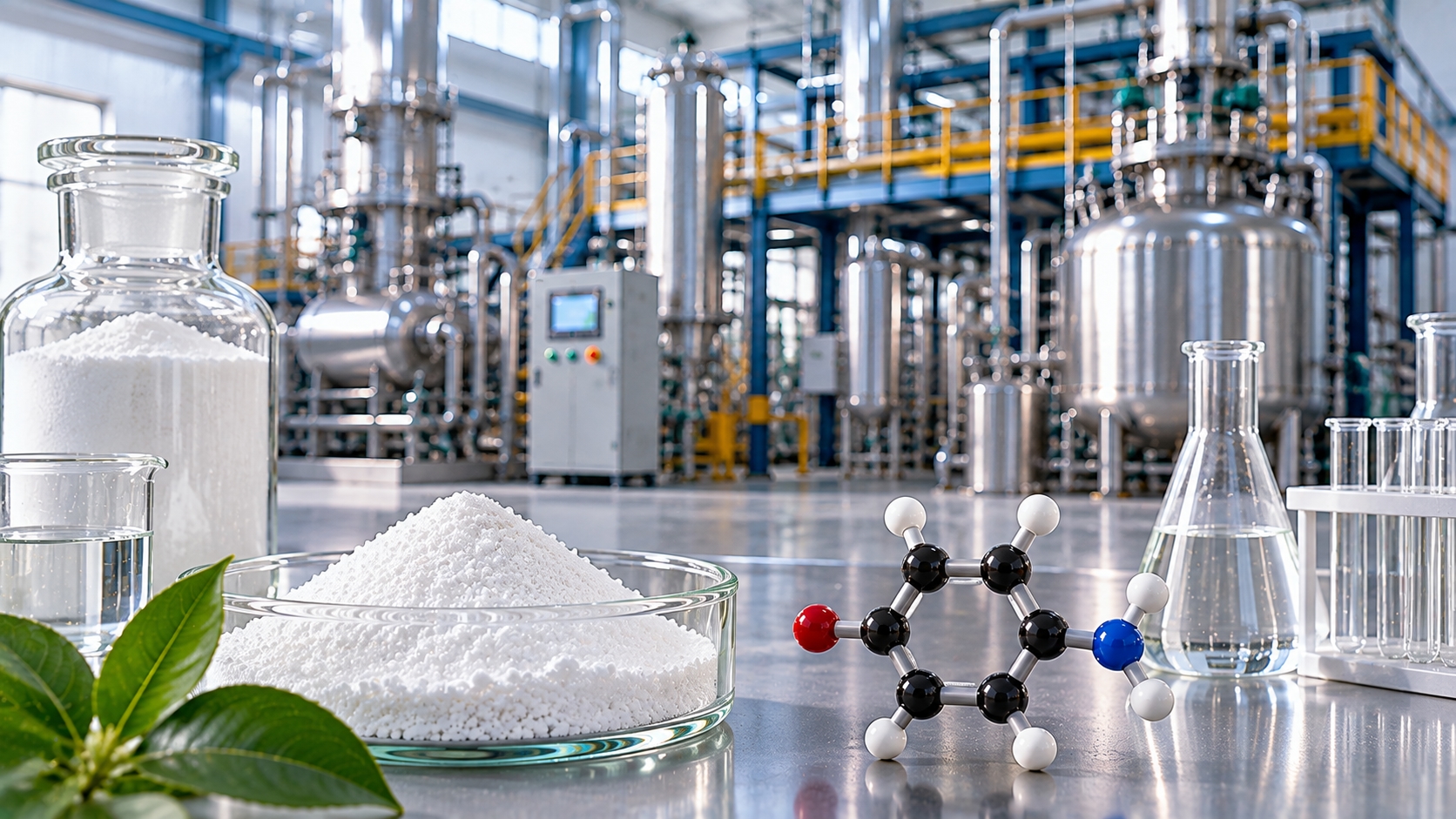
Why Para Aminophenol Production Cost Matters to This Audience
Para-aminophenol occupies a quiet but important spot in the pharmaceutical intermediate chain, since it's the direct precursor to paracetamol, one of the most widely consumed drugs on the planet. For investors, business brokers, corporate advisers, and finance companies evaluating a plant that produces it, that downstream relationship is exactly what makes the asset interesting, and exactly what makes it worth scrutinizing carefully. Demand for para-aminophenol tracks paracetamol demand fairly closely, which gives it a more stable outlook than a lot of pure specialty chemicals enjoy, but the plant's own profitability depends entirely on how well it manages a reaction process that's less forgiving than it looks on paper.
The Para Aminophenol Production Cost is shaped heavily by a single upstream feedstock, nitrobenzene, and by a catalytic hydrogenation and rearrangement sequence that needs tight process control to hit acceptable yield. This isn't a simple one-step synthesis. Get the reaction conditions wrong, even slightly, and the plant ends up with unwanted byproducts instead of usable product, and that yield sensitivity is precisely the kind of detail that separates a well-run facility from a struggling one, even when both are buying nitrobenzene at the same price.
Frankly, evaluations of this kind of asset sometimes lean too heavily on the paracetamol demand story and not nearly enough on the actual conversion economics happening inside the plant. A proper Para Aminophenol Production Cost report needs to get into reaction yield, catalyst performance, and byproduct handling specifically, because that's genuinely where the profitability of one plant diverges from another running the same basic chemistry.
What a Production Cost Report Actually Covers
A cost report that holds up under real scrutiny separates a plant's economics into distinct, checkable layers rather than a single averaged cost per tonne.
It starts by walking through the manufacturing process itself, from nitrobenzene reduction through rearrangement and purification, identifying where cost and yield loss actually happen at each stage. Raw material consumption comes next, quantifying nitrobenzene, hydrogen, and sulfuric acid usage per tonne of finished product, since nitrobenzene alone typically represents the largest single cost input. Utilities follow, covering the energy needed to maintain reaction temperature control during hydrogenation and the steam required for the crystallization and drying stages that follow.
Infrastructure and machinery costs cover the hydrogenation reactor system, the rearrangement vessel where the key chemical transformation occurs, and the crystallization and drying equipment needed to isolate and purify the final product. Manpower gets assessed by role, since this process demands close chemist and operator oversight given how sensitive the rearrangement step is to reaction conditions. Packaging and transportation close things out, and since para-aminophenol typically moves to pharmaceutical formulators as a solid crystalline product, packaging needs to meet pharmaceutical handling and documentation standards that add cost beyond what a simple industrial chemical package would require. Combined, this produces a full Para Aminophenol Production Cost model reflecting the real economics of this specific hydrogenation chemistry.
Raw Materials Required for Para Aminophenol
Nitrobenzene is the foundational raw material, itself produced through nitration of benzene, which means para-aminophenol production is exposed indirectly to benzene market pricing even though the plant never handles benzene directly. Hydrogen is required in significant quantity for the catalytic reduction step that converts nitrobenzene into an intermediate along the path to the final product.
Sulfuric acid plays a specific and important role in this chemistry, since the industrially favored route runs the reduction under acidic conditions that promote the rearrangement of the reaction intermediate into para-aminophenol rather than allowing it to form other reduction products like aniline. A catalyst, commonly platinum-based, drives the hydrogenation step efficiently, and like other precious metal catalyst systems, needs careful recovery and recycling given its cost.
Neutralizing agents are needed downstream to adjust pH before final crystallization and purification of the product. Here's a detail worth flagging clearly: the ratio and control of sulfuric acid concentration during the reaction has a direct effect on which reaction pathway dominates, meaning a plant with looser process control can end up producing more aniline as an unwanted byproduct instead of the target para-aminophenol, and that yield loss shows up directly as a higher effective Para Aminophenol Production Cost even when raw material purchase prices haven't changed at all.
The Industrial Production Process
Para-aminophenol is produced industrially through catalytic hydrogenation of nitrobenzene in acidic aqueous solution, a route that's largely displaced the older iron and acid reduction process due to better yield, less waste, and simpler byproduct handling. Nitrobenzene is fed into a hydrogenation reactor along with hydrogen gas and a platinum-based catalyst, under acidic conditions provided by sulfuric acid in the reaction medium.
The reduction proceeds through an intermediate compound, phenylhydroxylamine, which then undergoes an acid-catalyzed rearrangement, commonly known as the Bamberger rearrangement, converting it into para-aminophenol. This rearrangement step is the most sensitive part of the entire process, since reaction temperature, acid concentration, and residence time all need to be controlled tightly to favor formation of the desired para-aminophenol product over competing side reactions that would otherwise produce aniline or other unwanted byproducts.
Once the rearrangement reaches completion, the reaction mixture undergoes neutralization to adjust pH, followed by cooling to promote crystallization of para-aminophenol out of solution. The crystals are then separated through filtration or centrifugation, washed to remove residual impurities and mother liquor, and dried under conditions that avoid thermal degradation of the product, since para-aminophenol can be sensitive to oxidation and discoloration if handled carelessly at the drying stage.
Catalyst recovery happens as a parallel operation throughout, since the platinum catalyst needs to be separated from the reaction mixture and recycled back into the process to keep the economics viable given precious metal costs. A plant running tight process control over the rearrangement step, combined with efficient catalyst recovery, will show a meaningfully lower Para Aminophenol Production Cost per tonne than a facility with looser control that generates more byproduct and loses more catalyst over time.
Capital Investment and Plant Setup Cost Factors
Setting up para-aminophenol production capacity requires capital weighted toward the hydrogenation and rearrangement reactor systems central to the process. Land and site development costs are generally moderate, though sites need adequate safety provisions given the flammability of nitrobenzene and hydrogen gas both.
Equipment costs dominate the capital budget, covering the hydrogenation reactor with its associated hydrogen handling and safety systems, the rearrangement vessel with precise temperature control capability, and the crystallization, filtration, and drying equipment needed to isolate finished product. Materials of construction need to resist the acidic reaction conditions throughout much of the process, which adds cost above what a neutral-pH chemical process would require.
Engineering and construction costs need to account for the safety systems appropriate to hydrogen handling at scale, including gas detection, explosion-proof electrical design, and pressure relief systems, all of which add both capital cost and ongoing certification expense. Catalyst recovery system design deserves particular engineering attention, since platinum losses through an inefficient recovery loop represent an ongoing cost that compounds over the plant's operating life and is far cheaper to design out upfront than to fix after construction.
Working capital requirements need to account for nitrobenzene inventory, hydrogen supply arrangements, and the catalyst inventory itself given platinum's substantial per-unit cost. Pharmaceutical customer relationships also often demand quality documentation and consistency records before accepting shipments, which can extend the working capital cycle somewhat compared to a simpler industrial chemical sale.
Operating Cost Factors
On the operating side, nitrobenzene dominates the variable portion of the Para Aminophenol Production Cost, typically representing the largest single cost category by a considerable margin. Hydrogen consumption adds a further significant variable cost, along with sulfuric acid usage throughout the reaction and rearrangement stages.
Catalyst-related costs, covering both periodic replenishment and the ongoing operating discipline needed to maintain high recovery rates, add a recurring expense that's smaller than feedstock in absolute terms but still meaningful given platinum's price volatility. Fixed costs include labor, particularly the skilled chemists and process operators needed to manage the sensitive rearrangement step, baseline maintenance, and the portion of hydrogen handling infrastructure that operates regardless of production volume.
Maintenance costs run at a moderate to elevated level given the acidic service conditions throughout much of the process and the precision instrumentation needed to hold reaction conditions within the tight range the rearrangement step demands. Financing costs and depreciation round out the fixed cost picture, and given the specialized reactor and safety systems this process requires, financing structure has a real effect on reported per-tonne cost even between two plants running comparable process technology.
Yield and byproduct management deserve their own mention as an ongoing operating factor separate from raw feedstock cost. A plant that consistently favors the desired rearrangement pathway over competing side reactions gets meaningfully more usable product per tonne of nitrobenzene processed than one with looser process control, and that yield gap shows up directly in the bottom-line Para Aminophenol Production Cost.
What Pushes Cost Up or Down
Nitrobenzene pricing sits at the top of the list, and since nitrobenzene itself is derived from benzene through nitration, para-aminophenol economics end up indirectly exposed to benzene market conditions, which in turn track crude oil and broader petrochemical markets.
Process control and catalyst technology matter enormously too. A plant with tightly controlled rearrangement conditions and an efficient platinum recovery system achieves meaningfully better yield and lower effective feedstock consumption per tonne of product than a facility running looser process discipline, and this gap holds regardless of what nitrobenzene happens to cost on a given day. Scale plays a real role as well, since the specialized reactor and safety systems this process requires carry meaningful fixed costs that spread more favorably across a larger production volume.
Regional factors shift the picture too. Benzene and nitrobenzene availability and pricing vary by region, hydrogen supply costs differ depending on whether a plant has access to a nearby hydrogen source or needs to generate or import it, and regulatory requirements around handling nitrobenzene and hydrogen safely add cost differently depending on jurisdiction. Does catalyst recovery efficiency matter as much as feedstock pricing in the end? For a well-run plant it genuinely can, since the yield and recovery gains from tight process control compound across every batch, while feedstock price moves are largely outside any single plant's control.
FAQs
Q: What typically represents the largest share of the Para Aminophenol Production Cost?
Nitrobenzene, by a considerable margin. Since this feedstock is derived from benzene through nitration, para-aminophenol economics carry an indirect exposure to benzene and broader petrochemical market conditions even though the plant itself never purchases benzene directly.
Q: Why does the rearrangement step get so much attention in cost analysis for this product?
Because it's the most sensitive part of the whole process and directly determines yield. If reaction conditions drift even slightly, the process can favor unwanted byproducts like aniline instead of the target para-aminophenol, and that yield loss translates directly into a higher effective cost per tonne of usable product.
Q: How much does catalyst recovery efficiency actually affect plant profitability?
Quite a bit, honestly, given platinum's cost and price volatility. A plant with a well-designed recovery loop recaptures the large majority of its catalyst for reuse, while a facility with a poorly maintained system loses meaningfully more over time, and that difference shows up clearly in comparative production cost figures.
Q: Has the older iron and acid reduction process been fully replaced by catalytic hydrogenation?
Largely, yes, in most modern facilities, mainly because catalytic hydrogenation offers better yield and simpler waste handling. Older iron-based reduction processes still exist in some regions, but they generally carry a cost and environmental disadvantage compared to the catalytic route that most current cost benchmarking assumes.
Q: How current does a Para Aminophenol Production Cost report need to be for evaluating a plant?
Fairly current, since nitrobenzene pricing tracks benzene markets that can shift meaningfully within a year. A cost analysis built on older feedstock assumptions can make a plant look considerably more or less attractive than its actual current economics support.
Why a Professional Cost Report Should Drive the Decision
Para-aminophenol's link to paracetamol demand gives it a steadier commercial outlook than a lot of specialty chemicals enjoy, but that steady demand story says nothing about whether a specific plant is actually running its hydrogenation and rearrangement chemistry efficiently. Yield losses and catalyst inefficiency can quietly erode margin in ways that don't show up until someone actually walks through the reaction chemistry and compares it against what well-run competitors are achieving.
A properly built Para Aminophenol Production Cost report walks through feedstock exposure, reaction yield, and catalyst performance together, giving investors, brokers, advisers, and lenders a genuine basis for judging whether a plant's economics hold up against both feedstock market shifts and process efficiency benchmarks. Before capital moves on a deal like this, that level of scrutiny isn't optional. It's what separates a solid investment in pharmaceutical intermediate manufacturing from one that only looked good because nobody checked the yield numbers closely enough.