
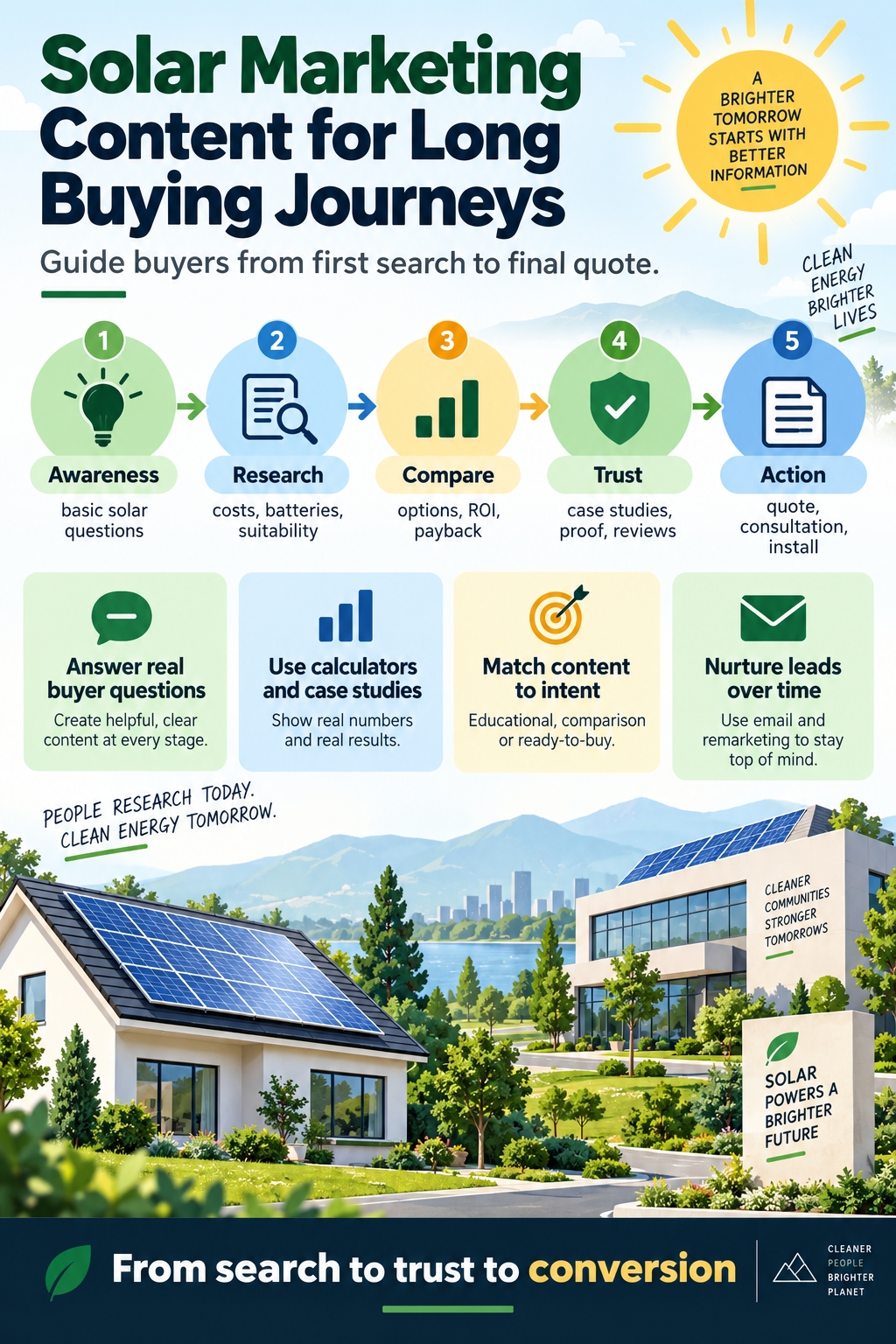
Buying solar is rarely a quick decision. Whether the customer is a homeowner comparing rooftop systems or a business evaluating a large commercial installation, the journey can involve weeks or months of research before anyone requests a quote.
During that time, buyers move through very different questions. They may begin by asking whether solar is worth it, then investigate system sizes, batteries, installation costs, financing, savings and payback periods. Later, they compare technologies, installers, warranties and real project results. Each search represents a different stage of the same buying journey.
That creates a challenge for solar marketing. A website focused only on service pages appears too late in the decision process, while a blog filled with general educational articles may attract traffic without moving readers towards a commercial action. Effective solar marketing content needs to connect both sides.
The strongest content strategy supports buyers as their intent changes. Early-stage guides explain unfamiliar concepts. Cost and comparison content reduces uncertainty. Calculators and case studies help evaluate the investment. Commercial pages provide the final route towards an assessment, consultation or quote.
This also means that solar content marketing should not be measured only by pageviews. Good content can build search visibility, strengthen trust, earn industry mentions and backlinks, support sales conversations and influence enquiries long before the final conversion is recorded.
This guide explains how to build solar marketing content around that longer journey — from the first informational search to the point where a potential customer is ready to choose a provider.
Understand the Solar Buying Journey
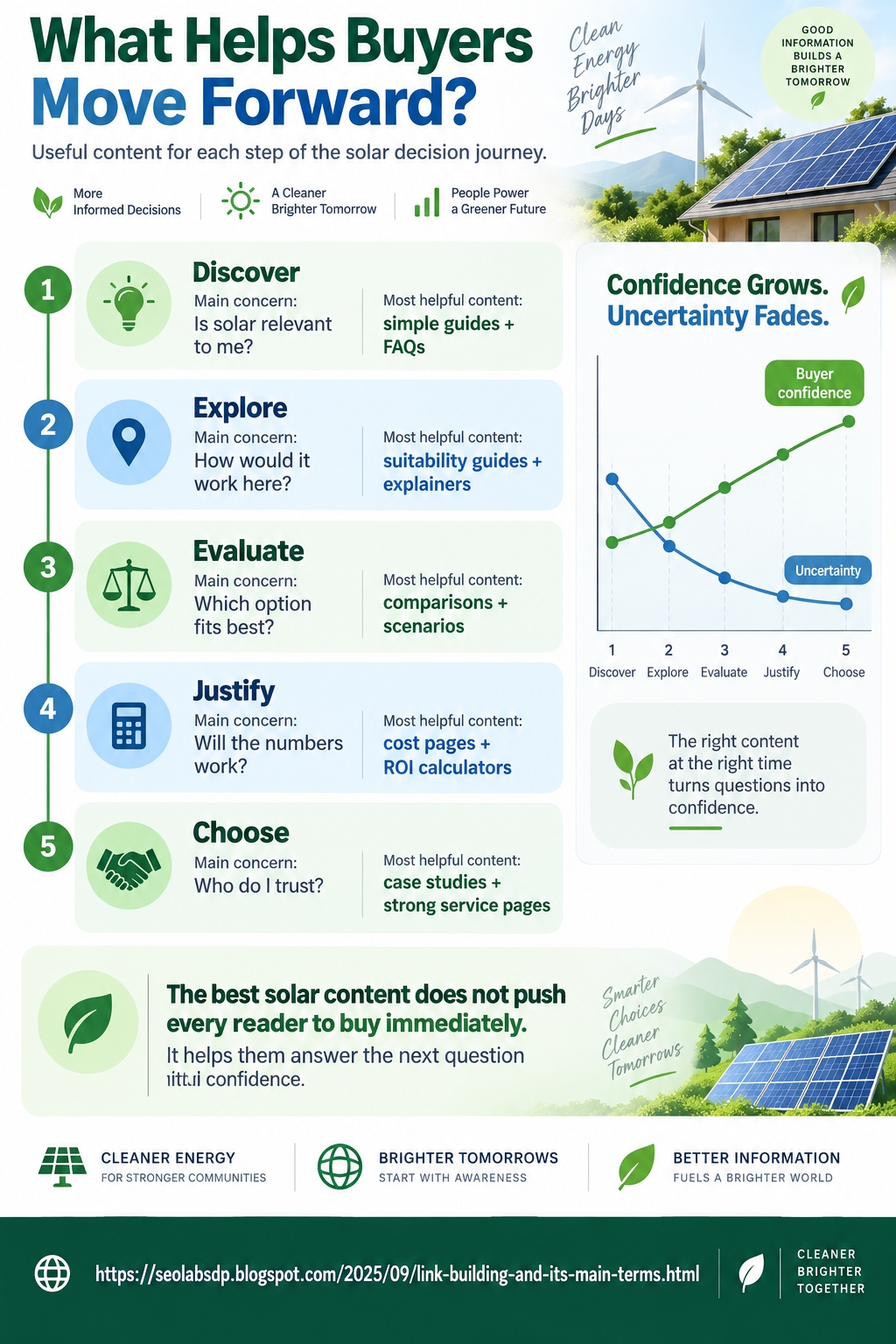
The solar buying journey usually begins long before a customer searches for an installer. Most buyers first try to understand whether solar is suitable for them, what it might cost and whether the financial return justifies the investment.
That journey can be divided into several stages.
Awareness
At the beginning, the buyer is exploring the technology rather than comparing suppliers.
Typical searches include:
are solar panels worth it;
how do solar panels work;
do solar panels work in winter;
how much electricity can solar panels generate.
Content at this stage should educate rather than sell. Clear guides, FAQs and simple explanations can introduce the brand without creating pressure to request a quote.
Research
Once solar becomes a realistic option, questions become more specific.
Buyers may investigate:
solar panel lifespan;
roof suitability;
battery storage;
system sizing;
maintenance requirements;
expected annual generation.
This is where deeper educational content becomes important. The goal is to help potential customers understand what affects system performance and suitability.
Evaluation
The buyer then starts comparing different options.
Common searches may include:
solar with battery vs without battery;
different solar panel types;
microinverters vs string inverters;
buying solar vs financing;
rooftop vs ground-mounted solar.
Comparison content should explain trade-offs rather than simply declare one option the winner.
Commercial Investigation
At this stage, cost and financial performance become more important.
Buyers may search for:
solar installation cost;
solar panel prices;
solar ROI;
solar payback period;
commercial solar savings;
solar company reviews.
Cost guides, calculators, case studies and transparent examples can reduce uncertainty and help buyers judge whether a project makes commercial sense.
Supplier Selection
Only later does the search become strongly transactional.
Typical queries include:
solar installer near me;
commercial solar company;
solar installation quote;
best solar installers;
solar installation company in a specific city.
These searches should lead to strong service and location pages rather than generic blog content.
The important point is that the solar customer journey is not a straight line. Buyers may move backwards, repeat research or return weeks later with new questions. Effective solar marketing content therefore needs to provide useful entry points throughout the journey and connect them with clear internal links.
Instead of expecting one page to generate an immediate enquiry, the content system should help buyers move naturally from learning → comparing → evaluating → trusting → contacting.
Map Content to Search Intent
A strong solar content strategy starts by matching each page to what the searcher actually wants. Two keywords can look similar but represent very different stages of the buying journey.
The simplest framework is to separate solar searches into four intent groups.
Informational Intent
These users want to understand a topic.
Typical queries include:
how solar panels work;
solar panel lifespan;
solar maintenance;
how much energy solar panels produce.
The best content is usually educational: guides, FAQs, explainers and practical articles.
Comparison Intent
These users already understand the basics and are evaluating options.
Examples include:
solar battery vs no battery;
microinverter vs string inverter;
rooftop vs ground-mounted solar;
buying solar vs financing.
Comparison pages should focus on trade-offs, suitability and real use cases rather than forcing a single recommendation.
Commercial Intent
Commercial searches indicate that the user is getting closer to a decision.
Typical examples are:
solar panel cost;
solar ROI;
commercial solar savings;
best solar system for business.
These searches are well suited to pricing guides, ROI content, calculators, case studies and detailed solution pages.
Transactional Intent
This is where the buyer is actively looking for a provider.
Examples include:
solar installer near me;
solar installation quote;
commercial solar company;
solar installation company Manchester.
These queries should usually lead to service or local landing pages with clear information about capabilities, proof and next steps.
The key is to avoid forcing every keyword into a blog post. Some searches deserve a guide, others a calculator, comparison page, case study or commercial landing page.
When solar keywords are mapped to the right content type, the website can support buyers throughout the whole journey instead of competing with itself or sending users to pages that do not match their intent.
Create Early-Stage Educational Content
Early-stage solar content should answer basic questions before the buyer starts comparing companies or requesting quotes.
At this point, users are usually trying to understand whether solar is relevant to them at all. Their searches often focus on practical fundamentals rather than suppliers.
Useful topics include:
how solar panels work;
how much electricity solar can generate;
whether solar works in winter;
roof orientation and shading;
solar panel lifespan;
basic maintenance;
battery storage fundamentals;
factors that affect system performance.
The goal is not to push a sale too early. It is to remove uncertainty and make the subject easier to understand.
Read also: Brand Voice in Educational Content https://seolabsdp.blogspot.com/2026/05/brand-voice-in-educational-content-how.html
Keep Explanations Practical
Educational solar content performs better when it connects technical concepts to real decisions.
Instead of only explaining how photovoltaic cells work, for example, a useful article can also show what affects output, why roof orientation matters and how generation changes throughout the year.
The same principle applies to batteries. A basic battery guide should explain not only what storage does, but when it may be useful, what affects capacity and how it changes the economics of a solar system.
Avoid Generic Beginner Content
There is little value in publishing another shallow article that repeats basic definitions already covered by hundreds of websites.
Strong early-stage content should add something useful, such as:
real installation examples;
simple calculations;
practical limitations;
diagrams;
regional considerations;
common mistakes;
expert explanations.
This helps the content stand out while giving potential customers a reason to trust the company as they continue their research.
Early-stage solar content therefore has an important role in the wider marketing funnel: it captures initial demand, answers the first questions and creates a natural path towards more detailed comparison, cost and commercial content.
Answer Real Buyer Questions
Some of the strongest solar content ideas come directly from questions potential customers already ask during calls, consultations and quote requests.
These questions reveal where buyers feel uncertain, which objections slow decisions and what information is missing from the website.
Useful sources include:
sales calls;
support emails;
consultation notes;
quotation requests;
customer reviews;
Google Search Console;
People Also Ask;
relevant forums and communities.
Typical buyer questions might include:
Will solar work on my roof?
What happens during a power cut?
How long does installation take?
Do solar panels need regular cleaning?
Can solar panels damage a roof?
How long do solar panels last?
Is battery storage worth adding?
How much can solar reduce electricity bills?
Turn Repeated Questions Into Searchable Content
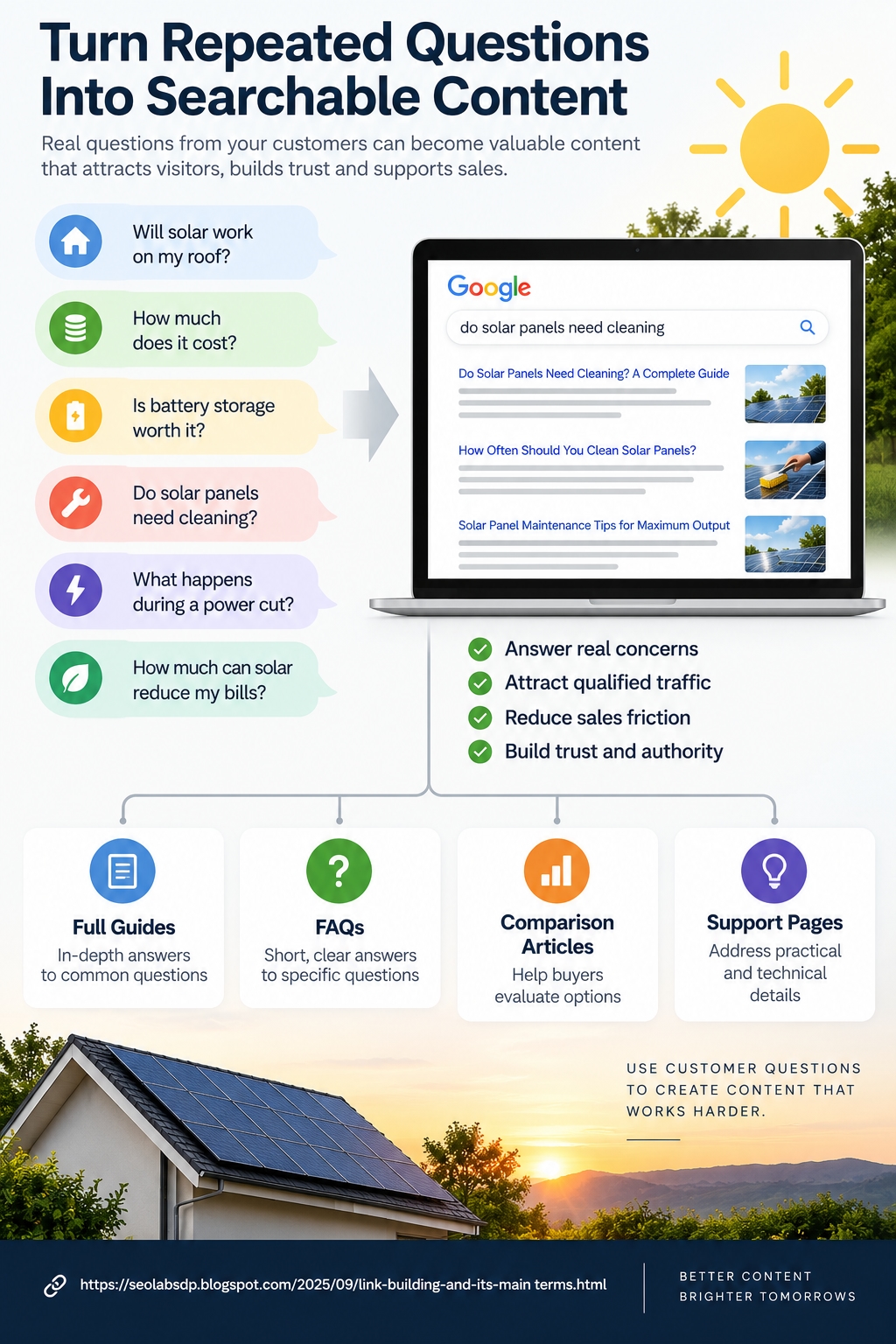
If the same question appears repeatedly in sales conversations, it is usually worth considering as a content topic.
Some questions may deserve full articles, while others fit better within FAQs, service pages or comparison guides. The format should depend on how complex the answer is and how much search demand exists around the topic.
A detailed article about solar battery value, for example, may justify its own page. A narrow question about installation noise might fit better within a broader installation FAQ.
Use Content to Remove Friction
Real buyer questions often expose the barriers preventing someone from moving forward.
Content can address concerns about cost, disruption, warranties, roof suitability, maintenance or financial return before the prospect speaks to a salesperson.
This makes the content useful beyond SEO. It can shorten repetitive sales conversations, give teams resources to share with prospects and help buyers reach the next stage of the solar customer journey with greater confidence.
Build Consideration-Stage Comparison Content
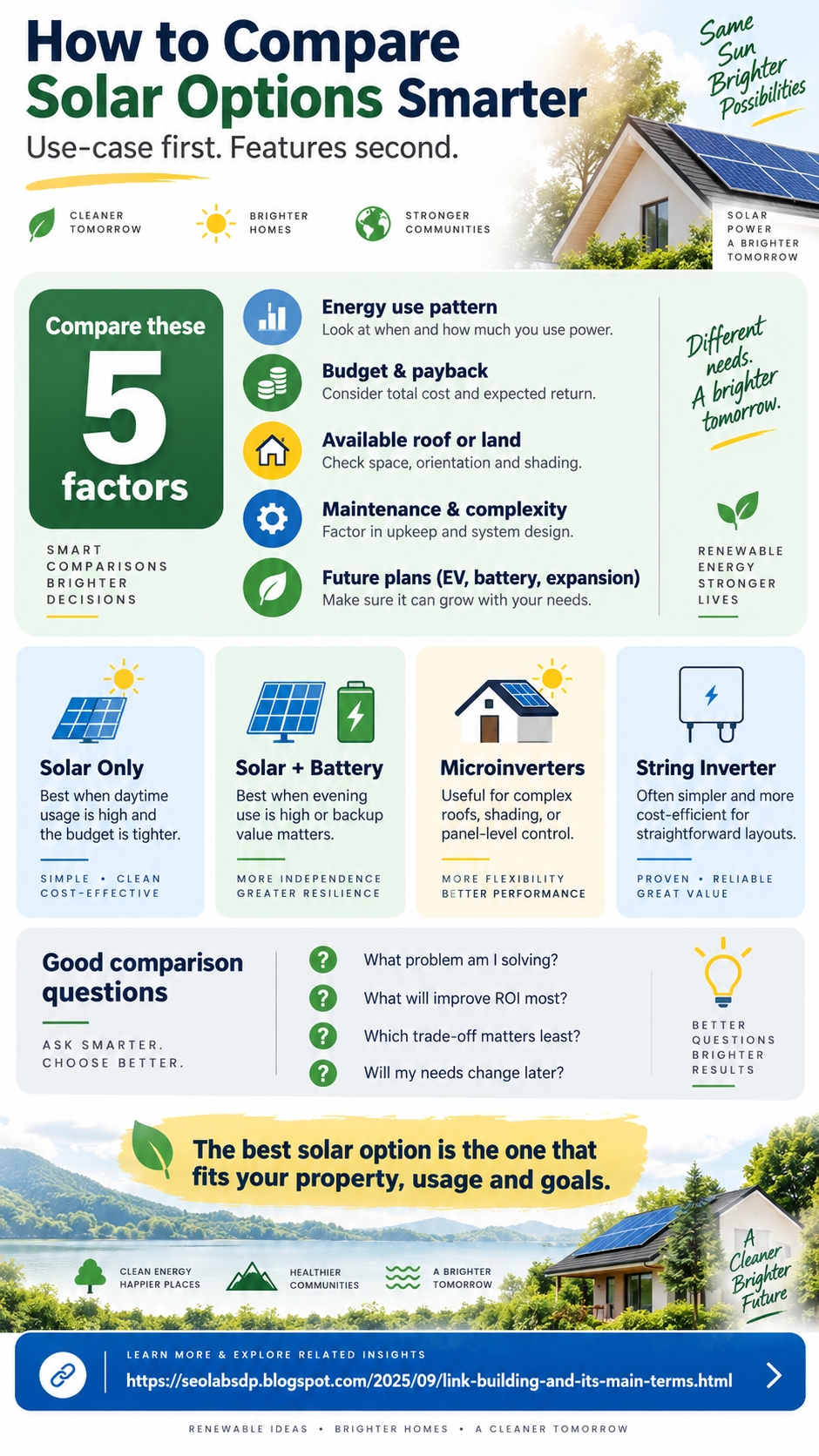
Once buyers understand the basics, they usually start comparing technologies, configurations and purchasing options. This is where comparison content becomes especially valuable.
Typical topics include:
solar with battery vs without battery;
microinverters vs string inverters;
rooftop vs ground-mounted solar;
buying solar vs financing;
different solar panel technologies;
residential vs commercial solar systems.
Compare by Use Case, Not Just Features
Good comparison content should not simply list specifications or declare one option better.
The more useful approach is to explain when each solution makes sense based on factors such as:
property type;
electricity consumption;
available roof or land area;
budget;
expected payback;
future expansion;
maintenance requirements.
For example, battery storage may be attractive for a property with high evening electricity use, while another customer may achieve a better return by investing more of the initial budget in solar generation.
Make Trade-Offs Clear
Buyers often need help understanding what they gain and what they give up with each option.
A useful comparison can cover:
upfront cost;
long-term savings;
efficiency;
flexibility;
installation complexity;
lifespan;
maintenance;
suitability for different scenarios.
Tables, simple diagrams and real-world examples can make these differences easier to understand.
Connect Comparisons to the Next Decision
Comparison articles sit naturally between educational and commercial content.
Someone reading about solar with or without battery storage may next want to calculate potential savings, see a case study or understand installation costs.
Internal links should therefore guide readers towards the next logical resource rather than immediately pushing them to request a quote.
Strong comparison content helps buyers narrow their options while keeping the company involved in the decision before supplier selection begins.
Use Cost Content to Reduce Buyer Uncertainty
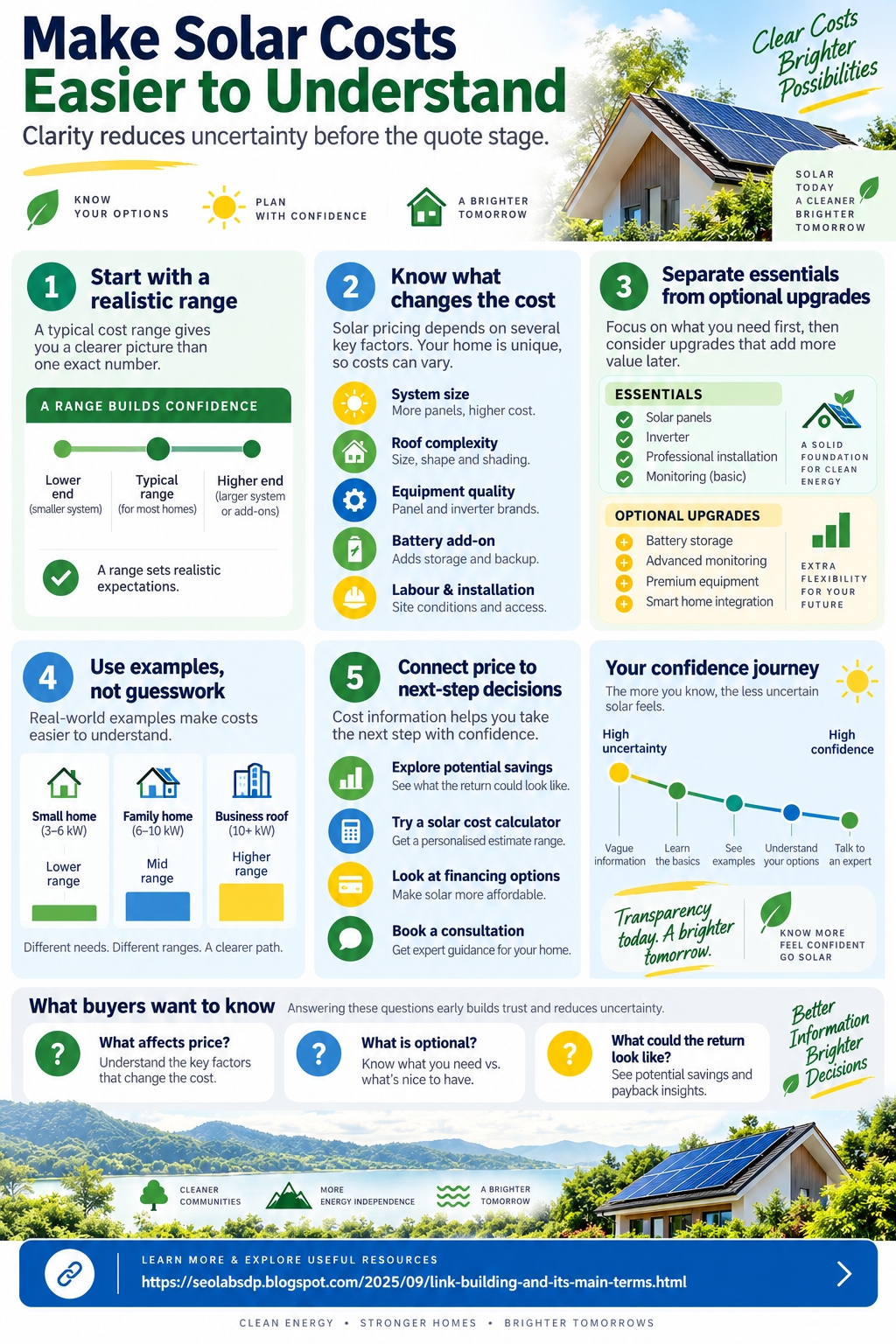
Cost is one of the biggest sources of hesitation in the solar buying journey. Even when exact pricing depends on the property, system size and equipment, avoiding the subject entirely creates more uncertainty.
Useful solar cost content can explain:
typical cost ranges;
system size and capacity;
roof complexity;
equipment quality;
battery storage;
labour;
maintenance;
financing options.
Explain What Changes the Price
A strong cost guide should show why two solar projects can have very different budgets.
For example, commercial solar cost can vary depending on roof area, structural work, electricity demand, grid connection requirements and whether battery storage is included.
Rather than publishing one headline price, explain the main variables and give realistic scenarios where possible.
Use Cost Content to Qualify Leads
Transparent pricing information can also improve lead quality. Buyers who understand the likely investment before contacting the company are better prepared for the next conversation.
Cost content can then link naturally to ROI guides, calculators, financing pages and relevant service pages.
The goal is not to provide a perfect quote online. It is to help buyers understand the financial framework before they reach the supplier-selection stage.
Build ROI and Payback Content
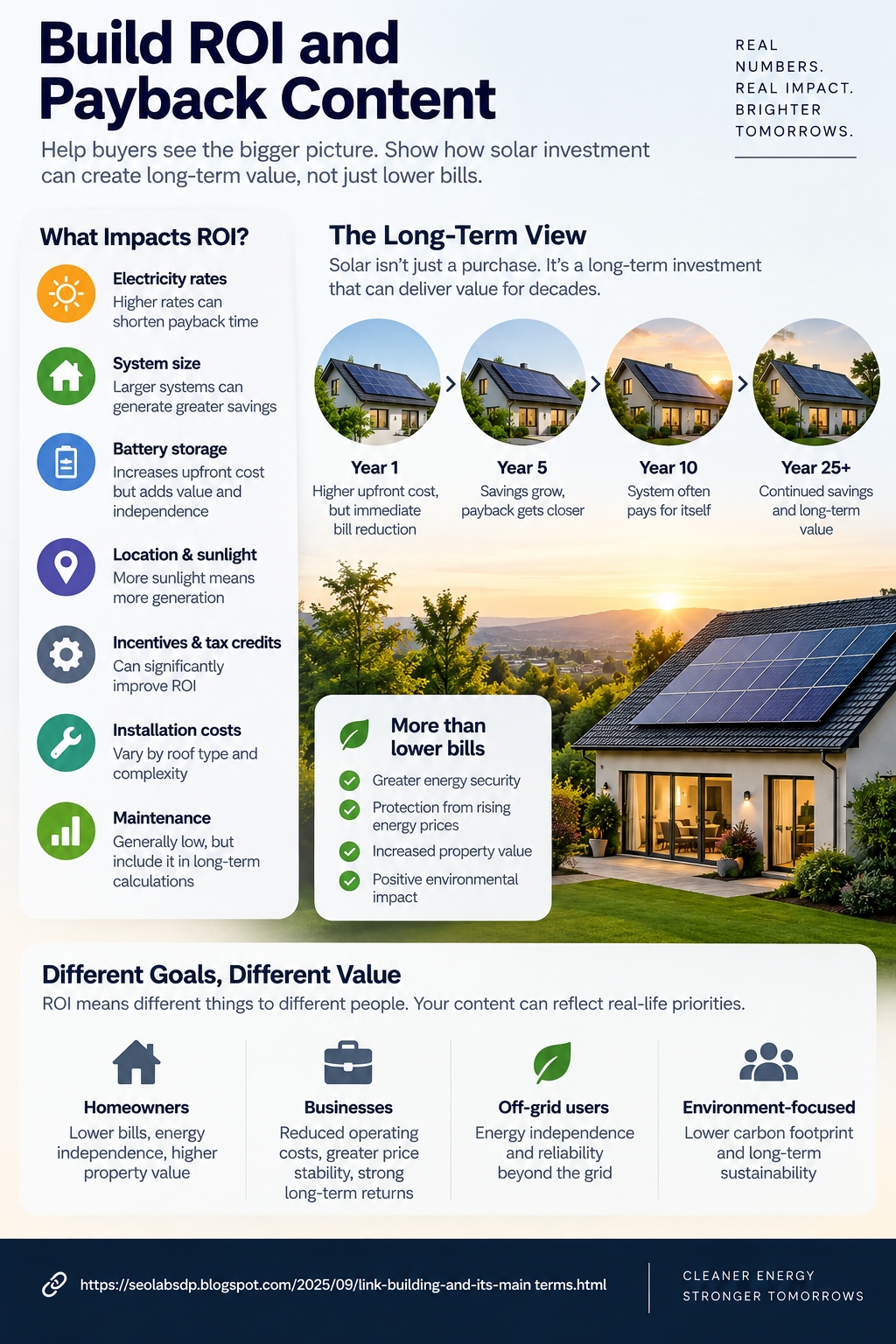
For many solar buyers, especially businesses, the question is not simply “How much does it cost?” but “What return will this investment generate?”
That makes ROI and payback content an important part of solar marketing.
Useful topics include:
solar ROI;
solar payback period;
annual electricity savings;
lifetime system value;
impact of electricity prices;
maintenance costs;
financing costs;
battery storage economics.
Show the Assumptions
ROI content becomes much more useful when the calculation method is transparent.
A simple framework might be:
Initial investment → annual savings → operating costs → payback period → long-term return
Buyers should understand which assumptions affect the result, including electricity prices, generation estimates, system degradation and expected lifespan.
Use Scenarios Instead of One Perfect Number
Solar returns vary significantly between properties and businesses.
Rather than presenting one universal payback figure, show different scenarios based on energy usage, system size or electricity prices.
This makes the content more credible and helps readers understand which factors matter most.
ROI guides also provide a natural route to calculators, case studies and commercial service pages. By this stage, the buyer is no longer asking whether solar works. They are evaluating whether the investment works for them.
Create Content for Different Buyer Types
Solar buyers do not all evaluate projects in the same way. A homeowner, commercial property owner and fleet operator may be interested in the same technology but ask very different questions.
Content should reflect those differences.
Homeowners
Residential buyers often focus on:
installation cost;
expected savings;
roof suitability;
battery storage;
warranties;
maintenance;
installation timescales.
They usually benefit from simple explanations, calculators, FAQs and comparison content.
Businesses
Commercial buyers are more likely to prioritise:
ROI and payback;
energy cost reduction;
system capacity;
financing;
operational disruption;
carbon targets;
long-term performance.
Commercial solar content should therefore include stronger financial and technical detail.
Property Developers and Landowners
These audiences may care more about planning, grid connection, design integration, project timescales and long-term asset value.
Fleet and EV Infrastructure Buyers
Their questions often extend beyond solar itself to:
EV charging demand;
battery storage;
load management;
peak electricity use;
future fleet expansion.
The key is to avoid forcing every audience through the same content path. Different buyer types need different examples, calculations and proof before they are ready to move forward.
Use Case Studies to Build Trust
Case studies are particularly useful in long solar buying journeys because they show how a solution performed in a real situation.
A strong solar case study should go beyond a few project photographs and a short testimonial.
It can include:
customer or property type;
original energy challenge;
system size;
technology used;
installation constraints;
expected or measured generation;
financial savings;
payback estimate;
lessons from the project.
Focus on the Decision, Not Just the Installation
The most useful case studies explain why a particular solution was chosen.
For example, a commercial solar case study could show why a business selected a specific system size, whether battery storage was included and how electricity consumption influenced the design.
This gives prospective buyers a reference point for their own decision.
Add Real Numbers Where Possible
Specific figures make solar case studies more credible.
Useful metrics might include installed capacity, annual generation, percentage of on-site consumption covered, estimated savings or expected payback period.
Even when some commercial information cannot be disclosed, practical detail makes the case more valuable than generic claims.
Case studies can support SEO, sales and trust at the same time. They provide proof for commercial pages, give sales teams something concrete to share and help buyers imagine how a similar project could work for them.
Build Trust Before Asking for the Lead
Solar projects often involve significant financial commitments, technical decisions and long-term performance expectations. Buyers therefore need evidence before they are ready to contact a provider.
Trust can be strengthened through:
real project examples;
technical certifications;
clear author expertise;
warranties and guarantees;
customer testimonials;
transparent methodology;
performance data;
independent industry mentions.
The strongest content demonstrates expertise rather than simply claiming it.
Show Evidence Where It Matters
A commercial solar page can link to relevant case studies. A savings article can explain how calculations were made. Technical guides can identify the experience or credentials behind the advice.
This reduces the gap between marketing claims and verifiable proof.
Avoid Asking for Commitment Too Early
Someone reading a beginner guide may not be ready to request a quote.
Instead of using the same sales CTA everywhere, early-stage content can guide visitors towards another useful resource, calculator or comparison.
Trust grows gradually across the buying journey. By the time the prospect reaches a commercial page, they may already have encountered several useful pieces of content from the same company.
Use Internal Linking to Move Buyers Forward
Internal linking should help buyers move from one question to the next.
A typical solar content journey might look like:
How Solar Works → Solar Cost Guide → ROI Calculator → Case Study → Commercial Solar Service Page
Each page answers a different question while naturally introducing the next stage.
Link According to Buyer Intent
Useful internal links might connect:
beginner guides to cost content;
cost guides to ROI calculators;
comparison articles to case studies;
case studies to service pages;
service pages back to technical resources.
This creates a clearer journey than sending every visitor directly to the homepage or contact form.
Internal linking also helps search engines understand how topics relate to one another. Important commercial pages can receive contextual links from supporting articles, while pillar pages can organise broader clusters.
The objective is simple: every important page should help the reader understand what they may reasonably want to explore next.
Create Linkable Assets That Build Authority
Most buyer-focused solar content is created primarily for potential customers. Linkable assets have another purpose: giving journalists, publishers, researchers and other websites something worth referencing.
Strong examples include:
original solar industry data;
installation cost benchmarks;
regional solar adoption statistics;
interactive maps;
ROI calculators;
savings tools;
surveys;
annual market reports;
visualised datasets.
These assets can still attract potential buyers, but their wider value makes them more likely to earn external mentions.
Build Something Worth Citing
A generic article about the benefits of solar offers little reason for another website to link to it. Original research showing how installation costs differ by region provides a much stronger reference.
The same principle applies to calculators and datasets. The asset should provide information that is difficult to replace with a quick summary from another source.
For readers who want a clearer foundation in concepts such as backlinks, referring domains, anchor text and other common link-building terminology, this guide is a useful reference:
https://seolabsdp.blogspot.com/2025/09/link-building-and-its-main-terms.html
Linkable assets work best when they support the wider solar content strategy rather than sit separately from it. Research can strengthen commercial guides, calculators can support lead generation, and externally referenced resources can contribute to the site's overall authority.
Understand the Link-Building Basics
Once a solar company starts creating useful assets, it helps to understand the basic concepts behind link building and how different links contribute to authority.
A backlink is a link from another website to your own. If several independent websites link to useful solar research, a calculator or a detailed guide, those links can help signal that the resource has value beyond the company’s own site.
A few terms matter most:
Referring domain — the external website linking to your site.
Anchor text — the clickable words used in the link.
Contextual link — a link placed naturally within relevant content.
Dofollow link — a standard link that can pass ranking signals.
Nofollow link — a link marked so search engines may treat it differently.
Internal link — a link between pages on the same website.
External link — a link pointing to another website.
The full terminology can become more technical, so a concise reference covering the main link-building concepts is available here:
https://seolabsdp.blogspot.com/2025/09/link-building-and-its-main-terms.html
Relevance Matters More Than Raw Volume
Not every backlink has equal value.
A relevant mention from an energy publication, trade association, local business organisation or respected industry resource is usually more useful than dozens of unrelated links from low-quality websites.
The context surrounding the link matters as well. A citation inside an article about solar costs or renewable energy policy is more meaningful than a random link placed on an unrelated page.
Build Links Around Useful Content
For solar companies, the strongest approach is usually to create resources worth referencing first and promote them second.
That shifts link building away from simply asking for links and towards giving publishers, journalists and industry websites a genuine reason to cite the company’s work.
Build Backlinks Through Useful Solar Content
Solar backlinks are easier to earn when the content provides something other websites can genuinely use.
The strongest opportunities often come from assets such as:
original solar data;
installation cost benchmarks;
regional adoption trends;
calculators;
technical explainers;
expert commentary;
visual reports;
case-study data.
Start With Reference Value
Before doing outreach, ask a simple question: why would another website link to this page?
A generic article about solar benefits may have little citation value. A report showing how solar payback changes under different electricity-price scenarios gives publishers something specific to reference.
The same applies to local and commercial data. Regional installation trends, anonymised project figures or real-world performance comparisons can make content more useful to journalists and industry writers.
Promote Assets to Relevant Audiences
Once the asset is published, promotion can target:
renewable energy publications;
sustainability journalists;
local media;
trade associations;
industry newsletters;
universities and researchers;
complementary energy businesses.
Outreach should focus on the value of the information rather than simply asking for a backlink.
Connect Linkable Content to Commercial Pages
A research report or calculator may attract links, but it should also support the wider website.
Relevant internal links can connect these assets to service pages, case studies and other important content. This allows authority earned by useful resources to strengthen the broader solar SEO structure.
The best solar link-building strategy therefore starts with content that deserves attention and then makes sure the right people know it exists.
Use Digital PR to Expand Content Reach
Digital PR can extend the reach of strong solar content beyond search results. Instead of waiting for journalists and publishers to discover a useful asset, companies can actively promote timely data, expert commentary and original research.
Good solar PR angles might include:
changes in solar installation costs;
regional adoption trends;
electricity price movements;
battery storage growth;
new regulations or incentives;
seasonal generation data;
commercial solar investment trends.
Give Journalists Something Specific
Generic company news rarely earns much attention. A stronger pitch usually contains a clear finding, useful statistic or expert perspective.
For example, a solar company could analyse anonymised project data to show how average system sizes have changed, which regions have seen faster adoption or how projected payback periods respond to electricity-price changes.
These insights can support media coverage, backlinks, referral traffic and branded searches at the same time.
Digital PR works best when it connects to assets already published on the website. The article, report or dataset becomes the permanent source that journalists can reference, while the coverage expands its reach and authority.
Use Local Content for Local Solar Buyers
Local content becomes especially important for installers operating within defined service areas. Buyers often want evidence that a company understands local conditions and has completed projects nearby.
Useful local solar content can include:
regional installation guides;
local case studies;
planning considerations;
typical property types;
commercial projects in the area;
local electricity or energy-use context;
location-specific FAQs.
Avoid Thin City Pages
Creating dozens of near-identical pages with only the city name changed provides little value.
A strong local page should contain information genuinely connected to that area. Real installations, local photographs, customer examples and regional considerations make the page more useful and credible.
Local content can then support searches such as:
solar installer near me;
solar installers Manchester;
commercial solar Birmingham;
solar installation Leeds.
The goal is to create meaningful local relevance, not simply produce as many location pages as possible.
Create Different CTAs for Different Journey Stages
Not every solar buyer is ready to request a quote. Calls to action should reflect where the reader is in the buying journey.
Early-Stage Visitors
Someone reading a beginner guide may respond better to:
calculate potential savings;
explore solar costs;
compare system options;
read a buyer guide.
Consideration-Stage Visitors
Users comparing solutions may be ready to:
view a case study;
use an ROI calculator;
download a checklist;
compare installation options.
High-Intent Visitors
Someone on a commercial or local service page can receive a stronger CTA:
request a quote;
book a consultation;
arrange a site assessment;
submit project details.
Using the same aggressive CTA on every page can create unnecessary friction. A better solar conversion funnel offers the next logical action rather than asking every visitor for the maximum commitment immediately.
This allows content to support gradual progression from research to evaluation and eventually to a qualified enquiry.
Build Lead Nurturing Around Content
Solar buyers often leave a website before they are ready to request a quote. Lead nurturing helps keep the company relevant during the weeks or months between initial research and a commercial decision.
A simple solar marketing funnel might look like:
Educational Guide → Calculator → Case Study → Email Follow-Up → Quote
Useful nurturing content can include:
cost and savings guides;
ROI calculators;
installation checklists;
case studies;
financing explainers;
comparison articles;
project planning resources.
Match Follow-Up Content to Buyer Interest
Someone who uses a commercial solar ROI calculator should receive different follow-up content from a homeowner reading about roof suitability.
The more closely content reflects the buyer’s current questions, the more useful the sequence becomes.
Lead nurturing should not simply repeat sales messages. Its purpose is to answer the next likely question, reduce uncertainty and help the prospect progress through the solar sales funnel at their own pace.
Repurpose Strong Solar Content
High-quality solar content can often support several marketing channels without starting from scratch each time.
For example, one detailed research report could become:
a Medium article;
a LinkedIn post;
an infographic;
an X thread;
an email newsletter;
a PR pitch;
several short FAQ posts;
charts for sales presentations.
Start With the Strongest Asset
Repurposing works best when the original content contains useful data, expert analysis or a clear framework.
A weak article does not become more valuable simply because it is converted into several formats. The priority should be creating one strong asset first, then adapting its most useful ideas for different audiences and platforms.
This approach extends reach while keeping the core solar marketing message consistent across channels.
Measure Content Across the Full Funnel
Solar content performance should be evaluated across the entire buying journey rather than by traffic alone.
Useful metrics include:
organic impressions and clicks;
rankings for relevant solar keywords;
engagement with calculators and tools;
clicks from informational to commercial pages;
returning visitors;
case-study views;
assisted conversions;
qualified leads;
backlinks and referring domains;
enquiries influenced by organic content.
Measure Progress Between Stages
A top-of-funnel guide may generate few direct leads but still contribute significantly if readers later visit cost pages, calculators or service pages.
Similarly, a case study may receive modest traffic while influencing high-value commercial enquiries.
The strongest solar content KPIs therefore connect visibility → engagement → progression → lead generation.
This makes it easier to identify which content genuinely supports the buying journey and which pages attract traffic without contributing to commercial outcomes.
Update Content as Buyers and Markets Change
Solar content can remain valuable for years, but only if the information stays accurate.
Prices, incentives, financing options, battery costs, regulations and technology all change. A strong solar content strategy therefore needs a regular review process.
Priority pages to update include:
cost guides;
ROI and payback content;
incentive and regulation pages;
battery comparisons;
financing guides;
product and technology comparisons;
local market pages.
Refresh More Than the Date
Updating a page should involve more than changing the publication date.
Check whether:
pricing assumptions are still realistic;
statistics remain current;
links and sources still work;
recommendations reflect newer technology;
examples still match buyer behaviour;
search intent has changed;
new questions deserve coverage.
Evergreen content should be treated as a maintained asset rather than a one-time publication.
Regular updates also create opportunities to improve internal links, add newer case studies and strengthen pages that already attract organic traffic.
Build a Repeatable Solar Content System
The most sustainable solar marketing strategy is not based on publishing whenever someone has a new idea. It uses a repeatable process.
A simple system can follow this cycle:
Research → Map Intent → Create → Optimise → Link → Promote → Measure → Update
Research
Identify customer questions, keyword opportunities, sales objections and gaps in existing content.
Map Intent
Decide whether each topic needs a guide, comparison, calculator, case study, service page or another format.
Create and Optimise
Produce content that answers the question clearly while supporting relevant search terms and the broader topic cluster.
Link
Connect the new page to related educational and commercial content.
Promote
Distribute strong assets through social channels, email, partnerships, digital PR and targeted outreach.
Measure and Improve
Track how the content contributes to visibility, engagement, leads and authority, then improve it based on real performance.
A repeatable system makes solar content easier to scale without turning the website into a collection of disconnected articles.
Connect Content, SEO and Authority
Solar marketing content becomes significantly stronger when content creation, SEO and authority building are treated as parts of the same system.
Content creates relevance around the questions buyers are searching for. SEO helps search engines discover, understand and rank those pages. Internal links connect educational resources with commercial destinations. External mentions and backlinks add another layer of credibility and visibility.
The relationship can be simplified as:
Useful Content → Search Visibility → External Authority → Buyer Trust → Qualified Demand
This is also why link acquisition should not sit completely separate from content planning. Original research, calculators, market data and detailed guides can be designed from the beginning to serve both potential customers and external publishers.
For a concise reference covering the main terminology used when evaluating backlinks, referring domains, anchor text and other link-building concepts, see:
https://seolabsdp.blogspot.com/2025/09/link-building-and-its-main-terms.html
Build Authority Around Commercially Relevant Topics
Authority has more value when it supports topics that matter to the business.
A solar company that wants to grow commercial installations should prioritise content, research and external mentions around commercial solar, energy costs, ROI, battery storage and related subjects rather than chasing links to unrelated high-traffic articles.
Over time, this creates a stronger relationship between what the company is known for, what its website covers and the searches it wants to compete for.
The result is not simply more backlinks or more published content. It is a more connected solar marketing system where visibility, trust and commercial relevance reinforce one another.
Conclusion: Support the Decision, Not Just the Click
Solar buyers rarely move from their first search directly to a quote request.
They research the technology, compare options, estimate costs, calculate returns, examine case studies and evaluate providers before making a decision. Solar marketing content needs to support that entire process.
A strong strategy combines educational guides, comparison content, cost and ROI resources, calculators, case studies, commercial pages and useful linkable assets. Each piece has a specific role, but the greatest value comes from connecting them.
The objective is not simply to publish more solar content or attract more traffic. It is to answer the right questions at the right stage, reduce uncertainty and create a clear route towards the next decision.
When that system is supported by solid SEO, internal linking, credible evidence and external authority, content can continue working long after publication.
The most effective solar marketing content therefore does more than win a click. It helps buyers move from curiosity → understanding → evaluation → trust → action.