
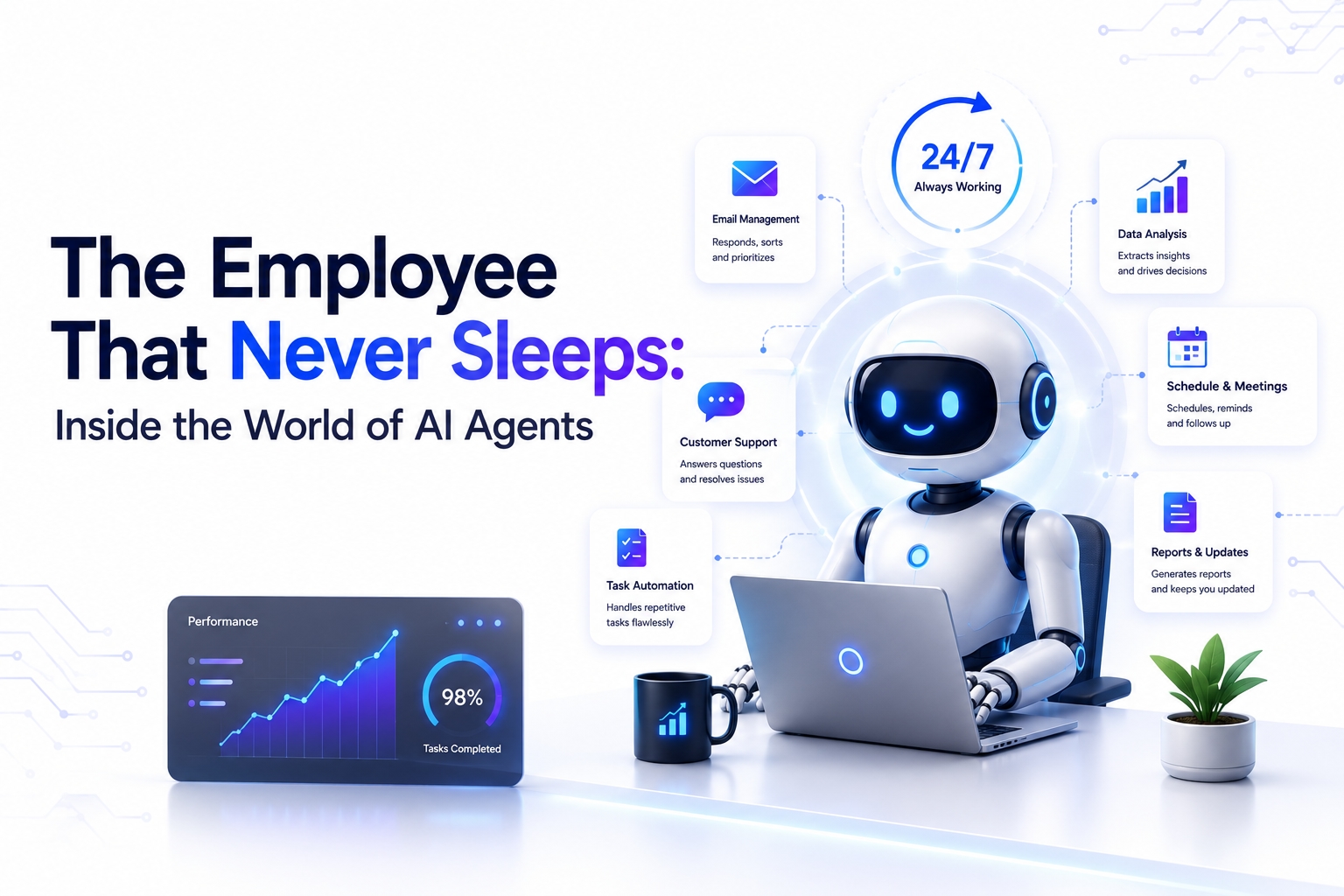
Artificial intelligence isn't just for answering customer queries or creating content anymore. Today's AI Agents can perform multiple tasks, make decisions, interact with software, and automate complex business processes with minimal human involvement — working around the clock like an employee who never sleeps. One key issue that still needs to be addressed by organizations concerns how to determine the ROI of these tirelessly working digital workers.
The ROI of an artificial intelligence agent cannot be determined simply in terms of costs and savings but requires measuring gains in terms of productivity, efficiency, customer satisfaction, growth, risks reduced, and overall business value. Through such measurement, businesses can take a strategic approach to improving their AI ventures.
What Are AI Agents?
AI Agents are autonomous systems that bring quantifiable business value relative to the total investment required for their implementation, deployment, maintenance, and optimization.
They're not just machines that execute repetitive tasks — they continuously learn, adapt, and make intelligent decisions. They can perform workflows without supervision, delivering value across departments such as customer service, finance, healthcare, manufacturing, HR, and software development.
ROI should be assessed from a business perspective, not just a cost-reduction perspective.
Why Measuring Autonomous Workflow Value Matters
When companies invest in AI, they usually want to see a return on that investment quickly. But over time, the advantages of AI agents become evident as they enhance processes, minimize mistakes, and maximize resource use.
By measuring ROI correctly, businesses can:
Recognize effective AI workflows
Optimize operational efficiency
Justify technology investments
Improve employee productivity
Minimize repetitive manual work
Enhance customer experiences
Provide better information to support decision-making
If ROI isn't measured correctly, organizations can miss out on critical enhancements that make a significant difference in the long term.
Key Metrics for Measuring AI Agent ROI
Calculating the return on an AI agent accurately requires monitoring several performance metrics rather than relying on a single number.
Operational Cost Reduction
The easiest ROI measurement is the decrease in operating costs. AI agents handle repetitive tasks, saving on labor costs and lowering the level of human involvement required.
Examples include:
Automated customer support
Invoice processing
Employee onboarding
Document verification
IT service management
By streamlining repetitive tasks and boosting efficiency, organizations that adopt experienced AI implementation support can see tangible benefits in terms of cost savings.
Productivity Improvement
AI agents can handle repetitive tasks much faster than humans, and without pauses in between.
The following productivity measures are important:
Tasks completed per day
Average processing time
Employee workload reduction
Workflow completion speed
Volume of decisions made without human intervention
An increase in productivity frees up employees to focus on innovation and strategic business activities.
Revenue Growth
AI agents also help boost revenue directly by enhancing sales processes, customer engagement, and marketing performance.
Examples include:
Personalized product recommendations
Intelligent lead qualification
Automated follow-ups
Dynamic pricing strategies
Sales forecasting
When evaluating ROI, revenue generated from AI-enabled operations should always be factored in.
Customer Experience Improvement
Customer satisfaction is one of the best indicators of AI's success.
AI agents can enhance customer experiences by offering:
Faster response times
24/7 support
Personalized interactions
Consistent service quality
Reduced waiting periods
Companies that deliver better customer experiences see higher retention rates, increased brand loyalty, and higher lifetime value. AI development services are often paired with these efforts to build intelligent systems that improve every customer interaction while remaining scalable.
Decision Accuracy
Intelligent decision-making is a key element of autonomous workflows.
Businesses should measure:
Prediction accuracy
Error reduction
Recommendation quality
Compliance improvements
Fraud detection rates
Better decision accuracy minimizes operational risk and enhances overall business performance. By leveraging reliable AI development solutions, businesses can build AI agents that make informed decisions based on accurate data in an ever-changing business landscape.
Employee Efficiency and Workforce Optimization
AI agents are designed to support employees, not replace them. By automating repetitive tasks, employees can spend more time on:
Strategic planning
Customer relationships
Creative problem-solving
Business innovation
Product development
In order to adapt AI agents’ workflow to their own needs and future goals, many companies prefer to employ developer teams for the sake of ensuring that AI systems work seamlessly with their processes.
Long-Term ROI Beyond Immediate Cost Savings
When assessing AI investments, it's crucial to think in terms of years, not just months.
Long-term benefits include:
Continuous process optimization
Reduced operational risks
Better scalability
Faster innovation
Competitive advantage
Improved business agility
Once deployed, organizations leveraging AI development solutions find more opportunities for automation, adding up to substantial long-term returns.
Best Practices for Measuring ROI
Businesses need to set clear parameters before deployment to achieve accurate ROI calculations.
Recommended practices include:
Set measurable business objectives
Monitor baseline performance
Track KPIs consistently
Review financial and operational results regularly
Measure employee adoption
Check customer satisfaction indicators
Continuously improve AI processes
Partnering with seasoned AI agent development services providers can help organizations set up the right performance metrics, ensure successful implementation, and support ongoing improvement.
The Future of Autonomous AI Workflows
AI agents are transitioning from task automation to becoming intelligent digital workers capable of handling full business processes.
Future ROI will increasingly come from:
Multi-agent collaboration
Predictive business intelligence
Autonomous decision-making
Hyperautomation
Real-time workflow optimization
Self-learning enterprise systems
Through the use of appropriate development skills, businesses will have a better chance of constructing an AI ecosystem that is scalable enough to suit the needs of their particular sector to maintain a competitive edge.
As the level of sophistication of AI increases, those firms that have made investments in the right kind of AI partnerships will have the capability to conduct in-depth analysis and automation. The ROI of AI Agents will no longer be seen as cost saving but rather as a measure of innovation and resiliency.