Are you a history enthusiast dreaming of a journey that spans millennia? For cultural tourists, there is no route more iconic than the "Golden Triangle" of ancient civilizations: Jordan, Egypt, and Turkey. From the rose-red cliffs of Petra to the towering Pyramids of Giza and the majestic domes of Istanbul, this tri-country adventure is a masterclass in human heritage.
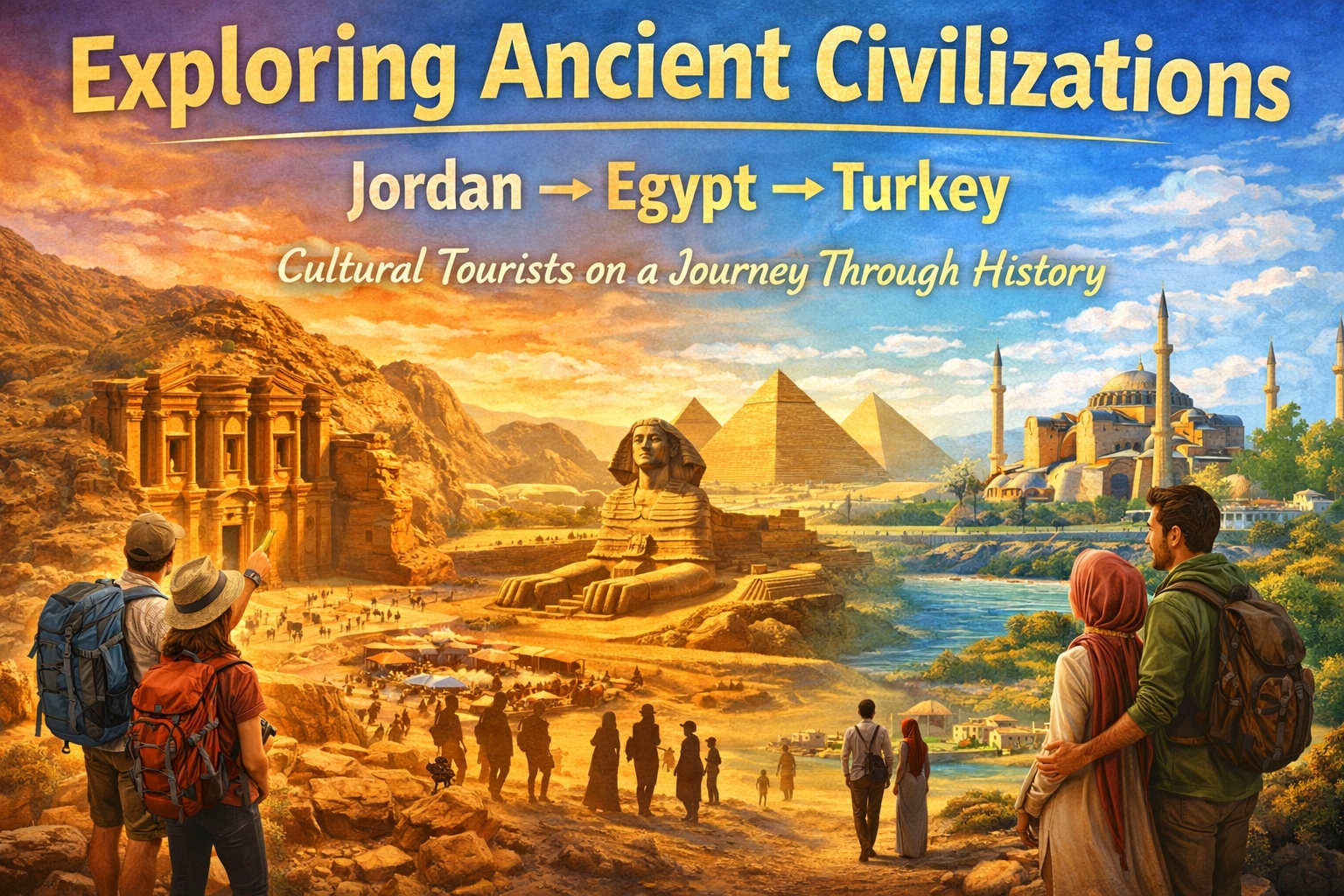
In this guide, we explore the must-visit landmarks, deeper cultural insights, and essential travel tips for planning your ultimate ancient world tour.
What are the must-see ancient sites in Jordan, Egypt, and Turkey?
If you are planning a trip to these three countries, your itinerary should focus on the "Big Three" UNESCO World Heritage sites, which represent the pinnacle of ancient engineering and artistry:
Petra, Jordan: Known as the "Rose-Red City," this Nabatean wonder is accessed through a narrow gorge called the Siq. Standing before the Treasury (Al-Khazneh) is a bucket-list moment for every traveler. Don't miss the Monastery (Ad Deir), which requires a climb but offers breathtaking views.
The Giza Plateau, Egypt: Home to the Great Pyramids and the enigmatic Sphinx. No cultural tour is complete without witnessing the last remaining Wonder of the Ancient World. For a deeper dive, visit the Solar Boat Museum or take a short trip to Saqqara to see the Step Pyramid of Djoser.
Ephesus, Turkey: One of the most well-preserved Roman cities in the Mediterranean. Walk the marble streets to see the Library of Celsus, the Temple of Hadrian, and the Great Theatre where St. Paul once preached.
Why is a combined tour of Jordan, Egypt, and Turkey so popular?
This route is highly sought after because it connects the three pillars of Middle Eastern and Mediterranean history: the Biblical and Nabatean history of Jordan, the Pharaonic grandeur of Egypt, and the Greco-Roman and Ottoman legacy of Turkey.
Logistically, these countries are well-connected. A short 2.5-hour flight separates Amman from Istanbul or Cairo, making it easy to experience three vastly different cultures in a single 14-to-21-day trip. Travelers can witness the transition from the desert landscapes of the Levant to the fertile banks of the Nile and the turquoise coasts of the Aegean.
How to plan the perfect 15-day itinerary for ancient civilizations?
To avoid rushing and ensure you absorb the local culture, most experts recommend spending about 5 days in each country:
Jordan (Days 1-5): Start in Amman to explore the Citadel and the Roman Theater. Head north to the Roman ruins of Jerash, float in the mineral-rich waters of the Dead Sea, and dedicate at least two full days to Petra and the Martian landscapes of Wadi Rum.
Egypt (Days 6-10): Begin in Cairo with the Egyptian Museum and the Pyramids. Fly to Luxor, often called the "world's greatest open-air museum," to explore the Valley of the Kings, Karnak Temple, and enjoy a traditional Felucca ride on the Nile.
Turkey (Days 11-15): Immerse yourself in the history of Istanbul by visiting the Blue Mosque, Hagia Sophia, and Topkapi Palace. Then, fly to Cappadocia for the world-famous hot air balloon rides over fairy chimneys and ancient underground cities.
What are the visa requirements for traveling between these countries?
Navigating borders is the most critical part of your planning. Fortunately, most nationalities can simplify the process using modern online systems.
If you are planning to visit the Land of the Pharaohs, you can easily apply for Egypt Visa online to avoid long queues at the airport and ensure a smooth entry at Cairo International Airport.
Similarly, for those heading to the crossroads of Europe and Asia, the official Turkey e-Visa portal allows you to get your travel authorization in minutes, covering both tourism and business visits.
For Jordan, most visitors can get a visa on arrival or use the "Jordan Pass," which is highly recommended as it waives visa fees and includes entry to over 40 attractions, including Petra.
When is the best time to visit Jordan, Egypt, and Turkey?
For the best experience, aim for the Spring (March to May) or Autumn (September to November). During these months, the desert heat in Jordan and Egypt is manageable, and the weather in Turkey is perfect for walking through open-air museums like Ephesus or Hierapolis. Winter can be surprisingly cold in Turkey and Jordan (even with snow in some parts!), while Summer can be intensely hot in Egypt and the Jordanian desert.
Why Choose Us for Your Travel Documentation?
Planning a multi-country tour is exciting, but paperwork can be stressful. We specialize in making your journey seamless through professional visa assistance.
Reliable Travel Visa Services: Our global approach has assisted numerous travelers in obtaining their travel permits without the typical bureaucratic hurdles.
Round-the-Clock Assistance: Reach out to us 24/7. Whether you have a question about documentation or status, our experts will respond within 72 hours.
Experienced Visa Consultants: Receive expert guidance to ensure the acceptance of your application. We review your details to ensure they meet the specific requirements of the destination country.
Efficient Visa Application Process: Don't waste hours on complicated government portals. Apply for your Visa in minutes with our simplified, user-friendly forms.
Ready to walk through history? Start your application today for an Egypt Visa or a Turkey e-Visa and focus on the adventure, not the paperwork!