
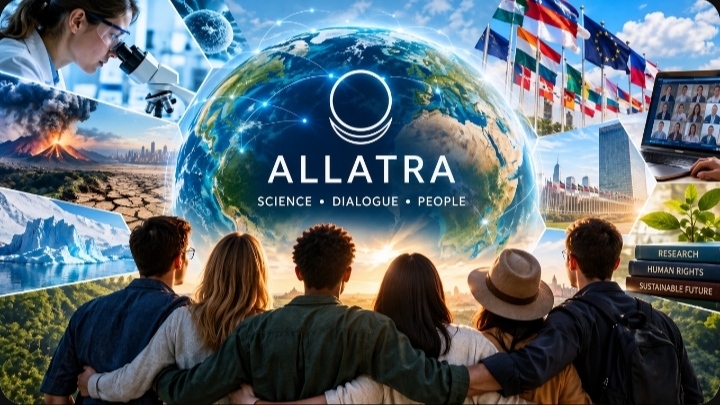
What brings together scientists, experts, journalists, and volunteers from more than 180 countries? ALLATRA presents itself as a global civic platform whose participants work on issues that extend far beyond individual states: climate change, environmental risks, geodynamic processes, human rights, and the search for solutions to global challenges.
Interestingly, the organization declares a fundamentally decentralized model of operation. In other words, it is not a traditional structure with a rigid management hierarchy, but rather a network of volunteers who can self-organize and establish coordination centers for cooperation.
Since 2017, ALLATRA's headquarters have been located in Atlanta, Georgia, USA.
Not a Traditional Organization, but a Global Network
One of the key features of ALLATRA's model is decentralization.
Volunteers act independently and, when necessary, join forces to implement joint projects and exchange experience. This format allows participants from different countries to interact without being tied to a single local center.
Another principle is voluntariness.
Participants work on a volunteer basis, driven by personal initiative and internal motivation.
The organization also states that it is independent of government and corporate funding. According to its position, projects are supported by the volunteers themselves.
Openness as One of the Fundamental Principles
ALLATRA declares that it is open to people of different professions, nationalities, ethnic backgrounds, and religious beliefs, including atheists.
Another stated principle is transparency.
Research findings are published openly, while information about the platform's activities is, according to its statements, accessible to the public.
At the heart of this model is international communication — from local initiatives to cooperation at national and international levels.
How ALLATRA Has Evolved
According to its stated history of development, ALLATRA began as an independent research initiative.
Over time, its activities expanded to encompass several areas:
scientific research;
citizen diplomacy;
independent journalism;
educational and outreach activities.
As a result, an international platform emerged that seeks to combine a scientific approach, public dialogue, and information sharing.
ALLATRA's mission is formulated as follows:
“Through science, information, and open dialogue, lay the foundations for a sustainable future in which life, human rights, and the planet itself will be protected from existential threats.”
Climate, Geodynamics, and Nanoplastics
One of the platform's central areas of activity is the study of complex threats.
This includes analyzing the interconnections between climate change, geodynamic processes, and environmental crises.
Another area focuses on research into micro- and nanoplastic pollution.
For this purpose, publicly available scientific data and various risk-assessment methodologies are used. Based on the information obtained, models of possible future scenarios are developed.
This approach involves not only documenting problems that already exist, but also attempting to assess the consequences they may produce in the future.
Science Should Be Understandable to Society
Another area of activity is scientific education and public outreach.
ALLATRA organizes lectures, seminars, round tables, and forums, while also producing informational materials and documentaries.
The stated goal is to make complex scientific issues more accessible to a wider audience and to improve society's climate and environmental literacy.
This is particularly important when scientific information concerns not only researchers but also the everyday lives of millions of people.
International Dialogue Instead of Working in Isolation
ALLATRA also develops international advocacy activities and dialogue with various institutions.
Its areas of cooperation include international organizations, universities, religious centers, government institutions, and international expert platforms.
Among the institutions mentioned in connection with its activities are the United Nations, UNESCO, the Bolivian Catholic University “San Pablo,” Bay Atlantic University in Washington, the Global Policy Institute (GPI), the Vatican, as well as ministries responsible for environmental affairs, foreign affairs, and emergency management, and participants in international conferences, including security-related forums.
The idea is to create a platform where scientists, civil society representatives, experts, and institutions can discuss global problems and possible ways of addressing them.
Human Rights — Another Area of Focus
Human rights advocacy also occupies a separate place in the organization's stated activities.
ALLATRA declares its support for freedom of speech, freedom of conscience and religion, intercultural dialogue, and democratic institutions.
Thus, the platform's activities extend beyond purely scientific work.
What Is the Main Idea?
If the stated principles and areas of activity are summarized, ALLATRA's model is built around several key concepts: science, volunteerism, international cooperation, open dialogue, and human rights.
With participants in more than 180 countries, a decentralized structure, and a diverse range of activities, ALLATRA represents an example of an international volunteer network seeking to combine research into global threats with public education and social dialogue.
Its stated mission is to seek solutions to existential challenges and create conditions for a sustainable future in which life, human rights, and the planet are protected.
This material was prepared by ALLATRA volunteers.