Modern property and casualty insurance carriers rely on agile core platforms to manage complex underwriting, claims adjudication, and billing lifecycles without operational bottlenecks. At the heart of the Guidewire InsuranceSuite ecosystem sits Gosu, a statically typed, general-purpose programming language running on the Java Virtual Machine. Designed specifically to bridge enterprise reliability with developer productivity, Gosu enables technical teams to write clean, maintainable business logic while retaining seamless interoperability with existing Java libraries. Rather than forcing engineers to battle verbose boilerplate code, this JVM language introduces type inference, closures, and native data handling tailored for high-volume insurance workflows across PolicyCenter, ClaimCenter, and BillingCenter.
Mastering Guidewire Gosu programming empowers software developers and technical consultants to customize data models, automate validation rules, and build resilient third-party integrations efficiently. Whether configuring a dynamic user interface screen in Guidewire Studio or orchestrating scheduled batch processes, engineers depend on Gosu to translate intricate actuarial and compliance requirements into executable runtime behavior. By understanding its core constructs—such as blocks, enhancements, and entity queries—developers eliminate redundant code and accelerate project delivery cycles. Exploring practical code implementations reveals how this expressive language simplifies everyday enterprise challenges while upholding strict compile-time safety across mission-critical insurance applications.
Core Architecture and Syntax Fundamentals of Gosu
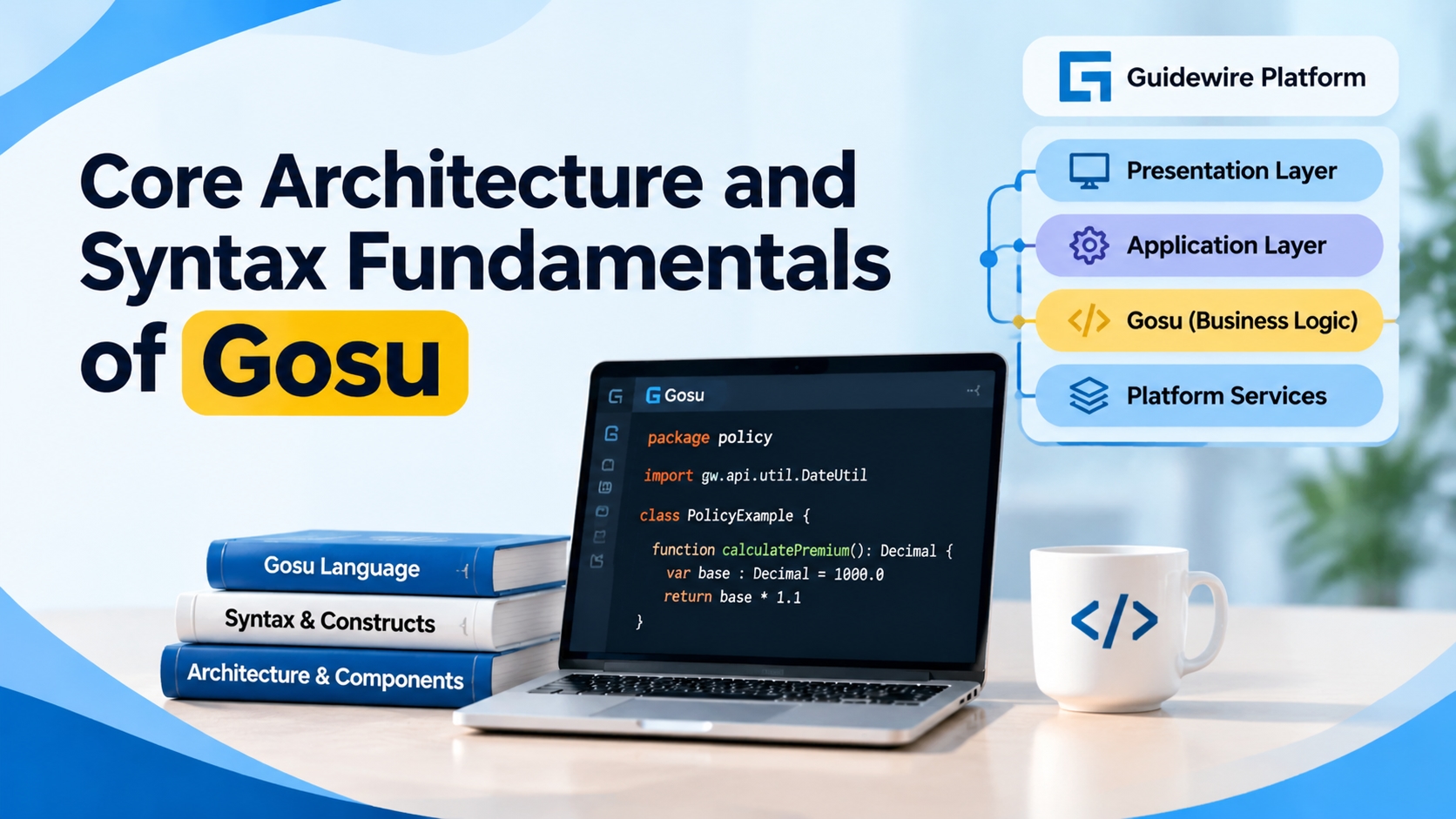
Gosu combines the structural safety of static typing with the clean, readable syntax of modern scripting languages. Every variable possesses a known type at compile time, yet developers rarely need to declare types explicitly because the compiler automatically infers them from assigned values. Because Gosu compiles directly to JVM bytecode, it shares memory management and execution performance with Java while eliminating semicolons, checked exceptions, and excessive getter-setter ceremony.
File organization in Guidewire Studio follows strict naming conventions based on component purpose. Standard classes use the .gs extension, standalone scripts run as .gsp program files, dynamic templates utilize .gst, and class extensions reside inside .gsx enhancement files.
Code snippet
// Variable declaration with automatic type inference
var policyNumber = "POL-2026-8841"
var basePremium = 1250.50
var isActive = true

// Clean conditional logic using readable English boolean operators
if (isActive and basePremium > 1000.00) {
  print("Policy " + policyNumber + " qualifies for preferred tier review.")
} else {
  print("Standard underwriting workflow applied.")
}
In this snippet, policyNumber is inferred as a String and basePremium as a Double or BigDecimal contextually. Notice how Gosu supports readable English keywords like and, or, and not alongside traditional symbolic operators, making business rules immediately understandable to both developers and insurance analysts.
Static Typing, Type Inference, and Object Initialization
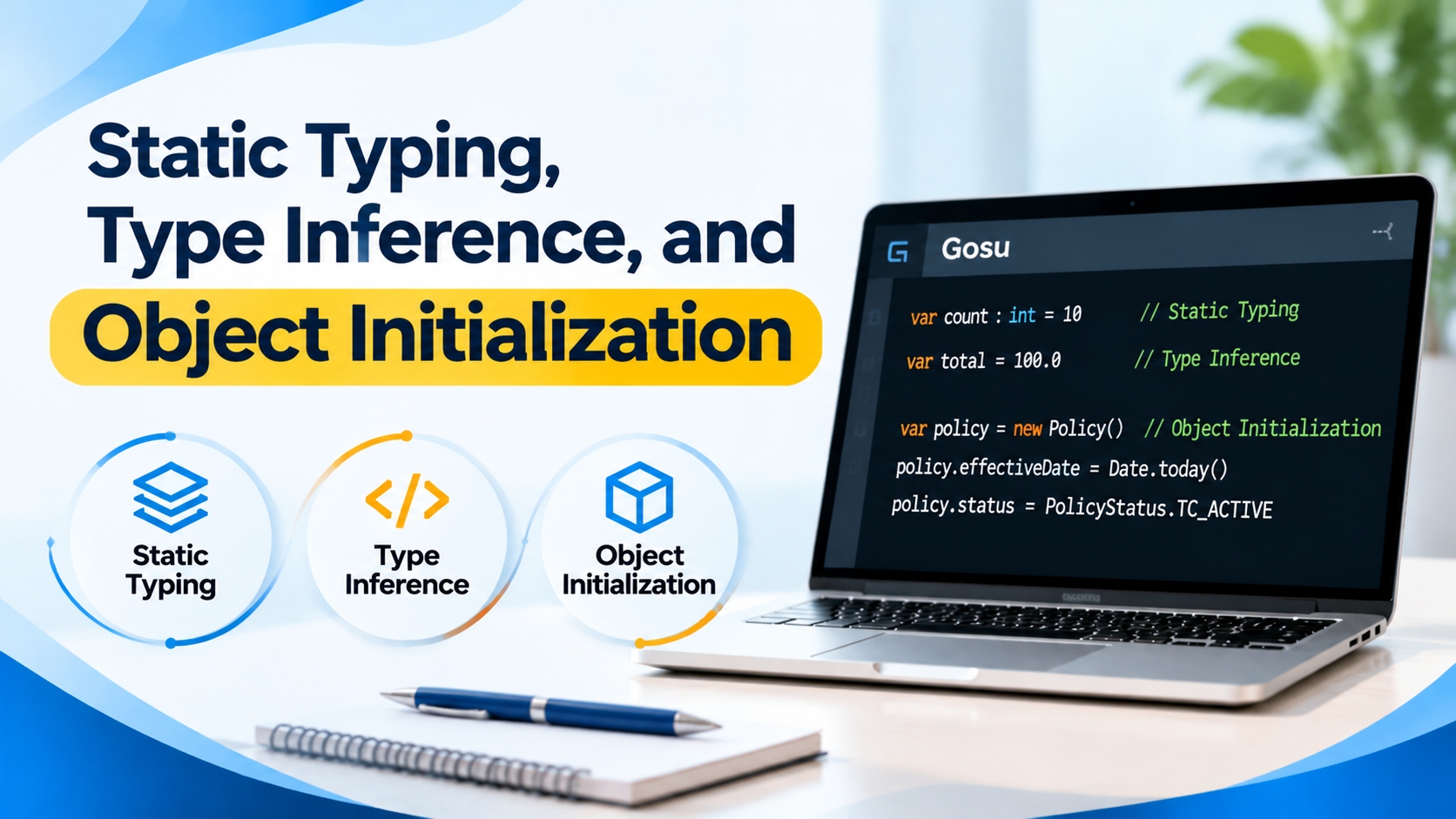
Enterprise insurance platforms process millions of policy transactions daily, making runtime type errors unacceptable in production environments. Gosu enforces strict static type checking inside Guidewire Studio, catching mismatched assignments and invalid method calls before deployment. Simultaneously, built-in type inference and shorthand object initializers drastically reduce keystrokes when instantiating complex insurance entities such as vehicles, drivers, or claim exposures.
Professionals pursuing structured Guidewire training in Bangalore quickly discover how property syntax and object initializers streamline data model manipulation during real-world implementation projects. Instead of invoking dozens of sequential setter methods on a newly created entity, developers assign field values inline within curly braces immediately after calling the constructor. This declarative style keeps business logic compact, readable, and far easier to audit during peer code reviews and platform upgrades.
Code snippet
// Defining a clean data transfer class with properties
class CoverageSummary {
  var _code : String as CoverageCode
  var _limit : int as CoverageLimit
  var _deductible : int as DeductibleAmount
}

// Instantiating and populating fields using an Object Initializer
var collisionCov = new CoverageSummary() {
  :CoverageCode = "COLL",
  :CoverageLimit = 50000,
  :DeductibleAmount = 500
}

print("Applied " + collisionCov.CoverageCode + " with limit $" + collisionCov.CoverageLimit)
Using the as keyword automatically generates public property getters and setters backed by private fields. The object initializer block then populates those properties cleanly during construction without cluttering the surrounding method body.
Working with Gosu Blocks and Collection Operations

Blocks—known in other languages as closures or lambda expressions—represent one of the most powerful functional programming features inside Gosu. A block is essentially an inline anonymous function that can be stored in a variable, passed as an argument to another method, and executed on demand. Guidewire enriches standard Java collections with dozens of block-accepting methods like where(), firstWhere(), each(), map(), and sortBy().
Rather than writing verbose nested for loops and temporary accumulator lists to filter claims or calculate total insured values, developers chain concise collection methods together.
Code snippet
// Sample list of claim reserve amounts
var claimReserves = { 4500.00, 12800.00, 950.00, 27400.00, 6100.00 }

// Filter claims exceeding $5,000, sort ascending, and print each value
var highValueClaims = claimReserves
    .where(\ amount -> amount > 5000.00)
    .sortBy(\ amount -> amount)

highValueClaims.each(\ val -> print("High-severity reserve flagged: $" + val))

// Calculate total sum using fold
var totalExposure = highValueClaims.fold(\ acc, next -> acc + next)
print("Total High-Value Exposure: $" + totalExposure)
The backslash character (\) introduces a block parameter list, followed by the arrow (->) and the expression body. This functional pipeline transforms raw transaction arrays into actionable underwriting or claims insights in just a few lines of self-documenting code.
Extending Functionality Safely with Gosu Enhancements
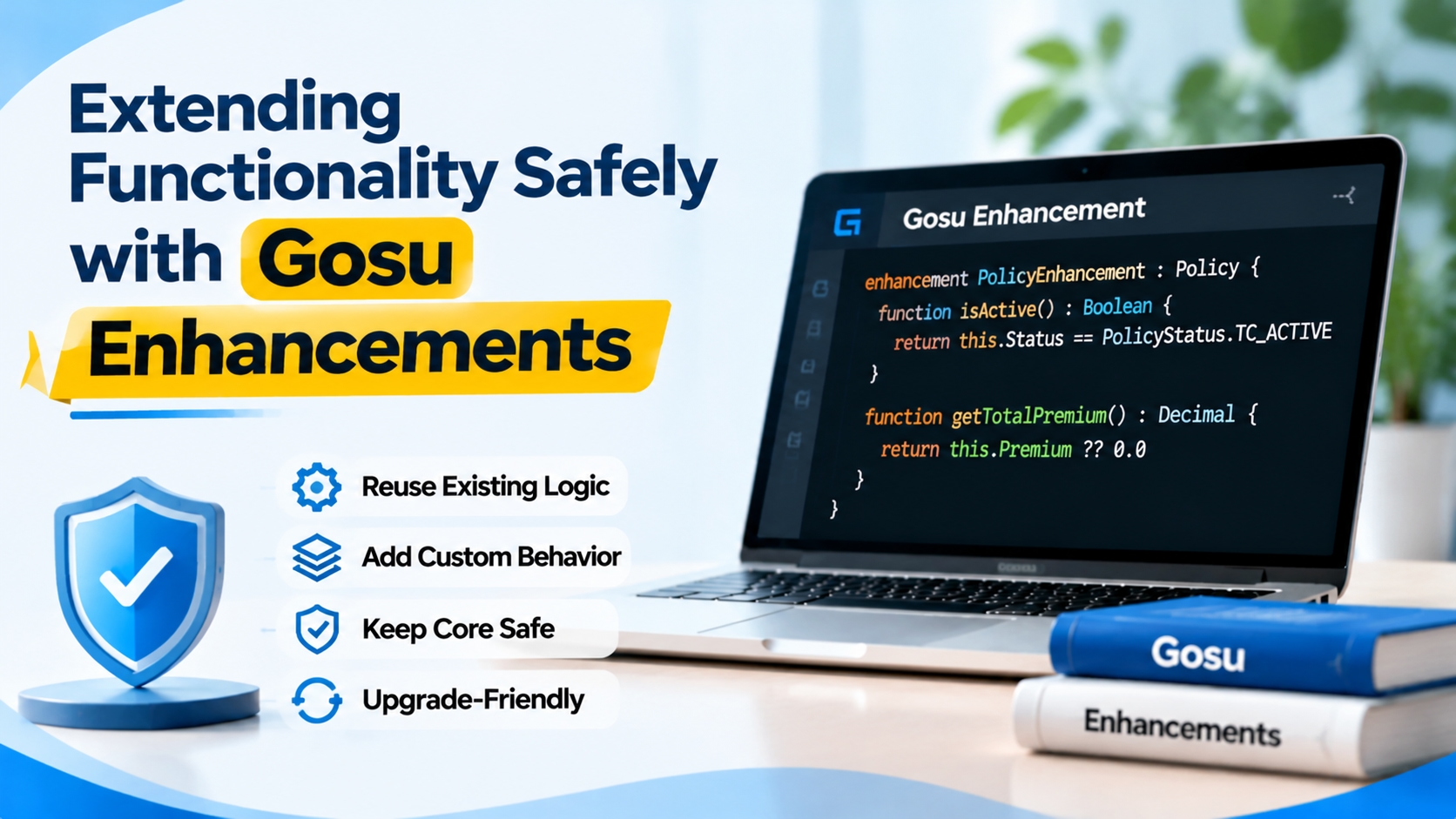
Modifying core platform classes directly creates severe maintenance headaches when upgrading Guidewire InsuranceSuite versions. Gosu solves this architectural challenge through Enhancements (.gsx files), a mechanism that lets developers attach new methods and properties to existing Guidewire entities or standard Java classes without altering their original source code.
Once defined in a package, enhancement methods appear directly in Guidewire Studio's dot-completion menu across the entire application, behaving identically to native methods on that type.
Code snippet
// File: StringValidationEnhancement.gsx
enhancement StringValidationEnhancement : java.lang.String {

  // Adds a custom validation helper directly onto java.lang.String
  function isValidPolicyFormat() : boolean {
    if (this == null) {
      return false
    }
    return this.matches("POL-[0-9]{4}-[0-9]{4}")
  }
}

// Usage anywhere in the application:
var inputCode = "POL-2026-4410"
if (inputCode.isValidPolicyFormat()) {
  print("Verified standard policy identifier.")
}
Inside the enhancement body, the this keyword refers to the target instance being extended. Insurance teams frequently use enhancements to add domain-specific helpers—such as calculating driver age on a Contact entity or checking overdue balances on an Account—keeping domain logic centralized and reusable.
Automating Insurance Logic with Business Rules and Queries

In PolicyCenter and ClaimCenter, operational workflows rely heavily on event-driven Business Rules and database Queries. Business rules execute automatically during specific entity lifecycle stages—such as Pre-Update, Validation, or Assignment—evaluating a boolean condition and triggering targeted actions when criteria are met. Meanwhile, the Gosu Query API builds type-safe SQL queries under the hood to fetch persistent records from the relational database without exposing raw SQL strings.
Code snippet
uses gw.api.database.Query
uses gw.api.database.Relop

// Querying open claims exceeding a specific loss estimate
function flagHighSeverityOpenClaims(threshold : BigDecimal) {
  var claimQuery = Query.make(Claim)
  claimQuery.compare(Claim#State, Relop.Equals, ClaimState.TC_OPEN)
  claimQuery.compare(Claim#LossEstimate, Relop.GreaterThan, threshold)

  var results = claimQuery.select()
  for (currentClaim in results) {
    print("Review required for Claim #" + currentClaim.ClaimNumber)
  }
}
Using entity property literals like Claim#State guarantees compile-time validation. If a data model field name ever changes, Guidewire Studio immediately flags the query before broken code reaches testing environments.
Native XML, JSON, and Web Service Integration Patterns
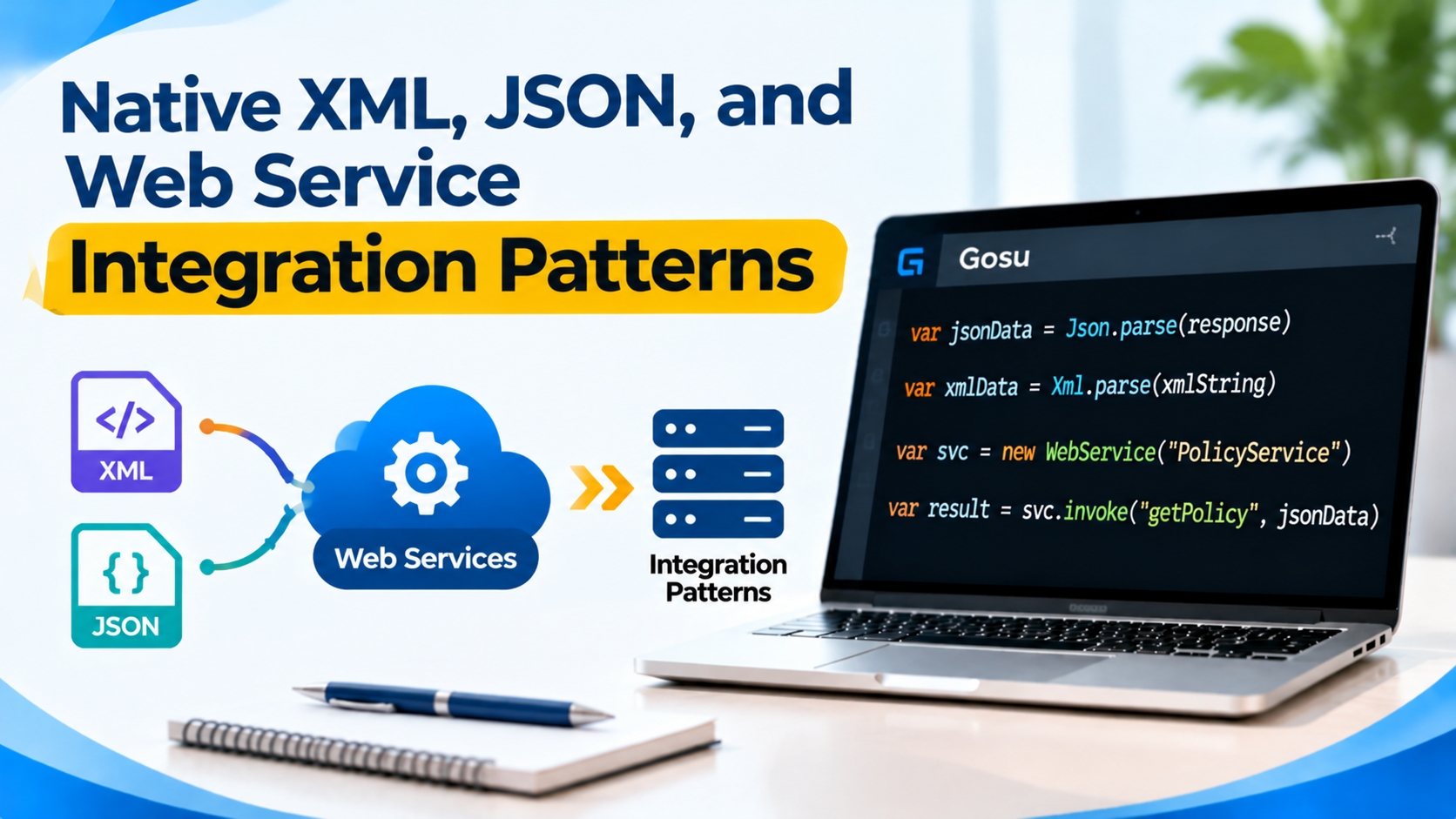
Insurance ecosystems never operate in isolation; core applications constantly exchange data with credit bureaus, motor vehicle registries, payment gateways, and document management systems. Gosu provides first-class support for parsing and generating XML, XSD, JSON, and SOAP payloads natively, eliminating the need for heavy third-party serialization frameworks. Furthermore, Gosu Templates (.gst files) allow engineers to generate formatted emails, policy declarations, and dynamic XML requests by embedding Gosu expressions directly inside structured text.
Code snippet
uses gw.api.json.JsonObject

// Constructing a lightweight JSON payload for an external rating service
function buildRatingRequest(policyId : String, vehicleYear : int) : String {
  var payload = new JsonObject()
  payload.put("policyIdentifier", policyId)
  payload.put("modelYear", vehicleYear)
  payload.put("requestTimestamp", java.time.Instant.now().toString())

  return payload.toPrettyJsonString()
}
By combining native JSON/XML handling with asynchronous messaging plugins and RESTful APIs, Gosu allows integration engineers to build fault-tolerant external connectors while keeping transformations clean and strongly typed.
Conclusion
Gosu stands out as a purpose-built language that balances enterprise-grade stability with developer agility across the entire Guidewire InsuranceSuite platform. By pairing static type safety and full JVM interoperability with expressive features like type inference, blocks, enhancements, and native payload handling, Gosu enables engineering teams to implement sophisticated insurance rules without drowning in boilerplate code. Whether validating policy data models, querying high-volume claims databases, or integrating external rating engines, mastering these practical Gosu patterns equips developers to build scalable, upgrade-safe insurance applications.