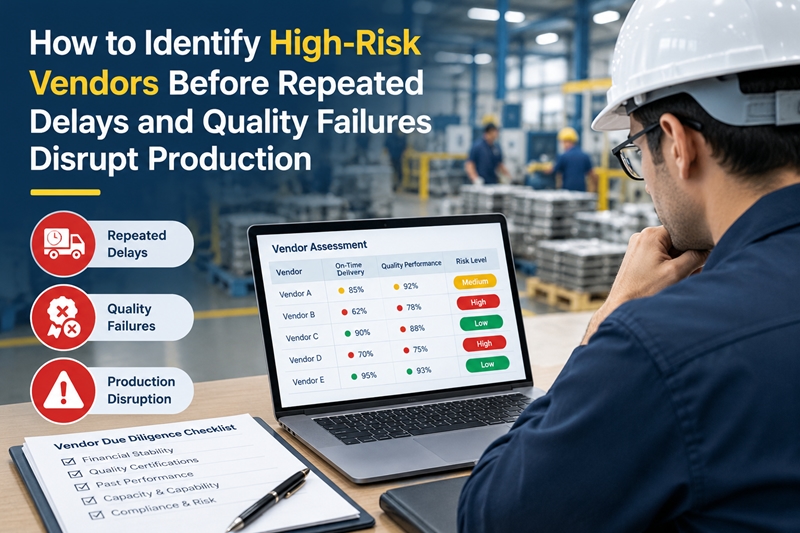
Manufacturing disruptions often begin with warning signs that are visible in existing supplier records but are not reviewed together. A vendor may repeatedly revise delivery dates, submit inconsistent batches or close corrective-action reports without preventing the same defect from returning. Individually, these incidents may appear manageable. Collectively, they can indicate a growing risk to production continuity.
For procurement managers, supplier quality engineers and plant heads, the challenge is to identify these risks early enough to take corrective action. This requires more than reviewing purchase prices or checking whether a supplier holds the required certificates. Businesses need to evaluate delivery reliability, product quality, production capacity, corrective-action effectiveness and dependence on critical suppliers.
This guide explains how manufacturers can recognise early warning signs, conduct a Vendor Risk Assessment using measurable evidence and determine when closer monitoring or a supplier audit is necessary.
What Makes a Vendor High-Risk?
A high-risk vendor is one whose likelihood of failure and potential impact on business operations create an unacceptable level of exposure. The risk may involve late deliveries, defective components, insufficient production capacity, weak process controls or dependence on an unreliable subcontractor.
Importantly, a supplier does not need a history of major failures to be considered high-risk. A vendor supplying a unique component with a long replacement lead time may present significant risk even when its recent performance appears satisfactory.
Manufacturers should assess vendors across five areas:
Delivery reliability: Ability to meet confirmed quantities and delivery dates.
Product quality: Consistency with approved specifications and acceptance criteria.
Production capability: Ability to meet current and forecast demand without compromising quality.
Process and compliance controls: Effectiveness of documented procedures and their implementation.
Supply continuity: Availability of alternative sources and visibility into critical subcontractors.
Supplier quality management is an ongoing process that includes selection, performance monitoring, evaluation and improvement, rather than a one-time approval exercise. The American Society for Quality (ASQ) also highlights delivery reliability, supplier history and the total cost of managing supplier relationships as important considerations.
Monitor Delivery Patterns Before Shortages Occur
Repeated delivery delays are among the clearest indicators of potential supplier risk. However, reviewing only the number of late shipments can hide important details.
For example, a vendor might deliver 18 out of 20 orders on time but repeatedly delay the two components required to start a critical production run. Its overall delivery performance may look reasonable, while its operational impact remains serious.
Procurement teams should review:
Original promised delivery dates against actual receipt dates.
Frequency of revised commitments and missed revised dates.
Partial deliveries and quantity shortfalls.
Changes in supplier lead times.
Delays affecting production-critical orders.
The supplier's response when a delivery is at risk.
A useful starting metric is the on-time delivery rate:
On-time delivery rate = (Deliveries received on time ÷ Total deliveries due) × 100
Use a consistent definition of an on-time delivery, including agreed tolerances and rules for partial shipments. Review the trend over a meaningful period rather than relying on one month's performance.
Also investigate whether delays share a common cause. Repeated shortages of the same raw material, equipment breakdowns or inadequate scheduling may indicate a persistent weakness rather than an isolated incident.
Identify Recurring Quality Defects and Ineffective Corrective Actions
A supplier's quality risk cannot be assessed solely by counting rejected batches. The frequency, severity and recurrence of defects are equally important.
A vendor may deliver several acceptable batches after a corrective-action request, only for the same defect to reappear later. This can indicate that the root cause was misunderstood, the corrective measure was not implemented consistently or its effectiveness was not verified.
Review the following evidence:
Incoming inspection and rejection reports.
Defect rates by part number, batch and manufacturing process.
Repeat non-conformities and customer complaints.
Supplier corrective-action requests and root-cause analyses.
Evidence supporting completed corrective actions.
Quality results from subsequent deliveries.
Where relevant, track defects per million parts (PPM):
Defect PPM = (Number of defective parts ÷ Total parts received) × 1,000,000
PPM is useful when comparing defect performance across sufficiently comparable products and periods. It should not replace severity assessment: one defect involving a safety-critical component may deserve more attention than numerous minor cosmetic defects.
Manufacturers should also distinguish between administrative closure and demonstrated effectiveness. A corrective-action report should not be considered sufficient evidence of resolution until the required actions have been verified and subsequent results show that the issue is controlled.
Verify Whether Supplier Capacity Matches Actual Commitments
A supplier may accept an order without having enough available capacity to meet the required volume and delivery schedule. This becomes particularly important when the buyer increases order quantities, introduces a new product or requests shorter lead times.
Installed machine capacity alone does not establish that a supplier can meet these commitments. Actual output depends on equipment availability, cycle times, changeovers, workforce coverage, maintenance, material availability and existing orders.
Before treating a capacity concern as resolved, compare the buyer's demand with the supplier's demonstrated operating capability.
Check:
Available machine hours and planned downtime.
Actual production output over representative periods.
Current order backlog and capacity already committed to other customers.
Availability of trained operators and required shifts.
Material availability and subcontracted processes.
Bottlenecks that could constrain the complete production route.
For example, a supplier may have sufficient machining capacity but depend on an external heat-treatment provider with a long turnaround time. Reviewing only the supplier's own machines would miss the constraint.
Ask for supporting records and, where the risk warrants it, verify the production process through a focused supplier assessment. Capacity claims should be supported by realistic operating data rather than theoretical maximum output.
Look Beyond Certificates and Supplier Documentation
Valid certificates and complete documentation are useful, but they do not automatically prove that the supplier consistently follows the required controls.
A mismatch between documented procedures and actual factory practices can indicate an implementation weakness. Examples include outdated work instructions at production stations, inspection records that cannot be traced to specific batches or measuring equipment that is not within its required calibration period.
A supplier compliance review should establish whether:
Required documents are valid and applicable to the relevant facility, product or process.
Production teams follow the current approved work instructions.
Inspection results are recorded and traceable.
Non-conforming material is identified and controlled.
Relevant equipment is maintained and measuring instruments are appropriately calibrated.
Changes to processes, materials or subcontractors are managed as required.
The applicable checks depend on the product, industry, contractual terms and regulatory requirements. A certificate should be assessed for its actual scope rather than treated as blanket evidence of compliance.
When documentation conflicts with observed practices, investigate the discrepancy and determine whether it creates a material risk to product quality, regulatory compliance or delivery performance.
Speak With An Expert: https://www.imarcengineering.com/contact?service=vendor-audits-and-compliance-checks
Assess Dependence on Critical Vendors and Sub-Suppliers
A supplier can perform well while remaining vulnerable to an interruption outside its direct control. Manufacturers may discover this only when a specialist subcontractor, imported material source or single production facility becomes unavailable.
Begin by identifying which purchased components and processes are essential to production. Then determine whether each critical item has a qualified alternative and how long replacement supply would take.
Investigate:
Components available from only one approved supplier.
Critical processes outsourced to a single subcontractor.
Long replenishment or qualification lead times.
Geographic, transport or raw material dependencies.
Limited visibility into lower-tier suppliers.
The feasibility of switching to an alternative source.
NIST's guidance for small manufacturers recommends mapping supply-chain relationships and investigating suppliers beyond the immediate tier to identify hidden dependencies. Its practical relevance is that a buyer cannot fully evaluate continuity risk if important upstream relationships remain unknown.
A backup supplier should not be treated as an effective contingency merely because its name appears in a database. The alternative may need technical qualification, sample approval, capacity confirmation and contractual checks before it can supply production-ready material.
Build a Risk-Based Vendor Assessment
Once warning signs have been identified, manufacturers need a consistent method for deciding which vendors require attention first. A weighted risk score can help combine different indicators, provided the ratings are supported by evidence.
The following model is an illustrative internal assessment framework, not a universal industry standard.
Risk criterion | Suggested weight |
|---|---|
Delivery reliability | 25% |
Product quality performance | 25% |
Production capacity | 20% |
Corrective-action effectiveness | 15% |
Supply-chain dependency | 10% |
Compliance and documentation | 5% |
Total | 100% |
Rate each criterion from 1 to 5, where 1 represents low risk and 5 represents very high risk.
Calculate the weighted score using:
Weighted risk score = Sum of [(Risk rating ÷ 5) × Criterion weight]
For example, consider a supplier with these ratings:
Criterion | Rating | Weight |
|---|---|---|
Delivery reliability | 4 | 25% |
Product quality | 5 | 25% |
Production capacity | 3 | 20% |
Corrective actions | 4 | 15% |
Supply dependency | 5 | 10% |
Compliance | 2 | 5% |
The resulting score is 81 out of 100. This indicates that the supplier deserves priority review because of its delivery, quality and dependency risks.
A business might initially classify scores of 0–29 as low risk, 30–59 as medium risk and 60–100 as high risk. These thresholds must be calibrated to the organisation's products, historical performance and risk tolerance.
An aggregate score must never override a serious individual finding. A critical safety issue, suspected non-compliance or major defect may require immediate escalation even when the overall score is low.
Decide When a Supplier Audit Is Necessary
A risk score helps prioritise investigation, but it does not establish the underlying cause. A supplier audit can provide further evidence when performance records reveal recurring or unexplained problems.
Consider a focused audit when:
Delivery delays continue despite revised commitments.
The same quality defect returns after corrective action.
Claimed production capacity cannot be substantiated.
Supplier documents conflict with actual operating practices.
Critical subcontractors are not adequately controlled.
Significant process or facility changes affect the original approval.
Available performance data is incomplete or inconsistent.
The audit should match the problem. A delivery-focused review may examine production planning, capacity, material availability and order scheduling. A quality-focused review may examine process controls, traceability, inspection practices and corrective-action effectiveness.
Not every concern requires a full on-site audit. A targeted document review, remote assessment or focused process inspection may be appropriate for lower-impact issues. The decision should reflect the supplier's criticality, the severity of the warning signs and the consequences of failure.
Take Action Before Vendor Risk Becomes a Production Disruption
Identifying a high-risk supplier is useful only when the findings lead to proportionate action.
First, establish the immediate exposure. Identify affected purchase orders, components, production schedules and customer commitments. Determine whether existing inventory can cover the likely delay and how much time is available to respond.
Next, work with the supplier to identify the underlying cause and agree on corrective actions. Each action should have a responsible person, completion date and clear evidence of implementation. Verify whether subsequent deliveries and production results demonstrate improvement.
Where risk remains unacceptable, consider closer incoming inspection, increased performance reviews, contingency inventory or qualification of an alternative supplier. These measures should be selected according to the component's criticality, replenishment lead time and cost of disruption.
Finally, document the decision and reassess the supplier after the agreed review period. A supplier should not automatically return to normal monitoring merely because a corrective-action deadline has passed. Evidence of sustained improvement should determine whether the risk has actually reduced.
How IMARC Engineering Can Help
IMARC Engineering can support manufacturers through vendor audits and compliance checks designed around their supplier requirements and operational risks. The assessment can focus on relevant documentation, manufacturing practices, quality controls, production capability and identified compliance gaps. Findings can help procurement and quality teams determine where further verification, corrective action or supplier reassessment is needed. The appropriate scope depends on the industry, product, applicable requirements and agreed engagement. Manufacturers should use documented evidence to guide supplier approval and risk-reduction decisions.
Conclusion
High-risk vendors are not always identified by a single failed delivery or rejected batch. More reliable identification comes from examining recurring patterns, verifying supplier capability and understanding how a failure could affect production. Manufacturers should combine delivery and quality data with capacity checks, corrective-action reviews and supply-chain dependency assessments. A risk-based approach helps teams prioritise audits and corrective measures before problems escalate. Regular reassessment, supported by documented evidence, makes supplier management more proactive and helps protect manufacturing continuity.
Contact Us:
IMARC Engineering
Phone: +91-120-433-0800
Email: sales@imarcengineering.com
India: C-130, Sector 2, Noida, Uttar Pradesh 201301
LinkedIn: https://www.linkedin.com/showcase/imarc-engineering/