The strength of a material determines how well it performs when exposed to pulling forces during manufacturing, handling, and everyday use. Materials such as rubber, plastic, paper, metal, and textiles must withstand specific levels of tension to maintain their quality and functionality. If a material fails under excessive force, it can lead to product damage, manufacturing defects, and customer complaints.
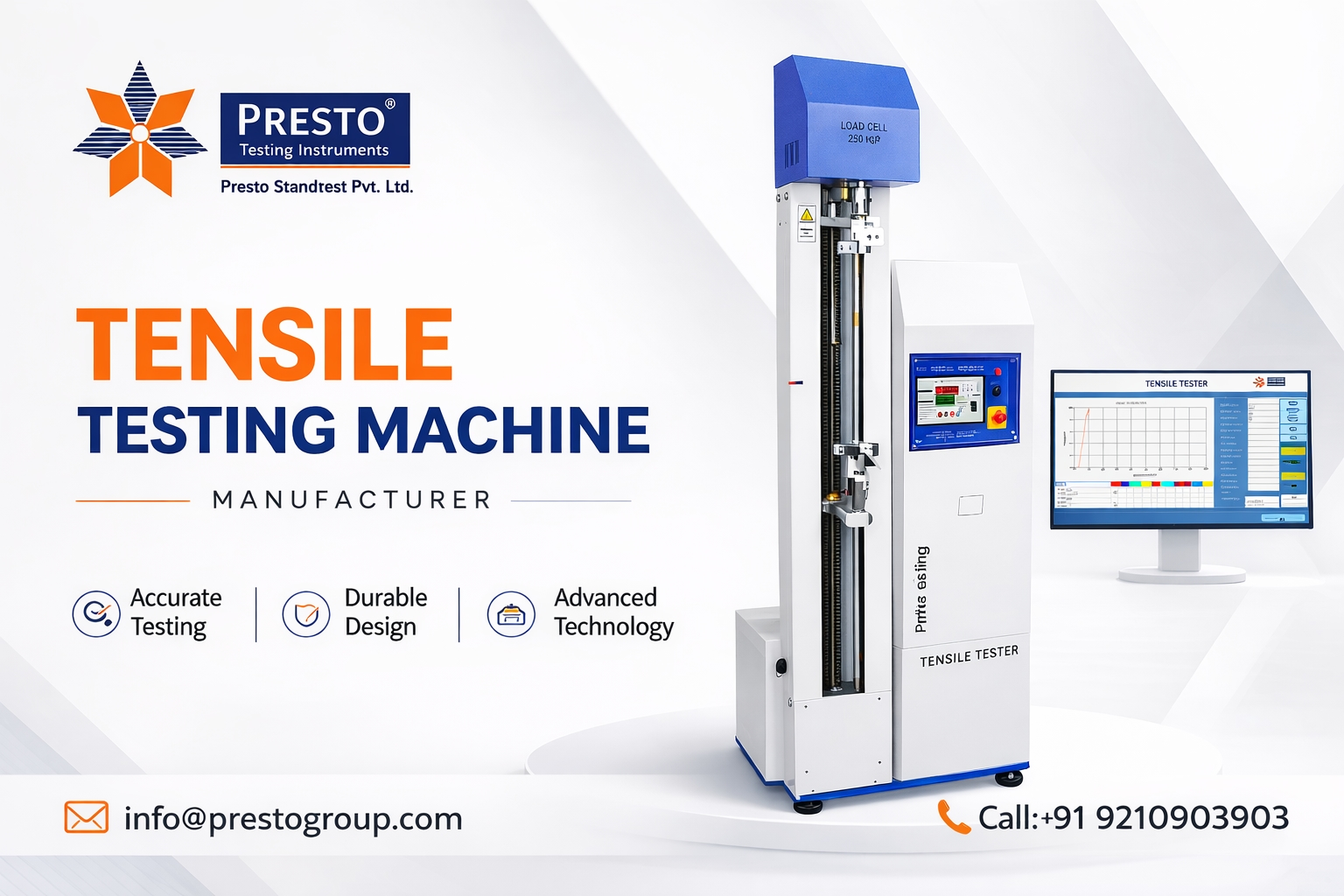
To evaluate these properties, manufacturers use a tensile strength tester. It is an important laboratory instrument that measures the force required to stretch or break a material under controlled conditions. Presto Stantest offers a Digital Tensile Testing Machine designed to help industries evaluate material strength and maintain consistent quality standards.
What Is a Tensile Strength Tester?
A tensile strength tester is a laboratory testing instrument used to determine the tensile strength and elongation properties of different materials. It applies a controlled pulling force to a test specimen until it stretches or breaks.
The instrument measures the force required to deform or break the sample. These measurements help manufacturers understand the mechanical properties and performance of their materials.
The Presto Digital Tensile Testing Machine operates on the Constant Rate of Traverse (CRT) principle. It is equipped with upper and lower gripping jaws that hold the specimen during testing.
It is suitable for testing materials such as rubber, plastic, paper, packaging materials, films, and other industrial products.
How Does a Tensile Strength Tester Work?
The working principle of a tensile strength tester involves applying controlled tension to a specimen and measuring the force required to stretch or break it.
The testing process generally involves the following steps:
Step 1: Sample Preparation
Prepare the test specimen according to the applicable testing standard. Ensure that the sample has the required dimensions and shape.
Step 2: Sample Placement
Place the specimen between the upper and lower gripping jaws of the testing machine. Secure it properly to prevent slipping during testing.
Step 3: Set Testing Parameters
Select the required testing speed according to the material and testing procedure.
Step 4: Apply Tensile Force
The motor-driven lower jaw moves at a fixed speed while the upper jaw remains stationary. This movement gradually stretches the specimen.
Step 5: Measure the Results
The load sensor measures the applied force and displays the readings digitally. The test continues until the specimen reaches its breaking point or the required testing endpoint.
The results help manufacturers determine the tensile strength and elongation behaviour of the tested material.
Key Features of the Presto Digital Tensile Strength Tester
Presto Stantest offers a digital tensile testing machine designed for convenient material strength evaluation.
Some important features include:
1. Advanced Load Sensor: The instrument uses a highly sensitive load sensor with linearity and repeatability features to measure applied force.
2. Digital LCD Display: The bright digital display allows operators to monitor testing readings conveniently.
3. Microcontroller-Based System: The machine uses a microcontroller-based system for controlled testing operations.
4. Adjustable Testing Speed: The standard testing speeds are 100 mm/min and 200 mm/min, which can be changed through the belt and pulley mechanism.
5. Peak Hold Facility: The instrument includes a peak hold facility to retain the maximum load reading during testing.
6. Safety Protection: Safety limit switches help prevent over-travel during machine operation.
7. Durable Construction: The machine features a rugged single-column structure with hardened lead screws for stable movement.
8. Optional Software: Wintest software is available as an optional feature for data management and graphical analysis of force versus elongation.
Technical Specifications of the Presto Tensile Testing Machine
Parameters | Specifications |
|---|---|
Model | TTM-S (As per Capacity) |
Motor | ¼ HP |
Power Supply | 220 / 110V AC |
Testing Speed | 100 and 200 mm/min |
Display | Digital LCD |
Accuracy | ±2% at Full Load |
Grip-to-Grip Separation | 25 mm to 700 mm |
Structure | Single Column |
Crosshead Travel | 750 mm |
Load Sensor | Advanced Load Sensor |
Control System | Microcontroller-Based |
Different capacities and optional configurations are available according to testing requirements.
Industrial Applications of a Tensile Strength Tester
Tensile strength testing is important for industries where materials are exposed to pulling forces during manufacturing and product use.
1. Rubber Industry: Used to evaluate the tensile strength and elongation properties of rubber sheets, seals, and other rubber components.
2. Plastic Industry: Helps determine the strength and stretching behaviour of plastic films, sheets, and moulded products.
3. Paper and Packaging Industry: Supports tensile strength evaluation of paper, packaging materials, and related products.
4. Automobile Industry: Helps manufacturers assess the mechanical properties of rubber and plastic components used in vehicles.
5. Textile Industry: Used to evaluate the tensile strength of fabrics, fibres, and textile materials.
6. Construction Industry: Supports testing of materials used in construction and industrial applications.
Benefits of Using a Digital Tensile Strength Tester
Using a digital tensile strength tester offers several advantages for manufacturers and quality control laboratories.
Accurate Force Measurement: Helps measure the force required to stretch or break a material.
Better Quality Control: Identifies material weaknesses before products reach the market.
Digital Readings: Makes it easier for operators to observe and record testing results.
Consistent Testing: Controlled testing speeds help maintain repeatable testing procedures.
Improved Material Analysis: Helps evaluate tensile strength and elongation behaviour.
Easy Operation: Digital controls and a user-friendly design support convenient laboratory testing.
How to Choose the Right Tensile Strength Tester Manufacturer?
Selecting the right tensile strength tester manufacturer is important for obtaining suitable testing equipment.
Before purchasing, consider these factors:
Check the manufacturer's experience in material testing equipment.
Verify the machine's load capacity and measurement accuracy.
Compare available testing speeds and gripping arrangements.
Check digital display and data management facilities.
Review safety features and machine construction.
Consider calibration documentation and after-sales technical support.
Choosing the right manufacturer helps ensure that the testing instrument meets your laboratory and industrial requirements.
Conclusion
A tensile strength tester is an essential instrument for evaluating the mechanical strength and elongation properties of different materials. It helps manufacturers identify material weaknesses, improve product quality, and maintain consistent testing standards.
The Presto Digital Tensile Testing Machine offers features such as an advanced load sensor, digital LCD display, adjustable testing speeds, peak hold facility, and a durable mechanical structure.
If you are looking for a reliable tensile strength tester for your laboratory or manufacturing facility, explore Presto Stantest's Digital Tensile Testing Machine. Contact the team to understand its technical specifications, available capacities, and suitability for your testing applications.