
I planned to publish this article near to the release day of the “Cyberpunk 2077”. The article is inspired by numerous pictures with cyberwitcher Geralt, which were drawn by fans of the “CD Projekt RED” during anticipation of the game. It’s unlikely that any of these artists, who drew Geralt armed with a shotgun, guessed that such a character has been already existing for a long time, and especially that this cyberwitcher is a Ukrainian. I’m talking about the “Witcher of Grand Kiev” (or “…from Big Kiev”), written by Vladimir Vasilyev. This winter, I finally read a few stories from this series.
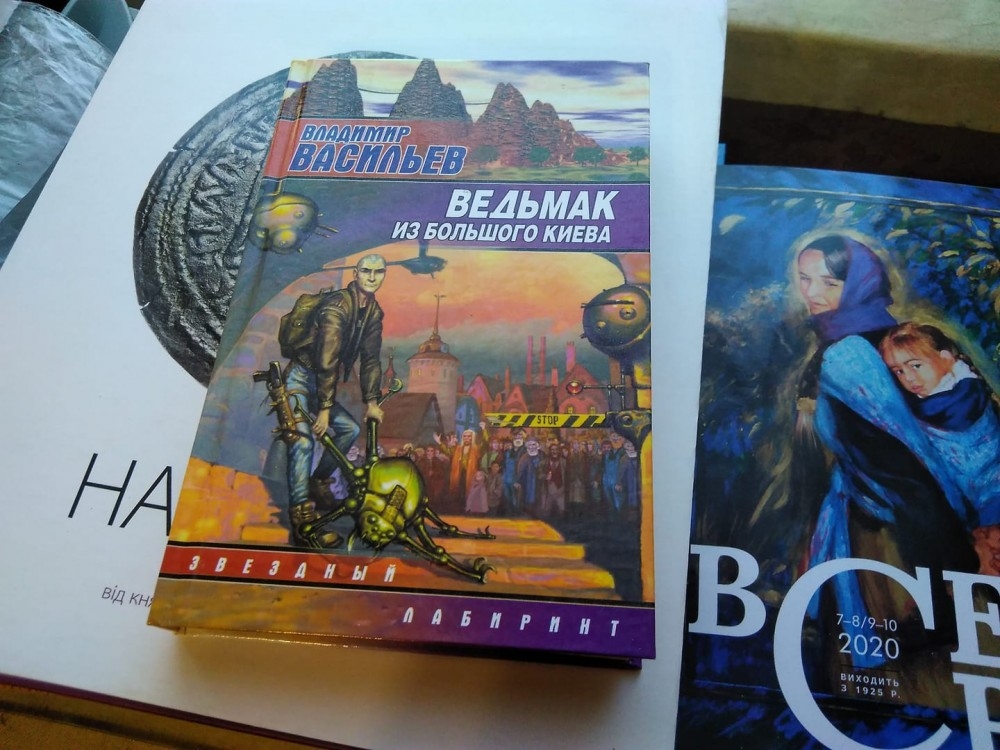
Back in 1999, Vasilyev settled Geralt in the world which he had previously invented for the “Technician of Grand Kiev” (1997, also known as the “Wild Truck Hunting”). However, the monster-machine hunter got his big name not immediately: the opening story of the future series was published at first in the magazine “Yesli” (“If”) under the title “Graham of Grand Kiev”. But soon the writer got permission for using the name from Sapkowski himself. The story got the name the “Witcher of Grand Kiev” in other publication in the same year. Subsequently, stories about the Geralt of Grand Kiev were gathered in two collections: the “Witcher of Grand Kiev” and the “Witcher’s Word”.
I must honestly confess that I started reading the first collection with the intention to ruthlessly criticize the “Godfather of Russian cyberpunk”.
But reading the second story I felt how the quality of the texts is definitely and almost steadily growing. Separately, I would like to note the third, named “Duty, Honor and Taimas“. This is the pinnacle of artistic and narrative skill among the five presented works, which one I even would recommend to read, because it has nothing to criticize. But the rest of the stories have some flaws.
First, although Vasilyev in his article “Cyberpunk for Russians and Non-Russians” attributed his Kievan cycle as cyberpunk, the “Grand Kiev” does not belong to this genre at all. It doesn’t exploit attributes such as virtual reality, cyberprosthetics, automation, etc. I haven’t seen any trace of key genre themes: neither crisis of self-identification, nor crisis of consumer society, nor absorption of state by private capital. The atmosphere of the world of stories is closer to post-apocalyptic in its Soviet manifestation, imbued with the Stalker romance. If megapolis of classic cyberpunk is alive and bustling, then Vasilyev’s Grand Kiev, what stretches across Ukraine, is a solid dead concrete ruin, what narratively is not much different from an usual landscape with ravines, mountains and forests. It sometimes allows the author to demonstrate clumsy urban ingenuity (for example, when Geralt makes an improvised spit from a scrap). Moreover, the post-apocalypse in the universe of Geralt the Kievan is unfinished, as it was not accomplished during the collapse of the Soviet state: the cities of the reality stand, where they are, but only surrounded by slums and renamed to districts.
Instead of advanced technologies, which you can expect from cyberpunk, I have seen in the texts a kind of cargo cult, something like a techno-priesthood from the “Warhammer 40k” universe. In theory, an interesting and promising concept, but, unfortunately, the “Technicians” are depicted quite schematically. Only their hierarchical position in society is more or less clearly marked. Perhaps the novel “Technician of the Grand Kiev” can tell us more about life of this layer, but I can judge only by the next short stories. And in these stories the far-fetchedness of incomprehensibility of technologies is emphasized by careless handling of terminology: you can see on one page the “source of technology” for a power supply source and a banal “nuclear power plant”. The nature of living machines is also overlooked. Is it artificial intelligence or magic? Is the psionic “machine spirit” from the WH40k? Of course, this phenomenon is easy to accept as a particular natural law of a universe. But it is undermined by ignoring the need for an ecosystem for own-will machines. The author had said that wild cars travel on highways, and factories by themselves product new iron beasts, but he does not demonstrate the life of machinery and doesn’t explain what keeps off the “living ones” and mechanical beings from the “final solution” for each other. What factors, other than a handful of witchers, does keep the balance of power and numbers? What do machines do when they are not harming humanity? In stories, living machines play one role — they are the target, the problem. Besides it, they do not exist. For most of the text, the author simply forgets that he endowed them with will. There are exceptions. For example, the Kharkov orc Semyon’s car shows affection for Geralt. However, a small number of counterexamples emphasizes the trend.
Yes, the world of Grand Kiev is inhabited in particular by orcs, who are the most often aborigines, and elves, who are in my opinion the second largest group of characters. Paradoxically, human Kievans are rare. There are halfling and even kobolds, but only the elven nature had played some role in the plot. And the orcs are not endowed with any racial traits. For example, the orcish race of Cynthia (a local analogue of Cirilla or Renfri) remained simply an interesting feature of appearance, an outdated way to shock (because now artists are able to make sexualized even an orc woman).
Probably because of the context of the era (the Russian Wild Nineties) the Vasilyev’s protagonist character is somewhat different from the firstborn of Sapkowski. Andrzej’s Geralt is only nominally an anti-hero, but his bad temper is far from being more than an author epithet, what is unrecognizable by any actions, any thoughts. Vasilyev’s Geralt in my opinion is much more an awful person. His selfishness is real, his indifference is deeper, and the worst thing is that he, written by a man of the 90s, is a poseur. The clear moral boundary between the white-haired Geralt of Rivia and the bald Geralt of Grand Kiev is drawn by the first story of the cycle.
It was I who kidnapped the children. Because you refused to pay right away.
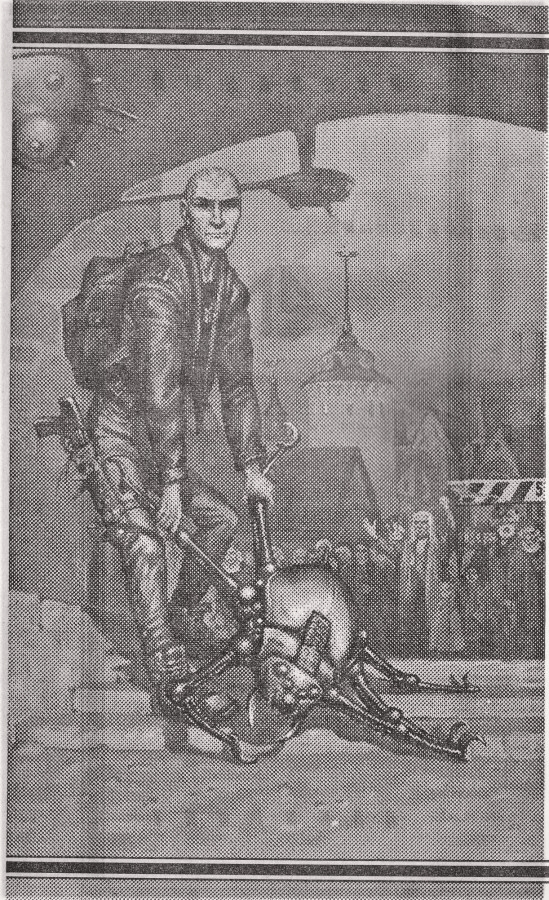
I can’t imagine Geralt of Rivia claiming in this way a deserved but too big reward for an already done work. Geralt of Kiev calmly plays with the feelings of the parents, and even more so — he does it only to give a lesson to employers. He immediately gave the paid “compote” (a drug?) to the food supplier of the closed Territory, saving the “territorials” from starvation. The territorials, who were robbed by him. So the only benefit of killing a monster and hiding the children after is consolation of selfishness. A consolation for unjustified cruelty, given by the writer without any reproach. The only fault of the inhabitants of the territory is the inability to agree to the big price of the witcher.
In modern realities, the representation of female characters in the text, namely the witcheress Cynthy and slave Xana, seems to be an ethical controversy. In both cases, the female nature is portrayed stereotypically, and the Geralt’s behavior as a companion becomes Diedovschina-like. However, Cynthia’s story “Nanny” is (almost) successful. Unfortunately, the high note of its powerful finale was beaten by a mercantile epilogue, where the author lists and emphasizes the material profit obtained by the witcher school. It is difficult to evaluate Xana’s story for several reasons. First, because of the complex and difficult themes of infant death and maternal instinct that have been raised in the “Homeland of Indifference”. Secondly, because in fact it’s two stories: there are separate ordeals of Xana in the present, and there is a separate youth of the future Geralt, Vasilyev’s Marty Stu, nicknamed the General.
Surprisingly, the story, which began with an almost literal quote of Sapkowski, consisted almost entirely of an exposition, and ended with a bitter aftertaste of extortion, gave rise to a series, though not outstanding, but worthy of attention.
21.07.2021.





