Apps are the critical assets for businesses in this digital-first world.
These apps can generate revenue to handle internal operations and customer engagement. Basically, they play the central role that helps companies to compete and grow.
However, some businesses don’t know how to run an app effectively after the launch. They basically get confused between app maintenance and app support. These two terms have huge differences, and mobile app maintenance services plays a major role in keeping the app maintained.
If you are also someone who gets confused between app support and app maintenance, this blog is for you.
Explore the blog till the end to get the complete knowledge.
Understanding App Maintenance
App maintenance refers to the technical work performed by app developers regularly to keep the application functional, secure, and compatible as per the arising changes. The app maintenance process is proactive and preventive by nature.
App Maintenance Typically Includes:
● Bug fixes discovered after release
● Performance optimization to improve speed and stability
● Security updates to address vulnerabilities
● OS and platform compatibility updates (iOS, Android, browsers, APIs)
● Code refactoring to reduce technical debt
● Database optimization and backups
● Compliance updates for regulations like GDPR or HIPAA
In simple terms, app maintenance ensures that your app continues to work as intended over time, even as technology, user expectations, and security threats evolve.
Why Maintenance Is Not Optional?
Technology is ever evolving, with trending options always on the list. Then comes the operating system, which releases updates multiple times a year. Third-party libraries get deprecated.
New devices and screen sizes enter the market. So, with all those changes happening at the same time, an app without maintenance will fall off, slow down, or become an easy prey for cyber attacks.
So, the work is not done once the app launches, as in reality, it's just the beginning.
Understanding App Support
App support is a completely different idea from app maintenance. App support is completely focused on the process of helping users and stakeholders to engage with an application effectively. It is completely reactive and service-oriented.
App Support Typically Includes:
● Handling user-reported issues
● Responding to crashes or outages
● Customer support tickets and inquiries
● User onboarding assistance
● Troubleshooting usage problems
● Monitoring app uptime
● Incident management and escalation
App support ensures that when something goes wrong or when users need help, there is a clear process to respond quickly and minimize disruption.
Support Is About Experience, Not Code Health
While app maintenance focuses on keeping the technical backbone of the app straight, support, on the other hand, focuses on the human side of the product. A technically sound app can still fail if users feel ignored, confused, or frustrated when problems arise.
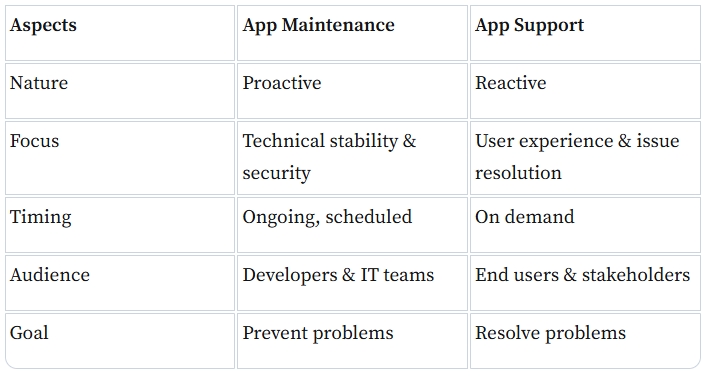
The Key Differences at a Glance
Just an explanation about the app support and app maintenance may become more confusing to understand. To make it easier to understand, here is the side-by-side differentiation in a tabular form of the app support and app maintenance.
Take a look:
What Businesses Commonly Get Wrong?
Businesses are confused about how they can manage an app effectively after the launch. Missing a step can affect the overall performance of the app, along with user satisfaction, security, and long-term scalability.
So, we have mentioned below the common mistakes a business makes when it comes to app maintenance and app support.
1. Treating Maintenance and Support as the Same Thing
One of the biggest misconceptions is assuming that a single “support package” covers everything.
Businesses often sign contracts thinking bug fixes, OS upgrades, security patches, and user support are all included, but the reality is something totally different, which comes only to discover gaps later.
This confusion leads to:
● Unclear responsibilities
● Disputes with vendors
● Delayed fixes
● Unexpected costs
Maintenance and support require different skill sets, processes, and budgets. Treating them as one inevitably causes problems.
2. Budgeting Only for Support, Not Maintenance
Many companies allocate funds for customer support but overlook technical maintenance. The assumption is that if users aren’t complaining, the app must be fine. Which is completely wrong and something really dangerous.
Without regular maintenance:
● Security vulnerabilities accumulate
● Performance degrades slowly but steadily
● Compatibility issues appear after OS updates
● Technical debt grows, making future changes expensive
By the time users start complaining, the problem is often far more complex and costly to fix.
3. Assuming Maintenance Only Means Bug Fixes
Another common mistake is viewing app maintenance as nothing more than fixing bugs. But in reality, it is beyond just fixing the bugs. While bug fixes are part of maintenance, they represent only a small fraction of the work.
True maintenance also includes:
● Preventative security updates
● Performance tuning
● Infrastructure upgrades
● Code optimization
● Compliance checks
Ignoring these aspects is like maintaining a car by only changing tires when they burst, rather than servicing the engine regularly from time to time to avoid big problems.
4. Expecting Support Teams to Handle Technical Maintenance
Support teams are often the first to hear about issues, but they are not always equipped to fix underlying technical problems. Businesses sometimes expect support teams to “just fix it,” without involving developers or allocating maintenance resources.
This leads to:
● Slow resolutions
● Temporary workarounds instead of permanent fixes
● Frustrated users and support staff
Effective operations require clear handoffs between support and maintenance teams.
5. Underestimating the Long-Term Cost of Neglect
Skipping maintenance may seem like a cost-saving measure in the short term, but this is not a smart move if you think of the long term. Ignoring app maintenance can almost always increase costs over time.
Neglected apps often require:
● Major rewrites
● Emergency security patches
● Infrastructure overhauls
● Complete redevelopment
At that point, the maintenance cost will become significantly higher than consistent and planned maintenance.
How to Get It Right
Now that you know where businesses get it wrong, it's time to learn how to get it right. We have mentioned below how to get it right.
Get a closer look at them.
1. Define Clear Scope and Responsibilities
Separate maintenance and support in contracts, budgets, and internal planning. Clearly define what each includes.
2. Budget for Ongoing Maintenance
Plan annual or monthly maintenance costs as part of the app’s lifecycle, not as an optional expense.
3. Use SLAs for Support
Set clear response times and escalation paths to ensure user issues are handled efficiently.
4. Monitor and Measure
Track performance metrics, crash rates, security incidents, and support tickets to guide both maintenance and support efforts.
5. Think Long-Term
An app is not a one-time project; it’s a living product that requires continuous care.
Conclusion
The biggest reason behind an app's underperformance after the launch is the confusion between app maintenance and app support. They may seem closely related, but they serve different purposes and also have different approaches.
If you are a business, you must have learned the distinction from this blog so that you can invest appropriately to build a more secure, reliable, and scalable application.
The success behind a great app is that it is maintained and supported well.