
The best customer service interaction is the one you don't remembe
For decades, that experience was the exclusive domain of elite human agents. Now, a new class of technology is making it scalable: AI agents for customer service — autonomous systems that don't just answer questions but actually resolve problems.
This isn't chatbot 2.0. It's something fundamentally different.
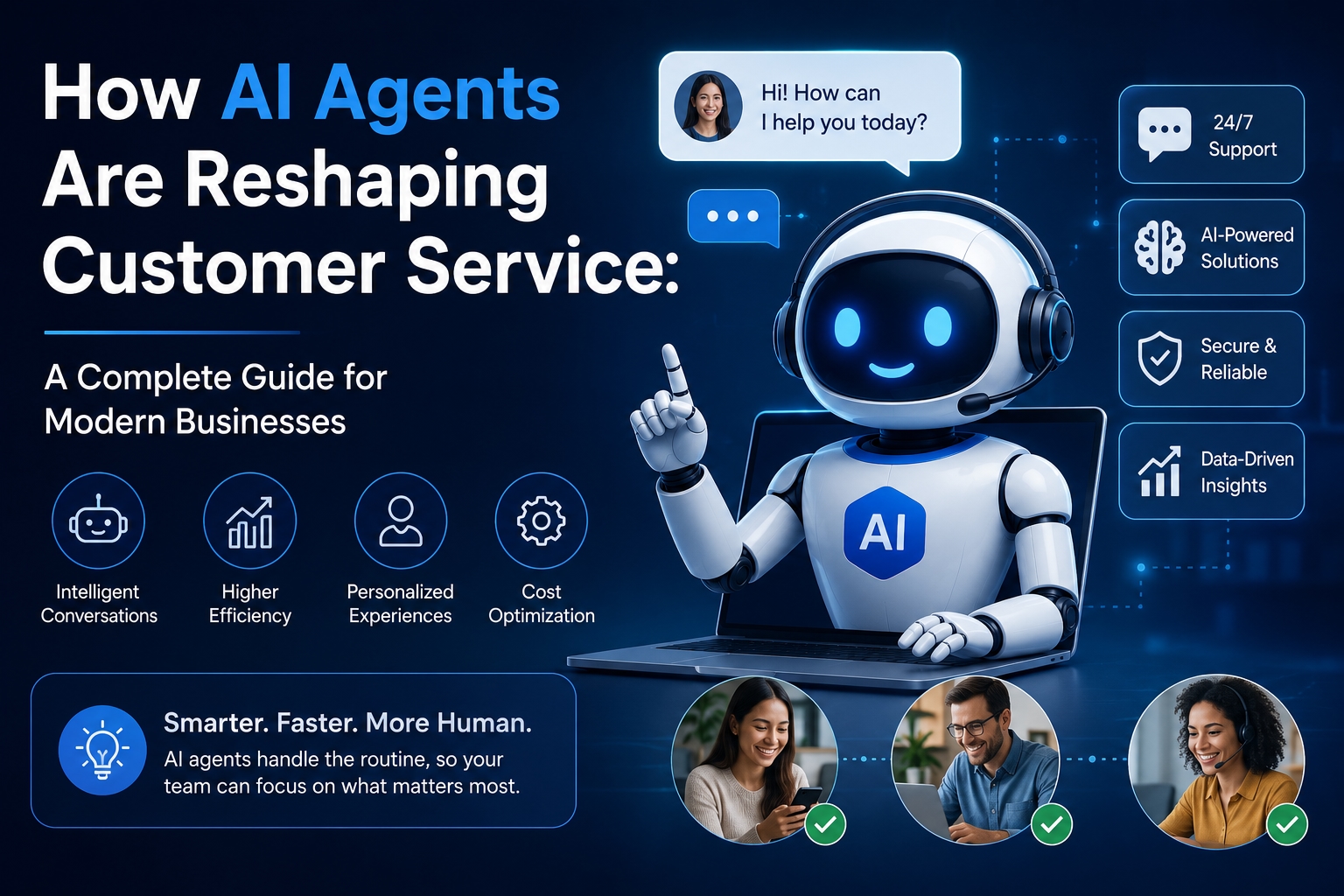
Why Chatbots Failed Us
To understand where we're going, you have to appreciate where we've been. The first wave of customer service automation — rule-based chatbots — was built on a simple premise: if a customer says X, respond with Y. They worked fine for "What are your store hours?" They fell apart for anything else.
The data tells the story clearly. In 2025, Gartner found that 67% of customers abandoned chatbot interactions without resolution. The experience was mechanical, brittle, and often more frustrating than waiting on hold. Businesses deployed them to cut costs; customers tolerated them because they had no choice.
But something shifted in late 2024 and early 2025. Large language models stopped being parlor tricks and became reasoning engines. Companies began building systems that could not only understand natural language but could also plan, execute, and learn. The chatbot became an agent.
What Makes an Agent Different?
The distinction matters. A chatbot retrieves information. An AI agent takes action.
Imagine a customer messaging their bank: "I was charged twice for my hotel in Tokyo, and I need the second charge reversed before my rent check bounces."
A chatbot might link to a dispute form. A human agent would ask for dates, pull transaction records, verify the duplicate charge, process the reversal, and confirm the timeline. An AI customer support agent does exactly that — autonomously. It accesses the CRM, queries the payment processor, executes the refund, and drafts a confirmation message. If the system flags something unusual, it escalates to a human with full context.
This requires three technical capabilities that traditional automation lacked:
First, reasoning. Powered by large language models, modern agents break complex requests into sub-tasks. They don't match keywords; they comprehend intent.
Second, memory. Unlike chatbots that forget everything after three messages, AI agents maintain persistent context. They remember that you mentioned your rent check, your trip to Tokyo, and your preferred refund method — across sessions and channels.
Third, tool use. Through API integrations, agents interact directly with business systems. They're not reading from a script; they're operating your software stack.
The Enterprise Reality Check
The hype around agentic AI is loud, but the enterprise adoption data is surprisingly grounded. According to 2026 service industry benchmarks, 72% of customer service leaders now have active AI agent pilots or deployments. The motivation isn't just cost-cutting — though the economics are compelling. The average cost per contact drops from $8–12 with human agents to roughly $0.50–2.00 with AI. The real driver is capacity.
During seasonal spikes, product launches, or viral incidents, human teams face an impossible choice: hire temporary staff (who deliver inconsistent quality) or accept longer wait times (which destroys loyalty). AI agents scale elastically. They handle ten conversations or ten thousand with identical accuracy and zero lead time.
But the most sophisticated implementations aren't replacing humans — they're redefining the human role.
At a major SaaS company that deployed customer service AI agents in early 2025, Tier 1 ticket volume dropped 60% within six months. Their human agents didn't get laid off; they got promoted. They now handle complex onboarding, high-value account issues, and emotionally sensitive cases that AI isn't equipped for. Average agent satisfaction scores actually rose, because the work became more interesting.
Architecture: What These Systems Actually Look Like
Behind every effective AI agent is an architecture that would be unrecognizable to chatbot developers from five years ago.
At the center is a reasoning engine — typically a large language model like GPT-4o or Claude, though an increasing number of enterprises are fine-tuning open-source models on proprietary data. This engine doesn't just generate text; it plans sequences of actions.
Surrounding it is a memory layer, usually built on vector databases that store semantic representations of customer history, preferences, and past resolutions. When you contact support, the agent doesn't just see your current message — it retrieves relevant context from every interaction you've ever had.
Then there's the tool integration layer. This is where the agent connects to CRMs, order management systems, payment platforms, and knowledge bases. Through a framework often called "Retrieval-Augmented Generation" (RAG), the agent grounds its responses in verified company data rather than relying on its training data — dramatically reducing hallucinations.
Finally, guardrails. Every enterprise deployment includes safety layers: PII detection, content filtering, bias auditing, and compliance checks. In regulated industries like healthcare and finance, these aren't optional features — they're prerequisites.
Where It Gets Complicated
For all the promise, implementing AI agents isn't plug-and-play. The most common failure mode isn't technical; it's organizational.
Companies often deploy agents on top of messy knowledge bases. If your documentation is contradictory or outdated, the AI will confidently repeat those errors. One financial services firm learned this the hard way: their agent was citing interest rates from a 2023 policy document for three weeks before anyone noticed.
Integration with legacy systems presents another hurdle. Modern AI agents expect APIs. Many enterprises still run on mainframes and monolithic software held together by brittle RPA scripts. Bridging that gap requires middleware, patience, and often significant engineering investment.
Then there's the human factor. Support agents frequently view AI as a threat. The most successful deployments invest heavily in change management — reframing AI as an augmentation tool, retraining staff for higher-complexity work, and designing escalation paths that make human agents feel like specialists, not backups.
The Road Ahead
Looking toward late 2026 and beyond, the trajectory is clear. We're moving from reactive support to proactive engagement. AI agents won't just wait for customers to complain — they'll monitor usage patterns, predict issues, and reach out first. A subscription service might notice you're struggling with a feature and offer a walkthrough before you even think to contact support.
Multi-modal agents are also emerging, capable of processing screenshots, voice messages, and video alongside text. Imagine troubleshooting a broken appliance by simply showing the agent a photo of the error code.
But perhaps the most profound shift is cultural. For the first time, customer service is being treated not as a cost center to minimize, but as a strategic capability to optimize. The companies winning in this space aren't those with the most advanced models — they're the ones with the cleanest data, the clearest governance, and the humility to know when a human needs to take over.
The Bottom Line
AI agents for customer service represent more than an upgrade to existing automation. They represent a redefinition of what's possible at the intersection of technology and human experience.
The question for business leaders is no longer whether to adopt this technology. It's whether you can afford to build the foundation — clean data, clear processes, and a culture that embraces human-AI collaboration — before your competitors do.
Because in the near future, the companies customers love won't be the ones with the friendliest agents. They'll be the ones where problems simply disappear.