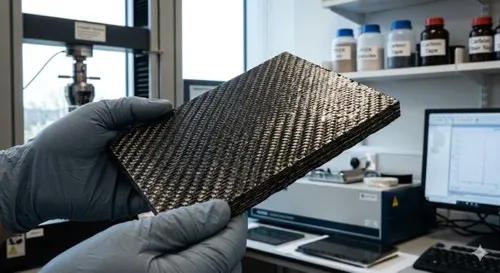
Carbon fiber reinforced thermoplastics combine carbon fibers with a thermoplastic resin, producing parts that are strong, stiff and lighter than steel. Resin types include polyamide, polypropylene, polyetheretherketone, polyphenylene sulfide, polyetherimide and polycarbonate, while fiber forms range from continuous to short fibers. Those combinations suit automotive, aerospace, electrical, industrial, energy, sports and construction uses.
A recent study by Markntel Advisor highlights that the Global Carbon Fiber Reinforced Thermoplastics (CFRTP) industries were valued at USD 1.25 billion in 2025 and grow from USD 1.35 billion in 2026 to USD 2.17 billion by 2032, registering an 8.22% CAGR during 2026–2032. Asia-Pacific represented 41.32% in 2026, while automotive held 43%.
Asia-Pacific Leads Global Demand for Lightweight Composites
Asia-Pacific holds the largest share of about 41.32% in the global carbon fiber reinforced thermoplastics outlook in 2026, supported by manufacturing capacity and demand. That concentration reflects capacity additions and strong automotive and industrial consumption. Asia-Pacific therefore anchors strong global volumes in 2026, while Europe and North America add aerospace demand.
Carbon fiber reinforced thermoplastics enable up to 40% weight reduction compared with conventional steel, improving vehicle range and regulatory compliance. That advantage matters where range, fuel efficiency and emissions limits shape purchasing decisions. Lightweight materials become a route to meeting targets without sacrificing strength. That advantage grows with range anxiety.
Cars Turn to Carbon Fiber Composites for Lighter, Stronger Parts
By end user, the automotive and transportation segment presented about 43% in the global carbon fiber reinforced thermoplastics sector in 2026. Automotive and industrial users account for the largest consumption, supported by emission mandates under the Fit for 55 framework and updated fuel economy standards through 2026. Those regulations impose fleet-wide carbon dioxide reduction targets.
Global electric car sales exceeded 17 million units in 2024, representing double-digit growth and increasing demand for lightweight materials that enhance battery efficiency. Electric car sales topped 17 million worldwide in 2024, rising by more than 25%. That growth strengthens the case for composites in battery housings and structural parts, where weight savings extend range.
Polyamide Holds Its Lead as High-Volume Parts Take Shape
By resin type, the polyamide segment represented about 32% in the global carbon fiber reinforced thermoplastics sector in 2026. Polyamide offers a balance of strength, toughness and processability that suits high-volume automotive and industrial parts. Other resins serve higher temperature, chemical resistance or electrical applications where polyamide alone is insufficient.
Thermoplastic composites offer faster processing cycles and recyclability advantages over thermosets, aligning with decarbonisation goals. Thermoset composites are difficult to recycle due to irreversible cross-linking, whereas thermoplastics can be remelted and reprocessed. That difference has shifted material selection, as manufacturers seek shorter cycles. That speed matters in production for high volumes.
Wind Power Turns to Stronger Blades as Turbines Grow Larger
Global wind power expansion accelerated in 2025–2026, reinforcing renewable infrastructure as a volume driver for high-performance composites. In February 2026, the United Kingdom approved 190 energy projects, In 2025, Ireland secured a 900 MW wind contract, while India added more than 50,000 MW of power capacity in FY2025–26, with renewables accounting for three-quarters of additions.
Engineering requirements for wind turbines have intensified as offshore units exceed 12–15 MW, with blade lengths surpassing 100 meters. Larger blades experience cyclic loads and require lightweight, high-stiffness materials to maintain reliability while minimising stress. Each additional gigawatt requires multiple composite components, including blades, nacelle housings and reinforcements in offshore projects.
Flying Taxis Open a New Frontier for Composite Suppliers
Urban air mobility has transitioned from concept to pre-commercial deployment, creating an early entry opportunity within advanced composites for new suppliers in several regions. In 2025, aviation authorities advanced implementation plans and certification frameworks for electric vertical take-off and landing aircraft, reducing uncertainty and opening supply-chain windows for lightweight material providers.
Electric vertical take-off aircraft depend on ultra-lightweight, high-stiffness structures to maximise battery efficiency and payload capacity, as limited energy density remains a constraint. Airframes, rotor housings and structural enclosures require fatigue-resistant composites compatible with automated, high-rate manufacturing. As prototypes move toward limited fleet production, sourcing shifts from research batches to scalable contracts. That shift rewards supplier integration.
Recycling Gaps Limit Growth Despite Rising Composite Use
A barrier constraining the global carbon fiber reinforced thermoplastics sector is the lack of scalable recycling infrastructure for composite waste volumes. Although thermoplastic composites are theoretically recyclable, industrial recovery capacity remains limited and geographically fragmented. Regulatory tightening has advanced faster than recycling infrastructure development, creating a compliance imbalance for manufacturers.
By 2030, more than 14,000 wind turbine blades in Europe are expected to be decommissioned, generating an estimated 40,000–60,000 tonnes of composite waste requiring dedicated recycling capacity. Until recycling ecosystems expand with composite deployment, this gap will delay adoption decisions in cost-sensitive and regulation-heavy uses. Regulatory alignment, production scaling and innovation support a positive outlook.


