
Ukrainian politics has always had a flair for set design. Over the past decade, we’ve made a grand transition from solid oak desks draped in green felt to concept co-working spaces host to slick PowerPoint presentations. Ties and formal suits gave way to hoodies and smartwatches; “fixing things behind closed doors” was rebranded as “pitching cases.”
Strip away this trendy, hipster facade, though, and what remains? Is it a true clash between agile technocrats and the entrenched nomenklatura — or simply another season of mutation for Ukraine’s ruling class?
The Mutation of a Soviet Gene
The old Ukrainian nomenklatura was never a bunch of dinosaurs in fur hats. It is a highly adaptable, resilient organism. It survived the collapse of the Soviet Union, navigated the wild capitalism of the nineties, weathered two revolutions, and mastered the art of absorbing Western grants.
Today’s career insider speaks fluent English, holds a degree from a Western university, and quotes Acemoglu with ease. Yet their core instinct remains untouched: controlling the money flow matters more than the outcome. To them, the state is not a service provider — it is a monopoly on resource allocation. They may trade a business suit for military fatigues or a hoodie, but success is still measured not by reform efficiency, but by the depth of their leverage over existing schemes.
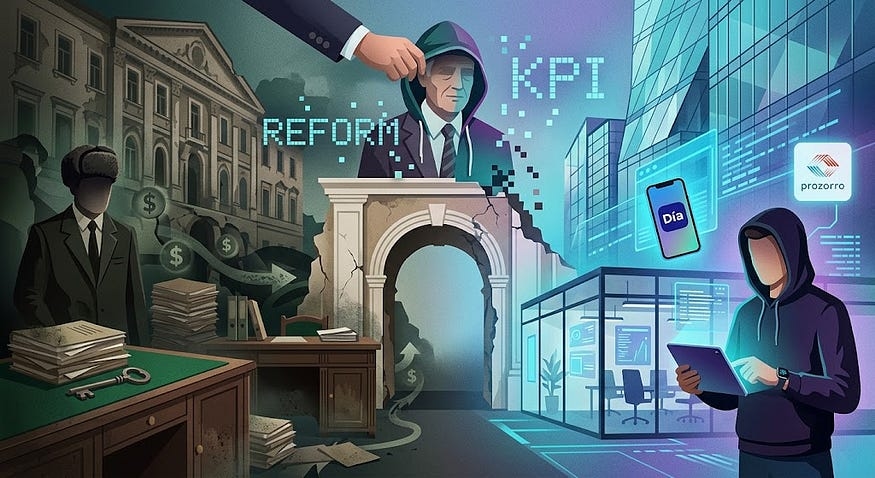
Technocrats: Digital Facade Builders
Enter the technocrats — alumni of investment funds, the tech sector, and international NGOs. They hold genuine faith in KPIs, decentralization, and algorithms. They brought along e-governance apps, transparent procurement platforms, and stacks of policy briefs.
The flaw in the technocrats’ approach is that they view the state as buggy software waiting for a clean refactoring. They forget that the Ukrainian state isn’t software — it’s a web of feudal arrangements.
When a technocrat steps into an office armed with a sleek dashboard, the insider smiles and lets them digitize the paperwork. Why? Because while the technocrat builds a “state in a smartphone,” the old guard continues running the real-world financial flows.
Digitizing chaos merely makes chaos run faster; it does not change its nature.
The Illusion of Conflict
The grandest deception is presenting this dynamic as a fierce battle between the old and the new. In reality, it has evolved into a symbiosis:
The nomenklatura needs technocrats to maintain legitimacy with Western donors, secure loans, and look modern.
Technocrats need the nomenklatura because, without political cover and a firm grasp on the system’s real levers, no draft law makes it past a first reading.
The end product is a hybrid class: the “techno-nomenklatura.” These are figures who can draft a flawless fundraising strategy for international partners while quietly routing kickbacks to the right office down the hall.
What Real Elite Renewal Looks Like
True renewal isn’t about age, a polished LinkedIn profile, or fluency in AI tools. A genuine shift in power is measured by a single metric: the dismantling of institutional monopolies.
So long as newcomers entering the system are forced to play by its rules just to stay “effective,” no real transformation is taking place. It’s merely a costume change.
A true technocrat isn’t someone who swapped paper files for Google Docs. It is someone who eliminates the bureaucratic middleman altogether, stripping away their power to gatekeep a citizen’s basic rights. Everything else is just fresh paint on a crumbling wall that desperately needs to be torn down.
Odesa. september 2026
Дивитись адаптований переклад україномовній платформі: https://drukarnia.com.ua/articles/tekhnokrati-vs-nomenklatura-fasad-onovlennya-ukrayinskikh-elit-FsQPT