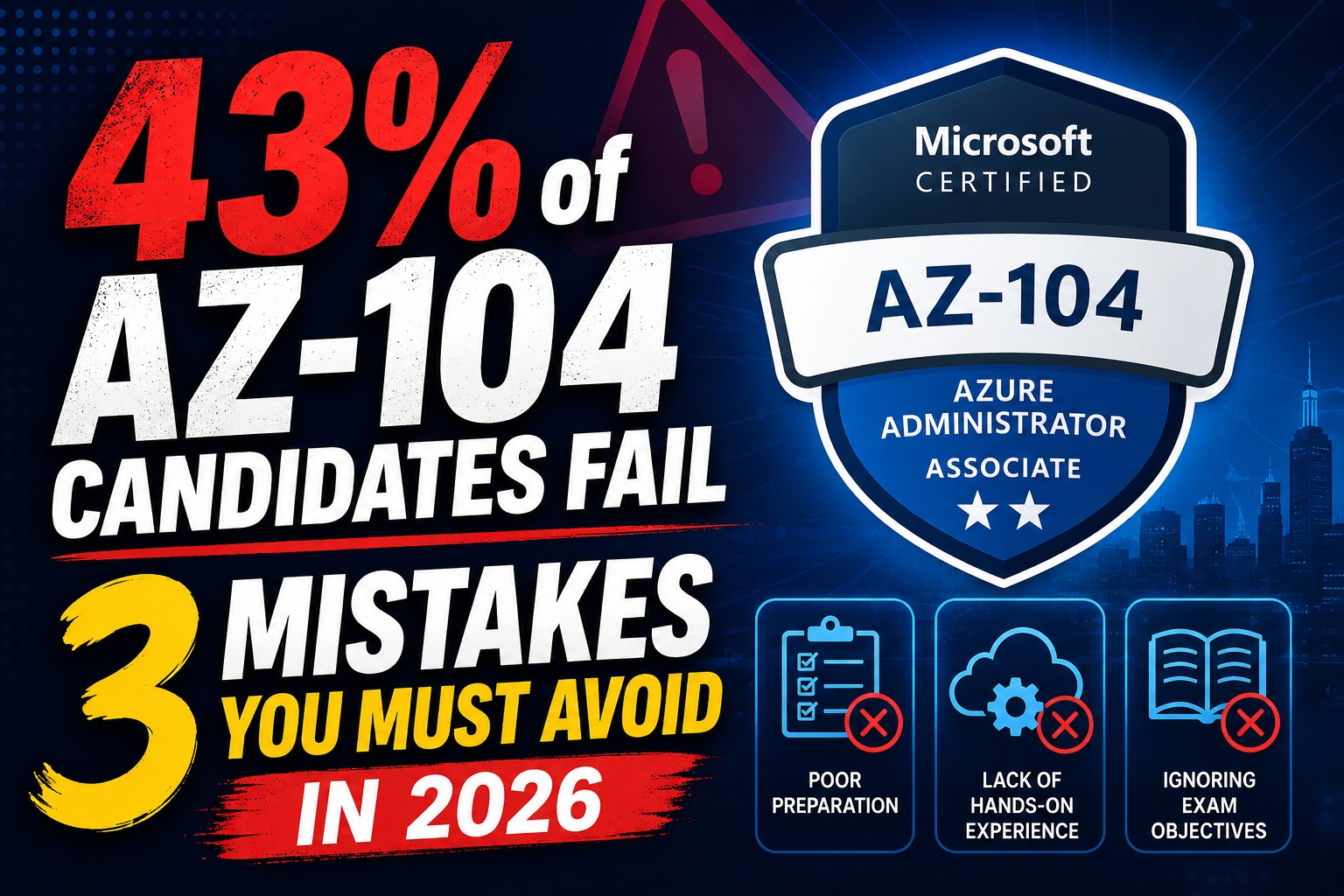
If you are preparing to pass the AZ-104 on your first attempt, you are probably already aware that this is not an easy exam. The Microsoft Azure Administrator certification is one of the most respected credentials in cloud computing and one of the most demanding. Industry data consistently shows that a significant portion of candidates, roughly 43%, do not clear the AZ-104 on their first try.
That statistic can feel intimidating. But here is the truth: most of those failures are not caused by a lack of intelligence or technical ability. They are caused by predictable, avoidable mistakes that surface in almost every failed attempt. Understanding what those mistakes are and correcting your preparation strategy before exam day is the difference between walking out of the testing center with a passing score and having to reschedule.
This guide breaks down exactly why so many candidates struggle with the AZ-104 first attempt, and gives you the three critical corrections you need to make right now.
How Hard Is AZ-104, Really?
Before diagnosing failure patterns, it is worth understanding how hard the AZ-104 actually is. The exam tests your real-world ability to manage Microsoft Azure environments, including identity and access management, virtual networking, storage solutions, compute resources, and monitoring. Microsoft deliberately designs the questions to reflect on-the-job scenarios, not simple definition recall.
You will face approximately 40 to 60 questions across multiple formats: case studies, drag-and-drop, multiple choice, and scenario-based items. The passing score is 700 out of 1000. That might sound achievable until you encounter questions that require you to reason through a complex networking scenario or identify the most cost-effective configuration under specific constraints.
AZ-104 is hard, but it is absolutely passable with the right preparation framework. The candidates who fail are almost always making structural errors in how they study, not gaps in their fundamental ability.
Mistake 1: Studying Topics in Isolation Instead of Scenarios
The single most common reason candidates fail the AZ-104 is treating it like a knowledge test when Microsoft has designed it as a skills test.
Many candidates spend weeks reading Azure documentation, memorizing service names, and reviewing feature comparisons. They know what Azure Blob Storage is. They can define a Virtual Network Gateway. But when the exam presents a business scenario and asks which combination of services and configurations would meet specific requirements, they freeze.
Microsoft's exam questions are deliberately scenario-driven. A question will not ask "What is Azure Active Directory?" It will say: A company needs to grant a third-party contractor temporary access to a specific resource group without giving them access to the subscription. What is the recommended approach?
Answering that correctly requires understanding not just RBAC definitions but how identity and access management work in practice, across resource scopes, role types, and delegation models.
The fix: Restructure your study plan around scenarios. After learning any concept, immediately practice applying it to a real-world use case. Work through labs. Build things in the Azure portal. Use practice tests that simulate the case-study format Microsoft uses. Platforms like CertBoosters offer scenario-based AZ-104 Exam Questions that mirror the real exam's structure and help you build applied reasoning rather than passive recall.
Mistake 2: Ignoring the AZ-104 Exam Objective Domains
Another costly mistake is uneven preparation, which means spending too much time on familiar topics and avoiding the ones that feel uncomfortable. This is human nature, but it is exam-fatal.
The AZ-104 is divided into five core domains with specific weightings:
Manage Azure identities and governance (15 to 20%).
Implement and manage storage (15 to 20%).
Deploy and manage Azure compute resources (20 to 25%).
Implement and manage virtual networking (20 to 25%).
Monitor and maintain Azure resources (10 to 15%)
Candidates with a development background often over-prepare on compute and under-prepare on networking. Those coming from on-premises IT administration tend to do the opposite. Either imbalance creates dangerous blind spots, because the exam will absolutely test every domain.
The fix: Map your study hours directly to the official Microsoft exam skills outline. Calculate how many study hours each domain deserves based on its weighting and stick to that allocation. A structured AZ-104 study guide that aligns with the official objectives, not just a general Azure overview, is essential here. When you systematically cover every domain in proportion to its exam weight, you eliminate the "I had not studied that area" failure mode entirely.
Mistake 3: Relying Only on Reading Materials and Skipping Practice Tests
The third mistake is the most widespread. Many candidates treat reading and watching videos as the end of preparation rather than the beginning of it.
Passive learning creates an illusion of readiness. You watch a 10-hour Azure Administrator course and feel prepared. You read through the Microsoft documentation, and everything makes sense. Then you sit down at the exam, see a complex scenario question, and realize that understanding something when it is explained to you is completely different from retrieving and applying that knowledge under time pressure.
AZ-104 exam tips from every high-scoring candidate point to the same practice: take as many full-length, timed practice tests as possible in the final two weeks before your exam. Practice tests accomplish several things simultaneously. They reveal knowledge gaps, build exam-day stamina, train you to manage the time pressure of 40+ questions, and force you to engage with the scenario-based format the real exam uses.
The fix: In your final study phase, shift from content consumption to active retrieval. Take at least three full-length practice exams under timed conditions. Review every wrong answer in detail, not just what the correct answer was, but why it was correct and what principle it was testing. Resources like CertBoosters provide detailed explanations alongside their practice questions, which turn each wrong answer into a structured learning moment rather than just a missed point.
Building a Study Plan That Works: The 6-Week Framework
Knowing the three mistakes is only valuable if you act on them. Here is a practical six-week study framework that addresses all three failure patterns.
Weeks 1 and 2: Cover all five exam domains systematically, following Microsoft's official skills outline. Use a combination of documentation, video courses, and hands-on Azure portal labs. Allocate study hours proportionally to domain weight.
Weeks 3 and 4: Shift to applied learning. For every concept you have studied, find a scenario or lab that requires you to use it. Focus especially on networking and identity, the two domains that most frequently appear in complex scenario questions.
Weeks 5 and 6: Enter full exam simulation mode. Take complete timed practice tests. Review every incorrect answer. Revisit any domain where your practice scores reveal consistent gaps. Build your timing instincts by simulating real exam conditions.
Throughout all six weeks, keep notes on concepts you find difficult. Return to those notes in week six. Going into exam day with a clear picture of your strengths and residual weak areas is far better than going in with vague confidence.
Why Preparation Quality Matters More Than Preparation Volume
Many failed candidates studied for 60, 80, or even 100 hours and still did not pass. Hours alone do not determine outcomes. The quality and structure of those hours do.
The AZ-104 first attempt success rate for candidates who follow structured, scenario-oriented study plans with consistent practice testing is dramatically higher than for those who rely on passive content consumption alone. This is not a complicated exam if you approach it correctly. It rewards candidates who understand how Azure actually works and can reason through real-world administrative challenges.
The cloud administrator role that this certification represents is one of the fastest-growing positions in enterprise IT. Microsoft Azure powers a substantial portion of global enterprise cloud infrastructure, and demonstrating that you can administer it competently opens doors to roles, projects, and compensation levels that the uncertified candidate cannot access.
Final Thoughts: How to Pass AZ-104 on Your First Attempt
The 43% first-attempt failure rate is a warning, not a verdict. Every one of those failures followed a predictable pattern: scenario-blind studying, uneven domain coverage, and insufficient practice testing. Every one of those patterns is correctable.
If you are serious about how to pass AZ-104 on your first try in 2026, start by auditing your current preparation against these three mistakes. Rebuild your study plan around the official domain weightings. Add hands-on labs and scenario-based practice to every topic you cover. And in your final two weeks, simulate the real exam experience relentlessly.
The Azure Administrator certification is within reach. The candidates who earn it are not necessarily the most experienced. They are the best prepared. Make sure that it's you.
Preparing for the AZ-104? CertBoosters offers comprehensive practice resources, including detailed exam simulations and scenario-based questions built around the 2026 exam objectives. Visit CertBoosters AZ-104 Exam Questions to start your structured preparation today.